

TL;DR:
- Most adults qualify for GLP-1 weight-loss medications if they have a BMI of 30 or higher or a BMI of 27 with at least one weight-related health condition. Eligibility requires a clinician review of medical history, labs, and previous weight-loss efforts, with key contraindications including personal or family history of medullary thyroid carcinoma or MEN2. These medications are approved for long-term weight management, but insurance coverage varies and typically requires documentation of BMI and comorbidities.
Most adults qualify for GLP-1 weight-loss medications if they have a BMI of 30 or higher, or a BMI of 27 or higher with at least one weight-related health condition. A licensed clinician makes the final call after reviewing your medical history, labs, and any prior weight-loss attempts.
TL;DR: Core eligibility rules at a glance
- Age: Typically 18 or older for adult indications (some pediatric approvals exist for specific agents)
- BMI ≥30: Qualifies on its own, regardless of other health conditions
- BMI ≥27 + comorbidity: Qualifies with type 2 diabetes, hypertension, obstructive sleep apnea, high cholesterol, or cardiovascular disease
- Key safety exclusions: Personal or family history of medullary thyroid carcinoma (MTC) or MEN2 syndrome, current pregnancy, and active or prior pancreatitis
- Clinician evaluation required: Expect a review of your health history, baseline labs (including HbA1c), and documentation of previous weight-loss efforts before any prescription is written
The FDA has approved semaglutide (Wegovy) and tirzepatide (Zepbound) specifically for chronic weight management in adults. Ozempic and Mounjaro carry diabetes indications and are sometimes prescribed off-label for weight loss. Medicare coverage for weight-loss GLP-1s remains limited and varies by plan. A clinician’s assessment is the only way to confirm whether you’re a candidate.
Table of Contents
- What are GLP-1 medications and which ones treat obesity?
- Who meets the standard GLP-1 eligibility requirements?
- Which health conditions let you qualify at a lower BMI?
- What conditions or situations disqualify you from GLP-1 therapy?
- How do clinicians evaluate whether you’re a good candidate?
- How does insurance coverage actually work for GLP-1s?
- What results and timelines should you realistically expect?
- How to prepare for your GLP-1 evaluation
- Key Takeaways
- The part most people underestimate about GLP-1 eligibility
- Legacymeds makes the evaluation process straightforward
- Useful sources and further reading
- FAQ
What are GLP-1 medications and which ones treat obesity?
GLP-1 receptor agonists are a class of drugs that mimic a gut hormone your body releases after eating. They slow gastric emptying, reduce appetite, and improve blood sugar regulation. Dual incretin agents like tirzepatide go further, also activating GIP receptors, which amplifies the weight-loss effect.
The agents most commonly used for weight management in the U.S. include:
- Semaglutide (Wegovy): Weekly subcutaneous injection; FDA-approved for chronic weight management and cardiovascular risk reduction in adults with obesity or overweight plus established heart disease
- Tirzepatide (Zepbound/Mounjaro): Weekly subcutaneous injection; Zepbound is the weight-management indication, Mounjaro the diabetes indication
- Liraglutide (Saxenda): Daily subcutaneous injection; indicated for adults with obesity and for adults with overweight plus at least one weight-related comorbidity
- Oral semaglutide and newer agents: Oral GLP-1 options have expanded, including orforglipron (Foundayo), which received approval in 2025–2026, giving patients who prefer tablets an alternative to injections
Trial data backs that up. Semaglutide trials showed substantial body weight reduction, and tirzepatide trials reported even larger losses at higher doses. These are clinically meaningful numbers, not marginal ones.
Pro Tip: Primary care physicians, endocrinologists, and obesity medicine specialists all prescribe GLP-1s. If your primary care provider is unfamiliar with the newer agents or you have complex metabolic conditions, ask for a referral to obesity medicine or endocrinology.
Who meets the standard GLP-1 eligibility requirements?
The FDA indications and most clinical guidelines use two numeric thresholds. Both are based on BMI measured in kg/m².

| Threshold | Requirement | Source/Basis |
|---|---|---|
| BMI ≥30 kg/m² | Qualifies for weight-loss GLP-1 therapy on its own | FDA-approved Wegovy labeling; Yale Medicine |
| BMI ≥27 kg/m² + comorbidity | Qualifies with at least one weight-related health condition | DailyMed liraglutide labeling; Yale Medicine |
| Age ≥18 | Standard adult indication; pediatric approvals exist for specific agents (e.g., liraglutide for ages 12+) | FDA product labeling |
How to calculate your BMI: Divide your weight in pounds by your height in inches squared, then multiply by 703. The NHLBI BMI calculator gives you the number in seconds.
A few important caveats on BMI as a rule:
- BMI doesn’t capture fat distribution or metabolic risk. Someone at BMI 28 with severe insulin resistance may carry more cardiovascular risk than someone at BMI 31 who is metabolically healthy.
- Clinicians increasingly use ethnicity-specific considerations. Research shows that metabolic risk rises at lower BMI thresholds in some Asian populations, which some providers factor into their decisions.
- The cutoffs are guidelines, not hard gates. A clinician can use clinical judgment when the picture doesn’t fit neatly into a number.
Which health conditions let you qualify at a lower BMI?
If your BMI falls between 27 and 29.9, a documented weight-related comorbidity is what gets you across the eligibility line. Yale Medicine notes that qualifying based on cardiovascular disease alone is often challenging because many insurers require documented major events, not just a diagnosis.
Commonly accepted qualifying conditions include:
- Type 2 diabetes (the most straightforward; also opens diabetes-indication prescribing)
- Hypertension (documented diagnosis, ideally with current medication or monitoring records)
- Obstructive sleep apnea (sleep study results strengthen the case considerably)
- High cholesterol / dyslipidemia (lipid panel showing elevated LDL or triglycerides)
- Atherosclerotic cardiovascular disease (ASCVD) (prior heart attack or stroke typically required by insurers, not just a diagnosis)
- Metabolic dysfunction–associated steatohepatitis (MASH/NASH) (liver function tests and imaging help document this)
The variability between insurers is real. A diagnosis of hypertension on your problem list may satisfy one plan’s prior authorization and get rejected by another that wants to see active medication management. Documentation quality matters as much as the diagnosis itself.
Pro Tip: Before your appointment, pull together your most recent labs, your current medication list, any sleep study reports, and cardiology notes if you have them. Clinicians who have this documentation in hand can build a stronger prior authorization case on the first try.
What conditions or situations disqualify you from GLP-1 therapy?
Some exclusions are absolute. Others require added caution and specialist input rather than a flat no.
Absolute contraindications:
- Personal or family history of medullary thyroid carcinoma (MTC)
- Multiple endocrine neoplasia syndrome type 2 (MEN2)
- Current pregnancy or planned pregnancy in the near term
- Breastfeeding
- Known hypersensitivity to the active ingredient or any component of the formulation
“GLP-1 receptor agonists, including semaglutide, are contraindicated in patients with a personal or family history of MTC or in patients with MEN2.” — Wegovy prescribing information
Relative precautions (require monitoring or specialist input, not automatic disqualification):
- History of pancreatitis: clinicians typically want a clear cause identified and resolved before prescribing
- Active gallstones or history of gallbladder disease: GLP-1s can increase gallstone risk, so this needs a frank discussion
- Severe gastrointestinal disease (gastroparesis, inflammatory bowel disease): slowed gastric emptying can worsen these conditions
- Diabetic retinopathy in people with type 2 diabetes: rapid glucose lowering has been associated with worsening in some cases; ophthalmology follow-up is often recommended
- Pediatric patients under the approved age threshold for the specific agent
If any of these apply to you, that’s not a reason to abandon the conversation with your provider. It’s a reason to have a more detailed one.
How do clinicians evaluate whether you’re a good candidate?
The assessment is more thorough than a BMI check. A complete evaluation typically covers several areas.
Medical history review: Your provider will ask about family history of MTC or MEN2, prior episodes of pancreatitis, gallbladder disease, and any history of eating disorders. Pregnancy status and contraception plans come up for anyone who could become pregnant.
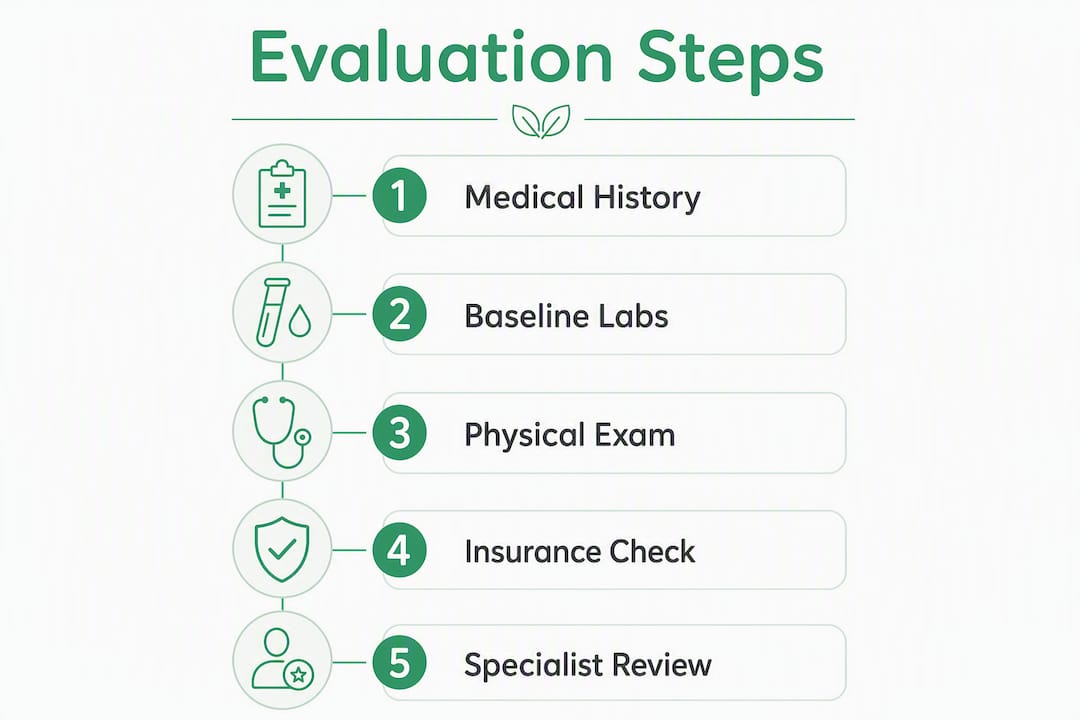
Baseline labs: StatPearls recommends ordering HbA1c or fasting glucose for diabetes screening, a lipid panel, liver function tests, and renal function at baseline. Lipase may be checked when pancreatitis history is a concern. The standard re-check cadence is 3 months, then 6 months, then every 6 months while on therapy.
Medication and supplement review: Several medications interact with GLP-1s, particularly oral drugs whose absorption depends on gastric emptying rate. Your full medication list, including supplements, needs to be on the table.
Prior weight-loss attempt documentation: This matters most for insurance purposes. Insurers often want to see that you’ve tried structured lifestyle interventions before approving a GLP-1 for weight loss.
Telehealth assessments follow the same clinical framework as in-person visits. The key difference is that labs are typically ordered to a local draw site before or shortly after the first consult, rather than drawn in-office on the same day.
Telehealth providers can usually make a prescribing decision within days of receiving lab results, which is faster than many in-person specialty referral timelines. For patients in areas with limited obesity medicine access, this matters.
How does insurance coverage actually work for GLP-1s?
Coverage is the most frustrating part of this process for most patients, and the picture is genuinely inconsistent.
- Private insurance: Coverage for diabetes indications (Ozempic, Mounjaro) is more common than for weight-loss indications (Wegovy, Zepbound). Many plans cover weight-loss GLP-1s but require prior authorization.
- Prior authorization: Expect to document BMI, qualifying comorbidities, and prior weight-loss attempts. The more objective your documentation (labs, sleep study, cardiology reports), the stronger the case.
- Medicare: Medicare’s coverage for weight-loss drugs has historically been limited. Coverage for GLP-1s used specifically for weight management has been restricted under traditional Medicare, though this continues to evolve. Medicare Part D covers semaglutide when prescribed for cardiovascular risk reduction in eligible patients with established heart disease.
- Marketplace plans: Coverage under Healthcare.gov plans varies by insurer and state.
Pro Tip: When calling your benefits line, ask specifically: “Does my plan cover semaglutide or tirzepatide for weight management under a weight-loss indication?” Then ask what documentation is required for prior authorization. “Cardiovascular disease” as a comorbidity often needs a documented event (heart attack or stroke), not just a diagnosis, to satisfy prior authorization criteria.
Manufacturer savings programs exist for both Wegovy and Zepbound and can significantly reduce out-of-pocket costs for commercially insured patients who don’t qualify for coverage. Out-of-pocket programs through telehealth providers are another route for patients who want to bypass the insurance process entirely.
What results and timelines should you realistically expect?
Clinical trials show semaglutide (Wegovy) produced roughly 11–15% body weight reduction in the STEP trials. Tirzepatide (Zepbound) showed larger losses at higher doses in the SURMOUNT trials. These are averages across trial populations; individual results vary based on starting weight, dose reached, and lifestyle factors.
A realistic timeline looks like this:
- Weeks 1–4: Appetite changes and GI side effects (nausea, constipation) are common during dose titration. Weight loss at this stage is modest.
- Months 3–6: Measurable weight reduction for most patients. Labs are rechecked at the 3-month mark.
- Month 12: Clinically meaningful weight loss for many patients who reach and maintain their target dose.
One thing the trial data makes clear: stopping the medication typically leads to weight regain. These drugs work while you take them. That means the decision to start is really a decision about long-term management, not a short course of treatment. Lifestyle modification — diet and physical activity — remains part of the plan throughout.
How to prepare for your GLP-1 evaluation
Walking into a provider visit or telehealth consult with organized documentation shortens the process and strengthens any prior authorization request.
Before your appointment:
- Calculate your current BMI using the NHLBI calculator and write down the number
- List all current diagnoses, especially any weight-related conditions (diabetes, hypertension, sleep apnea, high cholesterol)
- Gather recent lab results: HbA1c, lipid panel, liver function, and any other relevant tests from the past 12 months
- Document prior weight-loss attempts: programs, medications, duration, and results
- List all current medications and supplements, including doses
- Have pregnancy status and contraception information ready if applicable
- Collect any specialist reports: sleep study for OSA, cardiology notes for ASCVD, liver imaging for MASH
Questions to ask your provider:
- Which medication and dose are you recommending, and why?
- What labs do I need before starting, and when will we recheck them?
- What GI side effects should I expect during titration, and when should I call?
- What are the warning signs for pancreatitis or gallbladder problems?
- What does the prior authorization process look like for my insurance?
For telehealth visits, upload lab PDFs, sleep study reports, and cardiology notes to your patient portal before the consult. In-person visits: bring physical copies or have your records transferred in advance.
Key Takeaways
GLP-1 eligibility for weight loss comes down to two numeric thresholds, a short list of qualifying health conditions, and a clinician’s assessment of your full medical picture.
| Point | Details |
|---|---|
| BMI thresholds | BMI ≥30 qualifies on its own; BMI ≥27 qualifies with at least one weight-related comorbidity. |
| Qualifying conditions | Type 2 diabetes, hypertension, sleep apnea, dyslipidemia, and ASCVD are the most commonly accepted comorbidities. |
| Key disqualifiers | Personal or family history of MTC or MEN2, current pregnancy, and active pancreatitis are absolute contraindications. |
| Insurance reality | Coverage for weight-loss indications varies widely; prior authorization typically requires documented BMI, comorbidities, and prior lifestyle attempts. |
| Legacymeds option | Legacymeds offers online clinical evaluation for semaglutide and tirzepatide without insurance or membership fees, with free provider visits and unlimited support. |
The part most people underestimate about GLP-1 eligibility
The BMI cutoffs get all the attention, but the harder conversation is about what comes after eligibility is confirmed. Most patients focus on whether they qualify. Fewer think carefully about whether they’re ready for what the therapy actually requires.
GLP-1 medications work. The trial data on semaglutide and tirzepatide is among the strongest weight-loss evidence we’ve seen in decades. But they work as part of a long-term commitment, not as a standalone fix. The patients who do best are the ones who treat the medication as a tool that makes lifestyle changes easier, not a replacement for them. Appetite suppression creates an opening. What you do with that opening determines the long-term outcome.
There’s also a real gap between clinical eligibility and insurance coverage that frustrates patients and clinicians alike. Someone with a BMI of 28 and well-controlled hypertension may be a strong clinical candidate and still face months of prior authorization battles. That’s not a reflection of their medical need. It’s a coverage policy problem. Knowing this going in, and having your documentation organized before the first visit, is the single most practical thing you can do to move faster.
For patients with complex histories — prior pancreatitis, pregnancy planning, severe GI disease — specialist input from endocrinology or obesity medicine isn’t optional. It’s the right call. The goal is a monitoring plan that fits your specific risk profile, not just a prescription.
Legacymeds makes the evaluation process straightforward
If you’ve read this far and you’re ready to find out whether you’re a candidate, the next step doesn’t have to involve a months-long wait for a specialist appointment.
Legacymeds offers a fully online clinical evaluation for GLP-1 medications, including semaglutide and tirzepatide, without requiring insurance or a membership fee. A licensed provider reviews your health history, discusses your goals, and determines whether a prescription is appropriate for you. Free provider visits are included, and if you’re prescribed medication, it ships directly to you with a personalized plan and unlimited ongoing support.
This isn’t a subscription trap or a one-size approach. Legacymeds builds the plan around your medical profile, and a licensed clinician makes the prescribing decision based on your actual eligibility. Not everyone who applies will be prescribed medication — that’s how it should work.
Start your online evaluation today, or visit the Legacymeds program page to see what the process looks like before you begin.
This article is general health information, not medical advice. Confirm your specific eligibility and treatment options with a licensed healthcare provider.
Useful sources and further reading
The sources below are the primary references used in this article. Bringing relevant sections to a specialist visit, particularly the contraindication language, is worth doing if you have a complex history.
- Wegovy Prescribing Information (drugs.com) — Full FDA-approved labeling including indications, contraindications (MTC/MEN2, pregnancy), and dosing
- DailyMed: Liraglutide (Saxenda) Prescribing Information — Official labeling for liraglutide injection, including adult and pediatric indications
- StatPearls: Obesity Medications — Evidence-Based Management — Peer-reviewed clinical overview of patient selection, monitoring protocols, and long-term management
- Endotext: Pharmacologic Treatment of Overweight and Obesity in Adults — Comprehensive review of trial data, weight-loss ranges, and newer agents including oral formulations
- Yale Medicine: GLP-1 Medications for Weight Loss — How to Get Started — Practical clinical guidance on eligibility, insurance documentation, and cardiovascular comorbidity requirements
- Medicare: Weight Loss Drugs Coverage — Official Medicare coverage information for weight-loss medications
- NHLBI BMI Calculator — Free tool for calculating your BMI before a provider visit
Bring the Wegovy prescribing information’s contraindication section to any specialist visit if you have a personal or family history of thyroid disease, MEN2, or prior pancreatitis. It gives your provider the exact label language to work from.
FAQ
What conditions qualify you for GLP-1 weight-loss therapy?
Type 2 diabetes, hypertension, obstructive sleep apnea, high cholesterol, and atherosclerotic cardiovascular disease are the most commonly accepted qualifying conditions at a BMI of 27 or higher. A BMI of 30 or above qualifies on its own without a comorbidity.
Will Medicare pay for GLP-1 drugs in 2026?
Medicare coverage for GLP-1s used specifically for weight loss remains limited under traditional Medicare. Medicare Part D covers semaglutide (Wegovy) when prescribed for cardiovascular risk reduction in patients with established heart disease, but coverage for weight management alone varies by plan.
How do I get approved for a GLP-1 medication?
Schedule a visit with a primary care provider, endocrinologist, or telehealth service; bring your BMI calculation, recent labs, a list of weight-related diagnoses, and documentation of prior weight-loss attempts. Your provider submits a prior authorization to your insurer if needed, and the strength of your documentation directly affects how quickly that gets approved.
How long does it take to lose weight on a GLP-1?
Most patients see measurable weight loss within 3–6 months of starting therapy. Clinical trials with semaglutide (Wegovy) showed roughly 11–15% body weight reduction over 12 months, and tirzepatide (Zepbound) showed even greater reductions at higher doses in some trials.