
Get a Zepbound Prescription: Online, In-Person & Insurance Guide

To get a Zepbound prescription, a licensed healthcare provider must evaluate you, confirm you meet the clinical criteria, and write the Rx. That happens either in person with your primary care doctor or through a vetted telehealth service. Once prescribed, you fill it at a retail pharmacy or through LillyDirect, Eli Lilly’s direct-to-patient pharmacy channel. The whole process can take as little as a few days if you pay out of pocket, or several weeks if insurance prior authorization is involved.
Here is what to have ready before your first consult:
- Your current weight, height, and BMI
- A list of current medications and any known allergies
- Recent lab work if available (blood glucose, lipid panel, thyroid)
- A brief history of prior weight-loss attempts and results
- Your insurance card, if you plan to use coverage
Pro Tip: Ask about prior authorization (PA) during your very first appointment. Providers who initiate PA on day one cut weeks off the average wait time, according to Zepbound’s access and coverage guidance.
Legacymeds is a telehealth option that handles provider assessment, prescription issuance, and shipping without requiring insurance or membership fees. Medicare Part D is a possible coverage pathway for eligible patients, covered in detail below.
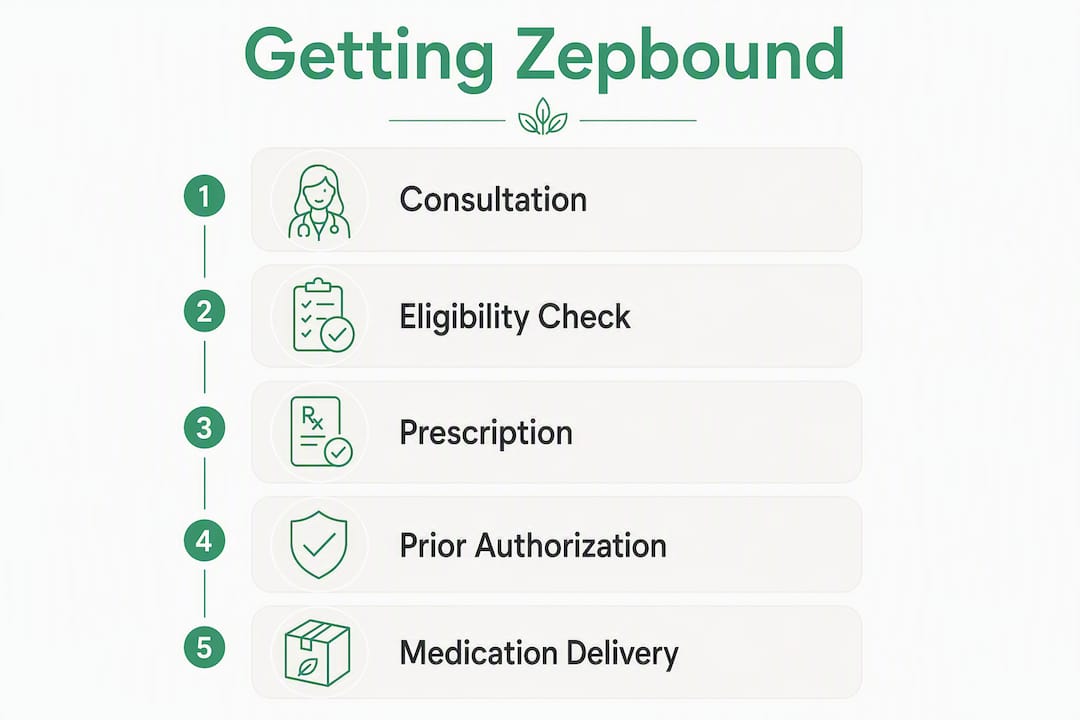
Table of Contents
- What is Zepbound, and who qualifies for it?
- How to get a Zepbound prescription, step by step
- How does insurance coverage and prior authorization work?
- Where should you fill your Zepbound prescription?
- What are the safety considerations and contraindications?
- How long does it take from first consult to first dose?
- How Legacymeds can help you get Zepbound
- Key Takeaways
- The real challenge with Zepbound is not qualifying — it is the system
- Legacymeds: skip the wait and start your Zepbound program
- Useful sources and next steps
- FAQ
What is Zepbound, and who qualifies for it?
Zepbound is the brand name for tirzepatide, a once-weekly injectable that acts on both GLP-1 and GIP receptors to reduce appetite and improve metabolic function. The FDA approved it for chronic weight management in adults, and it is prescribed as an adjunct to a reduced-calorie diet and increased physical activity.
Who typically qualifies:
- Adults with a BMI of 30 or higher (obesity)
- Adults with a BMI of 27 or higher who also have at least one weight-related condition such as type 2 diabetes, high blood pressure, high cholesterol, obstructive sleep apnea, or cardiovascular disease
- Patients who have not responded adequately to lifestyle changes alone
Clinicians also screen for contraindications before prescribing. A personal or family history of medullary thyroid carcinoma or Multiple Endocrine Neoplasia syndrome type 2 (MEN 2) disqualifies a patient per labeling. Pregnancy is also a contraindication.
Zepbound is available in 2.5 mg through 15 mg strengths, in single-dose pens, single-dose vials, multi-dose vials, and the single-patient-use KwikPen. The format matters practically: the KwikPen is only available through certain channels, and insurance formularies may cover one format but not another. Confirm which your plan covers before your provider writes the Rx.

How to get a Zepbound prescription, step by step
Telehealth and in-person visits are both legitimate routes to a Zepbound prescription. The right choice depends on your schedule, insurance, and how quickly you want to start.
Telehealth pathway
- Complete an online intake form covering your health history, current medications, weight goals, and any prior weight-loss treatments.
- A licensed provider reviews your intake and conducts a video or asynchronous consult.
- If you qualify, the provider writes the prescription and transmits it electronically to your chosen pharmacy or to LillyDirect.
- If insurance is involved, the provider initiates prior authorization at this stage.
Telehealth is faster for self-pay patients and removes the need to schedule an in-person appointment. The tradeoff is that some insurers require an in-person visit for PA documentation, so confirm your plan’s rules before booking.
In-person pathway
- Schedule a visit with your primary care physician, an obesity medicine specialist, or an endocrinologist.
- The provider conducts a physical exam, reviews labs, and screens for contraindications.
- If appropriate, they write the Rx and submit PA paperwork to your insurer.
- You fill at a retail pharmacy or request the Rx be sent to LillyDirect.
In-person visits tend to carry more weight with insurers during PA reviews because they include documented physical findings. If your plan has a history of denying GLP-1 prescriptions, starting in person may reduce appeal friction.
What to prepare for either consult
- Medical history and current medication list
- Recent labs if available and relevant
- Documentation of prior weight-loss attempts, including any previous medications
- Your weight-loss goals and any comorbid conditions you want to address
- Insurance information and a list of questions for the provider
Pro Tip: Ask your provider to send the prescription to LillyDirect if you are self-paying. LillyDirect guides patients through savings options and handles delivery directly from the manufacturer’s pharmacy network.
Questions to ask your provider
- Will my insurance require prior authorization, and can you start it today?
- Which formulation (pen, vial, or KwikPen) do you recommend for me?
- What is the dose escalation schedule?
- What side effects should prompt me to call you?
- If my insurer denies coverage, what is the appeals process?
How does insurance coverage and prior authorization work?
Many commercial insurance plans require prior authorization before covering Zepbound. PA is a formal request from your provider to your insurer, documenting that the medication is medically necessary for you specifically.
What PA typically requires:
- Documented BMI and weight history
- List of weight-related comorbidities
- Evidence of prior weight-loss treatments (diet programs, other medications)
- A letter of medical necessity from your provider
- Sometimes, step therapy documentation showing you tried other interventions first
Denials are common on the first submission. When that happens, your provider can file an appeal, usually with a more detailed letter of medical necessity that references your specific weight history and comorbidities. Multiple appeal submissions are not unusual, and persistence pays off. Ask your provider’s office whether they have a dedicated PA coordinator.
Medicare Part D is a meaningful pathway for eligible patients. Millions of Medicare Part D patients may be eligible to pay no more than $50 per month for Zepbound under certain criteria, though eligibility is not guaranteed. Use Lilly’s access tool at zepbound.lilly.com to check your specific plan.

Savings programs for commercial insurance patients: LillyDirect offers savings guidance and copay assistance pathways for patients with commercial coverage. Terms and eligibility vary, so confirm directly with LillyDirect or your provider.
If insurance denies you entirely: Cash-pay through LillyDirect or a telehealth service like Legacymeds is a practical alternative. Legacymeds operates without insurance requirements, so there is no PA wait and no membership fee.
Pro Tip: Before your consult, call your insurer’s member services line and ask specifically whether tirzepatide (Zepbound) is on your formulary and what the PA requirements are. Bring those notes to your appointment so your provider can tailor the submission.
Where should you fill your Zepbound prescription?
You have two main options: a retail pharmacy or LillyDirect. Each has real tradeoffs.
Retail pharmacy (CVS, Walgreens, Walmart, etc.):
- Use your insurance directly at the counter
- Local pickup is available same day if the medication is in stock
- Stock shortages have been an issue with GLP-1 medications; call ahead to confirm availability
- The pharmacist can answer questions about injection technique and storage
LillyDirect:
- Eli Lilly’s direct pharmacy channel ships Zepbound to your door
- Supports both insurance-managed fills and self-pay ordering through separate workflows
- Provides savings guidance and coverage support during the ordering process
- Prescribers send the Rx to LillyDirect using its specific NPI and NCPDP identifiers; tell your provider upfront if this is your preferred route
- The KwikPen format may be available here when retail pharmacies are out of stock
Practical steps for directing your Rx:
- Tell your provider at the end of the consult exactly where you want the prescription sent
- If using LillyDirect, confirm your shipping address and payment method before the Rx is transmitted
- If using a retail pharmacy, call ahead to verify stock before your provider submits the Rx electronically
What are the safety considerations and contraindications?
Zepbound is generally well tolerated, but there are side effects and contraindications every patient should know before starting.
Common side effects (usually most pronounced during dose escalation):
- Nausea, vomiting, diarrhea, and constipation
- Decreased appetite
- Injection-site reactions (redness, bruising, or mild swelling)
- Fatigue, especially early in treatment
Most GI effects improve after the first few weeks at each dose level. Eating smaller meals, avoiding high-fat foods, and staying hydrated all help.
Serious warnings to discuss with your provider:
- Possible risk of thyroid C-cell tumors (contraindicated with personal or family history of medullary thyroid carcinoma or MEN 2)
- Pancreatitis: stop the medication and call your provider if you experience severe, persistent abdominal pain
- Gallbladder disease: rapid weight loss can increase gallstone risk
- Hypoglycemia, particularly if you also take insulin or sulfonylureas
- Acute kidney injury, often secondary to dehydration from GI side effects
For a full list of contraindications and drug interactions, review the complete prescribing information on DailyMed and the Legacymeds GLP-1 safety resource.
Monitoring during treatment:
- Follow-up visits every few weeks to a few months depending on your provider’s protocol
- Labs as indicated: kidney function, liver enzymes, lipid panel, blood glucose
- Dose escalation is typically managed by your provider based on tolerability and response
Pro Tip: Store Zepbound pens and vials in the refrigerator (36°F–46°F). They can be kept at room temperature for up to 21 days if needed, but never freeze them. Inspect the solution before each injection; it should be clear and colorless to slightly yellow.
Zepbound is intended as an adjunct to a reduced-calorie diet and increased physical activity, with clinical guidance recommending approximately a 500 kcal/day deficit and 150 or more minutes of physical activity per week for best outcomes.
How long does it take from first consult to first dose?
The timeline varies significantly depending on whether you use insurance.
Self-pay through telehealth (fastest route):
- Intake and provider consult: same day to 48 hours
- Prescription issuance: same day as consult approval
- Shipping (LillyDirect or telehealth pharmacy): typically 3–7 business days
- Total: as few as 4–10 days
Insurance with prior authorization:
- Consult and PA submission: day 1–3
- PA processing by insurer: 3–14 business days (sometimes longer)
- Appeal if denied: adds 2–6 weeks
- Pharmacy fill and pickup or shipping: 1–5 business days after approval
- Total: 2–8+ weeks
Common bottlenecks:
- Insurer requests for additional documentation after initial PA submission
- Pharmacy stock shortages for specific formulations
- Delays in provider offices submitting PA paperwork
Pro Tip: If you are using insurance, ask your provider to submit the PA the same day as your consult rather than waiting for a follow-up. Proactive PA initiation shortens time-to-treatment and reduces the chance of a denial-related delay.
How Legacymeds can help you get Zepbound
Legacymeds is a direct-to-patient telehealth program built specifically for GLP-1 weight loss medications, including Zepbound (tirzepatide). The process is designed to remove the friction that slows most patients down.
What the Legacymeds process looks like:
- Complete a brief online intake covering your health history, weight, and goals
- A licensed provider reviews your information and conducts a clinical assessment
- If you qualify, the provider issues a prescription and coordinates shipment directly to your door
- Free provider visits are included, with no membership fees or insurance required
- Unlimited coaching and support are available throughout treatment
Legacymeds has worked with a large patient base, and most report clinically relevant reductions in body weight. The program pairs medication with personalized guidance, which aligns with clinical evidence showing that integrated care programs combining medication with coaching produce better long-term retention than medication alone.
Pro Tip: If you have been denied by insurance or simply want to skip the PA process entirely, Legacymeds’s out-of-pocket model means you can go from intake to first shipment in days, not weeks. Review the telehealth consent process before your first visit so you know exactly what to expect.
Key Takeaways
Getting a Zepbound prescription requires a licensed provider evaluation, a clear understanding of eligibility criteria, and a deliberate choice between insurance-managed and self-pay pathways to avoid weeks of unnecessary delay.
| Point | Details |
|---|---|
| Eligibility basics | BMI 30+ or BMI 27+ with a weight-related comorbidity; contraindications must be ruled out first. |
| Start PA on day one | Ask your provider to initiate prior authorization during the first consult to avoid 2–8 week delays. |
| Medicare Part D savings | Eligible patients may pay no more than $50/month; use Lilly’s access tool to verify your plan. |
| Fill route matters | Retail pharmacies use insurance directly; LillyDirect supports both insurance and self-pay with delivery. |
| Legacymeds option | No insurance or membership fees required; free provider visits and unlimited coaching included. |
The real challenge with Zepbound is not qualifying — it is the system
Most adults who ask about Zepbound actually meet the clinical criteria. The BMI thresholds are not particularly restrictive, and the list of qualifying comorbidities covers conditions that are extremely common in the U.S. adult population. What trips people up is not eligibility. It is the prior authorization maze, the pharmacy stock issues, and the general friction of navigating a system that was not designed for speed.
The conventional advice is to “talk to your doctor.” That is fine as far as it goes, but it undersells how much preparation matters. Patients who walk into a consult with their weight history documented, their prior treatment attempts listed, and a specific question about PA come out with a prescription and a submitted PA the same day. Patients who show up without that groundwork often leave with a referral and a follow-up appointment three weeks out.
Telehealth has genuinely changed this calculus. A well-run telehealth service can compress the intake-to-prescription timeline from weeks to days, and for patients who are paying out of pocket, the PA bottleneck disappears entirely. The tradeoff is that you are paying cash, which is not trivial. But for many patients, the cost of waiting, in motivation, in metabolic momentum, is higher than the cost of the medication itself.
Zepbound also works best as a long-term commitment. The clinical data supporting tirzepatide is built on sustained use alongside diet and activity changes. Stopping the medication typically leads to weight regain. That is not a reason to avoid it; it is a reason to go in with clear expectations and a provider who will stay engaged with you over time.
Legacymeds: skip the wait and start your Zepbound program
If you have spent time reading about prior authorization timelines and pharmacy stock issues, you already know the traditional route has friction built into it. Legacymeds removes most of it. There are no membership fees, no insurance requirements, and no waiting on a PA decision before your medication ships.
The process starts with a free online provider visit. A licensed clinician reviews your health history, confirms eligibility, and issues a prescription if appropriate. Zepbound ships directly to your door, and unlimited coaching support is included from day one. Over 500,000 patients have gone through the Legacymeds program, and most report meaningful reductions in body weight over time.
To get started, visit the Legacymeds weight loss program page and complete the intake form. Have your current medications, weight, and health history ready. The whole intake takes about 10 minutes.
Useful sources and next steps
Use these official resources to verify prescribing details, check your insurance coverage, and review safety information before your consult:
- DailyMed Full Prescribing Information: Complete labeling including contraindications, dosing, and storage
- Legacymeds GLP-1 Safety Information: Plain-language safety guidance for patients starting GLP-1 therapy.
- Legacymeds Weight Loss FAQ: Answers to common questions about pricing, insurance, and the prescription process.
Pro Tip: Before your first consult, call your insurer’s member services line and ask specifically whether tirzepatide (Zepbound) is covered under your plan and what documentation your provider will need to submit. Bring those notes to your appointment.
This article is general information, not medical or legal advice. Confirm current eligibility criteria, coverage rules, and prescribing requirements with your healthcare provider or your insurance plan directly.
FAQ
Can I get a Zepbound prescription online?
Yes. Licensed telehealth providers can evaluate you and prescribe Zepbound after a clinical assessment, just as an in-person doctor can. Legacymeds offers this service with free provider visits and no insurance required.
How do I qualify for Zepbound?
You typically need a BMI of 30 or higher, or a BMI of 27 or higher with at least one weight-related condition such as high blood pressure, type 2 diabetes, or sleep apnea. A licensed provider makes the final determination after reviewing your health history and ruling out contraindications.
Can I buy Zepbound directly from Eli Lilly?
Not directly in the traditional sense, but LillyDirect is Eli Lilly’s pharmacy channel that ships Zepbound to patients after a valid prescription is transmitted by your provider. It supports both insurance-managed fills and self-pay ordering.
Is there a savings program for Zepbound in 2026?
Eli Lilly’s access and coverage tools include savings pathways for commercially insured patients and note that eligible Medicare Part D patients may pay no more than $50 per month under certain criteria. Terms and eligibility vary; check zepbound.lilly.com for current details.
What happens if my insurance denies my Zepbound prescription?
Your provider can file an appeal with a detailed letter of medical necessity. Multiple appeal submissions are common. Alternatively, cash-pay options through LillyDirect or a telehealth service like Legacymeds bypass the PA process entirely.