

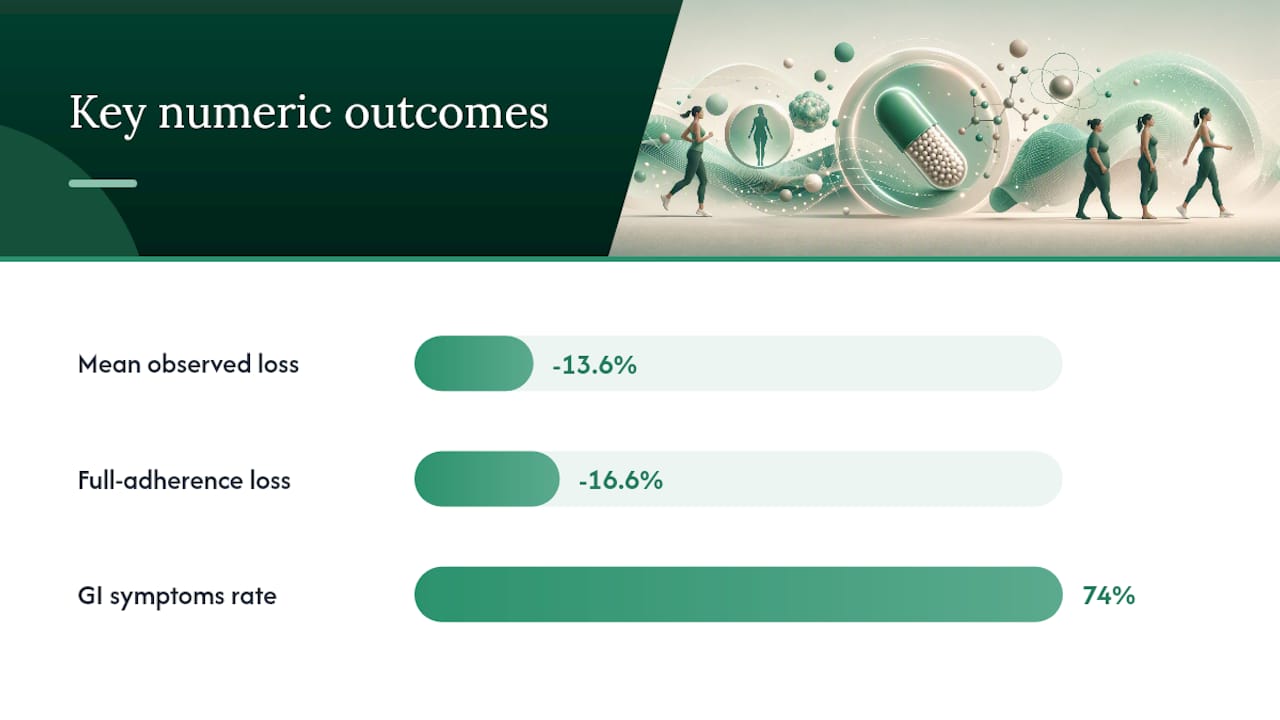
Yes: the Wegovy pill, oral semaglutide 25 mg, is FDA-approved for chronic weight management, and it produced double-digit average weight loss in phase 3 trials. In the OASIS 4 trial, adults taking the pill lost a mean of 13.6% of their body weight after 64 weeks, compared with 2.2% on placebo. Among people who took the medication consistently as directed, the estimated effect climbed to 16.6%.
- Approved for: chronic weight management in adults meeting BMI and comorbidity criteria
- Trial result: −13.6% mean weight loss at 64 weeks; −16.6% with full adherence
- Next step: talk to a licensed prescriber about eligibility, dosing, and whether the pill or an injectable fits your situation better
Key Takeaways
| Point | Details |
|---|---|
| FDA approval confirmed | The Wegovy pill was approved for chronic weight management on December 22, 2025, with U.S. pharmacy availability starting in January 2026. |
| Trial results are strong | OASIS 4 showed −13.6% mean observed weight loss and −16.6% with full adherence over 64 weeks. |
| Administration rules are non-negotiable | Take it each morning with minimal water and wait 30 minutes before food or other medications to preserve absorption. |
| GI side effects are common but manageable | About 74% of trial participants had gastrointestinal symptoms, mostly mild to moderate. |
| Legacymeds offers supervised access | The telehealth program provides prescriber assessment, titration management, and unlimited coaching without insurance or membership fees. |
This article is general information, not a substitute for advice from a qualified doctor. Consult a qualified healthcare professional about your own circumstances before acting on anything here.
Table of Contents
- What Oral Semaglutide for Weight Loss Actually Does in Trials
- FDA Approval and Who Qualifies Under the Label
- How Oral Semaglutide Works and How to Take It Correctly
- Side Effects, Safety, and When to Call Your Doctor
- What Oral Semaglutide Costs and How Insurance Plays In
- Getting Started: Eligibility and Your First Conversation
- Why Medical Supervision Matters With GLP-1 Therapy
- The Gap Between Trial Data and Real-World Habits
- Get Started With Medically Supervised Weight Loss
- Sources
- FAQ
What Oral Semaglutide for Weight Loss Actually Does in Trials
OASIS 4 enrolled about 307 adults with overweight or obesity and ran for 64 weeks, testing the 25 mg dose against placebo in a randomized, double-blind design. Researchers tracked two things above all: percent change in body weight, and how many participants hit weight loss milestones of 5%, 10%, 15%, and 20%.
The headline numbers: a mean observed weight loss of 13.6% versus 2.2% for placebo, and a higher estimated weight loss for those who stayed on therapy as prescribed. That gap between the two figures matters. The observed number includes everyone, even people who stopped early or missed doses. The estimand isolates what happens if you actually take it the way the label says.
- Mean weight loss (observed): −13.6%
- Mean weight loss (full adherence): higher substantial percentage
- Most participants reached a clinically meaningful weight loss threshold linked to improved metabolic markers
An average is not a promise. Some people in OASIS 4 lost far more than 16.6%, others less, and genetics, diet, and consistency all played a role. Clinicians who ran the trials also paired the medication with structured lifestyle changes, which is a detail worth remembering before you set expectations based on the drug alone.
FDA Approval and Who Qualifies Under the Label
The FDA approved the Wegovy pill for chronic weight management on December 22, 2025, and Novo Nordisk announced a U.S. launch planned for early January 2026. Pharmacies began stocking it shortly after.
- BMI threshold: approved for adults with a BMI of 30 or higher, or 27 or higher with at least one weight-related condition (high blood pressure, type 2 diabetes, high cholesterol)
- Indication: chronic weight management, not type 2 diabetes management
- Launch: available at U.S. pharmacies starting in January 2026, following the same distribution channels as other GLP-1 prescriptions
This is a meaningfully different approval than Rybelsus, which contains the same active ingredient, semaglutide, but has been on the market since 2019 strictly for type 2 diabetes. Rybelsus is not indicated for weight loss, and insurers treat the two drugs differently for coverage purposes even though the molecule is identical.
How Oral Semaglutide Works and How to Take It Correctly

Oral semaglutide is a GLP-1 receptor agonist. It mimics a gut hormone that slows stomach emptying, curbs appetite signals in the brain, and improves how your body manages blood sugar. The appetite suppression is the main driver behind the weight loss numbers in OASIS 4.
Getting the biology to work depends almost entirely on how you take the pill. Here’s the sequence that matters:
- Take it first thing in the morning, before anything else.
- Swallow it with no more than four ounces of plain water.
- Wait at least 30 minutes before eating, drinking anything else, or taking other oral medications.
- Follow the titration schedule, typically starting at a low dose and increasing every four weeks up to the 25 mg maintenance dose.
The 30-minute rule exists because the tablet’s coating temporarily changes the stomach’s environment to let the medication absorb before it breaks down. Skip that window, and you’re likely absorbing less drug than the trials tested.
Pro Tip: Set a recurring phone alarm for the same time every morning. Consistency in timing matters almost as much as the dose itself, since irregular administration can blunt absorption over weeks.
Switching from a weekly injectable to a daily pill means trading a once-a-week habit for a daily one, which some patients find harder to stick with long term.
Side Effects, Safety, and When to Call Your Doctor
Gastrointestinal side effects are the most common issue with oral semaglutide, and they’re not rare. Trial data showed GI adverse events in about 74% of participants on the drug versus 42.2% on placebo, mostly nausea, constipation, and diarrhea.
By the numbers: Roughly 3 out of 4 people taking oral semaglutide experienced some gastrointestinal symptom during trials, though most cases were mild to moderate and didn’t require stopping treatment.
- Most GI symptoms are worst during dose increases and tend to ease once you reach a stable dose.
- Rare but serious concerns include pancreatitis, gallbladder problems, and kidney issues in people with existing risk factors.
- People with a personal or family history of certain thyroid cancers should discuss this with a prescriber before starting.
- Persistent vomiting, severe abdominal pain, or signs of dehydration warrant urgent medical attention, not a wait-and-see approach.
Dose adjustments are common and expected. If side effects are hard to tolerate, a slower titration schedule often resolves the problem without abandoning treatment altogether. Legacymeds outlines these considerations in more detail in its GLP-1 medication safety information, which is worth reviewing before your first prescription conversation.
What Oral Semaglutide Costs and How Insurance Plays In
Pricing for the Wegovy pill varies widely depending on your insurance plan, and some covered patients may pay as little as $24 a month, while people paying out of pocket face a much higher list price.
- Insurance coverage for weight-loss drugs often requires prior authorization, meaning your doctor has to document BMI, prior weight-loss attempts, and comorbidities before approval.
- Step therapy policies sometimes require trying diet and exercise programs, or even other medications, before an insurer approves GLP-1 coverage.
- Telehealth programs, including Legacymeds, offer a route around some of these hurdles by bundling provider assessment, prescription, and ongoing support into one out-of-pocket program with no membership fee.
If you’re budgeting for treatment, Legacymeds’ pricing and insurance FAQ breaks down what to expect before you commit to a plan.
Getting Started: Eligibility and Your First Conversation
Before you bring this up with a provider, know where you stand. You likely qualify if your BMI is 30 or above, or 27 or above with a weight-related condition like high blood pressure or type 2 diabetes.
- Confirm your BMI and any qualifying comorbidities with a recent weight and health check.
- Ask your clinician about drug interactions, especially with other oral medications given the absorption window, and disclose any pregnancy plans since GLP-1 drugs aren’t recommended during pregnancy.
- Expect a titration schedule over several weeks or months, with follow-up visits to monitor side effects and progress.
- Bring records of prior weight-loss attempts if you’re pursuing insurance coverage, since documentation speeds up prior authorization.
If your primary care office has long wait times or limited experience prescribing GLP-1 medications, a telehealth option like Legacymeds’ prescription program offers a faster path to a licensed provider.
Why Medical Supervision Matters With GLP-1 Therapy
Dose titration isn’t optional guesswork. Going too fast increases GI side effects; going too slow delays results. A clinician who can adjust your schedule based on how you’re tolerating the medication is doing more than writing a prescription.
Every patient gets a provider assessment and unlimited ongoing coaching, not a one-time script.
- Look for licensed prescribers who monitor you over time, not just at intake.
- Confirm the program publishes clear safety information, not vague marketing language.
- Prioritize access to follow-up care, since side effect management and dose adjustments happen well after the first prescription.
Legacymeds’ safety information page lays out exactly what to expect from supervised care.
The Gap Between Trial Data and Real-World Habits
The OASIS 4 numbers are genuinely strong, but the 3 percentage point gap between the observed result and the full-adherence estimand tells you something the marketing rarely emphasizes: the drug’s ceiling depends on the patient sticking to a routine most people aren’t used to. A daily pill with a strict morning ritual, limited water, and a 30-minute food delay is a bigger behavioral ask than a weekly injection.
Conventional coverage treats the FDA approval as the finish line. It’s closer to the starting gate. That’s a habit problem as much as a medical one, and it’s why programs pairing medication with ongoing coaching tend to outperform prescriptions handed out without follow-up.
If you’re choosing between the pill and an injectable, don’t let convenience alone decide it. Ask which format you’ll actually stick with for a year, because adherence, not the delivery method, is what separates the trial’s best outcomes from its average ones.
Get Started With Medically Supervised Weight Loss
Reading about OASIS 4 results is one thing. Getting a prescription that fits your health history, budget, and daily routine is another. Legacymeds connects you with a licensed provider who evaluates your eligibility, manages your titration schedule, and stays available for unlimited follow-up, all without insurance or membership fees standing in the way.
Unlike a one-time telehealth visit that leaves you managing side effects alone, Legacymeds pairs your prescription with ongoing coaching, so dose adjustments and GI symptoms get addressed as they come up, not months later at a follow-up appointment you had to schedule yourself. More than 500,000 patients have used the program to reach a significant average body weight reduction. If you meet the BMI and comorbidity criteria covered above, start your GLP-1 weight loss program today and get matched with a provider who can walk you through eligibility and next steps.
Sources
- Oral Semaglutide at a Dose of 25 mg in Adults with Overweight or Obesity (OASIS 4) — PubMed
- Novo Nordisk SEC filing summarizing Wegovy pill approval
- A Pill Version of Wegovy Hits Pharmacies — TIME
- Wegovy obesity pill now available at pharmacies : Shots - NPR
FAQ
Can You Get Oral Semaglutide Over the Counter?
No. Oral semaglutide, including the Wegovy pill, requires a prescription from a licensed provider based on BMI and health criteria.
How Much Does the Semaglutide Pill Cost?
Cost varies by insurance coverage, with some covered patients paying around $24 a month, while uninsured patients face a much higher out-of-pocket price; telehealth programs like Legacymeds offer bundled pricing without membership fees.
What Is the Best Semaglutide Pill for Weight Loss?
The Wegovy pill (oral semaglutide 25 mg) is the only oral semaglutide product FDA-approved specifically for weight loss; Rybelsus contains the same ingredient but is approved only for type 2 diabetes.