
Short answer: current human evidence through 2025 and 2026 does not show a clear increase in thyroid cancer risk from semaglutide, though the follow-up window remains shorter than doctors would prefer. The FDA’s boxed warning exists because of rodent studies, not because of a confirmed human cancer signal. That distinction matters more than most patients realize when they first read the drug label and feel a jolt of alarm.
Here’s what the weight of evidence actually shows:
- Pooled clinical-trial datasets covering roughly 101,732 participants and 206,950 patient-years of exposure have not demonstrated a clear increase in thyroid cancer among semaglutide users.
- A large federated cohort study comparing GLP-1 receptor agonists against other diabetes drugs found no statistically significant increase in thyroid tumor risk.
- Post-marketing surveillance reporting rates sit around 0.001 cases per 100 patient-years of exposure, an exceptionally low number by any pharmacovigilance standard.
- The rare, aggressive subtype the warning is actually about, medullary thyroid carcinoma, has not shown a consistent pattern of excess cases in treated groups.
None of this means the question is closed. Longer-term data, particularly past the 4 to 5 year mark, are still accumulating, and that’s the honest caveat every responsible summary of this topic needs to carry.
Key Takeaways
Current human evidence, spanning pooled trial data, a large federated cohort, and a Medicare-focused analysis, does not show a clear increase in thyroid cancer risk from semaglutide, though long-term surveillance continues.
| Point | Details |
|---|---|
| Boxed warning origin | The FDA warning comes from rodent studies showing dose-dependent C-cell tumors, not confirmed human cancer cases. |
| Human data reassuring so far | Post-marketing reporting sits near 0.001 cases per 100 patient-years; cohort hazard ratios cluster between 0.83 and 0.95. |
| Follow-up remains limited | Most data covers about 4 to 5 years of exposure, short for a slow-developing cancer like medullary thyroid carcinoma. |
| Screening is targeted, not universal | Routine calcitonin testing or ultrasound isn’t recommended outside personal or family history of MTC or MEN2. |
| Report specific symptoms | A neck lump, persistent hoarseness, or swallowing trouble warrants prompt evaluation with your clinician. |
Table of Contents
- Does Semaglutide Increase Thyroid Cancer Risk? Summarizing the Evidence
- Why Does Semaglutide Have a Thyroid Cancer Warning?
- What Do Human Clinical Trials and Cohort Studies Actually Show?
- Who Should Avoid Semaglutide, and What Symptoms Need Attention?
- What Longer-Term Research Still Needs to Answer
- How Legacymeds Approaches GLP-1 Safety and Support
- Getting Personalized Guidance Before You Start Treatment
- What Patients Should Actually Take From This Evidence
- Sources
- FAQ
Does Semaglutide Increase Thyroid Cancer Risk? Summarizing the Evidence
The short version: several large, independent lines of evidence point the same direction, and it isn’t toward elevated risk. That’s unusual in medicine, where studies often conflict. Here, a pooled analysis of trial data, a federated multi-database cohort study, and a Medicare-focused cohort all converge on numbers close to what you’d expect without the drug in the picture.
The headline numbers most patients want to see: post-marketing reporting rates near 0.001 cases per 100 patient-years, and cohort hazard ratios close to 1.0 compared to other diabetes medications, meaning risk is not measurably higher than baseline.
Start with the pooled analysis of clinical trials and post-marketing data. Across a large trial population, researchers did not find a clear increased incidence of thyroid cancer tied to semaglutide exposure. One caveat worth sitting with: the pooled hazard ratio for GLP-1 receptor agonists versus placebo indicated uncertainty and the data could not rule out no effect. That interval crosses 1.0, which in plain terms means the result isn’t statistically distinguishable from no effect at all. Wide confidence intervals like that usually mean the event counts were small, and small numbers make any ratio jumpy.
Then there’s the federated cohort study that pulled data across multiple health databases using an active-comparator design, meaning it compared GLP-1 users against people taking other diabetes drugs rather than against untreated patients. That’s a stronger design because it controls for the fact that people on any diabetes medication tend to get more medical attention and more incidental imaging than the general population. The result: hazard ratios below or near 1.0 against SGLT2 inhibitors, and thyroid tumor incidence in the GLP-1 group similar to comparators. Those are not numbers that suggest an emerging cancer signal.
A separate Medicare cohort study looked at 73,388 new GLP-1 receptor agonist users with a mean age of 72.4, a population you’d expect to be at higher baseline thyroid cancer risk simply due to age. The adjusted three-year cumulative risk difference versus SGLT2 inhibitor users was negative 23 cases per 10,000, meaning the GLP-1 group actually showed slightly fewer cases over that window, not more.
A few things explain why studies on this topic don’t all read identically:
- Some rely on spontaneous adverse-event reporting (like the FDA’s FAERS database), which is useful for flagging signals but can’t establish causation or control for confounding.
- Cohort studies vary in how long they follow patients, and semaglutide’s marketed history is still shorter than older diabetes drugs used as comparators.
- Detection bias is real: patients starting a new weight-loss or diabetes medication tend to have more doctor visits, more labs, and more incidental neck imaging, which can surface thyroid nodules that were already there.
- Subtype matters. Most cancers detected in these studies are papillary thyroid cancer, a common and usually slow-growing type, not the medullary thyroid carcinoma the boxed warning specifically addresses.
Put together, three separate lines of evidence, pooled trial data, a large active-comparator cohort, and a Medicare-specific analysis, land in roughly the same place: no clear signal of elevated risk in the human data available so far. That’s reassuring, but it’s not the same as a guarantee, and every honest researcher studying this drug says so.
Why Does Semaglutide Have a Thyroid Cancer Warning?
The boxed warning traces back to rodent studies, not to human cancer cases. In lifetime studies, rats and mice given semaglutide developed thyroid C-cell tumors in a pattern that tracked with both dose and duration, meaning higher doses and longer exposure produced more tumors. That’s the kind of dose-response relationship toxicologists take seriously, and it’s exactly why the FDA prescribing information carries the warning and lists personal or family history of medullary thyroid carcinoma as a contraindication.

Here’s the part that gets lost in casual conversation about this drug: rodents are not small humans, and their C-cells (the thyroid cells that produce calcitonin and can give rise to medullary thyroid carcinoma) behave differently than ours. Rat and mouse C-cells express a much higher density of GLP-1 receptors than human C-cells do. That anatomical difference is well documented in the pharmacology literature and it’s the central reason regulators and researchers have been cautious about extrapolating the rodent findings directly onto human risk.
A few points worth holding onto:
- Regulatory agencies operate on precaution. A signal in animal studies triggers a boxed warning even before there’s any comparable human data, because the downside of missing a real risk is worse than the downside of over-warning.
- The rodent tumors were C-cell in origin, which is why the warning specifically calls out medullary thyroid carcinoma rather than thyroid cancer broadly.
- Species differences in receptor biology don’t prove humans are immune to the effect. They explain why the signal hasn’t clearly reproduced in years of human surveillance, without closing the door entirely.
That’s the honest state of play: a legitimate animal finding drove a legally required warning, and years of accumulating human data haven’t reproduced it in a way that changes the label.
What Do Human Clinical Trials and Cohort Studies Actually Show?
If you want the full picture instead of a single number, it helps to walk through how these studies were actually built. Trial data and observational cohort data answer slightly different questions, and knowing which is which changes how much weight you should put on each result.
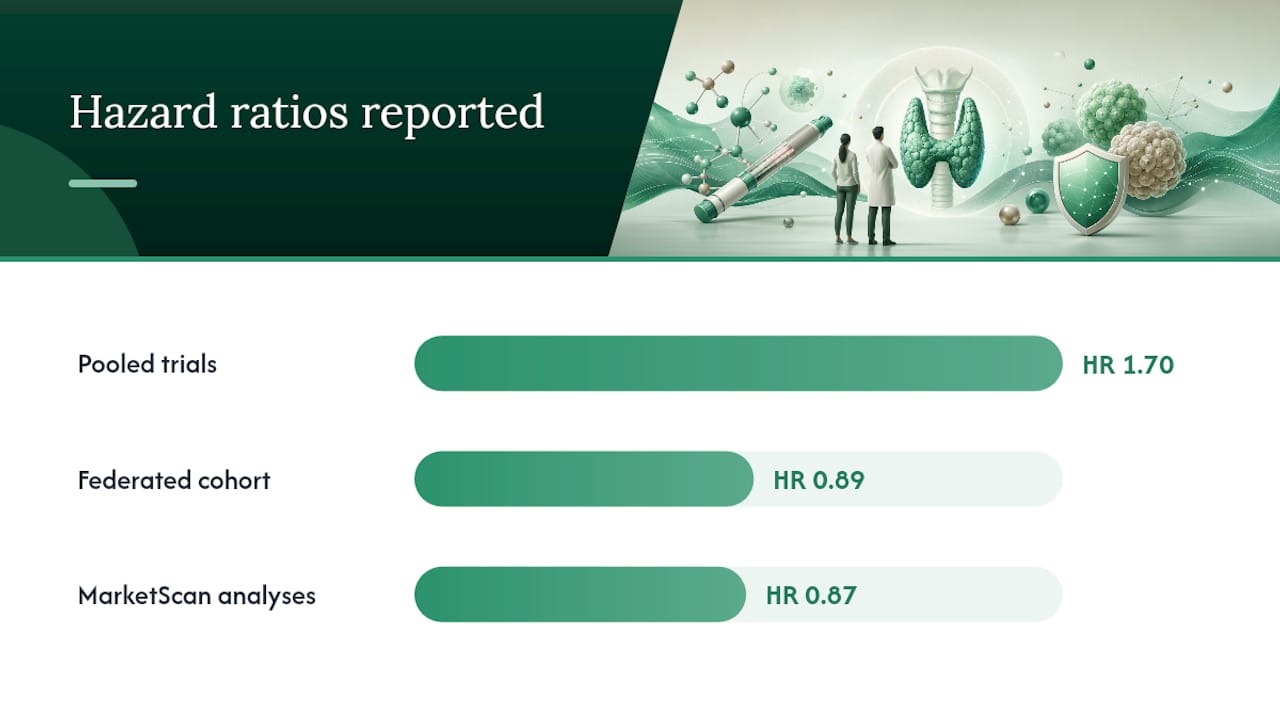
The pooled trial analysis covering roughly 101,732 participants and about 206,950 patient-years of semaglutide exposure is the closest thing available to a controlled experiment. Randomized trials assign patients to drug or placebo, which limits confounding, but they also weren’t designed primarily to detect rare cancers. Thyroid cancer, especially the medullary subtype, is uncommon enough that even a trial of this size may not capture enough events to produce a tight, reliable estimate. That’s the source of the wide confidence interval mentioned earlier (0.99 to 3.03) around the pooled hazard ratio of 1.70.
When a hazard ratio’s confidence interval nearly touches 1.0 at its lower bound, the honest reading isn’t “risk confirmed” or “risk ruled out.” It’s “the data can’t yet distinguish this from no effect, and more events over more years are needed to know for sure.”
Real-world cohort studies fill a different gap. They track much larger populations over routine clinical care rather than a trial protocol, which means bigger numbers but less control over who ends up on which drug. The federated multi-database cohort addressed this with an active-comparator design, tracking new users of GLP-1 receptor agonists against new users of SGLT2 inhibitors, DPP-4 inhibitors, and sulfonylureas rather than against untreated patients. That head-to-head structure matters because it means both groups were similarly likely to be getting routine diabetes care, routine labs, and incidental imaging. The resulting hazard ratios, 0.83 to 0.95 versus SGLT2 inhibitors, sit comfortably at or below the null.
Separately, Merative MarketScan database analyses reported a hazard ratio of 0.87 with a 95% confidence interval of 0.58 to 1.29, another result centered below 1.0 with a range that comfortably includes it. Combined with the post-marketing reporting rate near 0.001 cases per 100 patient-years of exposure, the surveillance side of the evidence base looks consistent with the trial and cohort side.
Not every study lands this cleanly, though, and it’s worth naming why. Nested case-control designs and spontaneous adverse-event reports, the kind submitted to databases like FAERS or EudraVigilance, have occasionally shown elevated reporting ratios for thyroid cancer among GLP-1 users. These signals get attention, and they should, but they come with real limitations: spontaneous reports aren’t adjusted for how long a patient was exposed, they can’t establish that the drug caused the cancer rather than simply preceding its diagnosis, and they’re vulnerable to reporting bias, meaning doctors and patients report suspected drug reactions more actively when a drug is in the news.
A useful way to hold all of this together:
- Trial data: strong on causal design, weaker on statistical power for rare outcomes.
- Large active-comparator cohorts: strong on sample size and real-world relevance, weaker on eliminating every source of confounding.
- Spontaneous reporting databases: useful for early signal detection, unreliable for estimating actual risk magnitude.
- Follow-up duration: most human data extends to roughly 4 to 5 years of exposure, which is short relative to how slowly some thyroid cancers, and especially medullary thyroid carcinoma, can develop and get diagnosed.
Most thyroid cancers detected across these datasets have been papillary thyroid cancer, a common and generally slow-growing subtype unrelated to the specific C-cell mechanism the boxed warning addresses. Medullary thyroid carcinoma cases have been rare across every dataset reviewed, and the case counts haven’t consistently favored the treatment group over the comparator group in any of the major analyses. That distinction, papillary versus medullary, is exactly why the clinical guidance below focuses so narrowly on personal and family history rather than broad population screening.
Who Should Avoid Semaglutide, and What Symptoms Need Attention?
If you’re weighing semaglutide or another GLP-1 medication, the guidance here isn’t complicated, but it is specific. It comes down to who shouldn’t take it, what monitoring actually makes sense, and what to report if something feels off.
- Know the contraindications. Semaglutide is contraindicated in anyone with a personal or family history of medullary thyroid carcinoma, and in anyone with Multiple Endocrine Neoplasia syndrome type 2 (MEN2), a genetic condition that raises MTC risk substantially. This isn’t a gray area; it’s a hard stop that your prescriber should ask about directly.
- Understand that routine screening isn’t standard for everyone else. Outside of that high-risk group, routine calcitonin blood testing or thyroid ultrasound isn’t recommended for asymptomatic patients starting a GLP-1 medication. The absolute event rates are low enough that broad screening tends to generate more unnecessary biopsies and anxiety than it prevents disease, a pattern well recognized in overdiagnosis research on thyroid nodules generally.
- Watch for specific symptoms, not vague ones. A lump or swelling in the front of the neck, a persistent hoarse voice, difficulty swallowing, or shortness of breath that doesn’t resolve are the symptoms worth reporting promptly. General neck discomfort or a sore throat that comes and goes with a cold is not the same thing, and it’s not a reason to panic.
- Talk through the decision with your clinician, not just the label. Shared decision-making means your prescriber should document that you understand the boxed warning, that your personal and family thyroid history has been reviewed, and that you know which symptoms warrant a call. Legacymeds’ own GLP-1 medication safety information page walks through this in more detail if you want a plain-language reference to bring to that conversation.
- Know when a change makes sense. If a new neck mass, voice change, or swallowing problem shows up while you’re on the medication, that’s a reason to pause and get evaluated, not necessarily a reason to panic or assume the worst. Your clinician can determine whether it’s related and whether an alternative treatment approach fits your situation better.
Pro Tip: Bring a simple written note to your first GLP-1 consultation listing any thyroid conditions, thyroid cancer, or MEN2 diagnoses among your parents, siblings, or children. That one detail is the single fastest way for a clinician to determine whether semaglutide is appropriate for you.
None of this is about fear. It’s about making sure the roughly one in a million or so patients for whom this drug is genuinely inappropriate get identified before day one, while everyone else can move forward without chasing tests that don’t add useful information.
What Longer-Term Research Still Needs to Answer
The honest gap in this evidence base is time. Most human data on semaglutide and thyroid outcomes covers exposure windows of roughly 4 to 5 years, and medullary thyroid carcinoma is rare enough, and can develop slowly enough, that even well-designed cohort studies may need longer horizons to fully rule out a modest effect.
A few specific things researchers say still need work:
- Cardiovascular outcome trials (CVOTs) and other long-running studies need extended follow-up periods specifically built to capture rare cancer outcomes, not just their primary cardiometabolic endpoints.
- Prospective registries that track thyroid history, family history, and cumulative GLP-1 exposure over many years are the most realistic way to accumulate enough medullary thyroid carcinoma cases for a statistically reliable estimate, since randomized trials rarely enroll enough patients or run long enough to catch a cancer this rare.
- Detection bias needs better accounting in observational studies. Patients starting weight-loss medications tend to get more clinical attention overall, which can inflate incidental thyroid nodule discovery independent of any drug effect.
- Spontaneous reporting signals, the kind that occasionally show up in FAERS or EudraVigilance data, need to be interpreted alongside exposure-adjusted cohort data rather than treated as standalone proof of risk.
None of this changes the current picture much. It just means the reassuring numbers available today come with an asterisk that honest researchers keep attached, and that pharmacovigilance on this question isn’t finished.
How Legacymeds Approaches GLP-1 Safety and Support
Legacymeds built its GLP-1 program around the idea that patients deserve straight answers before they start, not just after something goes wrong. Every patient works with a licensed provider who reviews personal and family thyroid history as part of the intake process, consistent with the contraindication guidance covered above.
That process includes a few concrete commitments:
- A dedicated GLP-1 medication safety information page that lays out contraindications, monitoring expectations, and warning signs in plain language.
- Free provider visits and unlimited ongoing coaching, so questions about symptoms or side effects don’t sit unanswered between appointments.
- A weight loss FAQ covering the logistical and safety questions patients ask most often before committing to a program.
If you’re weighing semaglutide against your own health history, the right next step is a conversation with a licensed provider who can review your specific risk factors, not a generic checklist. That conversation, paired with documented informed consent, is what shared decision-making is supposed to look like in practice.
Getting Personalized Guidance Before You Start Treatment
Reading the research is a good first step, but it can’t replace a conversation with a provider who knows your actual medical history. Legacymeds’ GLP-1 weight loss program pairs every new patient with a licensed provider for a full intake, including a direct review of personal and family thyroid history, before any prescription moves forward.
The program runs without membership fees or insurance requirements, and it includes free provider visits plus unlimited coaching for as long as you’re enrolled, so follow-up questions about symptoms or side effects have somewhere to go. If you’re specifically weighing the thyroid cancer question against your own family history, that’s exactly the kind of detail worth raising during intake rather than after your first prescription arrives. You can start that conversation through Legacymeds’ weight loss prescription program whenever you’re ready to move past reading and get a personalized answer.
What Patients Should Actually Take From This Evidence
The conventional advice on this topic tends to split into two unhelpful camps: either “the boxed warning means don’t worry, it’s just a formality” or “any cancer warning means walk away.” Both miss what the data actually supports.
The judgment I’d draw from this evidence is that the rodent-based warning did its job. It flagged a mechanism worth watching, and years of pooled trial data, large cohort studies, and post-marketing surveillance have not reproduced that signal in humans at any concerning magnitude. What gets underweighted in most consumer-facing coverage is how much the source of the data matters. A hazard ratio from an active-comparator cohort of hundreds of thousands of patients deserves more trust than a spontaneous adverse-event report, even when the second one makes for a scarier headline.
What patients should prioritize first isn’t a symptom checklist. It’s an honest conversation about family thyroid history before day one. That single detail sorts the rare person who genuinely shouldn’t take this drug from the overwhelming majority for whom the evidence, so far, looks reassuring.
— Bryan
This article is general information, not a substitute for advice from a qualified doctor. Consult a qualified healthcare professional about your own circumstances before acting on anything here.
Sources
- Assessment of Thyroid Carcinogenic Risk and Safety Profile of GLP1‑RA Semaglutide (Ozempic) Therapy
- Risk of Thyroid Tumors With GLP‑1 Receptor Agonists: A Retrospective Cohort Study
- Cohort analysis of GLP‑1RA thyroid cancer risk in Medicare beneficiaries
- Semaglutide prescribing information (DailyMed)
FAQ
How likely is it to get thyroid cancer from semaglutide?
Current evidence puts the risk very low. Post-marketing surveillance shows a reporting rate around 0.001 cases per 100 patient-years, and large cohort studies have not found a statistically higher rate compared to other diabetes medications.
Has anyone actually developed thyroid cancer while taking Ozempic?
Cases of thyroid cancer, mostly the common papillary subtype, have been reported among patients using semaglutide brands including Ozempic, but large comparative studies haven’t found these cases occur more often than in patients taking other diabetes drugs. Medullary thyroid carcinoma specifically, the subtype tied to the boxed warning, has remained rare and inconsistent across treatment groups.
Can itchy ears be a symptom of thyroid cancer?
Itchy ears alone are not a recognized symptom of thyroid cancer. The symptoms clinicians actually watch for are a neck lump, persistent hoarseness, trouble swallowing, or unexplained shortness of breath, and any of those warrant a conversation with your provider.
Has anyone gotten thyroid cancer from a GLP-1 medication generally?
Across pooled trial data and multiple large cohort studies of GLP-1 receptor agonists as a class, researchers have not found a clear increase in thyroid cancer incidence compared to other diabetes treatments, though most human follow-up so far extends to roughly 4 to 5 years of exposure.