

Most U.S. patients pay varying out-of-pocket amounts for a 28-day supply of Zepbound (tirzepatide), depending on their insurance status, dose, and which savings programs they qualify for. The manufacturer list price runs from roughly $499 to $1,086.37 per fill — but that number is almost never what lands on your pharmacy receipt.
Here are the fastest ways to close that gap:
- Check your insurer’s formulary first. Zepbound’s formulary placement varies widely by plan, and a single phone call can tell you whether you’re looking at a $25 copay or full list price.
- Enroll in the Zepbound Savings Card if you have commercial insurance. Eligible patients can pay as little as $25 per fill for up to a 3-month prescription, subject to annual caps and eligibility rules.
- Use LillyDirect self-pay pricing if you’re uninsured or on Medicare. Cash-pay tiers through the LillyDirect Self Pay Journey Program start at $299 per 28-day supply for lower doses and reach $449 for higher doses when you refill within 45 days.
- Ask your prescriber to submit prior authorization (PA) or file an appeal if your insurer initially denies coverage. Many denials are reversed when the prescriber documents medical necessity.
Medicare Part D generally excludes weight-loss-only drugs, so most Medicare beneficiaries will need to use the cash-pay path or discuss whether a secondary covered indication applies to their prescription.
Table of Contents
- What the list price actually means for your Zepbound cost
- How price varies by dose and formulation
- How insurance, Medicare, and Medicaid typically handle Zepbound
- Savings programs, coupons, and other ways to lower what you pay
- Practical options when you’re uninsured or on Medicare
- How to estimate your real monthly out-of-pocket
- Does formulation change cost? Vials versus pens and what to ask your provider
- Coverage trends and four steps to lower your costs now
- Key Takeaways
- The cost conversation nobody’s having clearly enough
- Legacymeds makes GLP-1 access straightforward, without the insurance maze
- Useful sources
- FAQ
What the list price actually means for your Zepbound cost
The wholesale acquisition cost (WAC) is the price Eli Lilly sets before any discounts, rebates, or insurance negotiations. It is a starting point for the supply chain, not a price most patients ever pay. According to Lilly’s pricing information page, the WAC for Zepbound ranges from approximately $499 to $1,086.37 per 28-day fill depending on dose and formulation.
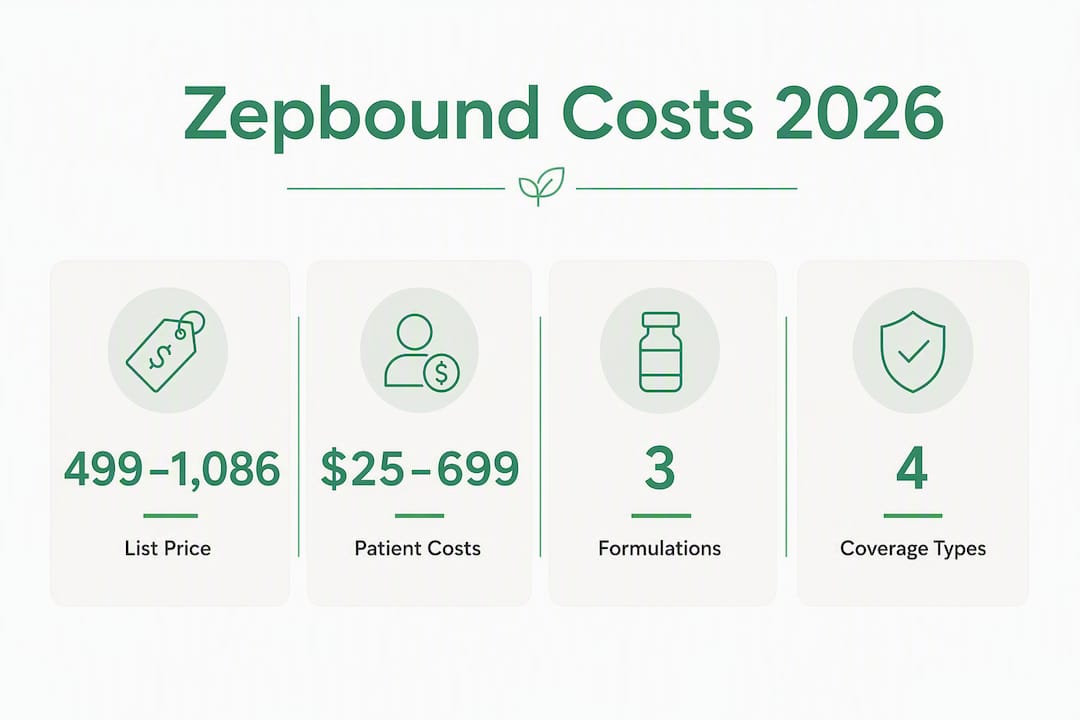
What you actually pay depends on five variables working together: your insurer’s formulary tier, your plan’s copay or coinsurance structure, whether prior authorization is required and approved, which manufacturer savings programs you qualify for, and the dose your prescriber selects. Change any one of those, and your monthly expense shifts significantly.
The confusion around list price is real and worth naming directly. Many news headlines quote the $1,086 figure as if it’s what patients pay at the pharmacy counter. For commercially insured patients with the savings card, the actual out-of-pocket can be $25. For an uninsured patient on a higher dose using LillyDirect, it’s $449 depending on refill timing. The WAC is a reference number — your actual cost is a product of your specific situation.
Statistic callout: Lilly’s direct-to-patient cash-pay tiers start at $299 per 28-day supply, significantly below the highest wholesale acquisition cost (WAC) for the drug.
How price varies by dose and formulation
Zepbound is available as single-dose pens, KwikPens, and lyophilized vials. Each formulation has different pricing tiers, and the dose you’re prescribed directly determines which tier applies.

The LillyDirect Self Pay Journey Program publishes the following cash-pay tiers:
| Dose | Formulation | LillyDirect Self-Pay Price (28-day supply) |
|---|---|---|
| 2.5 mg | Single-dose pen | $299/month |
| 5 mg | Single-dose pen | $399/month |
| 7.5 mg | Single-dose pen | $449/month (refill within 45 days) |
| — | Single-dose pen | $449/month (refill within 45 days) |
| — | Single-dose pen | $449/month (refill within 45 days) |
| 15 mg | Single-dose pen | $449/month (refill within 45 days) |
A few practical notes on what these numbers mean:
- Lilly defines a month as 28 days, and a 28-day supply equals up to 4 single-dose pens for pen formulations.
- The vial option through LillyDirect includes four single-dose lyophilized vials per 28-day supply. Patients must reconstitute the vials themselves and purchase bacteriostatic water and syringes separately — costs that don’t appear in the tier price.
- Retail pharmacy cash prices for Zepbound can differ from LillyDirect prices, and state taxes or dispensing fees may apply on top of either.
- The 2.5 mg dose is a starter dose only and is not approved as a long-term maintenance dose, so most patients move to higher tiers within the first few months.
Pro Tip: If you’re starting on 2.5 mg, the $299 entry price won’t reflect your long-term monthly expense. Budget for the 5 mg or 7.5 mg tier as your baseline once titration begins.
How insurance, Medicare, and Medicaid typically handle Zepbound
Commercial insurance is the most variable piece of the Zepbound pricing picture. Some plans cover it with a straightforward copay; others require prior authorization, step therapy (trying a cheaper drug first), or don’t cover it at all for weight management. The Zepbound Savings Card can reduce a commercially insured patient’s copay to as low as $25 per fill for up to a 3-month prescription — but only if the plan covers Zepbound and the patient meets eligibility requirements.

Pharmacy benefit managers (PBMs) play a significant role here. Your insurer’s PBM determines which drugs sit on which formulary tier, which directly affects your copay or coinsurance. Lilly has been working with major PBMs to expand coverage templates for Zepbound, and coverage has broadened for millions of commercially insured Americans as a result. Still, formulary placement isn’t universal, and a plan that covered Zepbound last year may have changed its tier this year.
Medicare Part D generally excludes drugs approved solely for weight loss under current federal law. Unless your prescription carries a secondary covered indication (such as type 2 diabetes or obstructive sleep apnea), most Medicare beneficiaries will not have Part D coverage for Zepbound. Medicaid coverage varies by state — some state programs cover obesity medications, others don’t, and eligibility criteria differ.
Statistic callout: The Zepbound Savings Card can bring eligible commercially insured patients’ copay to as low as $25 per fill, subject to annual caps and program expiration dates.
Pro Tip: Government beneficiaries — including Medicare and Medicaid enrollees — are explicitly excluded from the Zepbound Savings Card and most manufacturer copay programs. If you’re on Medicare, the LillyDirect cash-pay path is typically your most predictable option.
Savings programs, coupons, and other ways to lower what you pay
The Zepbound Savings Card
The savings card is Lilly’s primary tool for reducing out-of-pocket costs for commercially insured patients. Eligible patients can pay as little as $25 per fill for up to a 3-month prescription. Key limits to know:
- The card applies only to patients with commercial (private) insurance that covers Zepbound.
- Government beneficiaries (Medicare, Medicaid, TRICARE, and similar programs) are not eligible.
- Annual savings caps and card expiration dates apply — always check the current terms at Lilly’s savings page, since program details change.
LillyDirect Self Pay Journey Program
This is the cash-pay route, designed specifically for patients without insurance coverage or those on Medicare. Pricing starts at $299 for the 2.5 mg dose and reaches $449 for doses 7.5 mg and above — but only when you refill within the 45-day window. Miss that window, and the price can revert to $499 or $699 depending on your dose.
One critical rule: self-pay purchases under LillyDirect cannot be combined with insurance benefits. Choosing the cash-pay path typically requires a signed agreement that you won’t submit the purchase to insurance or have it counted toward your deductible.
Other cost-reduction options
- GoodRx and pharmacy discount cards can sometimes reduce retail cash prices at participating pharmacies, though savings vary and may not match LillyDirect tiers.
- Manufacturer patient assistance programs exist for patients who meet income-based eligibility criteria — contact Lilly directly to ask about current availability.
- Prior authorization and appeals are worth pursuing with your prescriber’s support. A well-documented PA request citing medical necessity and clinical history reverses many initial denials.
Pro Tip: Save every denial letter and prior authorization decision in writing. Insurers are required to provide a specific reason for denial, and that reason tells your prescriber exactly what documentation to include in the appeal.
Practical options when you’re uninsured or on Medicare
Medicare beneficiaries and uninsured patients face the same core challenge: the savings card isn’t available to them, and list price is not a realistic option. The LillyDirect cash-pay program is usually the most accessible path. Here’s a short checklist to work through:
- Verify the diagnosis code on your prescription. If your prescriber has documented a secondary covered indication (type 2 diabetes, obstructive sleep apnea), ask whether that changes your Part D formulary status.
- Check your Medicare Part D plan’s formulary directly. Call the plan or use Medicare’s online plan finder to confirm whether Zepbound appears under any covered indication.
- Discuss secondary indications with your prescriber. If tirzepatide is clinically appropriate for a covered condition you have, the prescriber may be able to document that indication, which could open a coverage path.
- Evaluate LillyDirect pricing for your dose. Compare the $299–$449 monthly tiers against your budget and factor in the cost of reconstitution supplies if you’re using the vial formulation.
- Ask about manufacturer assistance programs. Lilly maintains patient assistance programs for qualifying low-income patients — eligibility and availability change, so ask your provider or pharmacist for the current application process.
- Set a refill reminder. If you’re using the LillyDirect discounted tier, the 45-day refill window is a hard deadline. Missing it costs you the discount.
How to estimate your real monthly out-of-pocket
Three scenarios cover most situations patients find themselves in. Use these as a starting framework and adjust for your specific plan details.
Scenario A: Commercially insured with savings card Your insurer covers Zepbound, and you qualify for the savings card, which can substantially reduce your copay per fill. Inputs to collect: your plan’s formulary tier for Zepbound, your copay or coinsurance rate, and the savings card’s current annual cap.
Scenario B: Commercially insured, no coverage for Zepbound Your plan doesn’t cover Zepbound for weight management. You’re paying cash. LillyDirect tiers ($299–$449 depending on dose and refill timing) are likely lower than retail pharmacy cash prices. You cannot use the savings card in this scenario. Factor in whether your plan will count this toward your out-of-pocket maximum — under the non-combinable terms, it typically won’t.
Scenario C: Uninsured, using LillyDirect You pay the published LillyDirect tier directly. At 7.5 mg with on-time refills, that’s $449 per 28-day supply. At 2.5 mg starting dose, it’s $299. Add the cost of bacteriostatic water and syringes if you’re using the vial formulation — a detail that doesn’t appear in the headline price.
To build your own estimate:
- Start with the LillyDirect tier for your prescribed dose (or your plan’s negotiated rate if insured).
- Subtract any savings card benefit if you’re eligible.
- Add pharmacy dispensing fees or supply costs if applicable.
- Multiply by 12 to see annual Zepbound expenses before any program changes.
Statistic callout: A commercially insured patient using the savings card at the 7.5 mg dose could pay considerably less per fill than under LillyDirect cash-pay pricing, representing a significant monthly and annual savings.
Pro Tip: Use your insurer’s online coverage checker and take a screenshot with the date. If your plan later denies a claim, that screenshot is evidence that Zepbound was listed as covered when you filled.
Does formulation change cost? Vials versus pens and what to ask your provider
The short answer is yes, though not always in the direction patients expect. Vials through LillyDirect are priced similarly to pens at the same dose tier, but the total cost of using vials is higher once you account for reconstitution supplies. Bacteriostatic water, syringes, and alcohol swabs aren’t included in the LillyDirect vial shipment and must be purchased separately.
Providers typically prescribe vials when a patient needs more precise dose titration, has dexterity limitations that make pen injection difficult, or when the clinical situation calls for a formulation not available in pen form. For most patients starting on 2.5 mg or 5 mg, the single-dose pen is the default and the simpler option.
Dose selection has a direct and predictable effect on price. The 2.5 mg starting dose costs $299 per month on LillyDirect; moving to 7.5 mg adds $150 per month at the discounted refill rate. That’s a meaningful budget difference over a year of treatment.
Statistic callout: The increase from the 5 mg tier to the 7.5 mg tier adds to the monthly cost, and missing the 45-day refill window at 7.5 mg results in a notably higher price due to loss of discounted rates.
Questions worth asking your prescriber or pharmacist before your next fill:
Pro Tip: Ask your prescriber whether your current dose is the lowest clinically appropriate dose for your progress. Staying at a lower dose longer — if medically sound — keeps monthly costs lower and preserves the discounted LillyDirect tier.
Coverage trends and four steps to lower your costs now
Zepbound’s coverage picture has shifted meaningfully in the past year. Lilly’s work with major PBMs has resulted in Zepbound being covered for millions more commercially insured Americans, and that expansion is ongoing. Formularies update quarterly, so a plan that excluded Zepbound six months ago may now include it. Rechecking your formulary every 90 days takes five minutes and can save hundreds of dollars.
Clinical data on tirzepatide continues to accumulate, and post-hoc analyses of tirzepatide trials show substantial weight reductions in treated participants. That evidence base is part of why payers are reconsidering coverage policies — obesity medicine is increasingly treated as a chronic disease management category rather than a lifestyle benefit, which changes how PBMs classify these drugs.
Statistic callout: Lilly has announced that Zepbound coverage has expanded to millions of Americans through PBM template updates — making it worthwhile to recheck your formulary regularly.
Four steps to take right now:
- Run your insurer’s coverage check. Log into your plan’s portal or call member services and ask specifically about Zepbound’s formulary tier and prior authorization requirements.
- Enroll in the savings card if you’re commercially insured. Even if your copay is manageable, the card can reduce it further and is worth activating before your next fill.
- Submit a prior authorization or appeal with your prescriber’s support. If you’ve been denied, ask your prescriber to document BMI, comorbidities, and prior treatment history in the PA request.
- Set a calendar reminder for your LillyDirect refill window. If you’re on the cash-pay path, the 45-day refill deadline is the single most important date to track.
Pro Tip: Formulary updates often take effect January 1 and July 1. If you’re approaching either date, recheck your plan’s drug list before your next fill — coverage status can change between refills.
Key Takeaways
Most patients who plan ahead pay far less than Zepbound’s list price: the savings card, LillyDirect tiers, and prior authorization together represent the three most reliable levers for reducing what you actually owe each month.
| Point | Details |
|---|---|
| List price vs. real cost | WAC runs $499–$1,086.37, but most patients pay $25–$699 depending on insurance and dose. |
| Savings card eligibility | Commercially insured patients can pay as little as $25 per fill; government beneficiaries are excluded. |
| LillyDirect cash-pay tiers | Prices run $299–$449 per 28-day supply; missing the 45-day refill window can increase the price for higher doses. |
| Prior authorization matters | A well-documented PA or appeal with your prescriber’s support reverses many initial denials. |
| Legacymeds GLP-1 program | Legacymeds offers online tirzepatide prescriptions with free provider visits and unlimited coaching, no insurance required. |
The cost conversation nobody’s having clearly enough
The loudest number in any Zepbound article is the list price. It gets cited in news stories, congressional hearings, and social media posts as evidence that weight-loss drugs are unaffordable. And for some patients, they genuinely are. But the list price framing obscures a more complicated and more useful truth: what you pay depends almost entirely on decisions that can be influenced.
The savings card, the LillyDirect cash-pay program, prior authorization, formulary rechecks — none of these are secret. They’re documented on Lilly’s own website. What’s missing for most patients isn’t information; it’s someone to help them work through the steps in the right order. A prescriber who submits a thorough PA request, a pharmacist who flags the refill window, a care team that knows which savings programs apply to your situation — those are the variables that actually determine your bill.
The patients who pay $25 a month aren’t luckier than the ones paying $699. They’re better supported.
Legacymeds makes GLP-1 access straightforward, without the insurance maze
If the coverage complexity described above sounds like more friction than you want to deal with, there’s a more direct path. Legacymeds offers an online GLP-1 weight loss program that includes a free provider visit, a personalized tirzepatide prescription, and free shipping — no insurance required, no membership fees.
The program is built for patients who want to skip the formulary negotiations and prior authorization back-and-forth. Your provider assessment happens online, your prescription is initiated through the platform, and your medication ships directly to you. Ongoing coaching and unlimited provider guidance are included, so you’re not navigating dose adjustments or refill timing alone. Legacymeds has supported over 500,000 patients through this process, with an average weight reduction of 18% of body weight.
Ready to get started? Begin your GLP-1 assessment today, or visit the Legacymeds GLP-1 program page to see how the process works from intake to first shipment. For pricing and insurance questions specific to your situation, the GLP-1 FAQ covers the most common scenarios in plain language.
This article provides general information about Zepbound pricing and savings programs and is not a substitute for professional medical or financial advice. Program terms, eligibility, and prices change frequently — verify current details directly with Eli Lilly, your insurer, or a licensed healthcare provider.
Useful sources
Program terms, pricing tiers, and coverage policies change. The sources below are where the information in this article comes from — check each one directly for the most current figures before making any coverage or purchasing decisions.
- Zepbound Cost Information | Eli Lilly — Manufacturer’s official WAC and patient cost overview, including the list price range and notes on how patient cost differs from WAC.
- LillyDirect Zepbound Self Pay Journey Program — Cash-pay pricing tiers by dose ($299–$449), refill window rules, and what’s included in each shipment.
- Zepbound Savings Card | Coverage and Affordability — Savings card eligibility, the $25 minimum copay for eligible commercially insured patients, and program caps.
- Zepbound Savings Page — Monthly supply definitions (28-day month, 4 pens per fill), current program terms, and expiration dates.
- LillyDirect Terms and Conditions — Non-combinable cash-pay rules and the attestation requirement for self-pay purchases.
- Lilly PBM Coverage Announcement — Lilly’s announcement on expanded PBM coverage templates for Zepbound and the broader obesity medicine portfolio.
- Tirzepatide Clinical Analysis | PMC — Post-hoc analysis of tirzepatide trial outcomes, relevant to understanding why payers are expanding coverage.
FAQ
How much is Zepbound without insurance?
Without insurance, the most predictable cash-pay option is the LillyDirect Self Pay Journey Program, which prices Zepbound at $299 per month for the 2.5 mg dose, $399 for 5 mg, and $449 for doses 7.5 mg through 15 mg when refilled within 45 days. Retail pharmacy cash prices may differ and are generally higher.
Who cannot use the Zepbound Savings Card?
Government beneficiaries — including patients on Medicare, Medicaid, TRICARE, or other federal programs — are explicitly excluded from the Zepbound Savings Card and most Lilly manufacturer copay programs. The card is available only to commercially insured patients whose plans cover Zepbound.
Is Zepbound covered by Medicare?
Medicare Part D generally does not cover drugs approved solely for weight loss under current federal law. If your Zepbound prescription is tied to a covered secondary indication such as type 2 diabetes or obstructive sleep apnea, coverage may be possible — discuss the specific diagnosis code with your prescriber and verify with your Part D plan directly.
What is the success rate of tirzepatide for weight loss?
Clinical trial data and post-hoc analyses show substantial weight reductions in tirzepatide-treated participants, which is a key reason payers are expanding coverage. Individual results vary based on dose, adherence, and metabolic factors — discuss realistic expectations with your prescriber before starting treatment.
Can Legacymeds help me access Zepbound without insurance?
Yes. Legacymeds offers an online GLP-1 program that includes a free provider visit, tirzepatide prescription, and free shipping with no insurance or membership fees required. You can review GLP-1 pricing and insurance questions or start your assessment directly at legacymeds.org.