
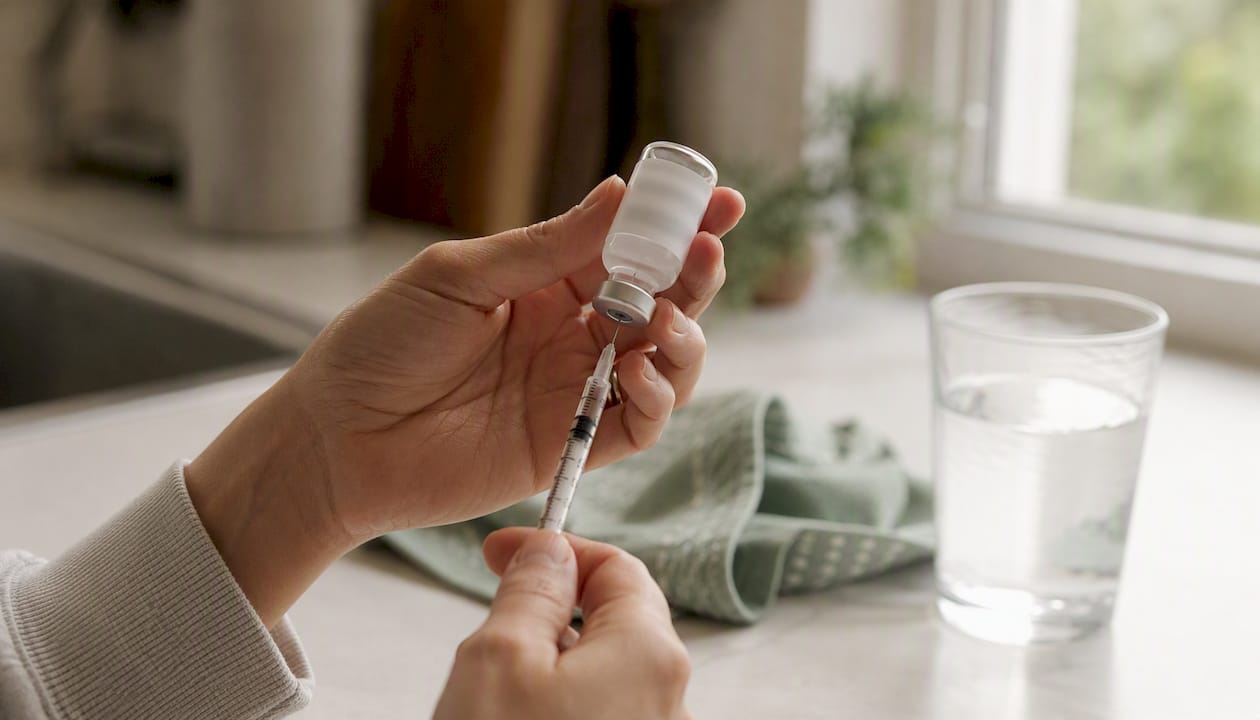
Compounded semaglutide is not FDA-approved, and the agency has made its position clear: when FDA-approved options like Ozempic or Wegovy are available, patients should use them instead. The FDA has issued multiple safety communications and warning letters about unapproved compounded GLP-1 products, and as of April 30, 2025, it had received adverse event reports tied to compounded semaglutide alone, many involving dosing errors serious enough to require hospitalization. If you are currently using a compounded version or have been offered one, the single most important step is to contact your prescribing clinician before your next dose and ask whether an FDA-approved product is now accessible to you.
Three facts frame everything that follows:
- The national semaglutide shortage that originally justified compounding was resolved in February 2025, removing the primary legal rationale for large-scale production.
- FDA-approved semaglutide products come with standardized dosing, verified potency, and regulated manufacturing; compounded versions do not.
- The FDA ended temporary enforcement discretion for state-licensed pharmacies on April 22, 2025, and for outsourcing facilities on May 22, 2025, meaning most compounded semaglutide sold today is operating outside the window regulators once allowed.
Key Takeaways
Compounded semaglutide carries documented safety risks that FDA-approved products like Ozempic and Wegovy do not, and the FDA’s enforcement discretion that once allowed its production ended in spring 2025.
| Point | Details |
|---|---|
| FDA-approved products are safer | Ozempic and Wegovy use standardized pens and verified potency; compounded versions lack both. |
| 520 adverse event reports filed | The FDA received 520 compounded semaglutide reports by April 30, 2025, many involving serious dosing errors. |
| Enforcement discretion ended | The FDA ended compounding allowances for state pharmacies April 22, 2025 and outsourcing facilities May 22, 2025. |
| Report adverse events to MedWatch | Call 1-800-FDA-1088 or file online; include lot number, pharmacy details, and symptom timeline. |
| Legacymeds prescribes FDA-approved GLP-1s | Licensed clinicians, no membership fees, and ongoing support make it a regulated alternative to compounded products. |
Table of Contents
- What is compounded semaglutide and why did pharmacies start making it?
- What are the specific safety risks of compounded semaglutide?
- What has the FDA said and what is the current legal status?
- How does compounded semaglutide compare to FDA-approved products?
- When might compounding be medically justified?
- How can you verify a pharmacy and spot red flags?
- What should you do if you used compounded semaglutide or have symptoms?
- Safer alternatives and how to get legitimate GLP-1 care in the U.S.
- What clinicians actually do when patients arrive on compounded GLP-1s
- Legacymeds offers a regulated path to FDA-approved GLP-1 care
- Sources
- FAQ
What is compounded semaglutide and why did pharmacies start making it?
A compounded drug is one mixed or altered by a pharmacy outside the FDA’s standard drug-approval process. The pharmacy may change the dose, the form, or the ingredients. Compounded products are not reviewed for safety, efficacy, or manufacturing quality the way FDA-approved drugs are. They can be legally produced under specific, narrow circumstances, most commonly when a commercially approved version is unavailable or when a patient has a documented medical need that the approved product cannot meet.
Compounded semaglutide emerged for three overlapping reasons:
- Shortage: Ozempic and Wegovy faced severe supply shortages from roughly 2022 through early 2025, placing both on the FDA’s drug shortage list. Under federal law, compounding pharmacies may produce copies of drugs on that list.
- Demand: The rapid rise of GLP-1 medications for weight loss created demand that outpaced Novo Nordisk’s manufacturing capacity.
- Cost: Compounded versions were often sold at a fraction of the list price for Ozempic or Wegovy, attracting patients without insurance coverage.
What compounders produced, though, was not always a straightforward copy. A peer-reviewed product scan identified 33 unique compounded semaglutide and tirzepatide products on the market, many using non-injectable formulations like sublingual drops and oral disintegrating tablets, and many containing added ingredients such as B vitamins, L-carnitine, or NAD+. None of those formulation variations have been tested for equivalence to the injectable semaglutide in Ozempic or Wegovy. Multi-dose vials, which require patients to draw and measure their own doses, replaced the single-dose auto-injector pens that come with FDA-approved products.
What are the specific safety risks of compounded semaglutide?
The risks are not theoretical. They fall into four concrete categories, each with documented real-world harm.
Dosing errors
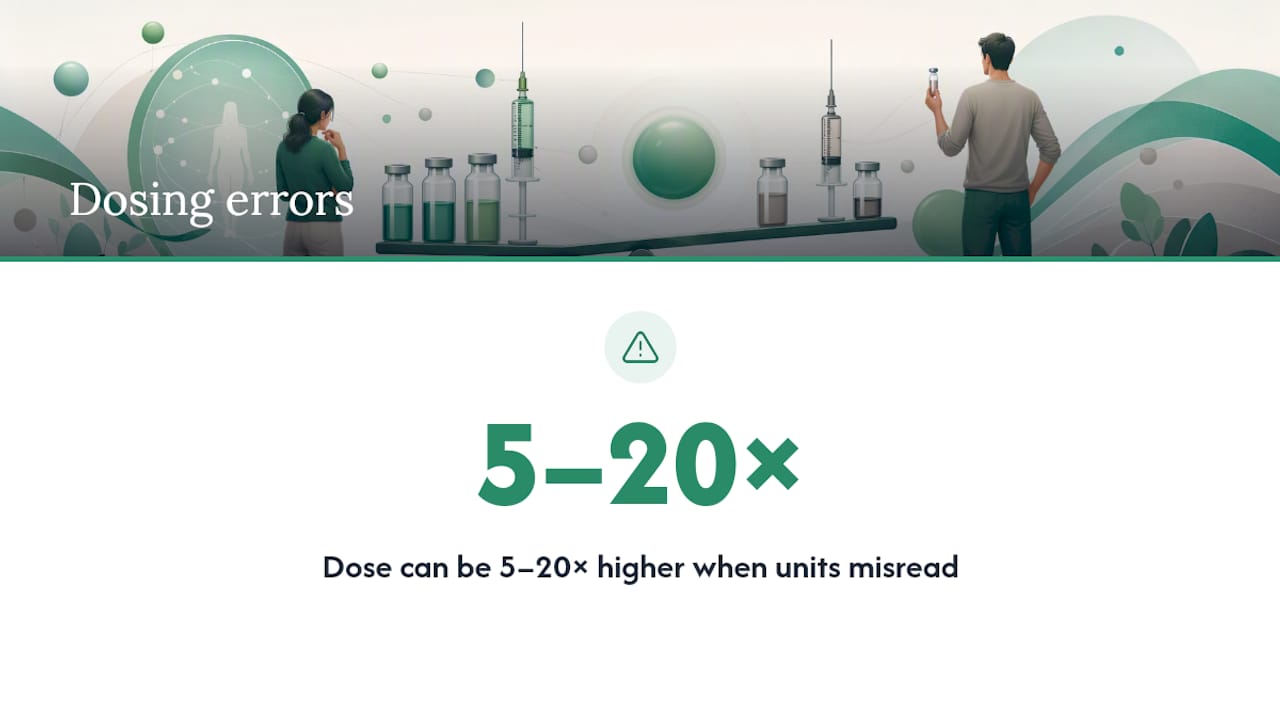
This is the dominant failure mode. Multi-dose vials require patients to draw a volume of liquid and convert it to milligrams, a step that FDA-approved auto-injector pens eliminate entirely. The FDA has specifically warned about dosing errors from compounded injectable semaglutide tied to patients using insulin syringes calibrated in units rather than milligrams. When a patient misreads units as milligrams, the actual dose delivered can be 5 to 20 times higher than intended. Clinicians emphasize that this single design difference, a pre-filled pen versus a vial and syringe, accounts for a large share of the serious adverse events reported to the FDA.
Pro Tip: If you are currently using a compounded semaglutide vial, write down the exact volume you draw (in milliliters), the concentration on the label (mg/mL), and the resulting dose in milligrams before every injection. Bring that record to your next provider visit.
Potency and concentration variability
Unlike FDA-approved drugs, compounded products are not subject to batch-release testing requirements. Potency can vary between pharmacies and even between batches from the same pharmacy. A patient who switches suppliers or receives a new batch may unknowingly receive a significantly different dose.
Unapproved salt forms and added ingredients
Medical experts at Stanford warn that many compounded products use semaglutide sodium or semaglutide acetate rather than the base form used in Ozempic and Wegovy. These salt forms have not been shown to be pharmacologically equivalent. Their absorption rates, half-lives, and dose-response curves may differ, creating unpredictable clinical outcomes. Added ingredients like vitamins or amino acids introduce further unknowns, particularly for patients with allergies or those on other medications.
Counterfeits, storage failures, and degradation
Reported adverse events across the 520 compounded semaglutide cases include nausea, vomiting, severe dehydration, fainting, and pancreatitis. Adverse event reporting to the FDA is voluntary and widely acknowledged to capture only a fraction of actual incidents, so these numbers likely understate the true scope.

What has the FDA said and what is the current legal status?
The FDA’s regulatory posture has shifted significantly since 2022, and the timeline matters for understanding what is and is not currently permitted.
The FDA’s clarification on compounding policies explains the distinction between 503A and 503B compounders. A 503A pharmacy is a traditional compounding pharmacy that fills individual patient prescriptions. A 503B outsourcing facility operates at larger scale and is subject to more rigorous FDA oversight, including facility registration and Current Good Manufacturing Practice requirements. Both categories lost their enforcement discretion protection in spring 2025.
The April 2026 proposal to remove semaglutide, tirzepatide, and liraglutide from the 503B Bulks List would, if finalized, eliminate the primary legal mechanism by which outsourcing facilities produce these drugs at scale. Until that rule is finalized, narrow exceptions remain, but the direction of regulatory travel is clear.
How does compounded semaglutide compare to FDA-approved products?
FDA-approved semaglutide products include Ozempic (injectable, approved for type 2 diabetes), Wegovy (injectable, approved for chronic weight management), and Rybelsus (oral tablet, approved for type 2 diabetes). Each went through clinical trials, manufacturing inspections, and labeling review before reaching patients.
Safety and quality control
FDA-approved products are manufactured under Current Good Manufacturing Practice standards with batch testing for potency, sterility, and stability. Compounded products are not subject to those requirements. A product scan study found that the safety and efficacy of the unique formulations identified, including sublingual and oral disintegrating formats, are largely unknown.
Dose consistency and administration errors
Single-dose auto-injector pens, the delivery format for Ozempic and Wegovy, pre-measure the dose and eliminate patient measurement steps. Multi-dose vials, common among compounded products, require the patient to draw the correct volume and convert units. That extra step is where most documented serious errors occur.
Regulatory approval and oversight
Ozempic and Wegovy carry FDA approval with a defined label, contraindications, and post-market surveillance requirements. Compounded versions carry none of those protections. A pharmacy can change the formulation, concentration, or added ingredients without notifying any federal regulator.
Available formulations
FDA-approved semaglutide comes as a subcutaneous auto-injector pen (Ozempic, Wegovy) or an oral tablet (Rybelsus). Compounders have marketed sublingual drops, oral disintegrating tablets, and multi-dose vials. None of the non-injectable formats have been shown to replicate the pharmacokinetics of the tested injectable form.
When compounded use might be clinically considered
There are narrow circumstances where a clinician might document a clinical need for a compounded product: a patient with a confirmed allergy to an excipient in the approved formulation, or a dose strength that is not commercially available during a transition period. These cases require documented medical rationale and close monitoring.
When might compounding be medically justified?
Compounding has a legitimate role in medicine, but that role is narrow when an FDA-approved equivalent exists. The cases where a clinician might appropriately consider a compounded GLP-1 include:
- A documented, confirmed allergy to a specific excipient (not the active ingredient) in every FDA-approved formulation, with no alternative available.
- A dose strength that falls outside the commercially available range and is required for a specific patient’s titration plan, with that need documented in the medical record.
- A transitional period during a genuine, documented shortage where no approved product is accessible through normal distribution channels.
Even in these cases, the prescribing clinician carries the responsibility of documenting the rationale clearly. If compounding is unavoidable, using a 503B-registered outsourcing facility is preferable to a 503A pharmacy because outsourcing facilities face more rigorous manufacturing oversight. Frequent follow-up, lab monitoring, and dose verification are not optional in these situations. They are the minimum standard of care.
What these exceptions do not include: choosing a compounded product because it is cheaper, more convenient to order online, or available without a prior authorization process. Those are cost and access reasons, not clinical ones, and they do not justify the additional safety exposure.
How can you verify a pharmacy and spot red flags?
Before accepting any compounded semaglutide product, run through this checklist:
- Confirm a valid U.S. pharmacy license. Every state has a board of pharmacy with a public license lookup. The pharmacy should have a verifiable physical address and a working phone number in the United States.
- Check for 503B registration if it is an outsourcing facility. The FDA maintains a public list of registered 503B outsourcing facilities. If a supplier claims to be one but does not appear on that list, it is not.
- Request a certificate of analysis. A legitimate compounding pharmacy can provide third-party lab testing results confirming potency, sterility, and the absence of contaminants for the specific batch you are receiving.
- Confirm a prescription is required. No legitimate compounding pharmacy dispenses prescription medication without a valid prescription from a licensed U.S. clinician.
- Use FDA’s BeSafeRx resources. The FDA’s BeSafeRx program helps patients verify online pharmacy legitimacy before ordering.
Red flags that should stop you immediately:
- No prescription required, or a “consultation” that takes two minutes and automatically generates a prescription.
- A foreign shipping address or packaging with foreign-language labeling.
- Damaged, unlabeled, or poorly sealed packaging on arrival.
- Sublingual drops or oral disintegrating tablets marketed as equivalent to injectable semaglutide.
- Vague ingredient lists, or marketing claims about “enhanced” formulas with added vitamins or peptides.
- Prices dramatically below the cost of FDA-approved products with no explanation.
Pro Tip: Ask your telehealth or in-person provider directly: “Is this product from a 503B-registered outsourcing facility, and can you provide the certificate of analysis?” A provider who cannot answer that question is not the right provider for this medication.
What should you do if you used compounded semaglutide or have symptoms?
If you are currently using a compounded product or have recently stopped, here is a prioritized action list.
- For severe symptoms, call 911 or go to an emergency room. Signs of severe dehydration (extreme thirst, no urination, rapid heartbeat), fainting, or severe abdominal pain that could indicate pancreatitis require immediate medical attention. Do not wait for a telehealth appointment.
- For non-emergency concerns, contact your prescribing clinician before your next dose. Tell them the product name, the pharmacy, the concentration on the label, and the volume you have been injecting. Bring the vial or packaging to the appointment if possible.
- Report the adverse event to FDA MedWatch. You can file a report at MedWatch online or by calling 1-800-FDA-1088. Include the lot number from the vial, the pharmacy name and address, photos of the packaging, and a description of the symptoms and timeline. This reporting is how the FDA tracks harm and builds the case for enforcement action.
- Contact Poison Control if you suspect a dosing error. The national Poison Control number is 1-800-222-1222. They can advise on next steps for accidental overdose.
- Report to your state board of pharmacy. State boards can investigate individual pharmacies and take licensing action. A complaint filed with your state board adds to the record regulators use to identify problematic suppliers.
When switching from a compounded product to an FDA-approved therapy, assume your prior dose is uncertain. Start at the lowest available titration dose of the approved product and work up with your clinician’s guidance. If you were using semaglutide for type 2 diabetes management, do not stop any other diabetes medications without explicit clinician instruction. Abrupt discontinuation of insulin or other agents can cause dangerous blood sugar swings.
Safer alternatives and how to get legitimate GLP-1 care in the U.S.
FDA-approved semaglutide is accessible through several routes that do not require a compounded product:
- A prescription from a licensed clinician, filled at a retail or mail-order pharmacy, for Ozempic or Wegovy.
- Novo Nordisk’s patient assistance and savings programs, which can reduce out-of-pocket costs for eligible patients.
- Telehealth platforms that prescribe FDA-approved GLP-1 medications following a proper clinical assessment, with ongoing monitoring built in.
The key distinction with a legitimate telehealth pathway is what happens after the prescription. A provider who writes a prescription and disappears is not providing medical care. Monitoring semaglutide safety means tracking weight, blood pressure, kidney function, and GI tolerance over time, and adjusting the dose accordingly.
Legacymeds connects patients with licensed clinicians who assess eligibility, prescribe FDA-approved GLP-1 medications including semaglutide and tirzepatide, and provide unlimited ongoing support, all without insurance or membership fees. The program includes free provider visits and personalized plans built around individual metabolic needs. For patients who want to understand pricing and program logistics before committing, the GLP-1 program FAQ covers those details directly.
When evaluating any telehealth provider for GLP-1 care, look for:
- Licensed clinicians (physicians, nurse practitioners, or physician assistants) who review your medical history before prescribing.
- Clear prescribing criteria, not a rubber-stamp process.
- Transparent pricing with no hidden fees.
- Ongoing follow-up and dose adjustment, not a one-time consultation.
- Prescriptions for FDA-approved products, not compounded copies.
What clinicians actually do when patients arrive on compounded GLP-1s
When a patient comes in already using a compounded semaglutide product, the first clinical problem is that the actual dose is often unknown. The label may say one concentration, but without batch testing, there is no way to confirm it. The patient may have been drawing inconsistent volumes. They may have switched pharmacies mid-treatment. Starting from scratch at the lowest titration dose of an FDA-approved product is not a step backward. It is the only way to establish a reliable baseline.
The second issue is patient education. Many patients chose compounded products in good faith, often because a telehealth platform presented them as equivalent to Ozempic or Wegovy. They were not told about salt form differences, the absence of batch testing, or the dosing error risk. Explaining those gaps without making the patient feel blamed takes time, but it is the conversation that prevents them from returning to an unregulated source when the approved product’s cost feels high.
For patients using semaglutide to manage type 2 diabetes, the transition requires coordinating with whoever manages their diabetes care. Stopping semaglutide abruptly while continuing other glucose-lowering agents can destabilize blood sugar. That coordination is not optional, and it is one reason why ongoing clinical support matters more for this medication class than for most.
Legacymeds offers a regulated path to FDA-approved GLP-1 care
If you have been using a compounded product or are looking for a safer starting point, Legacymeds provides telehealth assessments with licensed clinicians who prescribe FDA-approved GLP-1 medications, including semaglutide and tirzepatide, when clinically appropriate. There are no membership fees, no insurance requirements, and no hidden costs. Free provider visits and unlimited coaching are included from the start, and the program is built around your individual metabolic profile, not a one-size prescription.
The GLP-1 medication safety information page explains exactly how the program handles FDA guidance and why regulated, prescription-based access matters. This article is for general informational purposes and does not replace advice from your clinician. For urgent symptoms, contact your provider or emergency services directly. When you are ready to pursue a safe, supervised path to GLP-1 therapy, start your assessment at Legacymeds.
Sources
- FDA’s Concerns with Unapproved GLP-1 Drugs Used for Weight Loss
- What Are the Safety Concerns Regarding Compounded GLP-1 Receptor Agonists?
- Compounded GLP-1s: Why doctors worry and the FDA is cracking down
- Compounded Semaglutide and Tirzepatide Products Use Unique Formulations but Efficacy and Safety Largely Unknown
This article is general information, not a substitute for advice from a qualified doctor. Consult a qualified healthcare professional about your own circumstances before acting on anything here.
FAQ
Can you still get compounded semaglutide in the U.S.?
Compounded semaglutide is still produced by some pharmacies, but the FDA’s enforcement discretion that once protected that practice ended in April and May 2025. Most compounded semaglutide sold today operates outside the regulatory window regulators previously allowed, and the FDA advises patients to use FDA-approved products when available.
Is the FDA going to stop compounded semaglutide permanently?
The FDA proposed on April 30, 2026, to exclude semaglutide, tirzepatide, and liraglutide from the 503B Bulks List, which would permanently close the primary large-scale compounding pathway for these drugs if finalized. Until that rule is finalized, narrow clinical exceptions remain, but the regulatory direction is toward full restriction.
Is compounded semaglutide safer than Ozempic?
No. FDA-approved Ozempic uses a verified, tested formulation delivered in a pre-filled auto-injector pen that eliminates patient measurement errors. Compounded versions lack batch testing, may use unapproved salt forms with unknown pharmacology, and require patients to draw and measure doses from multi-dose vials, the primary source of serious adverse events reported to the FDA.
What should you do if you experience side effects from compounded semaglutide?
For severe symptoms such as extreme dehydration, fainting, or severe abdominal pain, call 911 or go to an emergency room immediately. For non-emergency concerns, contact your prescribing clinician before your next dose and report the event to FDA MedWatch at 1-800-FDA-1088 or online, including the lot number and pharmacy details.
How do you find a safe, legitimate GLP-1 program in the U.S.?
Look for a telehealth or in-person provider that prescribes FDA-approved semaglutide products, employs licensed clinicians who review your full medical history, and offers ongoing dose monitoring. Legacymeds provides exactly that pathway, with licensed provider assessments, FDA-approved GLP-1 prescriptions, and unlimited clinical support at no membership fee.