
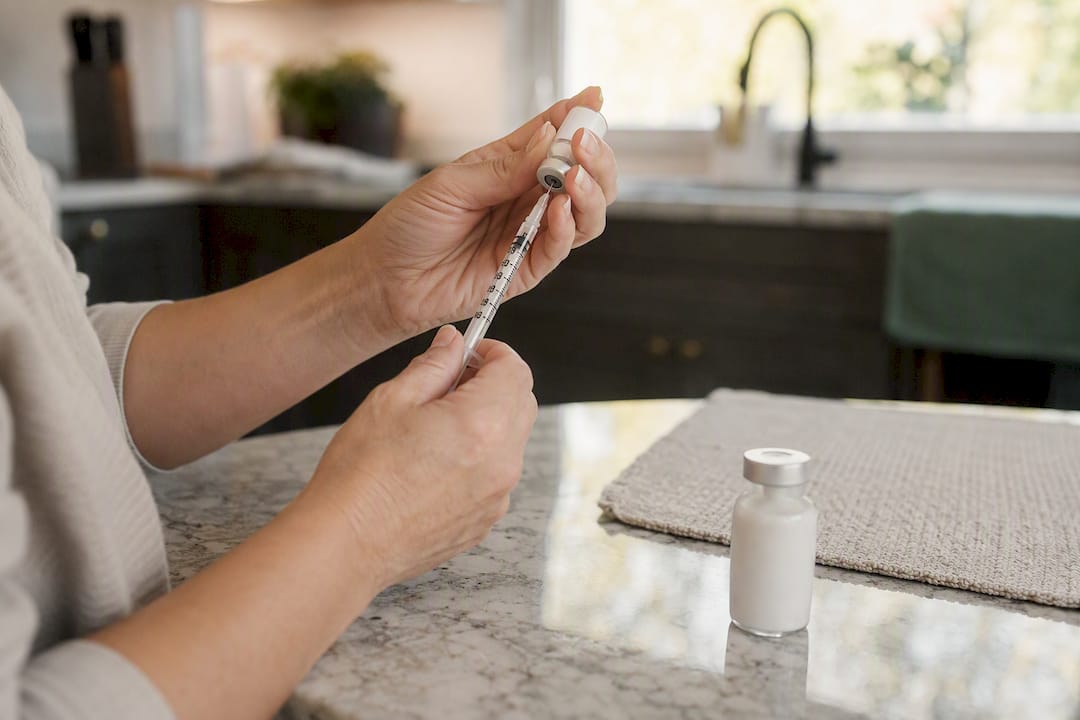
Compounded tirzepatide is not FDA-approved, and it carries real safety and legal risks that every patient should weigh before using it. The FDA has received more than 320 adverse event reports tied specifically to compounded versions of the drug.
If you’re currently using a compounded product or thinking about starting one, act on this now:
- Do not stop an injectable medication abruptly without talking to your prescriber first.
- Contact your provider to confirm exactly what you’ve been injecting and its source.
- Report any side effects to FDA MedWatch, especially severe abdominal pain or dehydration.
The safety concern isn’t theoretical. It’s showing up in FDA adverse event data, in hospital admissions, and in a growing pile of warning letters sent to telehealth sellers.
Key Takeaways
Compounded tirzepatide carries documented safety risks including dosing errors, contamination, and higher hospitalization odds, and the FDA is actively restricting its legal manufacturing pathway.
| Point | Details |
|---|---|
| Not FDA-approved | Compounded tirzepatide lacks FDA approval and has generated over 320 adverse event reports. |
| Legal pathway narrowing | The FDA’s 2026 proposal would exclude tirzepatide from the 503B bulk drug list entirely. |
| Dosing errors are common | Multi-dose vials have caused 10 to 20 times overdoses versus prefilled approved pens. |
| Evidence shows elevated risk | FAERS data shows a reporting odds ratio of 6.34 for suicidality and 48.92 for preparation errors. |
| Safer route exists | Legacymeds connects patients with FDA-approved GLP-1 prescriptions under clinician supervision. |
Table of Contents
- What Has the FDA Said About Compounded Tirzepatide Safety?
- What Safety Risks Come With Compounded Tirzepatide?
- Is It Legal for Pharmacies to Compound Tirzepatide?
- How Do You Spot a Risky Telehealth or Online Tirzepatide Seller?
- What Do the Adverse Event Numbers Actually Show?
- What Should You Do If You’ve Used Compounded Tirzepatide?
- What Are the FDA-Approved Alternatives to Compounded Tirzepatide?
- How Legacymeds Helps You Access Legal, Clinician-Supervised Tirzepatide
- Sources
- FAQ
What Has the FDA Said About Compounded Tirzepatide Safety?
The agency’s position has hardened considerably. In 2026, the FDA proposed excluding semaglutide, tirzepatide, and liraglutide from the 503B bulk drug substances list, a move that would shut down a major legal channel for mass-producing compounded versions of these drugs.
That follows years of the FDA flagging problems with unapproved GLP-1 copies. The agency has been direct about its recommendation: patients should avoid compounded versions of GLP-1 drugs whenever an FDA-approved product is available and accessible.
Key elements of the FDA’s current stance:
- Compounded tirzepatide was only ever permitted during declared drug shortages, not as a standing alternative.
- The FDA has sent warning letters to telehealth companies for marketing compounded GLP-1s with false claims of equivalence to approved drugs.
- Regulators have specifically called out vague labeling, inconsistent potency, and unapproved additives as ongoing concerns.
- The proposed 503B exclusion signals the FDA views the shortage justification as no longer applicable.
Patients often assume “compounded” means “customized and safe.” The FDA’s actions this year say otherwise.
What Safety Risks Come With Compounded Tirzepatide?
The risks aren’t abstract regulatory language. They show up as contamination, mislabeled concentrations, and dosing mistakes that wouldn’t happen with a standard prefilled pen.
Compounding pharmacies operate outside the sterility and quality-control standards that govern FDA-approved manufacturing. That gap has produced documented problems:
- Contamination and sterility failures at facilities lacking the oversight applied to approved drug manufacturers.
- Mislabeling and inaccurate concentrations, where the vial doesn’t contain what the label claims.
- Dosing errors from multi-dose vials. Unlike prefilled pens with fixed doses, vials require patients to draw up their own dose, and Stanford Medicine clinicians have documented 10 to 20 times overdoses from measurement mistakes.
- Untested formulation changes, including different salt forms or additives like vitamin B12 that can chemically react with the active peptide and create impurities never studied for safety.
Watch for severe gastrointestinal symptoms, signs of pancreatitis (persistent upper abdominal pain), gallbladder issues, or dehydration from excessive vomiting.
Pro Tip: Keep the original packaging and lot number of any compounded product you’ve used. If you need to report an adverse event or your doctor needs to investigate a reaction, that information is often the only way to trace what you actually received.
Is It Legal for Pharmacies to Compound Tirzepatide?
The legal framework hinges on two types of compounding pharmacies. 503A pharmacies compound individual prescriptions for specific patients, typically for a documented medical reason like an allergy to an inactive ingredient. 503B outsourcing facilities compound in bulk and can use FDA-listed bulk drug substances, but only when a drug is officially in shortage.
Tirzepatide’s shortage designation ended in late 2024, which already narrowed the legal basis for large-scale compounding. The FDA’s 2026 proposal to formally exclude tirzepatide from the 503B bulks list would close that pathway further.
- If finalized, the exclusion means outsourcing facilities can no longer legally compound tirzepatide from bulk ingredients.
- Some narrow 503A compounding may still occur for documented patient-specific needs, but it is not a general substitute for Zepbound or Mounjaro.
- Products from overseas sellers or unregistered online sources fall outside any legal compounding framework entirely, regardless of how they’re marketed.
How Do You Spot a Risky Telehealth or Online Tirzepatide Seller?
Fraudulent and low-quality sellers tend to share the same warning signs. Reuters reported the FDA sent 25 warning letters to telehealth companies in a single wave for misleading marketing around compounded weight-loss drugs.
Red flags to watch for:
- No prescription requirement, or a “prescription” issued after a two-minute online form with no real clinical review.
- Shipping from overseas or from a source that won’t disclose its pharmacy license.
- Vague or missing ingredient lists, or unusual delivery forms like sublingual drops not backed by clinical data.
- Marketing language claiming the product is “equivalent” or “identical” to Zepbound or Mounjaro.
Pro Tip: Use the FDA’s BeSafeRx tool to check whether an online pharmacy is properly licensed before you order anything, and search the pharmacy’s name alongside “FDA warning letter” for a quick red-flag check.
What Do the Adverse Event Numbers Actually Show?
A pharmacovigilance analysis of FDA Adverse Event Reporting System (FAERS) data from 2018 to 2024 gives the clearest quantitative picture yet, and the numbers are not subtle.
Compared to non-compounded GLP-1 formulations, compounded versions showed a reporting odds ratio of 6.34 for suicidality, 3.39 for cholecystitis, and 2.84 for abdominal pain, according to the FAERS pharmacovigilance study. Preparation and prescribing errors were dramatically more common too, with an odds ratio of 48.92, and hospitalization odds were 2.35 times higher.
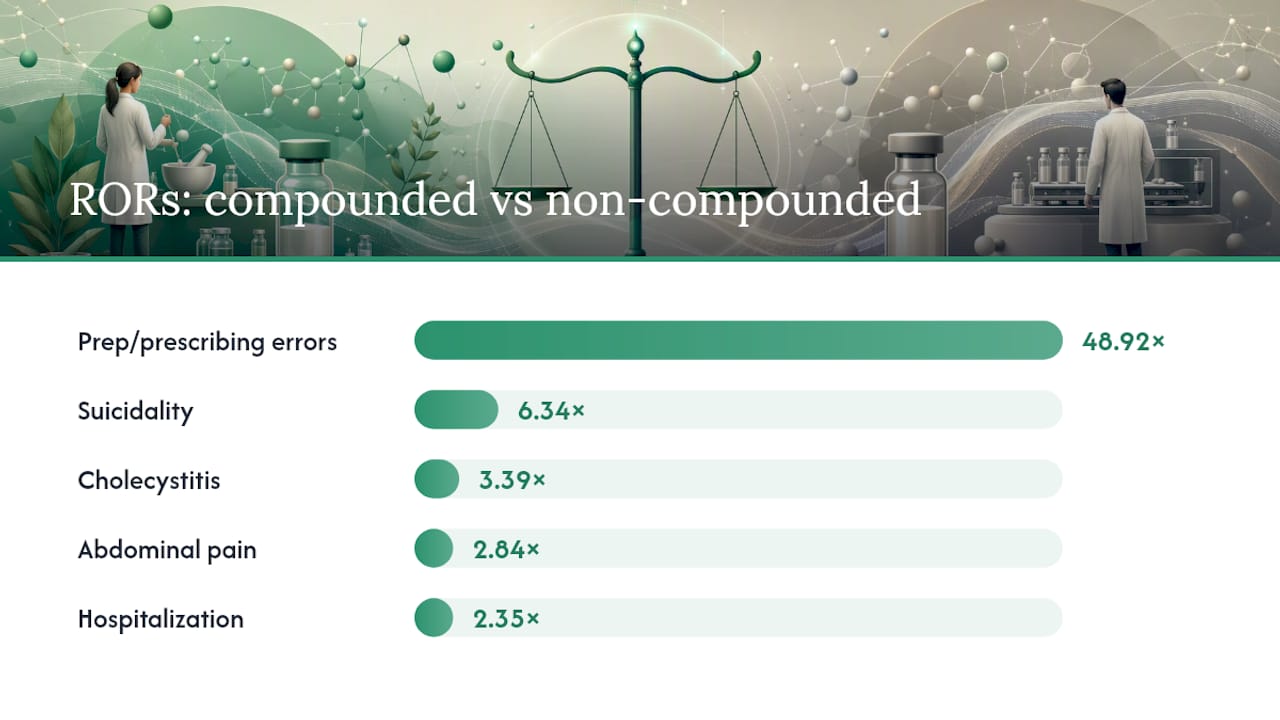
A reporting odds ratio isn’t proof of causation. FAERS relies on voluntary reports, and compounded products may simply generate more scrutiny because of their unregulated status. Still, a signal this consistent across multiple adverse event categories, especially preparation errors, points to a real quality-control problem rather than statistical noise.
What Should You Do If You’ve Used Compounded Tirzepatide?
Your next steps depend on where you are right now.
Before starting any tirzepatide product:
- Confirm your prescription came from a licensed clinician who actually reviewed your medical history.
- Verify the pharmacy’s credentials and ask for the lot number and manufacturing documentation.
- Ask directly whether the product is compounded or FDA-approved, and request the delivery form (pen vs. vial) and exact concentration.
If you’re currently using a compounded product, talk to your provider about transitioning to an FDA-approved version. Most clinicians will start you at a lower dose and titrate upward under supervision, and may check electrolytes or pancreatic enzymes if you’ve had gastrointestinal symptoms.
If you’ve had an adverse reaction:
- Seek urgent care for severe abdominal pain, persistent vomiting, or signs of dehydration.
- Report the event through FDA MedWatch.
- Bring the product packaging and lot number to your appointment so your clinician can document exactly what you took.
What Are the FDA-Approved Alternatives to Compounded Tirzepatide?
Two FDA-approved tirzepatide brands exist: Mounjaro, approved for type 2 diabetes, and Zepbound, approved specifically for weight management. Both come from Eli Lilly and are manufactured under FDA quality standards, not a local compounding pharmacy’s variable process. Semaglutide brands like Wegovy and Ozempic follow the same approved, tightly controlled manufacturing model.
The delivery system matters more than most patients realize. Approved products ship in prefilled, single-dose pens with the exact dose pre-measured. Compounded versions often arrive in multi-dose vials requiring manual measurement, which is where most dosing errors originate.
Legitimate access routes include:
- Talking with your clinician about an FDA-approved prescription and checking medication safety guidance for what to expect.
- Using licensed in-state pharmacies rather than unregistered online sellers.
- Exploring savings and pricing options for Zepbound if cost has been the reason you considered compounded alternatives.
A Practical Word on Safety Priorities
Patients often reach for compounded tirzepatide because it’s cheaper or easier to get without insurance hurdles. That’s understandable, but the FAERS data and FDA’s own regulatory retreat from 503B compounding tell you where the actual risk sits. Choosing an FDA-approved product with clinician oversight isn’t overly cautious. It’s the option backed by consistent manufacturing standards and real quality control.
How Legacymeds Helps You Access Legal, Clinician-Supervised Tirzepatide
Legacymeds gives you a straightforward path to FDA-approved GLP-1 medication without gambling on an unregulated vial from a source you can’t verify.
Every prescription through Legacymeds starts with a free provider assessment, so you get a clinician’s judgment on dosing and delivery instead of a self-measured vial. There’s no membership fee and no insurance requirement, and your medication ships directly to you with unlimited coaching support built into the program. Eligibility depends on a brief medical intake, and the program is designed to complement, not replace, your relationship with your regular doctor. If cost or access has been pushing you toward compounded alternatives, check your options and start your provider assessment to see what an FDA-approved plan actually costs before you consider anything unregulated.
Sources
- Compounded GLP-1s: Why doctors worry and the FDA is cracking down — Stanford Medicine
- Safety analysis of compounded GLP-1 receptor agonists: a pharmacovigilance study using the FDA adverse event reporting system — PubMed
- FDA proposes to exclude semaglutide, tirzepatide and liraglutide from 503B bulks list — FDA
This article is general information, not a substitute for advice from a qualified doctor. Consult a qualified healthcare professional about your own circumstances before acting on anything here.
FAQ
Is it safe to get compounded tirzepatide?
No. Compounded tirzepatide isn’t FDA-approved, and FAERS data shows significantly higher reporting odds for adverse events like cholecystitis and preparation errors compared with approved products.
Did the FDA shut down compounded tirzepatide?
Not entirely, but the FDA proposed excluding tirzepatide from the 503B bulk drug list in 2026, which would close the main legal pathway for large-scale compounding if finalized.
Can I still get compounded tirzepatide?
Legally, options are narrowing fast, and any remaining 503A compounding requires a documented, patient-specific medical reason rather than general cost or convenience.
What is the latest news on compounded tirzepatide?
The FDA’s 2026 proposal to exclude tirzepatide from the 503B bulks list, combined with 25 warning letters sent to telehealth companies, marks the most aggressive regulatory action yet on compounded GLP-1s.
How do I know if my tirzepatide is compounded or FDA-approved?
Check the packaging: FDA-approved Zepbound and Mounjaro ship in prefilled, single-dose pens with manufacturer labeling, while compounded products often arrive in multi-dose vials from a compounding pharmacy rather than Eli Lilly.