
GLP-1 receptor agonists change how many people experience alcohol, and early randomized trial data suggest some of them can meaningfully reduce craving and heavy drinking. The strongest signal comes from a 26-week double-blind, placebo-controlled trial showing once-weekly semaglutide 2.4 mg reduced heavy drinking days by a statistically significant margin in treatment-seeking patients with obesity and alcohol use disorder (AUD). A smaller randomized lab study and consistent preclinical data across multiple GLP-1 drugs add to that picture.
Three signals worth knowing upfront:
- A 26-week semaglutide RCT in treatment-seeking patients with AUD and comorbid obesity found a treatment difference of 13.7 percentage points in heavy drinking days (p=0.0015) versus placebo.
- A smaller randomized trial (n=48) in non-treatment-seeking adults showed low-dose semaglutide reduced lab alcohol self-administration, drinks per drinking day, and weekly craving.
- Preclinical studies across exenatide, liraglutide, and semaglutide consistently show reduced ethanol intake and attenuated dopamine release in reward circuits.
The caveat is real: no GLP-1 drug is FDA-approved for AUD. Evidence is promising but not definitive, and individual risks including nausea, a pancreatitis signal, and hypoglycemia risk for people on insulin or sulfonylureas make clinical oversight non-optional.
Key Takeaways
GLP-1 receptor agonists show genuine promise for reducing alcohol craving and heavy drinking in selected patients, with the strongest evidence coming from a 26-week semaglutide RCT showing a 13.7-percentage-point treatment difference in heavy drinking days, but no GLP-1 drug is FDA-approved for AUD and clinical supervision remains essential.
| Point | Details |
|---|---|
| Semaglutide RCT evidence | A 26-week trial found a 13.7-percentage-point treatment difference in heavy drinking days (p=0.0015) versus placebo. |
| Mechanism: reward circuits | GLP-1RAs dampen dopamine signaling in the VTA and nucleus accumbens, reducing the motivational pull of alcohol. |
| BAC and liver trade-off | GLP-1RAs may lower toxic liver metabolites via Cyp2e1 downregulation while raising peak BAC, increasing intoxication risk per drink. |
| Safety overlap | No direct chemical interaction exists, but nausea, pancreatitis risk, and hypoglycemia in diabetics make cautious use and monitoring necessary. |
| Legacymeds supervised care | Legacymeds provides clinician-supervised semaglutide and tirzepatide programs with provider assessment and safety monitoring, no insurance required. |
Table of Contents
- How GLP-1 receptor agonists affect brain reward circuits and drinking behavior
- What human clinical trials actually found
- How GLP-1 drugs change alcohol metabolism and what that means for your BAC
- Safety concerns when mixing alcohol with GLP-1 drugs
- What patients and clinicians should do about drinking on GLP-1 therapy
- What this evidence means for treating AUD and where research goes next
- How to read GLP-1 and alcohol trials without being misled
- An editorial perspective on what this evidence really means
- Supervised GLP-1 care with clinician oversight and safety monitoring
- Key studies, reviews, and registries to read next
- Sources
- FAQ
How GLP-1 receptor agonists affect brain reward circuits and drinking behavior
The mechanism connecting GLP-1 drugs to reduced alcohol use runs through the brain’s reward system, not just the gut. GLP-1 receptors are expressed in the ventral segmental area (VTA) and nucleus accumbens (NAc), the two structures at the core of mesolimbic reward circuitry. When GLP-1 receptor agonists (GLP-1RAs) activate those receptors, they dampen phasic dopamine release in response to rewarding stimuli, including alcohol. The practical result is reduced incentive salience: alcohol simply becomes less compelling.

A translational review of preclinical and early clinical evidence confirmed that GLP-1RAs modulate reward-related brain circuits across the VTA, NAc, and prefrontal cortex, reducing substance-seeking behaviors in animal models with consistent replication across exendin-4, liraglutide, and semaglutide. Rodent studies specifically show attenuated conditioned place preference for ethanol and reduced relapse-like drinking after abstinence periods.
Peripheral mechanisms add a second layer. GLP-1RAs slow gastric emptying, which delays alcohol absorption and can alter the subjective experience of intoxication. Reduced appetite also means people on these drugs tend to eat less before drinking, which paradoxically can intensify alcohol’s effects even as craving drops.
The pharmacology differs meaningfully across drugs in this class:
- Semaglutide has higher CNS penetration than older GLP-1RAs, which may explain why it shows stronger central reward effects in both animal models and human trials.
- Exenatide and liraglutide have more limited blood-brain barrier crossing, producing weaker but still measurable central effects in preclinical work.
- Dulaglutide and tirzepatide (a dual GIP/GLP-1 agonist) have less published data on alcohol-specific reward modulation, though tirzepatide’s GLP-1 component suggests a plausible similar mechanism.
Pro Tip: When discussing mechanism with patients, the gut-to-brain framing works well: GLP-1 signals travel from the gut through vagal afferent to the brain stem and then to reward centers, essentially turning down the volume on the brain’s “want” signal for alcohol.
What human clinical trials actually found
The clinical evidence base is small but growing, and the quality of the best studies is genuinely encouraging.
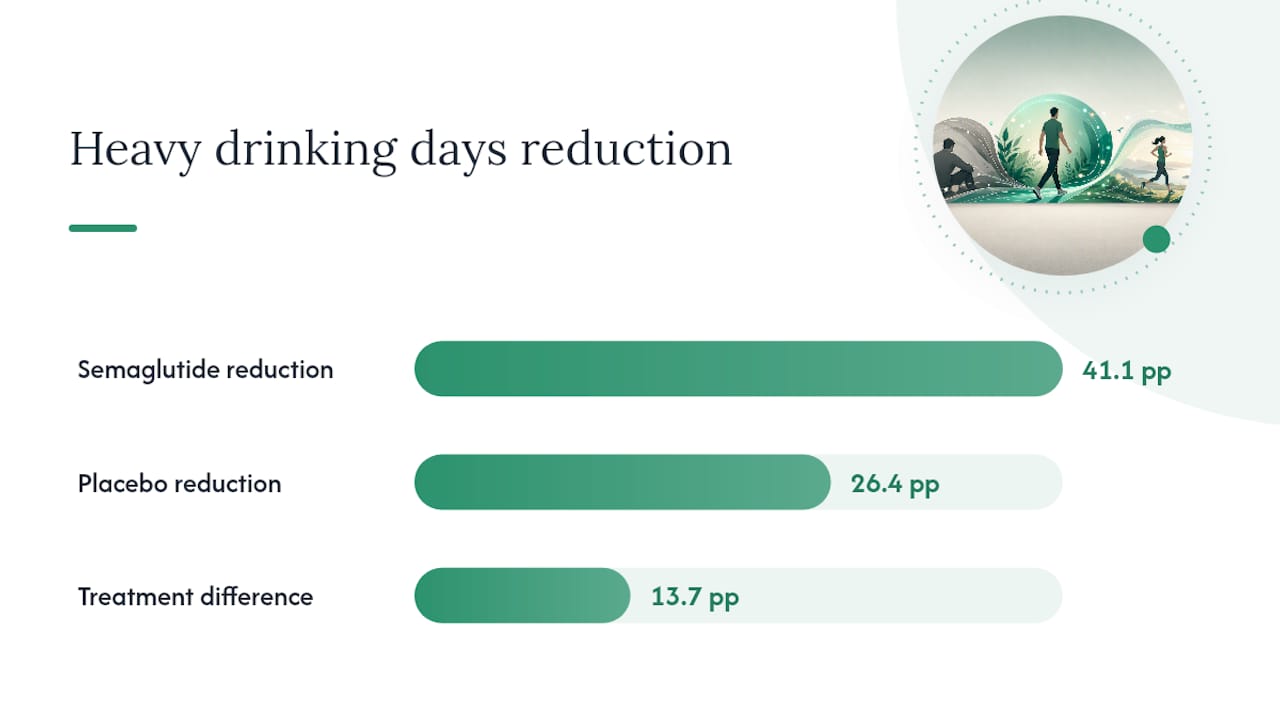
The Lancet semaglutide RCT is the most rigorous data point available. It enrolled treatment-seeking adults with AUD and comorbid obesity, randomized them to once-weekly subcutaneous semaglutide 2.4 mg or placebo for 26 weeks, and measured heavy drinking days as the primary endpoint. The semaglutide group reduced heavy drinking days by 41.1 percentage points from baseline; the placebo group reduced by 26.4 percentage points. That 13.7-point treatment difference reached statistical significance (p=0.0015). Secondary outcomes including total alcohol consumption and WHO risk-level classification also improved. The trial authors flagged gastrointestinal adverse events as the main safety concern requiring monitoring.
The smaller PubMed-registered semaglutide trial took a different approach: 48 non-treatment-seeking adults with AUD completed a laboratory alcohol self-administration task under low-dose semaglutide versus placebo. Semaglutide reduced grams consumed in the lab task, lowered peak breath alcohol concentration, cut drinks per drinking day, and reduced weekly craving scores. This study matters because it tests a mechanistic question in a controlled environment rather than relying on self-reported naturalistic drinking.
The NIH summarized that combining GLP-1 treatment with cognitive behavioral therapy reduced heavy drinking in a trial context, reinforcing the view that medication plus psychosocial support outperforms either alone.
Beyond semaglutide, the picture is thinner:
- Exenatide has shown reduced alcohol consumption in subgroup analyses of RCTs, particularly in patients with higher impulsivity scores, but the primary trials were not powered for AUD endpoints.
- Dulaglutide appears in observational and registry data. A systematic review and registry analysis found EHR-based associations between semaglutide use and a notably lower risk of incident or recurrent AUD diagnoses over about a year compared with some other treatments. That signal is observational, not causal, and subject to confounding.
- Liraglutide has preclinical alcohol data but limited dedicated human AUD trial evidence.
- Tirzepatide has no published AUD-specific RCT data yet; its dual GIP/GLP-1 mechanism makes it a logical candidate for future trials.
| Trial | Population | Dose and Schedule | Primary Outcome | Main Alcohol Effect | Notable AEs |
|---|---|---|---|---|---|
| Lancet semaglutide RCT (26 weeks) | Treatment-seeking AUD + obesity | 2.4 mg weekly subcutaneous | Heavy drinking days | −13.7 pp treatment difference (p=0.0015) | GI events (nausea, vomiting) |
| PubMed low-dose semaglutide (9 weeks) | Non-treatment-seeking AUD, n=48 | Low-dose weekly | Lab self-administration | Reduced grams consumed, peak BrAC, craving | Mild GI |
| Exenatide RCT subgroup | Mixed metabolic, high-impulsivity subgroup | Twice-daily subcutaneous | Primary: metabolic | Reduced alcohol use in high-impulsivity subgroup | Injection site reactions |
A systematic literature review covering studies through January 2025 found consistent preclinical evidence across 35 studies and limited but directionally positive clinical evidence across 6 studies, with the caveat that human findings are heterogeneous and sample sizes remain small.
Key statistic: The Lancet semaglutide trial reported a 41.1 percentage-point reduction in heavy drinking days from baseline in the semaglutide group, compared with 26.4 percentage points in the placebo group, a treatment difference of 13.7 percentage points (p=0.0015).
How GLP-1 drugs change alcohol metabolism and what that means for your BAC
The liver story is counterintuitive. Yale researchers found that GLP-1RAs down regulate hepatic Cyp2e1, the enzyme primarily responsible for oxidizing ethanol into acetaldehyde. Lower Cyp2e1 activity means less acetaldehyde production, which is genuinely protective for the liver since acetaldehyde drives much of alcohol’s hepatotoxic damage.
The catch is what happens to the alcohol that does not get metabolized as quickly. It stays in systemic circulation longer, producing higher peak blood alcohol concentrations and a slower clearance curve. In experimental models, this translated to measurably elevated BAC for the same alcohol dose.
What this means practically:
- Two drinks on a GLP-1 may hit harder than two drinks did before. The liver is processing alcohol more slowly, so the same intake produces a longer, higher BAC curve.
- Cognitive impairment and coordination risks increase even if the liver is handling the metabolic load better. These are not equivalent trade-offs from a safety standpoint.
- Reduced food intake amplifies this further. People on GLP-1 therapy eat less, and drinking on a near-empty stomach accelerates alcohol absorption independently of Cyp2e1 changes.
- The acetaldehyde reduction is potentially hepatoprotective for people with early alcohol-related liver disease, but this is preclinical evidence and not a reason to drink more.
Statistic callout: Yale’s experimental models showed that GLP-1RA treatment decreased hepatic Cyp2e1 expression and reduced toxic alcohol metabolites while simultaneously producing higher peak blood alcohol concentrations and slower alcohol clearance, a dual pharmacologic effect with opposite implications for liver health versus systemic intoxication risk.
Human quantification of these BAC changes is not yet fully established. The Yale findings are from experimental models, and clinical translation requires larger pharmacokinetic studies in humans before precise BAC-change estimates can be stated.
Safety concerns when mixing alcohol with GLP-1 drugs
There is no labeled direct chemical interaction between GLP-1 medications and alcohol. WebMD’s clinical summary confirms that alcohol is not contraindicated by label for semaglutide or other GLP-1RAs, but the practical overlap of side effects makes cautious use the right default.
The most common problem is additive nausea. GLP-1RAs already cause nausea in a significant portion of patients, particularly during dose escalation. Alcohol independently irritates the gastric lining and triggers nausea. Combined, the effect can be severe enough to cause prolonged vomiting, dehydration, and electrolyte imbalances. Delayed gastric emptying from GLP-1 therapy also means alcohol sits in the stomach longer before absorption, which can intensify the eventual intoxication.
Pancreatitis signal. GLP-1RAs carry a labeled warning for pancreatitis, and heavy alcohol use is one of the most common independent triggers of acute pancreatitis. The combination does not guarantee pancreatitis, but the risk overlap is clinically meaningful. Any patient with a history of pancreatitis should avoid alcohol entirely while on a GLP-1.
Hypoglycemia risk. For patients managing type 2 diabetes with insulin or sulfonylureas alongside a GLP-1, alcohol adds a meaningful hypoglycemia risk. Alcohol suppresses hepatic glucose output, and when combined with insulin secretagogues, blood glucose can drop to dangerous levels without the usual warning symptoms.
Red flags that require immediate medical contact:
- Severe or persistent abdominal pain (possible pancreatitis)
- Prolonged vomiting that prevents keeping fluids down
- Signs of hypoglycemia: shakiness, confusion, cold sweats, rapid heartbeat
- Unusual sedation or loss of coordination disproportionate to the amount consumed
Population-specific notes:
- Diabetes patients on insulin or sulfonylureas: highest hypoglycemia risk; discuss alcohol limits explicitly with your prescriber.
- Liver disease: already compromised Cyp2e1 function plus GLP-1-mediated further downregulation may produce unpredictable BAC and metabolite patterns.
- Pregnancy: alcohol is contraindicated in pregnancy; GLP-1s are also not recommended during pregnancy.
- Concurrent medications: sedatives, benzodiazepines, and opioids all interact with alcohol independently; adding a GLP-1 that slows gastric emptying can alter the absorption timing of oral medications taken around the same time as alcohol.
Pro Tip: Review the GLP-1 medication safety information page before your first drink on any GLP-1 therapy. Knowing your specific drug’s side-effect profile and your own metabolic risk factors takes less than ten minutes and can prevent a genuinely bad night.
What patients and clinicians should do about drinking on GLP-1 therapy
The main rule is simple: if you plan to drink while on a GLP-1, assume your tolerance has reset. Eat a full meal first, start with one standard drink, alternate with water, and stop at the first sign of nausea or unusual dizziness. What felt like a moderate amount before may now produce a stronger, longer-lasting effect.
Patient checklist for drinking on a GLP-1:
- Eat a full meal before drinking, not a light snack.
- Start with one standard drink and wait 30 minutes before considering a second.
- Alternate every alcoholic drink with a full glass of water.
- Stop immediately if you feel nausea, unusual dizziness, or disproportionate sedation.
- Avoid drinking on any day when you have had vomiting, diarrhea, or very low appetite from GLP-1 side effects.
Clinician-facing monitoring checklist:
- Baseline assessment: document AUD history, AUDIT-C score, liver panel (AST, ALT, GET), HbA1c, and current diabetes medications before starting a GLP-1.
- Monitoring schedule: recheck liver enzymes at 3 months if baseline is elevated; ask about alcohol use at every visit using a brief standardized screen.
- Dose adjustment triggers: persistent nausea or vomiting that coincides with drinking warrants a dose reduction or temporary pause.
- Referral triggers: AUDIT-C score of 4+ (women) or 5+ (men), any history of alcohol-related hospitalization, or patient report of increased drinking despite GLP-1 therapy.
- Off-label AUD discussion: if a patient asks about using a GLP-1 specifically to reduce drinking, explain the current evidence honestly: promising RCT data exists, but no GLP-1 is FDA-approved for AUD, and medication should be paired with behavioral support such as CBT or motivational interviewing.
For telehealth intake documentation, a brief script works well: “Do you drink alcohol? How many standard drinks per week on average? Have you ever been told your drinking was a concern?” Pair that with a baseline metabolic panel and note any concurrent medications that interact with alcohol. This takes under two minutes and creates a defensible clinical record.
Pro Tip: Patients often underreport alcohol use at intake. Framing the question as “how many drinks in a typical week” rather than “do you drink heavily” consistently yields more accurate answers and opens the door to a productive conversation about GLP-1 effects on craving.
For patients curious about alcohol alternatives during GLP-1 treatment, understanding how kava compares to alcohol in terms of mechanism and risk profile can be a useful conversation starter in behavioral counseling settings.
What this evidence means for treating AUD and where research goes next
GLP-1RAs are an emerging option that may genuinely help reduce craving and heavy drinking in selected subgroups, particularly people with comorbid obesity. The Lancet semaglutide trial is the clearest evidence yet that this is not just a pharmacological curiosity. But “promising” and “ready for broad adoption” are not the same thing.
Research gaps that still need filling:
- Durability: the longest RCT to date ran 26 weeks. Whether effects persist at 12 or 24 months is unknown.
- Dose-response: the optimal dose for AUD reduction may differ from the weight-loss dose; this has not been systematically studied.
- Lean patients: both major semaglutide trials enrolled patients with obesity. Whether GLP-1RAs reduce drinking in people without obesity is an open question.
- Head-to-head comparisons: no published trial has directly compared semaglutide or another GLP-1RA to naltrexone, acamprosate, or disulfiram for AUD outcomes.
- Neuropsychiatric safety: GLP-1RAs carry an ongoing regulatory review for suicidality and depression signals; this matters particularly in an AUD population with elevated baseline psychiatric risk.
- Long-term liver outcomes: the hepatoprotective Cyp2e1 signal from Yale is preclinical; human liver outcome data from AUD trials are not yet available.
- Impulsivity and relapse risk: exenatide’s subgroup signal in high-impulsivity patients suggests GLP-1RAs may reduce impulsive drinking specifically, but this has not been a primary endpoint in any trial.
Clinical implications for now:
- Patients with obesity and AUD represent a population where a GLP-1 could address both conditions simultaneously, which is a genuinely compelling dual-indication case.
- Medication alone is not enough. Expert guidance consistently emphasizes that GLP-1RAs should be adjuncts within a comprehensive treatment plan that includes CBT or other evidence-based psychosocial support.
- Patient selection matters: people with active pancreatitis history, severe liver disease, or unstable diabetes on insulin require careful risk-benefit assessment before combining GLP-1 therapy with any alcohol use.
The Clinicaltrials provides trial details and posted results for the semaglutide AUD study. Larger phase 3 trials with longer follow-up and broader populations are the logical next step; results from those studies will determine whether regulatory review for an AUD indication becomes viable.
How to read GLP-1 and alcohol trials without being misled
Not all studies in this space carry equal weight, and the difference between a well-designed RCT and an observational registry analysis is clinically significant.
The hierarchy to apply:
- Double-blind, placebo-controlled RCTs with clinically meaningful primary endpoints (heavy drinking days, abstinence rates, WHO risk-level shifts) are the gold standard. The Lancet semaglutide trial meets this bar.
- Laboratory self-administration studies (like the n=48 semaglutide trial) are mechanistically valuable but measure controlled-environment behavior, not naturalistic drinking. They support mechanism; they do not establish real-world effectiveness alone.
- Observational EHR and registry studies can generate hypotheses and detect signals at scale, but confounding is pervasive. A patient prescribed semaglutide for obesity may drink less for reasons unrelated to the drug: weight loss itself, lifestyle changes, or healthcare engagement. The 50%–56% lower AUD risk signal from registry data is interesting, not conclusive.
Common limitations in the current literature:
- Small samples: most trials outside the Lancet study enrolled fewer than 100 participants.
- Short durations: 9–26 weeks captures acute effects but misses relapse patterns that emerge over months.
- Heterogeneous populations: treatment-seeking patients with obesity differ substantially from non-treatment-seeking community drinkers; effects may not generalize.
- Missing long-term safety data: neuropsychiatric outcomes, liver disease progression, and cardiovascular events require longer follow-up than current trials provide.
Checklist for evaluating future GLP-1 and AUD trials:
- Is the primary endpoint clinically meaningful (heavy drinking days, abstinence) rather than a surrogate like craving score alone?
- Was the analysis pre-registered to prevent outcome switching?
- Is the sample large enough and the follow-up long enough to detect durable effects?
- Does the trial report adverse events systematically, including psychiatric and GI outcomes?
Applying this checklist to any new study will quickly separate signal from noise as this field moves fast.
An editorial perspective on what this evidence really means
The GLP-1 and alcohol story is one of the more genuinely interesting developments in addiction medicine in years, and the temptation to overstate it is real. A single well-powered RCT showing a 13.7-percentage-point treatment difference in heavy drinking days is meaningful. It is not a cure, and it is not a reason to prescribe semaglutide to every patient with AUD.
What strikes me about the evidence is the mechanism. GLP-1RAs do not suppress drinking the way naltrexone blocks opioid reward or disulfiram makes drinking aversive. They appear to reduce the motivational pull of alcohol at the reward-circuit level, which is a fundamentally different approach. That distinction matters for patient experience: people on semaglutide often report that they simply stopped wanting to drink as much, rather than feeling blocked or punished. Whether that translates to better long-term adherence than existing AUD medications is a question worth studying.
The population specificity is the part I think gets underappreciated. Both major semaglutide trials enrolled patients with obesity. The overlap between obesity and AUD is not coincidental: shared reward dysregulation, overlapping metabolic pathways, and high comorbidity rates make this a natural target population. Extrapolating those results to lean patients with AUD is a hypothesis, not a finding.
The practical takeaway for clinicians is this: if a patient has both obesity and AUD, a GLP-1 is worth a serious conversation today, paired with behavioral support and careful monitoring. For patients without obesity, the evidence does not yet support that same conversation. And for anyone asking whether they can drink on Wegovy or Zepbound, the honest answer is: probably yes, in moderation, but your tolerance has changed and your prescriber should know.
Supervised GLP-1 care with clinician oversight and safety monitoring
If you are considering GLP-1 therapy and alcohol use is part of your health picture, the quality of clinical oversight matters more than the specific drug.
Legacymeds offers a clinician-supervised GLP-1 program built around personalized assessment, not a one-size prescription. Every patient starts with a provider evaluation that covers medical history, current medications, and metabolic risk factors, including alcohol use. The program offers both semaglutide and tirzepatide, with free shipping, unlimited ongoing provider support, and no insurance or membership fees required. For patients with questions about how their drinking habits interact with GLP-1 therapy, that provider relationship is where those conversations happen, with access to GLP-1 medication safety information and lab-monitoring guidance built into the process.
This is not an AUD treatment program, and Legacymeds does not promise AUD outcomes. What it provides is supervised prescribing with the clinical infrastructure to catch problems early, adjust dosing when needed, and refer patients to behavioral health support when that is the right next step.
Ready to start? Begin your clinical intake at Legacymeds and discuss your full health picture, including alcohol use, with a licensed provider.
Key studies, reviews, and registries to read next
The sources below represent the highest-value primary and secondary literature on GLP-1 drugs and alcohol:
- Once-weekly semaglutide versus placebo in patients with AUD and comorbid obesity (The Lancet): the largest and most rigorous RCT to date; primary reference for any clinical discussion of semaglutide and AUD.
- Low-dose semaglutide effects on alcohol self-administration and craving (PubMed): mechanistic human RCT in a lab setting; demonstrates reduced craving and intake in non-treatment-seeking adults.
- GLP-1 plus therapy can reduce heavy drinking (NIH): accessible NIH summary of trial findings; useful for patients and non-specialist clinicians.
- Translational review: GLP-1RAs and substance use disorders (PMC): synthesizes preclinical and early clinical evidence on reward-circuit modulation; essential for understanding mechanism.
- GLP-1 Receptor Agonists Protect the Liver During Alcohol Consumption (Yale School of Medicine): explains Cyp2e1 downregulation, BAC changes, and hepatoprotective signals from experimental models.
- Systematic review and registry evidence on GLP-1RAs and alcohol-related outcomes (PMC): covers 35 preclinical and 6 clinical studies; important for understanding the evidence hierarchy and observational limitations.
- Clinicaltrials: trial registration and posted results for the semaglutide AUD study; check here for updated status on ongoing research.
- GLP-1 Drugs Like Ozempic and Alcohol (WebMD): patient-facing safety summary covering side-effect overlap and practical precautions.
Sources
- Randomized clinical trial: low-dose semaglutide effects on alcohol self-administration and craving - PubMed
- GLP-1 plus therapy can reduce heavy drinking
- Translational review: GLP-1 receptor agonists and substance use disorders - PMC
- GLP-1 Receptor Agonists Protect the Liver During Alcohol Consumption | Yale School of Medicine
FAQ
Why do hangovers feel worse on Ozempic or Wegovy?
GLP-1 drugs slow gastric emptying and reduce food intake, so alcohol absorbs differently and peak blood alcohol concentration tends to run higher for the same number of drinks. The result is a more intense intoxication and a harder recovery, not a direct chemical reaction between the drug and alcohol.
Why does semaglutide make some people not want alcohol?
Semaglutide activates GLP-1 receptors in the brain’s reward centers, particularly the VTA and nucleus accumbens, dampening the dopamine response that makes alcohol feel rewarding. Clinical trial participants have described this as a natural loss of interest in drinking rather than a forced aversion.
Can you drink alcohol while taking Ozempic, Wegovy, or Zepbound?
Alcohol is not contraindicated by label for semaglutide or tirzepatide, but overlapping side effects including nausea, delayed gastric emptying, and altered BAC kinetics make moderation and clinical awareness important. Patients with diabetes on insulin or sulfonylureas face additional hypoglycemia risk and should discuss specific limits with their prescriber.
Are GLP-1 drugs approved to treat alcohol use disorder?
No GLP-1 receptor agonist is currently FDA-approved for AUD. The evidence, including the Lancet semaglutide RCT and smaller randomized studies, is promising but still emerging, and larger phase 3 trials are needed before regulatory review for an AUD indication becomes viable.
Does drinking on a GLP-1 damage the liver?
Preclinical evidence from Yale suggests GLP-1RAs may actually reduce toxic alcohol metabolites in the liver by downregulating Cyp2e1, which is potentially hepatoprotective. However, the same mechanism raises peak blood alcohol concentration, increasing systemic intoxication risk. Human liver outcome data from AUD trials are not yet available.
This article provides general health information and is not a substitute for professional medical advice. Discuss your specific situation, including alcohol use and medication safety, with a licensed healthcare provider.