

Most GLP-1 medications don’t meaningfully change how oral birth control is absorbed at steady state. Tirzepatide (Mounjaro/Zepbound) is the exception: it produces the most consistent pharmacokinetic (PK) changes in oral contraceptive exposure of any agent in this class, and its manufacturer explicitly recommends backup contraception. For everyone on a GLP-1 receptor agonist, three immediate actions matter:
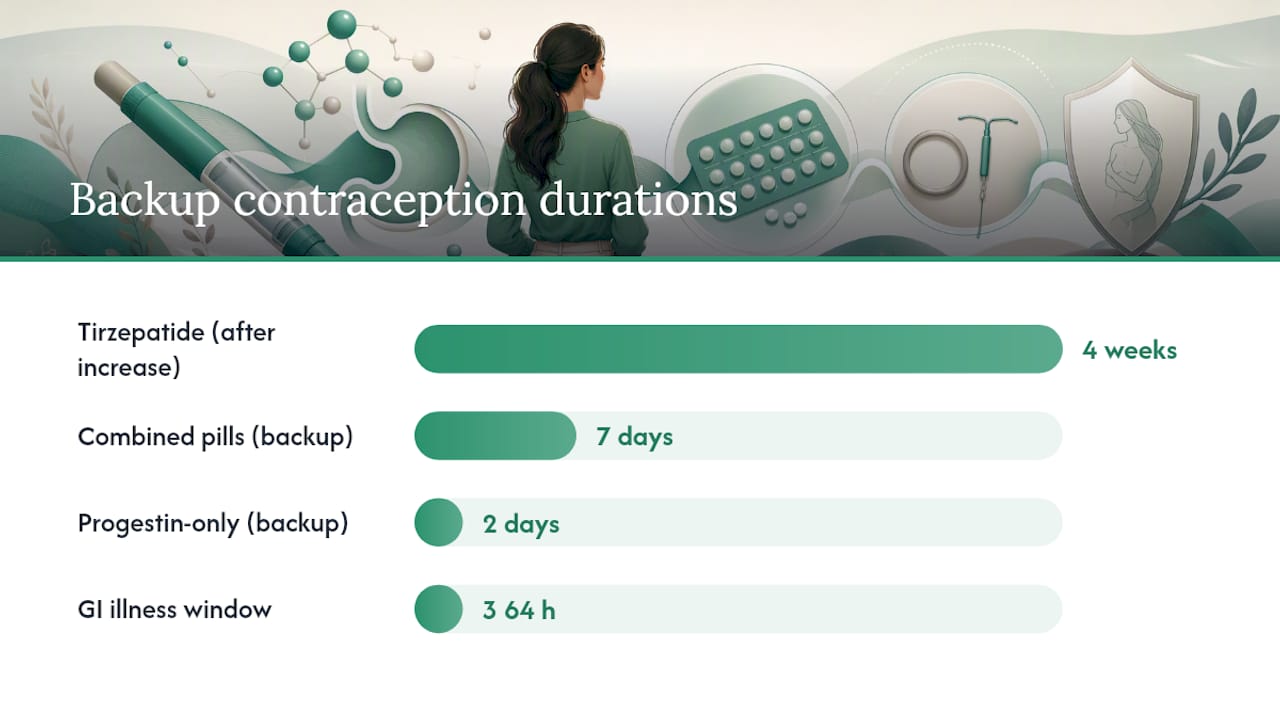
- Add a barrier method or switch to a non-oral contraceptive for at least 4 weeks when starting tirzepatide or increasing its dose.
- If you’re on semaglutide (Ozempic/Wegovy/Rybelsus), liraglutide (Saxenda/Victoza), or dulaglutide (Trulicity), no routine extra backup is required at steady state, but vomiting or diarrhea episodes still trigger missed-pill rules.
- Tell your prescribing provider you use hormonal birth control before your first dose.
Key Takeaways
Tirzepatide carries the strongest evidence for reduced oral contraceptive absorption among GLP-1 receptor agonists, requiring a 4-week backup window at initiation and each dose increase; semaglutide, liraglutide, and dulaglutide show minimal PK impact at steady state.
| Point | Details |
|---|---|
| Tirzepatide is the outlier | It’s the only GLP-1 agent with consistent PK evidence of reduced oral contraceptive exposure. |
| 4-week backup window | Add a barrier method or switch to non-oral contraception for 4 weeks after each tirzepatide dose increase. |
| Non-oral methods are safest | IUDs, implants, and injectables bypass the GI tract and are unaffected by gastric-emptying delay. |
| Vomiting/diarrhea triggers missed-pill rules | Any GI illness episode during GLP-1 treatment can independently compromise oral pill absorption. |
| Weight loss can restore ovulation | Improved metabolic health may increase fertility; don’t assume prior irregular cycles mean low pregnancy risk. |
Table of Contents
- How do GLP-1 drugs affect oral contraceptive absorption?
- What do the clinical trials and manufacturer labels actually say?
- Which birth control methods are most at risk?
- What should you do if you’re on a GLP-1 and use hormonal birth control?
- When is the interaction risk highest?
- How does weight loss from GLP-1 therapy affect fertility?
- How Legacymeds supports you through contraceptive planning on GLP-1s
- An editorial perspective on the evidence gaps
- Sources
- FAQ
How do GLP-1 drugs affect oral contraceptive absorption?
The interaction isn’t a drug-drug interaction in the traditional sense. GLP-1 receptor agonists don’t touch the CYP450 enzyme system that metabolizes most medications. The mechanism is purely mechanical: these drugs slow gastric emptying, which delays how quickly an oral pill moves from your stomach into your small intestine, where absorption actually happens.
When a pill sits in the stomach longer than expected, its peak plasma concentration (Cmax) can drop and the time to reach that peak (Tmax) shifts later. For most combined oral contraceptives, a modest Tmax delay doesn’t translate into a clinically meaningful drop in total hormone exposure (AUC). But in some agents, particularly those with a more pronounced early gastric-emptying effect, the delay is large enough to matter.
A systematic review of 10 studies involving 305 participants found a pooled mean Tmax delay of 1.16 hours (95% CI, 0.10–2.22) across GLP-1 and dual GLP-1/GIP agents. That’s the average. Individual agents varied widely, and tirzepatide and short-acting agents like lixisenatide showed the largest shifts.
Why does the route matter so much? Injectable contraceptives, IUDs, implants, and transdermal patches bypass the GI tract entirely. Delayed gastric emptying can’t touch them. This is why non-oral methods are the go-to recommendation when absorption risk is a concern.
Pro Tip: If you’re already on a GLP-1 and take your pill at the same time every day, ask your provider whether spacing the pill away from your injection day could reduce peak gastric-emptying overlap. It won’t eliminate the risk with tirzepatide, but it’s a practical question worth raising.
What do the clinical trials and manufacturer labels actually say?
The evidence picture is uneven across agents, and that unevenness is the most important thing to understand.
Tirzepatide (Mounjaro / Zepbound) stands apart. A literature review covering six clinical trials found that tirzepatide produced statistically significant reductions in oral contraceptive AUC, Cmax, and Tmax in at least one trial, while most other GLP-1 receptor agonists showed no clinically significant PK differences. The controlled trial NCT04172987 tested tirzepatide’s effect on ethinylestradiol and norgestimate specifically, and its protocol required participants to use highly effective additional contraception throughout, which itself signals how seriously the researchers took the potential for reduced OC exposure.
The systematic review adds texture: some agents, including tirzepatide and lixisenatide when taken immediately before a combined oral contraceptive, showed notable reductions in progestin Cmax and AUC in specific trials. Estrogen exposure was less affected across agents.
Semaglutide (Ozempic / Wegovy / Rybelsus) tells a different story. A dedicated PK study showed that once-weekly semaglutide co-administered with ethinylestradiol/levonorgestrel produced minimal change in levonorgestrel AUC and no meaningful change in ethinylestradiol exposure. That’s reassuring, though it covers one specific regimen.
Liraglutide (Saxenda / Victoza) and dulaglutide (Trulicity) have not shown clinically significant OC PK changes in available studies. The FSRH clinical guidance does not recommend routine extra backup for semaglutide, dulaglutide, exenatide, lixisenatide, or liraglutide at steady state.
Regulatory bodies agree on tirzepatide’s distinct risk. National safety committee reviews align with manufacturer labeling: add barrier contraception or switch to non-oral methods for 4 weeks after starting Mounjaro or Zepbound and after each dose increase.
One critical caveat: nearly all of this evidence comes from small PK studies measuring surrogate endpoints (AUC, Cmax, Tmax) in healthy volunteers. No large trial has measured actual pregnancy rates as an outcome. PK changes are informative, but they aren’t proof of contraceptive failure.
Which birth control methods are most at risk?
| Method | Interaction risk | Notes |
|---|---|---|
| Combined oral pill (estrogen + progestin) | Moderate to high with tirzepatide; low with most GLP-1 RAs at steady state | Most studied; tirzepatide label recommends backup |
| Progestin-only pill (mini-pill) | Moderate; less studied | Narrow timing window makes any absorption delay more consequential |
| Vaginal ring (NuvaRing) | Low | Absorbed vaginally, not GI-dependent |
| Transdermal patch | Low | Bypasses GI tract entirely |
| Injectable (Depo-Provera) | Very low | Systemic absorption via IM injection |
| Implant (Nexplanon) | Very low | Subdermal; no GI involvement |
| Hormonal IUD (Mirena, Kyleena) | Very low | Local uterine delivery |
| Copper IUD (Paragard) | None | Non-hormonal; purely mechanical |
| Barrier methods (condom, diaphragm) | None | No absorption involved; useful as backup |
| Emergency contraception (levonorgestrel pill) | Potentially affected | Oral route; use non-oral EC (copper IUD) if absorption is a concern |
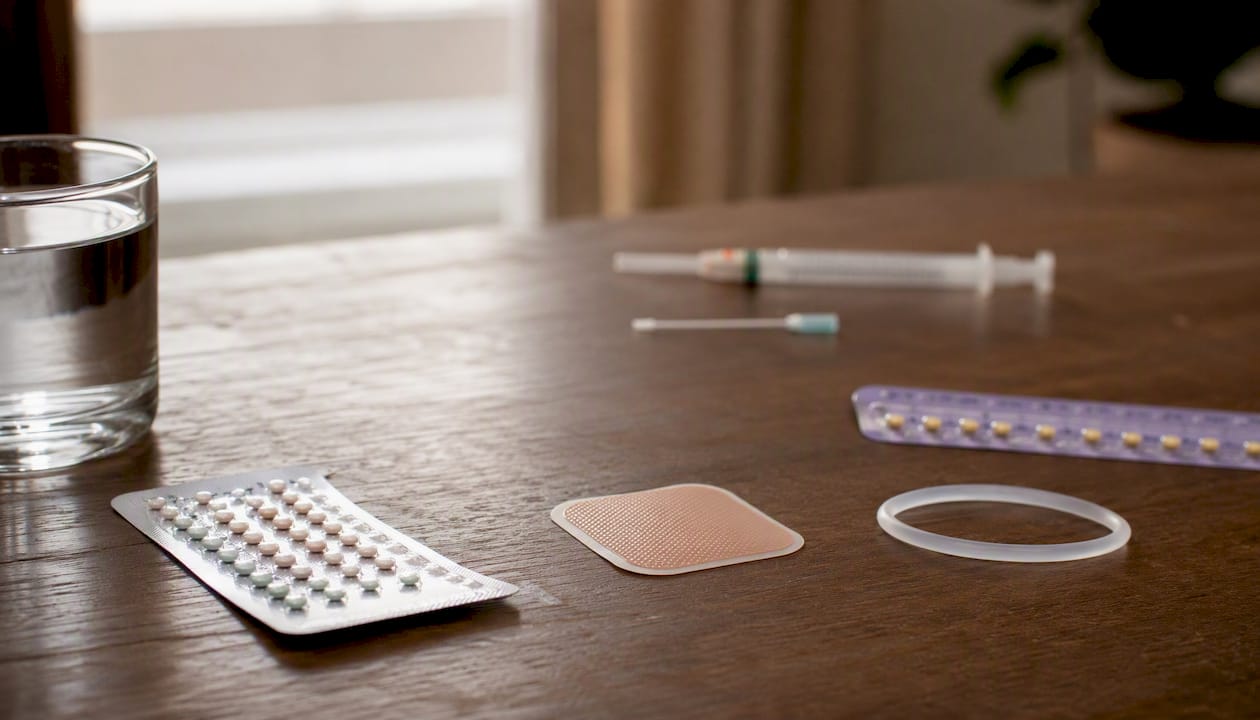
The pattern is clear: anything absorbed through the GI tract carries some risk when gastric emptying is slowed. Non-oral methods bypass this entirely and are the most reliable choice for patients who want to eliminate absorption uncertainty while on GLP-1 therapy.
Vomiting and diarrhea, which are common GLP-1 side effects during dose escalation, add a separate layer of risk. If you vomit within 2–3 hours of taking an oral pill, treat it as a missed dose and follow your pill’s missed-dose instructions.
What should you do if you’re on a GLP-1 and use hormonal birth control?
Start here: if you’re on tirzepatide and rely on an oral pill, add a barrier method now and keep it in place for 4 weeks after your most recent dose increase. For other GLP-1 agents, no routine backup is required at steady state, but the vomiting/diarrhea rule applies regardless of which drug you’re on.
Step-by-step checklist:
- Identify your GLP-1 agent. Tirzepatide requires the most caution; semaglutide, liraglutide, and dulaglutide have lower evidence of concern.
- If you’re on tirzepatide, add a condom or diaphragm for 4 weeks after each dose increase, including the starting dose.
- Consider switching to a long-acting reversible contraceptive (LARC): a hormonal or copper IUD, or a subdermal implant. These are unaffected by gastric emptying.
- If you experience vomiting or diarrhea within 3–4 hours of taking your pill, apply missed-pill rules and use backup for 7 days (or 2 days for progestin-only pills, per your pill’s instructions).
- If you’re planning a pregnancy, discuss washout timing with your provider before stopping your GLP-1. Stopping abruptly without a plan isn’t the right move.
- Take a pregnancy test if you’ve had unprotected sex during a high-risk window (initiation, dose escalation, or a GI illness episode).
Questions to bring to your provider:
- “What’s my dose escalation schedule, and when should I use backup contraception around each increase?”
- “Given my specific GLP-1 medication, would you recommend I switch to a non-oral method?”
- “If I want to get pregnant in the next year, when should I stop this medication?”
Pro Tip: During a telehealth visit, try this phrasing: “I use [pill name] for contraception. Can you confirm whether my GLP-1 dose requires backup contraception right now, and document your recommendation in my chart?” Getting it in writing protects you and ensures continuity if you see a different provider later.
When is the interaction risk highest?
Risk isn’t constant across your treatment timeline. It peaks during specific windows.
- First dose: Gastric-emptying delay is most pronounced after the initial dose of any GLP-1 agent, particularly tirzepatide. This is when absorption disruption is greatest.
- Each dose escalation: Every time the dose increases, gastric emptying slows again before the body adapts. The FSRH guidance recommends treating each escalation like a new initiation for contraceptive purposes, with a 4-week backup window for tirzepatide.
- Chronic steady state: For most GLP-1 receptor agonists, tachyphylaxis (the body’s adaptation to the drug) reduces the gastric-emptying effect over time. Risk is lower, though not zero, at stable doses.
- GI illness episodes: Vomiting or diarrhea during any phase of treatment can independently compromise oral pill absorption. This applies to all agents, not just tirzepatide.
If you vomit or have severe diarrhea during a high-risk window, use a barrier method for the next 7 days (or per your pill’s specific instructions) and consider a pregnancy test if you’ve had unprotected sex in the preceding 5 days.
How does weight loss from GLP-1 therapy affect fertility?
This is the part many patients don’t expect. GLP-1 medications don’t just change how your pill is absorbed. They can change whether you ovulate at all.
Weight loss and improved metabolic health, particularly in people with PCOS or obesity-related anovulation, can restore regular ovulation. Someone who previously assumed they had low fertility may find that changes quickly once they’re several months into GLP-1 treatment. That’s a good thing for people trying to conceive, but it’s a real risk for anyone who assumed irregular cycles meant low pregnancy odds.
If you’re planning a pregnancy, stopping your GLP-1 medication requires a washout period. Interim guidance from the FSRH suggests approximately 1 month for tirzepatide and 2 months for semaglutide before attempting conception. These figures are precautionary, based on limited human pregnancy data, and should be confirmed with your provider.
GLP-1 medications are generally avoided during pregnancy. Animal studies have raised developmental concerns, and there is insufficient human safety data to recommend continuing them. Plan your stoppage intentionally, not reactively.
For guidance on hormone-healthy nutrition during the transition off GLP-1 therapy and into a conception-planning phase, a registered dietitian familiar with metabolic health can be a useful addition to your care team.
How Legacymeds supports you through contraceptive planning on GLP-1s
Starting a GLP-1 program raises questions that go beyond weight loss. Contraceptive safety is one of them, and it deserves a real answer from a real provider, not a forum post.
Legacymeds’ online GLP-1 program includes a telehealth provider assessment before your first prescription, free ongoing provider visits, and unlimited coaching support. That means you have a clinical contact to ask about dose escalation timing, backup contraception windows, and washout planning, without scheduling a separate appointment or paying extra.
- Medication-specific counseling: your provider can confirm whether your specific GLP-1 agent requires backup contraception and document that recommendation.
- Contraceptive alternatives and referrals: if switching to a LARC or non-oral method makes sense for your situation, your Legacymeds provider can discuss options and coordinate with your reproductive health provider.
- Washout planning: for patients approaching a pregnancy decision, the care team can walk through timing guidance based on your current agent and dose.
Detailed medication safety information and answers to common program questions are available on the Legacymeds site, including guidance on side effects and what to expect during dose escalation.

An editorial perspective on the evidence gaps
The honest read on this literature is that tirzepatide is genuinely different from the rest of the class, and the clinical community is still catching up to that distinction. Most GLP-1 receptor agonist trials showed no meaningful OC PK changes. Tirzepatide’s dual GLP-1/GIP mechanism produces a more pronounced and sustained gastric-emptying delay, particularly early in treatment, and the PK data reflect that.
What the evidence doesn’t yet give us is real-world pregnancy outcome data. Every cited trial measured surrogate endpoints in small, healthy cohorts. That’s not a reason to dismiss the findings, but it is a reason to hold the risk estimates loosely and to treat individual counseling as non-negotiable. A blanket “GLP-1s affect birth control” claim overstates the evidence. A blanket “GLP-1s are fine with oral pills” claim understates the tirzepatide signal.
The practical answer sits in the middle: know your agent, know your timing windows, and ask your provider directly. The checklist in this article is a starting point, not a substitute for that conversation.
Sources
- Oral Contraceptive Failure With GLP-1 and Dual GLP-1/GIP Therapies: A Case Report and Systematic Review of Incretin–COC Interactions
- FSRH statement: Glucagon-like peptide-1 (GLP-1) agonists and oral contraception
- The impact of tirzepatide and glucagon-like peptide 1 receptor agonists on oral hormonal contraception
- Study NCT04172987
- Semaglutide, a Once-Weekly Human GLP-1 Analog, Does Not Reduce the Bioavailability of the Combined Oral Contraceptive, Ethinylestradiol/Levonorgestrel.
- Medicines Adverse Reactions Committee report: GLP-1 and oral contraceptives
A note on reading PK studies: AUC, Cmax, and Tmax are surrogate markers. A reduction in peak hormone concentration is a signal worth taking seriously, but it doesn’t directly measure pregnancy rates. Use these findings to inform precaution, not to calculate exact failure risk.
FAQ
Will GLP-1 medications affect my birth control?
It depends on which GLP-1 you’re taking and which contraceptive method you use. Tirzepatide has the strongest evidence for reducing oral pill absorption; semaglutide, liraglutide, and dulaglutide show minimal impact at steady state. Non-oral methods like IUDs and implants are not affected by any GLP-1 agent.
Can you take semaglutide while on birth control?
Yes. A dedicated PK study found that once-weekly semaglutide did not meaningfully reduce the bioavailability of a combined oral contraceptive. No routine backup contraception is recommended for semaglutide at steady state, though vomiting or diarrhea episodes still require standard missed-pill precautions.
Can birth control make it harder to lose weight on GLP-1s?
Hormonal contraceptives can influence weight through fluid retention and appetite changes in some patients, but there’s no established evidence that they block the weight-loss mechanism of GLP-1 receptor agonists. The two interact at the absorption level, not the metabolic level.
What should you not take with GLP-1 medications?
Any oral medication with a narrow therapeutic window or time-sensitive absorption profile warrants review when starting a GLP-1, since gastric emptying is slowed. Oral contraceptives, thyroid medications, and certain antibiotics are common examples. Always give your full medication list to your prescribing provider before starting.