
GLP-1 receptor agonists rarely cause the kind of metabolism-mediated drug interactions that worry pharmacists about most prescriptions. The real issue is mechanical, not enzymatic: these drugs slow gastric emptying, which delays how fast some oral medications get absorbed and can lower their peak concentration. A systematic review of GLP-1 receptor agonist interactions found this pattern repeatedly, decreased Cmax, delayed Tmax, but overall drug exposure (AUC) and clinical outcomes usually stayed unchanged.
That distinction matters for how you act on it. Most oral medications don’t need dose changes when a patient starts semaglutide, tirzepatide, liraglutide, dulaglutide, or exenatide. But a smaller group of drugs deserves closer attention:
- Narrow-therapeutic-index drugs like warfarin, digoxin, and dabigatran, where small absorption shifts can matter
- Levothyroxine, because timing and absorption are already sensitive to what else is in the stomach
- Insulin and sulfonylureas, where additive hypoglycemia risk requires a dose review, not just a PK footnote
- Patients with gastroparesis or significant renal dysfunction, where slowed transit compounds existing risk
Quick fact: PBPK modeling predicts that GLP-1 induced delays in gastric and small-intestinal transit could raise AUC substantially for a handful of oral drugs, dabigatran among them, even though most drugs show no meaningful AUC change.
The practical takeaway: monitor labs proactively for narrow-index drugs, stagger oral dosing when a medication’s absorption depends on timing, and treat modeling-based warnings as reasons for vigilance rather than automatic dose changes.
Key Takeaways
GLP-1 receptor agonists rarely cause clinically significant drug interactions through metabolism, but slowed gastric emptying can meaningfully affect absorption of narrow-therapeutic-index drugs like warfarin, digoxin, and dabigatran.
| Point | Details |
|---|---|
| Mechanism is mechanical, not enzymatic | GLP-1RAs slow gastric emptying rather than blocking liver enzymes, which delays but rarely blocks drug absorption. |
| Most drugs need no dose change | PK shifts like delayed Tmax rarely translate into clinically significant AUC or outcome changes for typical oral medications. |
| Narrow-index drugs need monitoring | Warfarin, digoxin, and dabigatran deserve lab checks or closer follow-up when GLP-1 therapy starts. |
| Insulin and sulfonylureas need dose review | Additive hypoglycemia risk makes this the most common real-world interaction, not a rare PK footnote. |
| Legacymeds builds review into intake | Provider medication review, free visits, and unlimited coaching are structured around catching interaction risks early. |
This article is general information, not a substitute for advice from a qualified doctor. Consult a qualified healthcare professional about your own circumstances before acting on anything here.
Table of Contents
- Understanding GLP-1 Drug Interactions: The Mechanism Behind Them
- Evidence by Drug and Drug Class: What the Studies Show
- Managing GLP-1 Medication Safety: A Practical Approach
- Who Faces Higher Interaction Risk With GLP-1 Drugs
- What the Research Still Doesn’t Answer
- Applying the Evidence in Telehealth GLP-1 Care
- How Legacymeds Supports Safe GLP-1 Prescribing
- Sources
- FAQ
Understanding GLP-1 Drug Interactions: The Mechanism Behind Them
GLP-1 receptor agonists don’t interact with other medications the way most drug classes do. There’s no meaningful competition for cytochrome P450 enzymes, no transporter blockade, none of the mechanisms that typically populate a pharmacology textbook’s interaction chapter. Instead, the entire interaction story centers on one physiologic effect: these drugs slow the stomach’s rate of emptying into the small intestine.
That single mechanism explains almost everything you need to know about GLP-1 medication interactions. When food and pills move through the gut more slowly, oral drugs that depend on rapid dissolution and absorption in the upper GI tract show delayed Tmax (the time to reach peak concentration) and often a lower Cmax (the peak concentration itself). What usually does not change is total drug exposure over time, the AUC, because the drug still gets absorbed, just later and sometimes more gradually.
The systematic review published in PMC analyzed 22 reports and six prescribing sheets and found this pattern held consistently across drug classes: PK values shifted, but clinical endpoints rarely moved enough to require action. That’s reassuring for most patients, but it also means clinicians can’t just wave off every interaction question with “GLP-1s don’t interact with anything.” The mechanism is real. Its clinical weight depends entirely on the drug involved.
The consistent finding across pharmacokinetic studies is a predictable pattern: delayed absorption, sometimes a lower peak, but exposure over time that stays essentially the same for most oral drugs. The exceptions are what matter clinically, and they tend to be narrow-therapeutic-index medications where even a delayed or slightly blunted peak can shift how a patient responds.
Injectable GLP-1 agents (semaglutide as Ozempic or Wegovy, tirzepatide as Zepbound or Mounjaro, liraglutide, dulaglutide, and exenatide) don’t carry special oral-absorption instructions of their own, since they bypass the gut. Oral semaglutide is different. It requires a specific administration routine: taken fasting, with a small amount of water, at least 30 minutes before the first food, beverage, or other oral medication of the day. That instruction exists to protect the drug’s own poor and variable absorption, not primarily to manage interactions with other drugs, but it adds a layer of complexity when a patient is also taking levothyroxine or another timing-sensitive medication first thing in the morning.
A few caveats are worth stating plainly:
- Most interaction studies are small, healthy-volunteer PK trials, not large outcome trials in the populations who actually take these drugs long-term
- Findings in healthy 25-year-olds don’t always generalize to a 68-year-old with reduced renal clearance and three other prescriptions
- Real-world, elderly, and polypharmacy populations remain underrepresented in the interaction literature
That gap between clean trial data and messy clinical reality is exactly where the guidance below tries to fill in the blanks.
Evidence by Drug and Drug Class: What the Studies Show
Different drug classes carry different levels of concern, and lumping them together does patients a disservice. Here’s what the evidence actually says for the medications patients and prescribers ask about most.
-
Warfarin and other vitamin K antagonists. Pharmacokinetic studies show some shift in absorption timing, but INR values in trials have generally remained stable. The Drugs notes no clinically important AUC change for warfarin in tested populations. The practical move: check INR when starting or stopping GLP-1 therapy in a warfarin patient, not because the interaction is dramatic, but because warfarin’s therapeutic window is thin enough that any variable is worth confirming.
-
Levothyroxine. Thyroid hormone absorption is famously sensitive to what’s in the gut at the same time, food, coffee, calcium, iron, and now, potentially, a slower-emptying stomach. Reports describe modest but clinically relevant reductions in absorption after starting a GLP-1RA. The fix is straightforward: keep levothyroxine on an empty stomach, separated from other oral medications, and recheck TSH roughly 6 to 8 weeks after starting or adjusting GLP-1 therapy.
-
Digoxin. PK variability with digoxin tends to be small on average, but averages don’t help an individual patient who’s already close to the toxic end of a notoriously narrow therapeutic window. Baseline digoxin monitoring at the start of GLP-1 therapy makes sense, especially in patients with renal impairment, since digoxin clearance already depends heavily on kidney function.
-
Oral contraceptives and hormonal agents. This is one of the more nuanced areas. Most studies of injectable GLP-1RAs show no meaningful change in hormonal exposure, but reviews have flagged tirzepatide specifically as having some signal worth watching, likely tied to its more pronounced effect on gastric emptying at higher doses. Practical guidance from pharmacy specialists at the NHS Specialist Pharmacy Service suggests counseling patients on strict adherence to oral contraceptive timing and considering non-oral contraceptive methods when pregnancy prevention is critical and adherence is uncertain.
-
Dabigatran and other narrow-index anticoagulants. This is the interaction that deserves the most attention right now, even though it’s the least clinically confirmed. PBPK modeling predicts dabigatran’s AUC could rise substantially, according to model outputs, when gastric and small-intestinal transit slows under GLP-1 therapy. That’s a modeled prediction, not a confirmed clinical outcome, but dabigatran’s narrow safety margin means the stakes of being wrong are high. Clinicians managing patients on dabigatran who start a GLP-1RA should consider closer monitoring, dilute thrombin time testing where available, or discuss alternative anticoagulant strategies for patients already at elevated bleeding risk.
-
Acetaminophen and common over-the-counter drugs. Here’s the reassuring end of the spectrum. Acetaminophen shows the classic delayed-Tmax pattern, absorption takes longer to peak, but overall exposure stays similar enough that dose adjustments are rarely necessary. The same holds for many other OTC oral medications tested in interaction studies.
-
Insulin, sulfonylureas, and other glucose-lowering agents. This isn’t a pharmacokinetic interaction so much as an additive pharmacodynamic one. GLP-1RAs lower blood glucose on their own; stacking them with insulin or a sulfonylurea increases hypoglycemia risk. This is the most clinically actionable interaction on this list, and it’s also the most common in real-world practice. Insulin and sulfonylurea doses often need to be reduced when a GLP-1RA is added, sometimes substantially, and patients need clear hypoglycemia education from day one.
Statistic worth remembering: across the drugs studied in the systematic review, the pattern of decreased Cmax and delayed Tmax showed up consistently, but clinically meaningful AUC changes were the exception, not the rule. The exceptions are exactly the drugs listed above.
Managing GLP-1 Medication Safety: A Practical Approach
Knowing the mechanism is one thing. Knowing what to actually do with a patient sitting in front of you, or a patient messaging you from home, is another. Here’s how the evidence translates into action.
Sort medications into two buckets first. Most oral drugs your patient takes need nothing more than routine monitoring, no dose change, no special timing. The second, smaller bucket, narrow-therapeutic-index drugs, medications cleared renally in a patient with reduced kidney function, and anything with a tight window between effective and toxic, deserves a specific plan before the first GLP-1 dose goes in.
Timing and staggering matter more than most patients realize. Oral semaglutide’s own administration rule (fasting, small sip of water, 30 minutes before anything else by mouth) is non-negotiable for the drug’s own absorption, but it also happens to solve half the interaction problem by default: it separates GLP-1 dosing from other oral medications automatically. For patients on injectable GLP-1RAs without that built-in spacing rule, a simple guideline works well: take time-sensitive oral medications like levothyroxine at a consistent time relative to meals and GLP-1 injections, and don’t let the schedule drift.
Build a monitoring cadence around the drugs that need it.
- Check TSH 6 to 8 weeks after starting or adjusting GLP-1 therapy in patients on levothyroxine
- Confirm INR at initiation and again within the first few weeks for patients on warfarin
- Get baseline digoxin levels in patients with any degree of renal impairment before or shortly after starting therapy
- Review glucose logs and reduce insulin or sulfonylurea doses proactively, don’t wait for a hypoglycemic event to prompt the change
- Reassess renal function periodically, since GLP-1RAs can affect fluid status and kidney clearance in some patients, especially early in treatment
Patient counseling deserves as much weight as the lab orders. Patients need to know what a slowed stomach means in plain language: some pills might take a little longer to “kick in,” and that’s expected, not a sign the medication is failing. They also need clear signs to report, unusual bruising or bleeding for anyone on an anticoagulant, symptoms of low thyroid function, palpitations or dizziness for anyone on digoxin, and any signs of hypoglycemia if they’re also on insulin or a sulfonylurea.
Pro Tip: If a patient is on more than one timing-sensitive medication, don’t try to solve every schedule conflict at once. Pick the drug with the narrowest safety margin, usually the anticoagulant or thyroid medication, build the schedule around that one first, then fit everything else around it.
One overlooked scenario: emergency situations. If a patient on a GLP-1RA needs activated charcoal or another gastric decontamination approach after an overdose or toxic ingestion, the extended gastric retention time from the GLP-1 drug could theoretically widen the window during which decontamination remains useful, though this hasn’t been rigorously studied and shouldn’t change standard emergency protocols without direct guidance from poison control or toxicology. For everyday safety questions, Legacymeds’ medication safety information page outlines the baseline precautions patients should know before starting therapy.
Who Faces Higher Interaction Risk With GLP-1 Drugs
Some patients need a more cautious approach than the general guidance above, and knowing who they are matters as much as knowing the mechanism itself.
- Patients with pre-existing gastroparesis or severe autonomic neuropathy. GLP-1RAs slow gastric emptying in everyone to some degree; in a stomach that already empties poorly, that effect compounds. This population sees the highest rates of nausea, bloating, and unpredictable drug absorption, and many clinicians consider gastroparesis a relative caution for GLP-1 therapy altogether.
- Chronic kidney disease patients on renally cleared, narrow-index drugs. Digoxin and dabigatran both depend on kidney clearance. Add reduced renal function to delayed gastric emptying, and you’ve got two variables working against a narrow safety margin at the same time.
- Older adults managing multiple prescriptions. Polypharmacy alone raises interaction risk regardless of GLP-1 status; layering a GLP-1RA’s absorption effects on top of five or six other medications means small individual effects can stack into something clinically noticeable. This is also the population where nausea and reduced appetite from GLP-1 therapy can themselves affect nutrition and medication tolerance.
- Anyone on multiple time-critical medications simultaneously. Anticoagulants, antiarrhythmics, and anticonvulsants share one trait: dosing precision matters, and a missed peak or delayed absorption isn’t just a theoretical PK curve, it’s a seizure threshold or an arrhythmia risk.
- Patients heading into surgery or dealing with acute illness. Perioperative fasting, altered GI motility from illness, and GLP-1-related delayed gastric emptying can combine in ways that matter for aspiration risk during anesthesia, which is why many surgical guidelines now recommend holding GLP-1 doses before elective procedures.
What the Research Still Doesn’t Answer
The clinical picture on GLP-1 drug interactions is more settled than a lot of patients assume, but it’s not complete. The systematic review established a consistent, low-risk pattern: PK values shift, clinical endpoints mostly don’t. That consistency across dozens of studied drug pairs is the strongest piece of evidence available right now.
PBPK modeling can flag which drugs deserve a closer look long before a clinical trial gets funded to test them directly. That’s its real value, and also its real limit: a modeled 205% AUC increase for dabigatran is a hypothesis worth taking seriously, not a confirmed clinical event.
Regulatory labeling reflects that same balance. FDA prescribing information for GLP-1 agents typically states there’s low potential for CYP-mediated interactions, while still flagging the gastric-emptying effect as worth monitoring for narrow-therapeutic-index drugs.
What’s missing:
- Large, real-world outcome studies in the polypharmacy and elderly populations who actually take these drugs long-term
- Dedicated interaction trials for some of the newer or less-studied GLP-1 agents
- Confirmation, one way or the other, of whether the dabigatran modeling signal translates into actual bleeding events
Applying the Evidence in Telehealth GLP-1 Care
Translating pharmacokinetic data into a workable safety process is where a lot of prescribing guidance falls short. It’s one thing to know that levothyroxine absorption can dip, another to build a system that catches it before it becomes a problem.
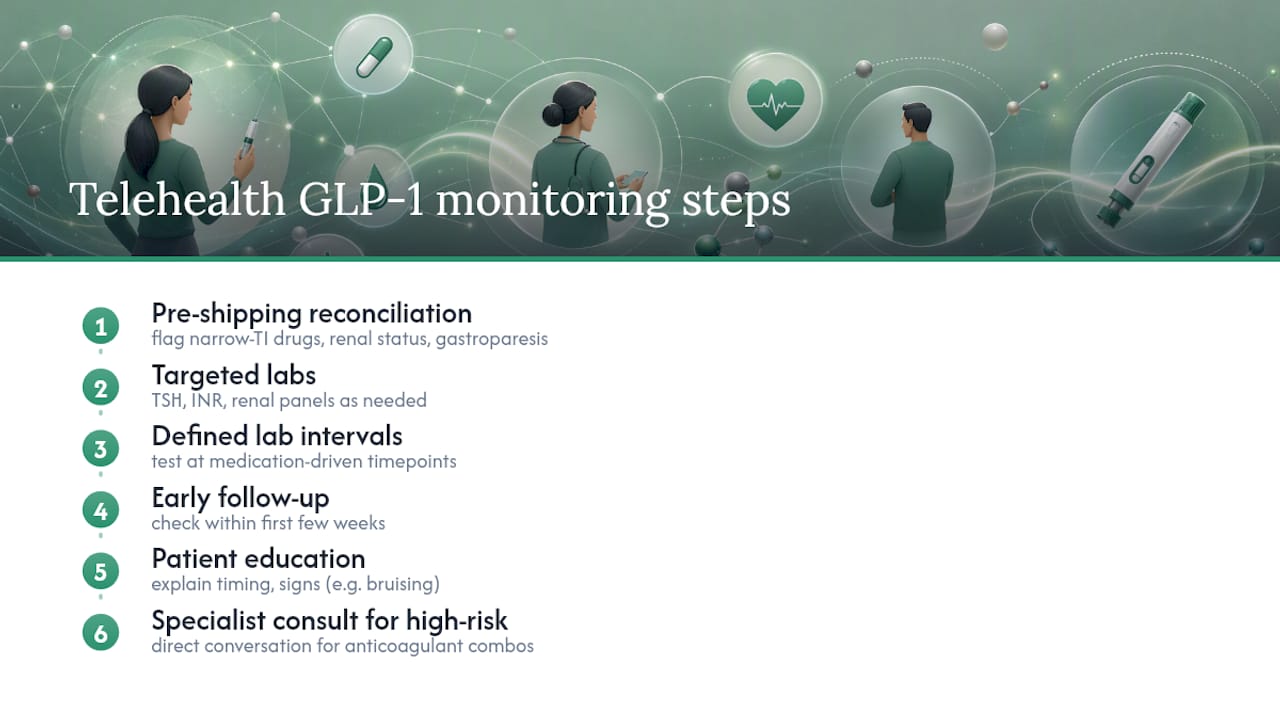
A sound monitoring workflow starts before the first dose ships: a full medication reconciliation that flags narrow-therapeutic-index drugs, renal function status, and any history of gastroparesis. From there, targeted labs at defined intervals, TSH, INR, renal panels, whatever the medication list calls for, matter more than blanket testing. Early follow-up windows, checking in within the first few weeks rather than waiting for a routine annual visit, catch the PK shifts that matter most while they’re still easy to manage.
Patient education carries real weight here too. A patient who understands why their pharmacist asked about warfarin timing is a patient who’ll actually report the bruise that shows up two weeks later. For anticoagulant combinations flagged by PBPK modeling, or any narrow-index drug where the stakes of a missed interaction are high, the right move is a direct conversation with the prescribing specialist rather than guessing.
— Bryan
How Legacymeds Supports Safe GLP-1 Prescribing
Legacymeds builds medication safety into the intake process itself, not as an afterthought after the prescription ships. Every patient starts with a provider assessment that reviews current medications before semaglutide or tirzepatide ever gets prescribed, which catches narrow-therapeutic-index concerns, thyroid medications, and anticoagulants before they become a problem instead of after.
That review isn’t a one-time checkbox. Legacymeds pairs it with unlimited ongoing coaching, so if you start levothyroxine timing questions or notice something feels different after a dose increase, you have a provider to ask without booking a separate appointment or paying an extra fee. Free provider visits mean the safety conversation happens as often as it needs to, not just at intake. The medication safety information page walks through what to expect, and if you’re ready to start with a program built around that kind of ongoing oversight, the GLP-1 weight loss program is where that intake review begins.
Sources
- Drug‑Drug Interactions Between Glucagon‑Like Peptide 1 Receptor Agonists and Oral Medications: A Systematic Review
- Drugs
- PBPK analysis relevant to GLP‑1RA effects on dabigatran - PubMed
FAQ
What drugs can you not take with a GLP-1?
There’s no long list of drugs that are outright off-limits, but warfarin, digoxin, dabigatran, levothyroxine, and insulin or sulfonylureas all require extra monitoring or dose adjustment because of their narrow safety margins or additive effects.
Why are older adults sometimes discontinuing GLP-1 medications?
Reasons vary and aren’t fully captured in interaction research specifically, but polypharmacy complexity, gastrointestinal side effects, and the added burden of coordinating medication timing around multiple prescriptions can make these drugs harder to tolerate in patients managing several chronic conditions at once.
Who should avoid taking a GLP-1 medication?
Patients with a personal or family history of medullary thyroid carcinoma or MEN 2, active pancreatitis, or severe gastroparesis generally need to avoid or use extreme caution with GLP-1 therapy; a full medication and history review during intake, the kind Legacymeds performs before prescribing, is how this gets caught early.
What medications can you not mix with semaglutide or Ozempic?
Semaglutide doesn’t have a hard list of banned combinations, but insulin and sulfonylureas require dose reduction to avoid hypoglycemia, and narrow-index drugs like warfarin and digoxin warrant lab monitoring rather than avoidance.
Do GLP-1 drugs interact with insulin directly?
Yes, though it’s a pharmacodynamic interaction rather than a pharmacokinetic one: both lower blood glucose, so combining them raises hypoglycemia risk and typically requires an insulin or sulfonylurea dose reduction when a GLP-1RA is added.