

Hair loss on a GLP-1 medication is real, documented, and in most cases temporary. The majority of evidence points to telogen effluvium driven by rapid weight loss and associated nutrient deficits, not a direct toxic effect of the drug itself. That distinction matters practically: it means the shedding usually reverses once weight stabilizes and nutritional gaps are corrected.
If you’re already noticing thinning, here are three things to do right now:
- Get baseline labs. Ask your provider for a CBC with ferritin, TSH, vitamin D, and B12. These rule out treatable deficiencies that accelerate shedding.
- Prioritize protein. Most people on GLP-1s eat far less than they realize. Aim for an adequate daily protein intake appropriate for your body weight.
- Contact your prescriber or a dermatologist if shedding is severe, has lasted more than six months, or is causing visible patterned thinning rather than diffuse loss.
Key Takeaways
GLP-1 hair loss is almost always telogen effluvium driven by rapid weight loss and nutrient deficits, not direct follicular toxicity, and most cases resolve within six to twelve months of metabolic stabilization.
| Point | Details |
|---|---|
| Cause is indirect | Hair loss on GLP-1s is driven by rapid weight loss and nutrient deficits, not direct drug toxicity. |
| Semaglutide and tirzepatide lead the signal | These two agents show the highest incidence rates and pharmacovigilance signals among GLP-1 receptor agonists. |
| Get the right labs | CBC with ferritin, TSH, vitamin D, and B12 are the essential first tests to order. |
| Regrowth is realistic | Most patients see meaningful hair recovery within 6–12 months after metabolic stabilization and nutritional correction. |
| Legacymeds provides clinical support | Legacymeds includes baseline labs, dose management, nutrition coaching, and dermatology referral in its GLP-1 care pathway. |
Table of Contents
- Does GLP-1 therapy actually cause hair loss? What the research says
- Which GLP-1 medications carry the strongest hair loss signal?
- What type of hair loss are you dealing with, and when does it stop?
- Why does GLP-1–driven weight loss affect your hair?
- Who is most likely to develop hair loss on a GLP-1?
- What labs should you get if you’re losing hair on a GLP-1?
- How to manage hair loss while staying on your GLP-1
- How to prevent hair loss before it starts on a GLP-1
- When should you slow down, pause, or change your GLP-1 therapy?
- When to see a dermatologist or endocrinologist
- How Legacymeds supports patients who report hair shedding
- A note on perspective: hair loss is manageable, and the conversation with your prescriber matters
- Legacymeds offers clinical support for GLP-1 side effects, including hair shedding
- Sources
- FAQ
Does GLP-1 therapy actually cause hair loss? What the research says
The short answer is yes, there is a real signal, but the word “cause” needs unpacking. Dermatology experts at the AAD are clear that GLP-1 drugs do not typically damage hair follicles directly. What they do is drive rapid weight loss, and rapid weight loss is a well-established trigger for telogen effluvium.
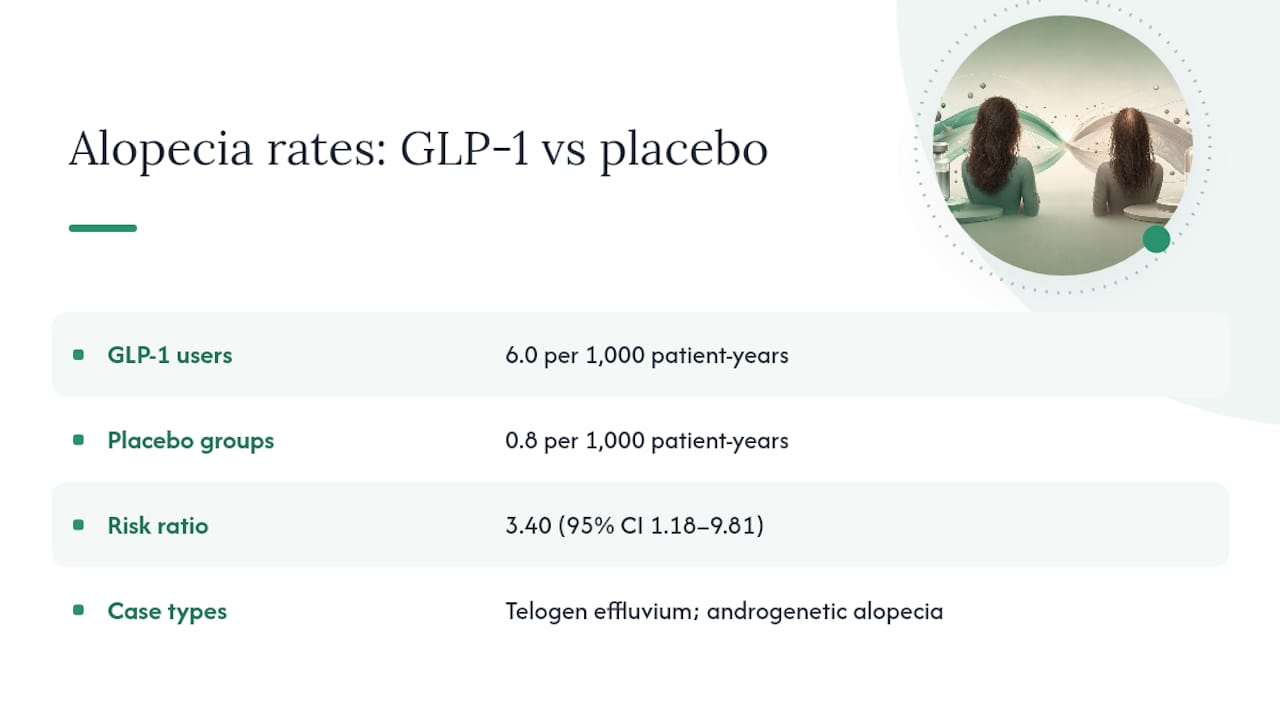
The quantitative signal is meaningful. A systematic review and meta-analysis reported an alopecia incidence rate of 6.0 per 1,000 patient-years in GLP-1 users versus 0.8 per 1,000 patient-years in placebo groups, a risk ratio of 3.40 (95% CI 1.18–9.81). That is a roughly threefold increase in reporting, and the review concluded that most cases were non-scarring, consistent with telogen effluvium and androgenetic alopecia.
Real-world data reinforce this. A large TriNetX EHR cohort study matched GLP-1 users against controls and found higher adjusted odds of telogen effluvium, androgenetic alopecia, and overall non-scarring hair loss at 12 months. These are not small signals from a handful of case reports; they come from a multicenter, real-world dataset.
A few important caveats: the systematic review identified heterogeneity across included studies, pharmacovigilance databases are subject to underreporting, and most studies have not yet controlled fully for confounders like baseline nutritional status or concurrent medications. The Cleveland Clinic and the American Academy of Dermatology (AAD) both acknowledge the association while emphasizing that the mechanism is indirect.
Key signal: A meta-analysis of GLP-1 trials found a statistically significant increased risk for alopecia compared to placebo, with most cases classified as non-scarring and potentially reversible.
Which GLP-1 medications carry the strongest hair loss signal?
Not all GLP-1 receptor agonists carry the same level of evidence. The systematic literature review that screened 133 studies and included 24 found that semaglutide and tirzepatide showed the highest incidence rates and the most frequent pharmacovigilance signal detection among GLP-1 agents.
- Semaglutide (brand names Ozempic for type 2 diabetes, Wegovy for obesity): Hair shedding on Wegovy and semaglutide hair loss appear more often in reports than with older agents like liraglutide, likely because the higher obesity-treatment doses produce larger and faster weight reductions.
- Tirzepatide (brand name Zepbound for obesity): Associated with some of the largest weight reductions in clinical trials, and BMJ reporting notes that higher-dose obesity indications are more frequently implicated than lower diabetes doses.
- Older agents (liraglutide, dulaglutide, exenatide): Fewer reports in the literature, though this may partly reflect lower weight-loss magnitude rather than a fundamentally different follicular effect.
The dose-indication relationship is worth flagging. Higher doses used for obesity tend to produce faster weight loss, and faster weight loss is the primary driver of telogen effluvium.
Sex differences show up in some datasets too. Females appear disproportionately affected in certain pharmacovigilance analyses, possibly because androgenetic alopecia is more likely to be unmasked in women with a genetic predisposition when estrogen-related protective effects shift during rapid weight change.
Pro Tip: Before escalating to a higher GLP-1 dose, ask your prescriber whether your current weight-loss pace is already fast enough to meet your health goals. Slowing escalation may reduce shedding risk without sacrificing long-term outcomes.
What type of hair loss are you dealing with, and when does it stop?
Two distinct patterns show up in GLP-1 users, and they have very different prognoses.
Telogen effluvium (TE) is diffuse shedding across the scalp. It happens when a physiologic stressor, such as rapid weight loss, caloric restriction, or nutrient depletion, pushes a large number of follicles simultaneously into the resting (telogen) phase. The follicles are not destroyed; they simply pause. Shedding typically begins about two to four months after the trigger, peaks over the following weeks, and then gradually resolves. Regrowth typically begins within three to six months of stabilization, with full recovery often taking six to twelve months.
Androgenetic alopecia (AGA) is patterned thinning, receding at the temples in men or widening part-line thinning in women. GLP-1 therapy does not create AGA from nothing; it can unmask a genetic predisposition that was already present. Once AGA is triggered, it does not simply reverse when weight stabilizes. It requires active management.
Timeline signal: Regrowth after telogen effluvium typically begins within three to six months of metabolic stabilization, with most patients seeing meaningful recovery by twelve months.
| Feature | Telogen effluvium | Androgenetic alopecia |
|---|---|---|
| Pattern | Diffuse, all-over thinning | Patterned (temples, crown, part-line) |
| Onset after trigger | 2–4 months | Gradual, may accelerate with trigger |
| Reversibility | Usually fully reversible | Partially reversible; requires treatment |
| Primary driver | Metabolic stress, nutrient deficit | Genetic predisposition, hormonal shift |
| Management approach | Correct deficits, wait, support nutrition | Minoxidil, finasteride (men), dermatology |
Finasteride is FDA-indicated for men only. Women who are or may become pregnant must not handle crushed or broken finasteride tablets, due to the risk of harm to a male fetus. It can also cause sexual side effects (reduced libido, erectile dysfunction) in a minority of men, which usually resolve after stopping treatment. Discuss these risks with a physician before starting.
Why does GLP-1–driven weight loss affect your hair?
The mechanisms are mostly indirect, and several pathways likely operate at once.
Rapid caloric and protein deficit. Hair follicles are metabolically expensive. When caloric intake drops sharply, the body prioritizes vital organs and deprioritizes hair growth. Protein is the structural building block of keratin; even a modest shortfall can push follicles into telogen. Most people on GLP-1s eat significantly less without realizing how little protein they are actually getting.

Micronutrient depletion. The AAD notes that iron, zinc, vitamin D, and B12 deficiencies are common drivers of shedding in GLP-1 users. Ferritin (stored iron) is particularly important; serum ferritin below roughly 30–40 ng/mL is associated with impaired hair cycling even when hemoglobin is normal.
Metabolic and hormonal shifts. BMJ analysis frames the GLP-1 hair loss association as predominantly downstream from metabolic and hormonal changes during rapid weight loss. Shifts in insulin and IGF-1 signaling, changes in androgen metabolism as adipose tissue decreases, and alterations in thyroid hormone absorption can all affect follicle cycling. Patients on thyroid replacement medication should recheck TSH after significant weight loss, since absorption and dose requirements can change.
The three-month lag. Hair follicles follow roughly three-month growth cycles. The shedding you notice today reflects a stressor your body experienced about three months earlier. This delay is why patients often feel confused: they may be eating better and feeling stronger by the time the shedding peaks, which makes the connection to GLP-1 therapy less obvious.
Mechanism signal: The three-month follicle cycle lag means peak shedding typically arrives two to four months after the metabolic trigger, not immediately after starting the medication.
Who is most likely to develop hair loss on a GLP-1?
Some risk factors are modifiable; others are not. Knowing which category yours falls into shapes how aggressively you should prepare.
Higher-risk profile:
- Losing weight rapidly (more than 1–1.5 lbs per week sustained over months)
- Low baseline ferritin, vitamin D, or B12 before starting therapy
- Female sex, particularly in the perimenopausal range
- Personal or family history of androgenetic alopecia
- Concurrent restrictive diet (very low calorie, low carb, or elimination diets)
- Pre-existing or undiagnosed thyroid dysfunction
- History of prior episodes of telogen effluvium (postpartum, post-illness)
Modifiable factors include the pace of weight loss, nutritional status, and thyroid management. These are the levers worth pulling before shedding starts.
Non-modifiable factors include sex, genetics, and a personal history of AGA. If you have a strong family history of pattern hair loss, that does not mean you should avoid GLP-1 therapy. It means you and your prescriber should plan proactively: slower escalation, baseline labs, and a lower threshold for dermatology referral.
Pro Tip: Ask about your family history of hair loss before your next dose escalation. If a parent or sibling has significant pattern thinning, flag it with your prescriber and consider a dermatology baseline visit before moving to a higher dose.
What labs should you get if you’re losing hair on a GLP-1?
A targeted lab panel rules out treatable causes and guides management. Bring this list to your next provider visit.
Essential labs:
- CBC with ferritin: Ferritin is the critical number, not just hemoglobin. Iron-deficiency hair loss can occur with normal hemoglobin but low ferritin.
- TSH (with free T4 if TSH is abnormal): Hypothyroidism is a common, underdiagnosed cause of diffuse hair loss and can be worsened by weight-change-related shifts in thyroid hormone absorption.
- 25-OH vitamin D: Deficiency is widespread and directly linked to hair cycling disruption.
- Vitamin B12: Especially relevant for patients on metformin (which impairs B12 absorption) or those eating very little animal protein.
- Serum zinc: Order when dietary intake is low or when the patient is on a restrictive diet.
- Comprehensive metabolic panel (CMP): Screens for liver and kidney function, which can affect nutrient metabolism.
- Pregnancy test: When clinically relevant; pregnancy is itself a major trigger for telogen effluvium.
What abnormal results mean for your care:
- Low ferritin: Oral iron supplementation, dietary iron sources, and recheck in 8–12 weeks.
- Abnormal TSH: Thyroid medication adjustment before attributing all hair loss to GLP-1 therapy.
- Low vitamin D: Supplementation (typically 2,000–4,000 IU daily, confirmed with your provider) and recheck in 3 months.
- Low B12: Supplementation or dietary correction; consider methylcobalamin form for better absorption.
- All labs normal: Diagnosis shifts toward weight-loss-mediated TE; focus on protein and pace of loss.
Questions to ask your clinician:
- “Can we check my ferritin specifically, not just my hemoglobin?”
- “Should I recheck my TSH given how much weight I’ve lost?”
- “Is my current rate of weight loss likely contributing to the shedding?”
A scalp biopsy or dermatology referral is appropriate when the pattern looks more like AGA than diffuse TE, when labs are normal but shedding is severe, or when shedding has continued beyond six months without improvement.
How to manage hair loss while staying on your GLP-1
Management follows a logical sequence. Work through these steps with your provider rather than making changes unilaterally.
- Confirm the diagnosis. Get the lab panel above. Rule out thyroid disease, iron deficiency, and B12 deficiency before attributing shedding entirely to weight loss.
- Correct nutritional deficits. Supplement what the labs show is low. Do not megadose; over-supplementation of selenium or vitamin A, for example, can itself cause hair loss.
- Hit your protein target. Aim for a sufficient amount of protein daily relative to your body weight to support hair health. Distribute it across meals rather than loading it all at dinner.
- Consider topical minoxidil. Over-the-counter 2% (women) or 5% (men) minoxidil is an evidence-based option for both TE and AGA. It does not fix the underlying cause, but it can shorten the shedding phase and support regrowth. Discuss with your dermatologist before starting.
- Discuss pace and dose with your prescriber. If weight loss is happening faster than 1–1.5 lbs per week, slowing the escalation schedule may reduce the metabolic stress driving TE. This does not mean stopping therapy.
- Refer to dermatology if shedding persists. Persistent shedding beyond six months, patterned thinning, or severe distress warrants specialist evaluation.
Supplement guidance:
- Iron: Supplement only if ferritin is confirmed low; unnecessary iron supplementation carries GI and oxidative risks.
- Vitamin D: Most GLP-1 users benefit from 2,000 IU daily as a baseline; adjust based on lab results.
- Biotin: Widely marketed for hair loss but evidence is weak in people without a biotin deficiency. High-dose biotin can also interfere with thyroid and troponin lab assays.
- Collagen peptides and protein powders: Practical tools for hitting protein targets when appetite is suppressed by GLP-1 therapy.
Expected timeline for improvement:
- Nutritional corrections: Lab markers typically improve within 8–12 weeks of supplementation.
- Visible shedding reduction: Usually 3–4 months after the underlying trigger is addressed.
- Meaningful regrowth: Most patients see noticeable recovery within 6–12 months after metabolic stabilization.
Patients managing injectable GLP-1 supplies at home may find guidance on managing diabetes medication inventory useful for keeping their regimen organized alongside any supplements or adjunct treatments.
How to prevent hair loss before it starts on a GLP-1
Prevention is more effective than treatment, and most of the steps are straightforward.
- Avoid extreme caloric restriction. GLP-1 medications suppress appetite significantly. Eating too little, not just losing weight, accelerates follicle stress. Work with a dietitian to set a caloric floor that supports weight loss without triggering severe TE.
- Stagger dose escalation. There is no clinical mandate to escalate as fast as the label allows. A slower escalation schedule gives your body more time to adapt and reduces the speed of weight loss.
- Take a daily multivitamin. The AAD recommends routine multivitamin use during GLP-1 therapy as a baseline preventive measure, particularly for patients prone to hair loss.
- Monitor ferritin and vitamin D proactively. Don’t wait for symptoms. Check these at baseline and again at three to six months.
- Work with a dietitian when possible. A registered dietitian can help you hit protein and micronutrient targets even when appetite is suppressed.
- Set realistic weight-loss pacing goals. Discuss with your prescriber what a sustainable rate looks like for your starting weight and health goals.
Pro Tip: Take baseline scalp photos and get a basic lab panel (ferritin, TSH, vitamin D, B12) before starting a higher-dose GLP-1 or before your next dose escalation. If shedding develops later, you’ll have a clear before-and-after reference that speeds diagnosis and rules out pre-existing deficiencies.
When should you slow down, pause, or change your GLP-1 therapy?
Hair loss alone is rarely a reason to stop a medication that is producing meaningful metabolic benefits. But there are thresholds worth knowing.
Continue with nutritional support when:
- Shedding is diffuse and consistent with TE (not patterned)
- Labs show a correctable deficiency
- Shedding began within the expected 2–4 month window after a dose increase
- Shedding is not causing severe distress or visible permanent thinning
Consider discussing a dose hold or slower escalation when:
- Weight loss is exceeding 1.5 lbs per week and shedding is severe
- Nutritional corrections have been in place for 8–12 weeks with no improvement
- The patient’s quality of life is significantly affected
Consider specialist input before any therapy change when:
- Biopsy or clinical exam suggests scarring alopecia (a rare but irreversible pattern)
- AGA is progressing rapidly and the patient has a strong genetic predisposition
- Multiple correctable causes have been addressed and shedding continues beyond six months
Questions to bring to your prescriber:
- “Is my current rate of weight loss faster than it needs to be for my health goals?”
- “Would a slower escalation schedule reduce my shedding risk without compromising outcomes?”
- “Are there alternative dosing strategies we could try before considering a pause?”
- “What are the realistic trade-offs for my weight and metabolic health if we slow down?”
Shared decision-making is the right frame here. Documented labs, a dermatology note, and a clear symptom timeline give your prescriber the information needed to make a well-reasoned recommendation rather than a reactive one.
When to see a dermatologist or endocrinologist
Most GLP-1-related hair loss can be managed in a primary care or telehealth setting. Specialist referral becomes appropriate in specific circumstances.
See a dermatologist when:
- Shedding has continued for more than six months without improvement
- The pattern looks like AGA rather than diffuse TE (widening part-line, temple recession)
- A scalp biopsy is needed to rule out scarring alopecia or other diagnoses
- You want to discuss prescription-strength topical or systemic options (finasteride, spironolactone, platelet-rich plasma)
- Hair loss is causing significant psychological distress affecting daily life
See an endocrinologist when:
- TSH or thyroid labs are abnormal and the picture is complex
- There are signs of insulin resistance, PCOS, or adrenal dysfunction contributing to hair loss
- Metabolic changes from weight loss have affected other hormone-dependent systems
What to bring to either appointment:
- Recent scalp photos (ideally a series showing progression)
- Your GLP-1 medication name, dose, and escalation timeline
- Lab results from the past 3–6 months
- A brief one-page symptom summary: when shedding started, pattern, severity, and what you’ve tried
A dermatologist will typically perform a clinical exam, may order additional labs or a trichoscopy, and can offer topical or systemic treatments. An endocrinologist will focus on the metabolic and hormonal contributors, particularly thyroid function and androgen levels.
How Legacymeds supports patients who report hair shedding
Legacymeds builds hair-shedding monitoring into its standard GLP-1 care pathway rather than treating it as an afterthought. Patients who report shedding receive a structured clinical response through the telehealth platform.
Care pathway for hair shedding concerns:
- Baseline labs at intake: Ferritin, TSH, vitamin D, and B12 are part of the standard pre-treatment workup for patients starting higher-dose GLP-1 therapy.
- Ongoing monitoring: Providers review labs and symptom reports at follow-up visits and flag abnormal trends early.
- Dose management: If shedding is severe and weight loss pace is a likely contributor, providers discuss escalation adjustments with the patient before making changes.
- Nutrition coaching: Unlimited coaching support includes guidance on protein targets and micronutrient strategies specific to GLP-1 therapy.
- Dermatology referral: When shedding is persistent, patterned, or not responding to nutritional correction, Legacymeds providers facilitate referral to a dermatologist.
Patients can review GLP-1 medication safety information on the Legacymeds site for a full overview of how the program monitors and manages side effects, including hair changes. The weight loss FAQ also covers common questions about dosing, monitoring, and what to expect during the first several months of therapy.
A note on perspective: hair loss is manageable, and the conversation with your prescriber matters
The patients who handle GLP-1-related shedding best are the ones who bring it up early, get the right labs, and frame it as a clinical problem to solve rather than a reason to panic or stop therapy abruptly. The evidence is reassuring: most shedding is temporary, most cases respond to nutritional correction and time, and the underlying weight-loss benefits of GLP-1 therapy are substantial.
When you call or message your prescriber, try something like: “I’ve noticed increased hair shedding over the past few weeks. Can we check my ferritin, TSH, and vitamin D, and talk about whether my current weight-loss pace might be a factor?” That one sentence moves the conversation from vague concern to a concrete clinical plan.
Legacymeds offers clinical support for GLP-1 side effects, including hair shedding
Hair shedding is one of the most common concerns patients raise after starting a GLP-1 medication, and it is exactly the kind of issue that benefits from a provider who knows your full clinical picture rather than a generic internet search.

Legacymeds provides free provider visits, baseline and follow-up lab ordering, personalized dosing plans, and unlimited nutrition coaching, all without insurance or membership fees. If you’re noticing hair changes and want a clinical assessment rather than guesswork, the process is straightforward: complete an online intake, connect with a licensed provider, and get a plan that accounts for your labs, your pace of weight loss, and your goals.
Telehealth visits are private and conducted under informed consent to telehealth services. Your health information is handled according to Legacymeds’s notice of privacy practices.
Do not stop or change your GLP-1 dose without talking to a provider first. The right next step is a clinical conversation, not an abrupt change. Start that conversation with Legacymeds today.
Sources
- How can GLP-1 drugs affect my skin, hair, and nails?
- GLP-1 therapies and hair loss: A systematic review of current evidence and implications for counseling
- GLP-1 therapies and hair loss: A systematic review of current evidence and implications for counseling
- BMJ article discussing metabolic changes and GLP-1 hair loss signals
This article is general information, not a substitute for advice from a qualified doctor. Consult a qualified healthcare professional about your own circumstances before acting on anything here.
FAQ
Is GLP-1 hair loss reversible?
Yes, in most cases. Hair loss on GLP-1 medications is typically telogen effluvium, which is fully reversible once weight stabilizes and nutritional deficits are corrected. Most patients see meaningful regrowth within 6–12 months.
How do you keep from losing hair on a GLP-1?
Prioritize protein intake appropriate for your body weight, take a daily multivitamin, check ferritin and vitamin D before and during therapy, and discuss a slower dose escalation schedule with your prescriber if weight loss is happening very quickly.
How do you stop hair from falling out on Ozempic or Wegovy?
Get a lab panel (ferritin, TSH, vitamin D, B12) to identify and correct any deficiencies, hit your daily protein target, and talk to your prescriber about whether your current pace of weight loss is contributing. Topical minoxidil can support regrowth while the underlying cause is addressed.
What is the best hair supplement for GLP-1 users?
There is no single best supplement. The right supplement depends on your labs. Iron (if ferritin is low), vitamin D, and B12 have the strongest evidence for correcting deficiency-related shedding. Biotin is widely marketed but has weak evidence unless you have a confirmed biotin deficiency, and high doses can interfere with thyroid lab results.
When should you see a dermatologist about hair loss on a GLP-1?
See a dermatologist if shedding has continued for more than six months, if the pattern looks like androgenetic alopecia rather than diffuse thinning, or if hair loss is causing significant distress. Legacymeds providers can facilitate that referral as part of the standard care pathway.