

Yes, you can switch GLP-1 medications, and it’s a common clinical decision, not a last resort. Pharmacy data suggest up to one-fourth of patients switch from their initial GLP-1 agent within the first year, often with better persistence on the new drug. But switching glp-1 medications safely means never doing it alone. This is a decision you make with a prescriber, not a swap you make on your own.
Before you touch a new pen or pill, three things need to happen:
- Pull together everything about your current regimen: drug name, dose, injection day, and how long you’ve been on it.
- List every other diabetes medication you take, especially insulin or a sulfonylurea, since those often need dose changes when you switch.
- Book a visit with your prescriber specifically to discuss the switch, not just a routine check-in.
Glycemic improvement can take up to six months to fully show up, and weight changes may keep evolving for nine to twelve months after you switch. Patience matters as much as planning in these cases.
Pro Tip: Write down your last three injection or pill dates before your appointment. Your prescriber needs that timeline to calculate exactly when to start the new medication.
Key Takeaways
Switching GLP-1 medications works best when it follows label-based titration, a clinician-set timing plan, and a 2 to 3 month reassessment rather than a same-week judgment.
| Point | Details |
|---|---|
| Never switch unsupervised | Always coordinate timing, dosing, and monitoring with a prescriber before changing agents. |
| Restart titration from the bottom | New medications start at their lowest labeled dose regardless of your prior dose on a different drug. |
| Expect a real timeline | Glycemic benefit can take up to six months; weight loss may continue for 9 to 12 months after a switch. |
| Watch concomitant medications | Insulin and sulfonylurea doses often need reduction and closer glucose monitoring during a switch. |
| Legacymeds supports the full switch | Free provider visits, personalized titration plans, and unlimited coaching help patients through the 2 to 3 month reassessment window. |
This article is general information, not a substitute for advice from a qualified doctor. Consult a qualified healthcare professional about your own circumstances before acting on anything here.
Table of Contents
- Why Patients Switch GLP-1 Medications
- What Is the Switching Process With Your Clinician?
- How Do Titration Schedules Change Between Semaglutide and Tirzepatide?
- Managing Side Effects and Adjusting Other Medications
- When Should You Reassess After Switching?
- How Legacy Meds Supports a Safe Medication Switch
- Contraindications and Comorbidities That Shape Your Options
- Navigating Insurance Coverage When You Switch
- Watching for Rare but Serious Reactions After a Switch
- Keeping Your Care Team in the Loop During a Switch
- Helping Patients Understand and Stick With a New Medication
- What Actually Matters When You Switch GLP-1 Medications
- Ready to Switch GLP-1 Medications With Support at Every Step
- Sources
- FAQ
Why Patients Switch GLP-1 Medications
Not every rough patch on a GLP-1 means it’s time to change drugs. But certain signals genuinely justify the conversation, and knowing which camp you’re in helps you make the case to your prescriber.
Medical reasons that typically justify switching diabetes drugs or weight-loss agents:
- Your A1C isn’t moving enough. If you’ve been adequately titrated for months and your glycemic targets remain out of reach, that’s a legitimate trigger.
- Weight loss has plateaued below your goal. Some patients respond more strongly to tirzepatide’s dual GIP/GLP-1 mechanism than to a GLP-1-only agent, or vice versa.
- New cardiovascular or kidney findings. A new diagnosis might point toward an agent with stronger outcomes data for your specific condition.
- Side effects you can’t tolerate. Persistent nausea, vomiting, or GI distress that doesn’t improve with slower titration is a real reason to reconsider, not just push through.
Non-medical reasons are just as valid, even though they get less attention:
- Your insurance switched formularies and no longer covers your current drug, or added a step-therapy requirement.
- Cost went up, and a similarly effective alternative is more affordable under your plan.
- You’re struggling with the device itself: a weekly injection versus a daily one, or a pen you find hard to use.
- Adherence has slipped because the current regimen doesn’t fit your routine.
Clinical consensus treats all of these as reasonable drivers for switching between GLP-1 receptor agonists, as long as the decision is individualized and reassessed later. If insurance is your trigger, bring your formulary letter or coverage denial to the appointment. It gives your prescriber something concrete to work from when requesting a prior authorization or suggesting an alternative.
What Is the Switching Process With Your Clinician?
Once you and your prescriber agree a switch makes sense, the process follows a fairly predictable sequence. Skipping steps is where most avoidable problems happen.
Pre-switch checklist
Before any new prescription gets written, your clinician should review:
- Recent labs, particularly kidney function and A1C if you have diabetes.
- Pregnancy status and contraception plans, since GLP-1s aren’t recommended during pregnancy.
- Personal or family history of pancreatitis or medullary thyroid cancer, which affects candidacy for this drug class generally.
- Your current dose, injection day, and how well you’ve tolerated it.
- Other medications, especially insulin or sulfonylureas, which may need adjusting before the switch even starts.
Timing the first dose of the new medication
This is where patients most often get confused, and where clinical guidance is actually fairly specific. Practical recommendations call for starting the new once-weekly GLP-1 the day after the last weekly dose of the prior agent, assuming the prior dose was tolerated reasonably well. If you were struggling with side effects on the old drug, your prescriber may instead have you wait until those symptoms resolve before starting the new one.
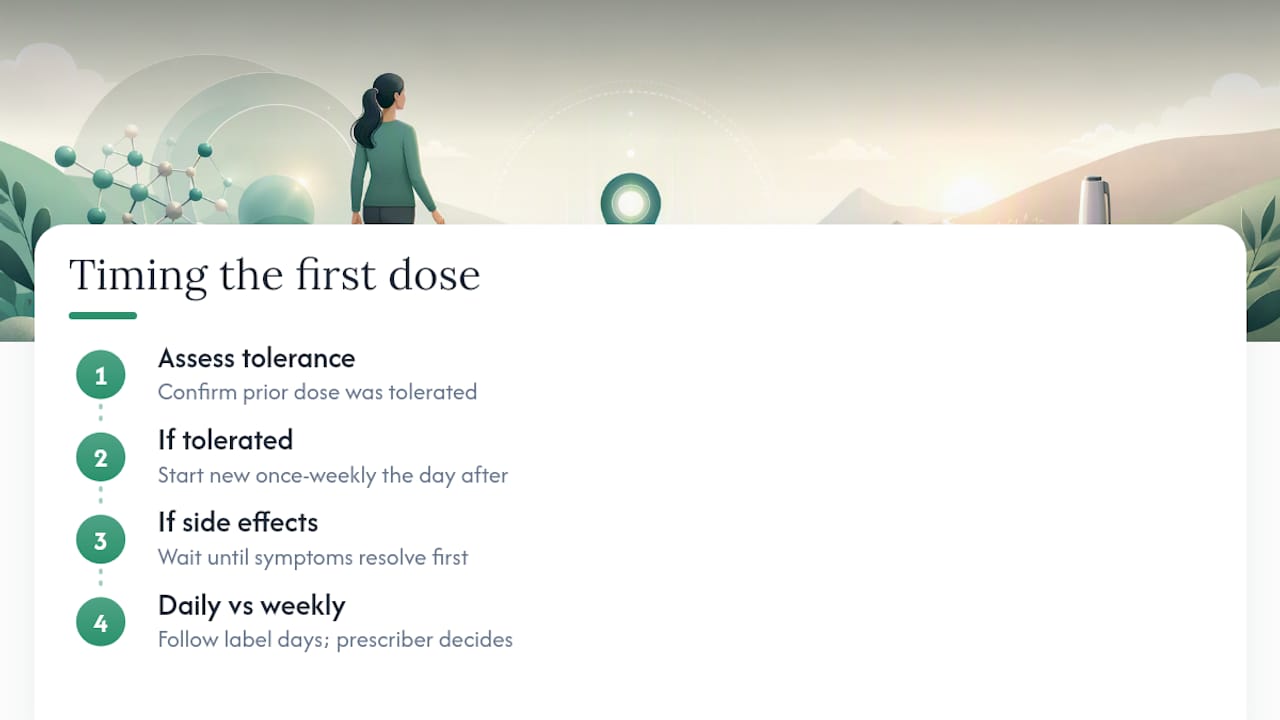
Moving from a daily oral agent to a weekly injectable, or the reverse, follows different logic entirely. Injectable-to-oral semaglutide transitions have their own label-based timing windows, usually measured in days rather than weeks. Your prescriber will map this to the specific molecules involved.
Setting the new starting dose
Your new medication almost always starts at its lowest labeled dose, regardless of what dose you were on for the old one. There is no milligram-for-milligram conversion between semaglutide and tirzepatide. They’re different molecules with different receptor activity, so a 2 mg semaglutide dose doesn’t translate to any specific tirzepatide number.
What to do if something goes wrong early on
- Severe or persistent nausea and vomiting: Call your prescriber’s office; don’t just stop cold or push through blindly.
- Signs of hypoglycemia (shakiness, confusion, sweating) if you’re also on insulin or a sulfonylurea: check your blood glucose immediately and treat per your usual low-glucose protocol, then report it.
- Marked dizziness or fainting: Stop the medication and contact your provider the same day.
- Signs of pancreatitis (severe abdominal pain radiating to the back, persistent vomiting): seek urgent care and stop the medication until evaluated.
Pro Tip: Keep your old medication’s box or pen until you’ve confirmed the new one is tolerable. If you need to pause and revert temporarily on your prescriber’s advice, you’ll want the details on hand.
How Do Titration Schedules Change Between Semaglutide and Tirzepatide?
Titration always restarts from the bottom when you switch molecules, and the specific starting dose depends on which direction you’re going.
- Starting tirzepatide after semaglutide: Product labeling typically calls for a 2.5 mg starting dose regardless of your prior semaglutide dose, with increases at labeled intervals based on tolerability.
- Starting semaglutide after tirzepatide: Some on-ramp protocols use a 0.25 mg starting dose, again independent of what tirzepatide dose you were previously on.
- Injectable-to-oral semaglutide or the reverse: Follows its own label-specific schedule rather than either of the above.
Semaglutide’s pharmacokinetics add a wrinkle that tirzepatide switches from other drugs don’t always have. Its long half-life means that after a higher dose, meaningful drug levels can persist in your system for several weeks. Some clinicians build in a longer interval before starting a new GLP-1 in that scenario, specifically to avoid overlapping GI or metabolic effects during the transition. This isn’t universal practice, and it depends on your dose history and how you tolerated the drug, but it’s a real pharmacokinetic reason your prescriber might tell you to wait longer than the standard “day after your last dose” rule.
Your prior dose and how well you tolerated it should shape where you start, even within labeled ranges. Someone who was maxed out on semaglutide 2.4 mg and tolerated it well is a different case than someone who never got past 1 mg because of nausea. The second patient may warrant an even more conservative approach on the new drug, extra caution your prescriber will factor in even though the label doesn’t spell it out drug by drug.
One administrative wrinkle worth knowing: Mounjaro and Zepbound both contain tirzepatide as their active ingredient, but they carry different FDA indications (diabetes versus weight management) and require separate prescriptions. Moving between them is a paperwork change, not a pharmacological one, since neither drug is more potent than the other at equivalent doses.
Managing Side Effects and Adjusting Other Medications
Nausea, mild vomiting, constipation, or diarrhea in the first few weeks after a switch is common, and it’s usually dose-related rather than a sign something is wrong. These symptoms tend to fade as your body adjusts, particularly if titration moves slowly.
A few practical steps make a real difference:
- Eat smaller meals more frequently instead of large ones.
- Cut back on fatty or greasy foods for the first week or two after a dose increase.
- Stay ahead of hydration, especially if diarrhea shows up.
- Contact your provider if vomiting prevents you from keeping fluids down, or if symptoms haven’t improved after a couple of weeks at a stable dose.
Conservative up-titration paired with these dietary tweaks is one of the lowest-risk, highest-payoff strategies available for reducing GI symptoms during any switch.
Other diabetes medications almost always need a second look when you start a new GLP-1. Sulfonylureas carry real hypoglycemia risk once a GLP-1 is added or changed, and many prescribers reduce the sulfonylurea dose at the same time, sometimes before the switch even happens. Insulin doses frequently need downward adjustment too, particularly if your appetite drops and your overall carbohydrate intake changes. This is exactly why increased glucose monitoring, checking more often than your usual routine for the first several weeks, matters so much during a switch.

DPP-4 inhibitors are commonly discontinued when a GLP-1 is started, since the two drug classes overlap in mechanism and combining them adds little benefit. Never stop or adjust any of these medications without confirming the plan with your prescriber first. Full safety and monitoring guidance for GLP-1 therapy covers this in more depth.
When Should You Reassess After Switching?
Clinical guidance points to a 2 to 3 month reassessment window after any GLP-1 switch, timed to evaluate both tolerability and early therapeutic response. This isn’t a random checkpoint. It’s roughly how long it takes to complete initial titration and see whether side effects are settling down.
Full benefit takes longer than most patients expect. Practitioners generally counsel that maximal glycemic improvement can take up to six months, while weight trajectories often keep shifting for 9 to 12 months after a switch. Changing medications again after just six weeks because the scale hasn’t moved much is usually premature.
Standard monitoring during this window includes:
- A1C rechecks on a schedule your prescriber sets, typically every 3 months if you have diabetes.
- Regular weight tracking, ideally at consistent times and conditions.
- Kidney function labs when clinically indicated, particularly if you’re on other renally cleared medications.
- Hypoglycemia logs if you’re also using insulin or a sulfonylurea.
A further change is reasonable if intolerance persists despite adequate titration time, if efficacy still hasn’t materialized after the full reassessment window, or if a new clinical development, a diagnosis, a formulary change, changes the calculus entirely.
How Legacy Meds Supports a Safe Medication Switch
Switching GLP-1 medications well requires exactly the kind of ongoing access this drug class generally makes hard to get: a clinician who knows your history, a titration plan built around your specific case, and a follow-up cadence that actually happens.
Legacymeds structures its program around that gap. Every patient gets an initial clinician assessment, a personalized titration plan when starting or switching medications, and continuing access to a provider without a separate consultation fee each time a question comes up.
Switching therapy isn’t about restarting from zero. It’s about carrying forward what worked, adjusting what didn’t, and giving the new medication a fair, supervised trial before judging the result.
What this looks like in practice:
- Free provider visits at the start of care and at follow-up points, including when a switch is being considered.
- Unlimited coaching access between visits, useful for the exact GI-symptom questions that come up in the first weeks after a switch.
- A titration schedule aligned to product labeling rather than a generic one-size-fits-all ramp.
- Written safety information patients can reference between visits.
Telehealth follow-up maps directly onto the 2 to 3 month reassessment window clinical consensus recommends, so switching patients get checked at the moments that actually matter.
Contraindications and Comorbidities That Shape Your Options
Not every GLP-1 or dual-agonist is appropriate for every patient, and this matters as much when switching as when starting fresh. A personal or family history of medullary thyroid carcinoma or multiple endocrine neoplasia syndrome type 2 generally rules out the entire drug class, regardless of which specific agent you’re considering.
Pancreatitis history deserves careful discussion with your prescriber before any switch, since it’s a known risk consideration across this drug class. Severe gastrointestinal disease, including gastroparesis, can make GLP-1 therapy harder to tolerate generally, which matters if GI intolerance was your reason for wanting to switch in the first place. Pregnancy and active plans to conceive are also reasons to pause the entire drug class rather than simply pick a different agent within it.
Kidney function, while not an absolute contraindication for most GLP-1s, influences dosing caution and monitoring frequency, particularly if you’re also on other renally cleared medications. Diabetic retinopathy history has come up in some rapid-improvement scenarios with semaglutide specifically, which is one reason your eye health history is worth mentioning if you’re moving toward that molecule.
None of these considerations should be self-diagnosed from a label insert. They’re exactly the kind of individualized factors that shape which specific agent makes sense for you, and why the switching decision belongs in a conversation with a prescriber who has your full history, not a general comparison chart.
Navigating Insurance Coverage When You Switch
Formulary changes are one of the most common non-medical triggers for a GLP-1 switch, and they tend to arrive without much warning. Your insurer can change which drugs it covers, add new prior authorization requirements, or shift a medication to a higher cost tier at any renewal cycle.
If cost or coverage is driving your switch, bring documentation to your appointment: the denial letter, the formulary update notice, or the new copay tier information. That paperwork gives your prescriber something concrete to act on, whether that means requesting a prior authorization, submitting an appeal, or simply choosing a covered alternative from the start.
Manufacturer savings cards and patient assistance programs exist for several GLP-1 brands and can meaningfully offset cost, though eligibility and savings amounts vary by insurance status and income. It’s worth asking your pharmacist or prescriber’s office directly what’s currently available, since these programs change frequently.
Direct-pay telehealth programs sidestep some of this complexity entirely by pricing medication and care access without routing through insurance formularies at all. That’s a different tradeoff, not automatically cheaper for everyone, but worth comparing against your current insurance-based costs, especially if you’re facing a step-therapy requirement or a denial. Legacymeds’ pricing and insurance FAQ walks through how that comparison typically plays out.
Watching for Rare but Serious Reactions After a Switch
Most switch-related side effects are mild GI symptoms that fade with time. A small number of reactions are serious enough that they need immediate medical attention, and it’s worth knowing what they look like before you need that information in a hurry.
Acute pancreatitis presents as severe, persistent abdominal pain, often radiating to the back, sometimes with vomiting that doesn’t let up. This requires urgent evaluation and stopping the medication until you’re assessed. Gallbladder problems, including gallstones, can also emerge during GLP-1 therapy and present as right-upper-abdominal pain, particularly after fatty meals.
Signs of an allergic reaction, facial or throat swelling, difficulty breathing, widespread hives, need emergency care immediately, not a call to the office the next morning. Severe or persistent vomiting that prevents you from keeping fluids down risks dehydration and kidney strain and also warrants same-day contact with your care team.
If you’re on insulin or a sulfonylurea alongside your GLP-1, watch closely for hypoglycemia symptoms, especially in the first few weeks of a switch when doses of those other medications may not yet be fully adjusted. Confusion, sweating, shakiness, or a fast heartbeat that resolves with fast-acting sugar should still be reported, since it usually signals a needed dose change rather than something to just manage repeatedly on your own.
Keep a symptom log during the first month after any switch. It sounds tedious, but a written record of timing and severity gives your prescriber far better information than a vague “I’ve been feeling off” at your next visit.
Keeping Your Care Team in the Loop During a Switch
A GLP-1 switch touches more than just the prescriber writing the new prescription. Your primary care physician, any endocrinologist involved in diabetes management, and your pharmacist all benefit from knowing a change is happening, ideally before it does.
Ask whichever provider initiates the switch to send updated medication lists to your other treating clinicians, particularly your primary care doctor if a specialist or telehealth provider is managing the switch. This matters most when insulin or sulfonylurea doses are being adjusted at the same time, since an out-of-date medication list anywhere in your records raises real risk of a dosing error.
Keep your own copy of the switch plan: old medication and dose, new medication and starting dose, the date of the first new dose, and any temporary changes to other diabetes medications. A simple note in your phone works fine. This becomes invaluable if you end up in an urgent care setting or emergency room during the transition period, where a clinician who has never seen you before needs the full picture fast.
If multiple specialists are involved, a cardiologist for cardiovascular risk factors, a nephrologist for kidney disease, make sure each one is aware of the switch and the reasoning behind it. Coordinated care isn’t just a nice ideal here. It’s the difference between a smooth transition and a preventable gap in your treatment.
Helping Patients Understand and Stick With a New Medication
Understanding why a switch is happening makes patients far more likely to stick with the new regimen through the adjustment period, rather than abandoning it at the first sign of nausea.
Effective education starts with a clear, specific reason: not just “we’re changing your medication,” but “your A1C has plateaued and this new option has a different mechanism that may work better for you.” Patients who understand the rationale tolerate the early adjustment weeks with more patience, because they know what to expect and why it’s worth pushing through.
Written materials matter more than most prescribers realize. A one-page summary covering the new dose schedule, expected side effects, and a direct number to call with questions reduces the anxious, uncertain calls that otherwise flood in during week two. Setting expectations about the timeline, up to six months for full glycemic benefit, up to a year for weight trajectory, prevents the common mistake of judging a switch too early and abandoning it before it’s had a fair chance to work.
Encouraging patients to keep a simple symptom and dose journal accomplishes two things at once: it gives the patient a sense of control during an uncertain period, and it gives the prescriber real data at the next visit instead of a vague recollection. That combination, clear rationale plus concrete tools, is what actually drives adherence through a medication switch, more than any single piece of advice about the drugs themselves.
What Actually Matters When You Switch GLP-1 Medications
The conventional advice on switching GLP-1s focuses almost entirely on dosing math, and that’s a mistake. The harder problem isn’t calculating a starting dose. It’s the two to three months of uncertainty between “we made a change” and “we know if it worked,” and most patients get very little support during exactly that window.
Clinical consensus is clear that switches should optimize outcomes, not happen for their own sake. But consensus documents don’t call your insurance company or answer your 9 p.m. question about whether nausea on day four is normal. That gap between published guidance and lived support is where switches actually succeed or fail. A patient who understands the six-month glycemic timeline and has someone to call in week two will stick with a switch through the rough patch. A patient left alone with a new pen and a pamphlet usually won’t.
If you’re considering a switch, prioritize access to a responsive clinician over the specific drug you’re switching to. The molecule matters less than whether someone is watching your progress at the 2 to 3 month mark.
Ready to Switch GLP-1 Medications With Support at Every Step
If a formulary change, a stalled result, or side effects have you thinking about switching, Legacymeds gives you what the switching literature actually recommends: a clinician-guided titration plan and a real reassessment checkpoint, without the cost of a membership fee or an insurance requirement standing between you and care.
Every patient starts with a free provider visit where your current medication, dose history, and reasons for wanting a change get reviewed before anything is prescribed. From there, your titration plan for the new medication follows product labeling, timed around your last dose of the current one, with unlimited coaching access if side effects or questions come up in between visits. That ongoing access matters most in exactly the weeks clinical guidance flags as highest-risk for a switch: the first month, and the 2 to 3 month reassessment point.
If you’re ready to talk through switching to semaglutide, tirzepatide, or a different formulation entirely, start your provider assessment and get a plan built around your history rather than a generic dosing chart.
Sources
- Switching between GLP‐1 receptor agonists in clinical practice: Expert consensus and practical guidance
- Switching Between Glucagon-Like Peptide-1 Receptor Agonists (PMC)
- Zepbound vs Mounjaro comparison (Healthline)
FAQ
How do I switch from one GLP-1 medication to another?
Schedule a visit with your prescriber to review your current dose and tolerability, then follow a label-based titration plan for the new medication, typically starting it shortly after your last dose of the previous one.
Is it safe to switch GLP-1 medications?
Yes, switching is common and considered safe when it’s clinician-supervised, with the new drug started at its lowest dose and reassessment scheduled around 2 to 3 months later.
Can you switch between Mounjaro and Zepbound?
Both contain the same active ingredient, tirzepatide, so switching between them is an administrative change requiring a new prescription rather than a different medication effect.
How do I switch from Ozempic to Mounjaro, and what dose should I start?
Your prescriber will typically start tirzepatide at its lowest labeled dose, often 2.5 mg, regardless of your prior semaglutide dose, since there’s no direct milligram conversion between the two drugs.
What can Legacymeds do if I want to switch my GLP-1 medication?
Legacymeds provides a free clinician assessment, a personalized titration schedule for the new medication, and unlimited coaching access through your reassessment period at no added membership cost.