

If you take oral birth control and you’re starting tirzepatide (Mounjaro or Zepbound), you need to know this before your first injection: tirzepatide can meaningfully reduce how much of your oral contraceptive your body absorbs. A single-dose pharmacokinetic study found that co-administering a 5 mg tirzepatide dose with an ethinylestradiol + norgestimate (EE/NGM) oral contraceptive reduced overall hormone exposure (AUC) by roughly 21–23% and cut peak blood levels (Cmax) by 55–66%. Those are not small shifts. The manufacturer’s guidance is direct: switch to a non-oral contraceptive method or add a barrier method for 4 weeks after starting tirzepatide and for 4 weeks after every dose escalation.
The key facts at a glance:
- Tirzepatide slows gastric emptying, which reduces how quickly and completely oral drugs are absorbed.
- The effect is largest right after the first dose and after each dose increase.
- AUC (total exposure) drops ~21–23%; Cmax (peak level) drops ~55–66% based on the EE/NGM single-dose trial.
- The 4-week backup window covers the period of greatest vulnerability.
- Non-oral methods (IUDs, implants, injectables, patch, ring) are generally not expected to be affected.
Pro Tip: Mark your calendar the day you take your first tirzepatide injection or increase your dose. Set a reminder 4 weeks out. That window is when your pill is most likely to underperform.
Key Takeaways
| Point | Details |
|---|---|
| Oral pills are vulnerable | AUC drops ~21–23% and Cmax drops ~55–66% when oral contraceptives are taken with tirzepatide. |
| 4-week backup rule applies | Use a barrier method or switch to a non-oral method for 4 weeks after initiation and each dose escalation. |
| Non-oral methods are safer | IUDs, implants, injectables, patches, and rings bypass GI absorption and are generally not expected to be affected. |
| Effect diminishes over time | Tachyphylaxis reduces the gastric-emptying delay with repeated weekly dosing, but guidance stays conservative. |
| Escalations reset the window | Every dose increase restarts the 4-week vulnerability period, not just the first injection. |
Table of Contents
- How does tirzepatide interact with oral medications?
- What does the clinical evidence actually show?
- Which birth control methods are affected and which are not?
- Your step-by-step plan when starting or changing tirzepatide
- Why tirzepatide may affect oral contraceptives more than other GLP-1 drugs
- A clinician’s perspective on managing this interaction
- Start your tirzepatide journey with the right support
- Sources
- FAQ
How does tirzepatide interact with oral medications?
Tirzepatide is a dual GLP-1 and GIP receptor agonist, sold under the brand names Mounjaro (for type 2 diabetes) and Zepbound (for weight management). Both drugs activate two gut hormone pathways simultaneously, and one of the most clinically significant effects of that dual activation is a pronounced slowdown in gastric emptying, meaning food and orally ingested substances move from the stomach into the small intestine more slowly than normal.
That delay matters for any drug you swallow. Slower gastric emptying changes when a drug reaches the intestine for absorption, which compresses the absorption window and lowers peak blood concentrations. For most medications, this is a minor nuisance. For oral contraceptives, where consistent hormone levels are what prevent ovulation, the drop can be clinically meaningful.
The effect is not constant. It is largest after the very first dose and after each dose escalation, then diminishes over repeated weekly injections through a process called tachyphylaxis. Your body adapts to the gastric-emptying delay over time. That is reassuring for long-term users, but it is exactly why the first 4 weeks after any dose change are the window that demands attention. For more on GLP-1 medication safety, including how these drugs interact with other substances, that context matters before you start.
What does the clinical evidence actually show?
The primary data come from a controlled pharmacokinetic study (ClinicalTrials.gov NCT04172987) that enrolled healthy female participants on a 28-day EE/NGM oral contraceptive regimen. Researchers administered a single 5 mg subcutaneous tirzepatide dose and measured what happened to contraceptive hormone levels. The protocol required participants to use additional highly effective contraception throughout the study, which tells you something about how seriously the researchers took the pregnancy risk.

The results were notable. According to the Certara Drug Interaction Database monograph, AUC for the contraceptive components fell by approximately 21–23% and Cmax fell by approximately 55–66%. The Cmax drop is the more striking number: peak hormone levels were cut by more than half. That parallel supports the tachyphylaxis explanation.
| Measure | Change with tirzepatide (single 5 mg dose) | Evidence basis |
|---|---|---|
| AUC (total exposure) | ~21–23% decrease | Single-dose PK study, EE/NGM |
| Cmax (peak level) | ~55–66% decrease | Single-dose PK study, EE/NGM |
| Effect at steady state | Likely reduced (tachyphylaxis) | Acetaminophen parallel data |
A JAPhA literature review that surveyed GLP-1 receptor agonist studies concluded that tirzepatide appears to have a greater impact on oral hormonal contraceptive absorption than most other GLP-1 agents, most of which showed little to no effect in their own trials. The review also called for stronger patient education on this interaction.
Two important limits apply here. First, the core data come from a single-dose study, not a multi-week steady-state trial. Second, tachyphylaxis suggests the real-world impact at week 6 or week 10 of tirzepatide therapy is probably smaller than the single-dose numbers imply. Still, guidance stays conservative because an unintended pregnancy is a serious outcome, and the Zepbound FDA package insert reflects that reasoning explicitly.
Which birth control methods are affected and which are not?
The short answer: oral pills are the vulnerable category. Everything that bypasses your gastrointestinal tract is largely in the clear.
Methods likely affected:
- Combined oral contraceptive pills (estrogen + progestin, like EE/NGM)
- Progestin-only pills (the “mini-pill”) — same absorption pathway, same theoretical risk
Methods generally not expected to be affected:
- Hormonal IUD (Mirena, Kyleena, Liletta, Skyla) — releases hormones locally, no GI absorption
- Copper IUD (Paragard) — non-hormonal, purely mechanical
- Subdermal implant (Nexplanon) — delivers progestin directly into the bloodstream
- Depot medroxyprogesterone injection (Depo-Provera) — intramuscular, bypasses the gut entirely
- Transdermal patch (Xulane, Twirla) — absorbed through skin, not the stomach
- Vaginal ring (NuvaRing, Annovera) — absorbed through vaginal mucosa
The patch and ring are worth a brief note. They are not swallowed, so tirzepatide’s effect on gastric emptying does not apply to them directly. Manufacturer guidance generally treats non-oral hormonal routes as not expected to be impacted, though formal PK studies on patch and ring co-administration with tirzepatide are limited.
Barrier methods (condoms, diaphragm) are unaffected by definition and serve as the recommended backup during the 4-week windows.
Your step-by-step plan when starting or changing tirzepatide
-
Before your first injection: Talk to your prescribing clinician and your OB-GYN or primary care provider about your current contraceptive method. If you use oral pills, this conversation needs to happen before dose one, not after.
-
Decide on your approach: Either switch to a non-oral method (IUD, implant, injection, patch, or ring) before starting tirzepatide, or commit to using a barrier method (condoms) consistently for the full 4 weeks following your first injection.
-
Mark the 4-week window: The Zepbound prescribing information and the Drugs.com interaction monograph both flag the 4 weeks after initiation and after each dose escalation as the highest-risk period. Write down the date of every dose change.
-
Repeat the backup plan at every escalation: Tirzepatide is typically titrated upward every 4 weeks. Each escalation restarts the vulnerability window. Plan for backup contraception at each step, not just at the start.
-
If you had unprotected sex during a vulnerable window: Consider emergency contraception (Plan B or ella) promptly. Take a pregnancy test if your period is late or you have any symptoms. Contact your provider the same day.
-
Questions to ask your clinician:
- Is my specific pill formulation the one studied, or is there data on my exact brand?
- Should I switch to an IUD or implant before I start tirzepatide?
- Do I need backup contraception after every future dose escalation?
- What is your preferred protocol for patients on rapid titration schedules?
Reproductive health organizations, including ReproductiveAccess, have published clinical guidance echoing exactly this approach: proactive counseling, documented backup planning, and a low threshold for switching to long-acting reversible contraception (LARC) when pregnancy prevention is a high priority.
Why tirzepatide may affect oral contraceptives more than other GLP-1 drugs
Most GLP-1 receptor agonists studied to date, including semaglutide (Ozempic, Wegovy), showed little to no clinically significant effect on oral contraceptive pharmacokinetics in their own trials. Tirzepatide’s dual GLP-1 and GIP agonism appears to produce a stronger initial delay in gastric emptying than single-pathway agents, which likely explains why its single-dose PK data showed such pronounced Cmax reductions.
The JAPhA review noted this distinction explicitly: tirzepatide stood out among GLP-1 class drugs for the magnitude of its observed effect on oral hormonal contraceptive absorption. That does not mean other GLP-1 agents are risk-free, but the evidence base for concern is currently stronger for tirzepatide.
Tachyphylaxis is the other piece of the picture. The gastric-emptying delay is not a fixed, permanent effect. It is largest right after the first dose and shrinks with repeated weekly injections as the body adapts.
The 4-week backup rule is not based on evidence that oral contraceptives fail at steady state. It is a conservative, pregnancy-prevention buffer that covers the most pharmacologically volatile period — the first weeks after a new dose — when the data are most concerning and the stakes of getting it wrong are highest.
A clinician’s perspective on managing this interaction
The interaction between tirzepatide and oral contraceptives is real, plausible, and supported by pharmacokinetic data. But it is also manageable with a straightforward plan, and it should not be a reason to avoid tirzepatide if it is the right medication for you.
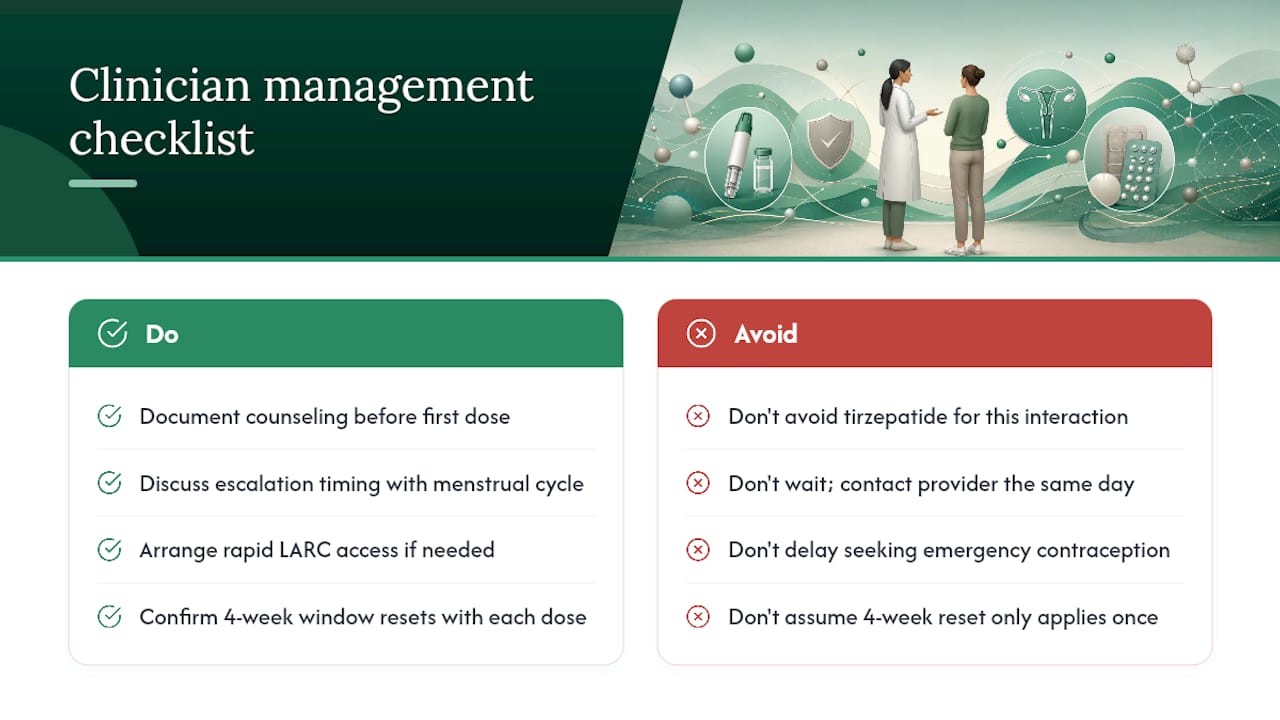
Clinicians who prescribe tirzepatide regularly document contraceptive counseling in the chart before the first injection. They discuss the timing of dose escalations relative to the patient’s menstrual cycle, arrange rapid access to LARC when pregnancy prevention is a high priority, and confirm that the patient understands the 4-week window resets with each dose increase. That last point is the one most patients miss: it is not just about the first shot.
Missed periods, a positive pregnancy test, or any concern about contraceptive failure during a vulnerable window are reasons to call your provider the same day, not to wait for your next scheduled visit. Emergency contraception is most effective within 72 hours of unprotected sex, and ella (ulipristal acetate) extends that window to 120 hours.
The broader takeaway is that starting tirzepatide is an opportunity to revisit your contraceptive plan entirely. If you have been meaning to switch to an IUD or implant, this is a practical moment to do it. You get more reliable contraception, you eliminate the interaction concern, and you reduce one variable in an already complex medication regimen.
Start your tirzepatide journey with the right support

Managing tirzepatide safely means having a provider who understands the full picture, including how it interacts with other medications; for detailed patient guidance, see Tirzepatide Side Effects: What You Need to Know | GLPCare. Legacymeds offers a personalized GLP-1 weight loss program with free provider visits, unlimited coaching, and no insurance or membership fees required. If you’re ready to explore tirzepatide or want guidance on starting safely, get your online weight loss prescription with a telehealth provider who can walk through your full medication profile, including your contraception, before dose one.
Sources
- tirzepatide monograph - Certara Drug Interaction Database
- Can adults with obesity or overweight taking Zepbound® (tirzepatide) also take oral contraceptives?
- The impact of tirzepatide and glucagon-like peptide 1 … (JAPhA literature review)
- A Study of the Effect of Tirzepatide on How the Body Handles Birth Control Pills in Healthy Female Participants
- ZEPBOUND (Eli Lilly and Company): FDA Package Insert, Page 4
FAQ
Does tirzepatide reduce the effectiveness of birth control pills?
Yes, it can.
What birth control is best while taking Zepbound?
Non-oral methods are the safest choice. IUDs (hormonal or copper), subdermal implants, depot injections, the transdermal patch, and the vaginal ring all bypass gastrointestinal absorption and are generally not expected to be affected by tirzepatide’s effect on gastric emptying.
Does GLP-1 medication interfere with birth control?
Most single-agent GLP-1 receptor agonists showed little effect on oral contraceptive pharmacokinetics in their own trials. Tirzepatide, a dual GLP-1 and GIP agonist, produced more pronounced reductions in a controlled study, making it the GLP-1 class drug with the strongest current evidence for this interaction.
Do I need backup contraception every time my tirzepatide dose increases?
Yes. The manufacturer recommends using a non-oral method or adding a barrier method for 4 weeks after initiation and for 4 weeks after each dose escalation, because the gastric-emptying effect is largest right after a new or higher dose.
This article is for general informational purposes only and is not a substitute for professional medical advice. Confirm your contraceptive plan with your prescribing clinician or OB-GYN before starting or changing tirzepatide.