

The single biggest lever against that trend is planning the stop with your prescriber and lining up a structured maintenance plan built around protein, resistance training, and regular monitoring before you take your last dose, not after.
TL;DR:
- About 60% of weight loss from GLP-1 drugs like Wegovy returns within one year, with most people regaining roughly 0.4 kg per month initially.
- Stopping GLP-1 therapy leads to rapid appetite rebound and metabolic adjustments, making weight regain faster and more pronounced early on.
- A structured transition plan, including high protein intake and resistance training, can help preserve muscle and slow physiological rebound after stopping the medication.
- Regular monitoring of weight and cardiometabolic markers is essential, with lab checks at three, six, and twelve months to catch early signs of regain.
- Long-term success depends on ongoing lifestyle support and clinician-guided adjustments, not just medication continuation or abrupt discontinuation.
Table of Contents
- How Much Weight Comes Back, and How Fast
- Medical Options and Clinician-Planned Transition Steps
- Eating to Mimic What the Drug Was Doing for You
- Training Your Body to Hold Onto Its Progress
- Managing Appetite and Staying Accountable Without the Drug
- Watching the Numbers That Matter Beyond the Scale
- Clinician Perspective: Reframing What Success Looks Like
- Sources
- FAQ
How Much Weight Comes Back, and How Fast
A 2026 systematic review and nonlinear meta-regression tracking patients after they stopped GLP-1 receptor agonists found that regain isn’t gradual and steady. It’s fast early, then it slows.
Other data point to similar territory: trial extensions and cohort studies show average monthly regain near 0.4 kilograms, with some groups regaining roughly two thirds of their loss within twelve months.
By the numbers: ~60% of lost weight returns at 1 year. Projected plateau: ~75%. Average pace: about 0.4 kg per month.
The mechanism isn’t a mystery. Semaglutide suppresses appetite by mimicking a gut hormone that slows stomach emptying and signals fullness to the brain. Stop the drug, and that signal fades within weeks. Hunger returns, often described by patients as “food noise,” while the body’s metabolic rate has already adjusted downward to match its new, smaller size. That combination, a stronger appetite drive meeting a body running on fewer calories than before, is what drives the rebound.
Medical Options and Clinician-Planned Transition Steps
Should you taper off Wegovy or stop cold? The honest answer is that the evidence doesn’t clearly favor one approach over the other yet. Research on GLP-1 discontinuation beyond the four-year mark remains sparse, so most guidance leans on clinical judgment rather than a settled protocol. Some prescribers reduce the dose gradually over several weeks before stopping entirely; others space out doses further apart as a middle step. Neither method has been shown to prevent regain outright, but both give your body, and your habits, more runway to adjust.
What matters more is what happens around the stop. Harvard Health’s clinician guidance recommends building your nutrition, activity, and monitoring plan before the last dose, not scrambling afterward.
Bring these questions to your prescriber:
- What are the risks of stopping now versus continuing at a lower dose?
- Should I switch to a different medication, such as tirzepatide, instead of stopping?
- How often should I have my weight, blood pressure, HbA1c, and lipids checked after I stop?
- What’s the plan if I start regaining weight quickly?
- At what point would you consider restarting therapy?
A reasonable monitoring cadence: weight checks every one to two weeks, and labs (HbA1c, lipids, blood pressure) at three and six months post-cessation. If you’re considering a different medication path entirely, this guide to switching GLP-1 medications walks through what a safe transition between drugs looks like.
Eating to Mimic What the Drug Was Doing for You
Wegovy did two jobs for your appetite: it made you feel full faster, and it kept you feeling full longer. Your diet now has to do both of those jobs without pharmacological help.
- Hit a real protein target. Aim for 25 to 35 grams per meal. Protein has the highest thermic effect of any macronutrient, meaning your body burns more calories digesting it, and it’s the single best tool for protecting lean muscle mass while your total calorie intake stays moderate.
- Load up on soluble fiber and high-volume foods. Oats, beans, lentils, and non-starchy vegetables take up physical space in your stomach and slow digestion, which stretches out the feeling of fullness closer to what semaglutide was producing.
- Eat on a schedule, not on willpower. Meals every three to five hours prevent the blood-sugar crashes that trigger the intense hunger spikes people describe once appetite suppression fades.
- Keep protein-forward snacks within reach. Greek yogurt, hard-boiled eggs, a handful of nuts, or a protein shake in your bag or desk drawer beats scrambling for whatever’s closest when hunger hits hard.
- Swap smart, not small. Trade white rice for a mix of rice and lentils, swap a bagel for eggs and avocado, or replace a soda with sparkling water and protein. Small substitutions compound.
Pro Tip: Batch-cook protein at the start of the week (grilled chicken, hard-boiled eggs, cooked lentils) so the highest-friction meal decision, “what protein do I add?”, is already solved before hunger sets in.
One caution: high-protein eating isn’t automatically safe for everyone. If you have chronic kidney disease or another condition affecting protein metabolism, talk to your prescriber before pushing protein intake up significantly.
Training Your Body to Hold Onto Its Progress
Diet alone won’t protect the muscle you built or the metabolic rate you’re trying to defend. Resistance training is the piece most people underuse, and it’s arguably the most important one for long-term maintenance.
- Lift at least three times a week, hitting all major muscle groups (legs, back, chest, shoulders, core) across the week rather than isolating one area per session.
- Progress the load over time. Adding weight or reps every few weeks, rather than repeating the same routine indefinitely, is what actually preserves lean mass and keeps your resting metabolic rate from sliding.
- Push aerobic volume higher than the general public health minimum. CDC guidelines call for 150 minutes of moderate activity weekly for general health, but people maintaining significant weight loss often need closer to 300 minutes a week to counter the metabolic slowdown that follows major weight loss.
- Structure a realistic week: three strength sessions, two to three cardio sessions (walking, cycling, swimming), and at least one full rest day.
If preserving muscle while cutting calories feels like a moving target, this breakdown on preventing muscle loss during GLP-1 treatment covers the training adjustments in more depth.
Managing Appetite and Staying Accountable Without the Drug
The hunger that returns after stopping Wegovy isn’t a willpower failure. It’s biological, and treating it that way changes how you respond to it.
- Weigh yourself weekly, same day, same conditions. Daily fluctuations of one to three pounds are normal and mean nothing; a consistent upward trend across three or four weeks is the actual signal worth acting on.
- Protect your sleep. Sleeping under six hours regularly raises ghrelin (the hunger hormone) and blunts leptin (the fullness hormone), a combination that intensifies food noise on top of what’s already returning naturally.
- Stay ahead of dehydration. Thirst often masquerades as hunger, and it’s the easiest false signal to rule out before reaching for food.
- Use stimulus control. Keep trigger foods out of easy reach, and pre-plan snacks so decisions happen before hunger, not during it.
Pro Tip: If food noise feels louder than expected, that’s the drug wearing off, not a sign you’re doing something wrong. An accountability structure, whether that’s a coach, a support group, or a check-in partner, measurably helps people push through this phase.
Watching the Numbers That Matter Beyond the Scale
Weight isn’t the only thing that shifts after you stop. Cardiometabolic markers that improved on Wegovy can drift back toward baseline. Research covered by Oxford found systolic blood pressure rising by as much as 7 mmHg in some groups after semaglutide discontinuation, alongside worsening lipids and glucose control within roughly one to one and a half years.
Watch window: HbA1c, blood pressure, and lipid panels can trend back toward pre-treatment levels within 12 to 18 months of stopping.
Get labs rechecked at three, six, and twelve months post-cessation. Flag these to your prescriber right away:
- A weight gain trend that continues for three or more consecutive weeks
- Blood pressure readings climbing 5 mmHg or more above your post-treatment baseline
- HbA1c rising toward or past the prediabetes threshold
Any of those should trigger a conversation about medication review, whether that means adjusting your current plan, restarting therapy, or a referral to a specialist. This isn’t a sign you failed; it’s a sign your body needs a different approach right now.
Clinician Perspective: Reframing What Success Looks Like
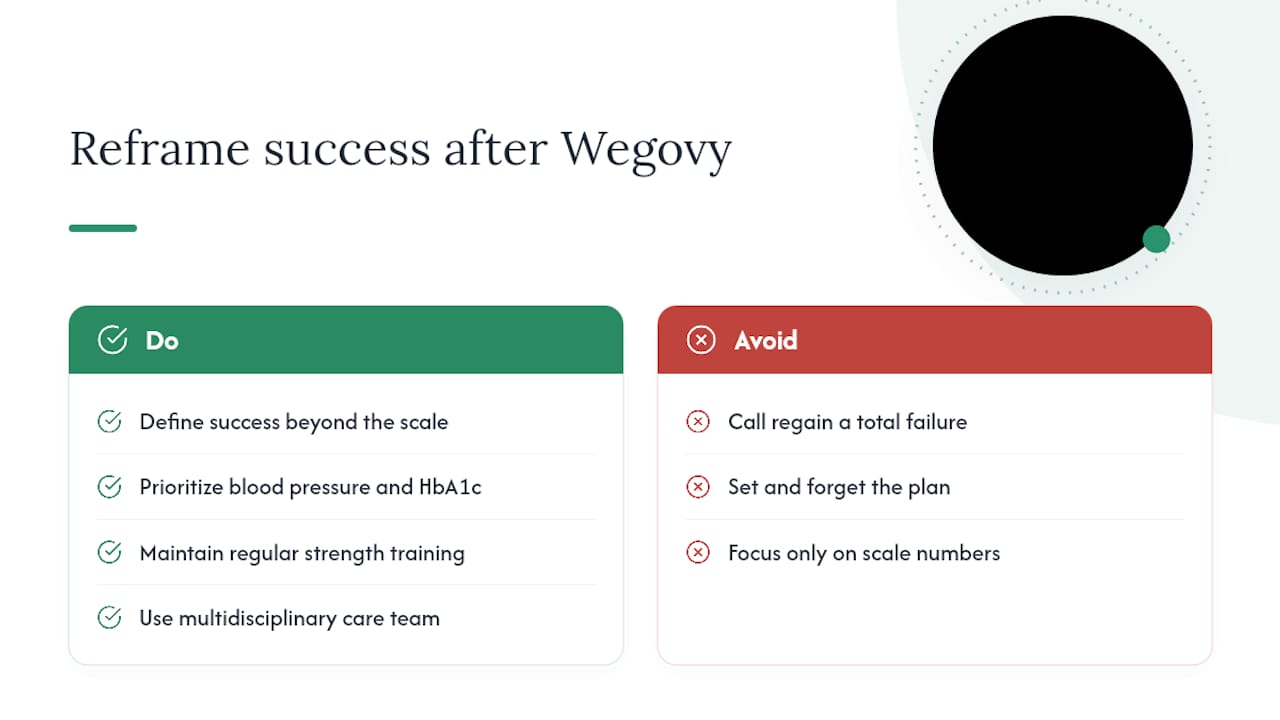
The framing that “you failed” if the scale creeps up after stopping Wegovy needs to go. Success after cessation isn’t zero regain. It’s minimizing regain and protecting the health markers that actually predict long-term outcomes, blood pressure, HbA1c, joint stress, sleep quality. A patient who regains 15 pounds but keeps their blood pressure controlled and stays consistent with strength training is doing better than the raw number suggests.
The strongest data we have points to a multidisciplinary approach, medical follow-up paired with nutrition and exercise support, as the highest-value path forward. That’s a shared decision between you and your prescriber, revisited over time, not a one-time plan you set and forget. Continuous-care models, whether clinic-based or telehealth, exist precisely because this isn’t a problem you solve once.
— Bryan
Sources
The trajectory and regain figures in this article come primarily from a 2026 nonlinear meta-regression on GLP-1 cessation and a systematic evidence summary on weight regain after anti-obesity drug discontinuation. Clinical transition guidance draws on Harvard Health’s practical advice for weaning off a GLP-1, and cardiometabolic reversal data comes from Oxford’s coverage of post-cessation health outcomes.
If you’re weighing whether to stay on therapy longer or explore your options, Legacy Meds’ GLP-1 weight loss program connects you with a provider who can build a transition plan around your specific health picture, no membership fees or insurance required. You can also review pricing and program logistics before booking a visit.
This article is general information, not a substitute for advice from a qualified doctor. Consult a qualified healthcare professional about your own circumstances before acting on anything here.
- Trajectory of weight regain after cessation of GLP-1 receptor agonists: a systematic review and nonlinear meta-regression
- Trajectory of the body weight after drug discontinuation in the treatment of anti-obesity medications
- Weaning off a GLP-1? Tips for the transition - Harvard Health
- New study finds stopping weight-loss drugs linked with faster regain ending diet (Oxford news coverage)
FAQ
How do you keep weight off after stopping Wegovy?
Combine a clinician-supervised transition plan with high protein intake, resistance training at least three times a week, and weekly weigh-ins to catch regain trends early, since lifestyle measures alone often only partially offset the appetite rebound that follows discontinuation.
Can you stay on Wegovy to maintain weight instead of stopping?
Yes, many prescribers recommend continuing GLP-1 therapy long-term for maintenance, since discontinuation studies consistently show regain once the drug is stopped; the decision should be made with your provider based on your health goals and response.
How many people maintain their weight loss after stopping Wegovy?
Most don’t fully maintain it. Roughly 60% of lost weight returns within one year of stopping, with regain trending toward a plateau near 75% over the longer term.
Does Wegovy become less effective over time?
Wegovy’s appetite-suppressing effect doesn’t typically diminish while you’re actively taking it and adhering to the prescribed dose; weight regain concerns arise after stopping the medication, not from declining effectiveness during treatment.