
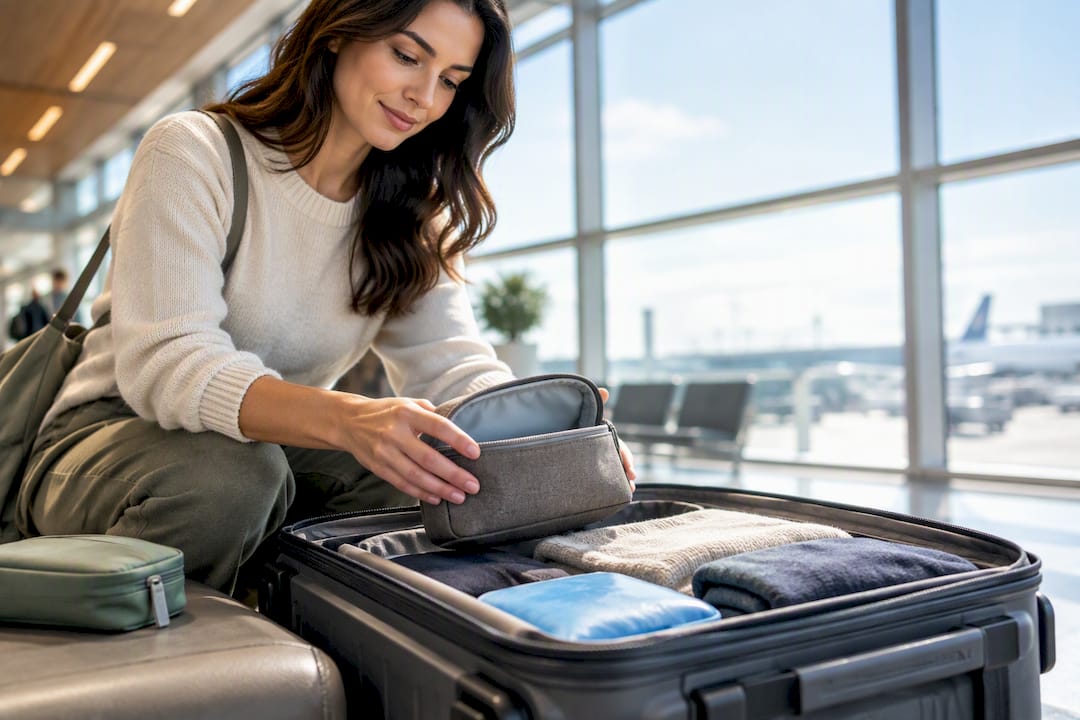
Yes, you can travel with Wegovy, in a carry-on, through airport security, and across borders, as long as you follow a few specific rules. Keep the pen in its original carton, pack it in your carry-on inside an insulated case, and carry your prescription and a clinician letter. Pens can handle up to 28 days unrefrigerated between 46°F and 86°F if the cap stays on, but they can never be frozen.
TL;DR:
- Wegovy pens are stable for up to 28 days at temperatures between 46°F and 86°F if kept in their original carton and cap has never been removed, but freezing ruins them.
- When traveling, always pack Wegovy in an insulated case with a thermometer strip and keep it away from direct ice contact to prevent freezing.
- Declare all medication and syringes at TSA checkpoints to avoid delays, and carry official documentation including a clinician letter when traveling internationally.
- For international trips, verify destination country rules, carry a prescription and clinician letter, and keep medications in their original labeled containers to prevent customs issues.
- Skipping doses is generally okay if missed by a few days, but contact your provider for advice if unsure or if your medication has been exposed to unsafe temperatures.
Table of Contents
- Storage Rules Every Wegovy Traveler Needs to Know
- Getting Wegovy Through TSA Without Delays
- What International Travel With Wegovy Requires
- Your Travel Day Checklist for Packing Wegovy
- Handling Missed Doses and Time Zone Shifts
- What to Do if a Wegovy Pen Malfunctions
- How Legacy Meds Supports Wegovy Travelers
- Why Planning Beats Improvising on Wegovy Trips
- Keep Your Treatment on Track While You Travel
- Sources
- FAQ
Storage Rules Every Wegovy Traveler Needs to Know
Wegovy is a temperature-sensitive drug, and the rules aren’t flexible just because you’re on vacation. The FDA prescribing information on DailyMed sets the standard: pens belong in the refrigerator at 36°F to 46°F. Once you’re away from a fridge, you get a 28-day window at 46°F to 86°F, but only if the pen’s cap has never been removed. After that window closes, or if the pen has ever frozen, it’s done. Wegovy tablets follow a different rule: they’re stable at 68°F to 77°F, with short excursions down to 59°F or up to 86°F tolerated.
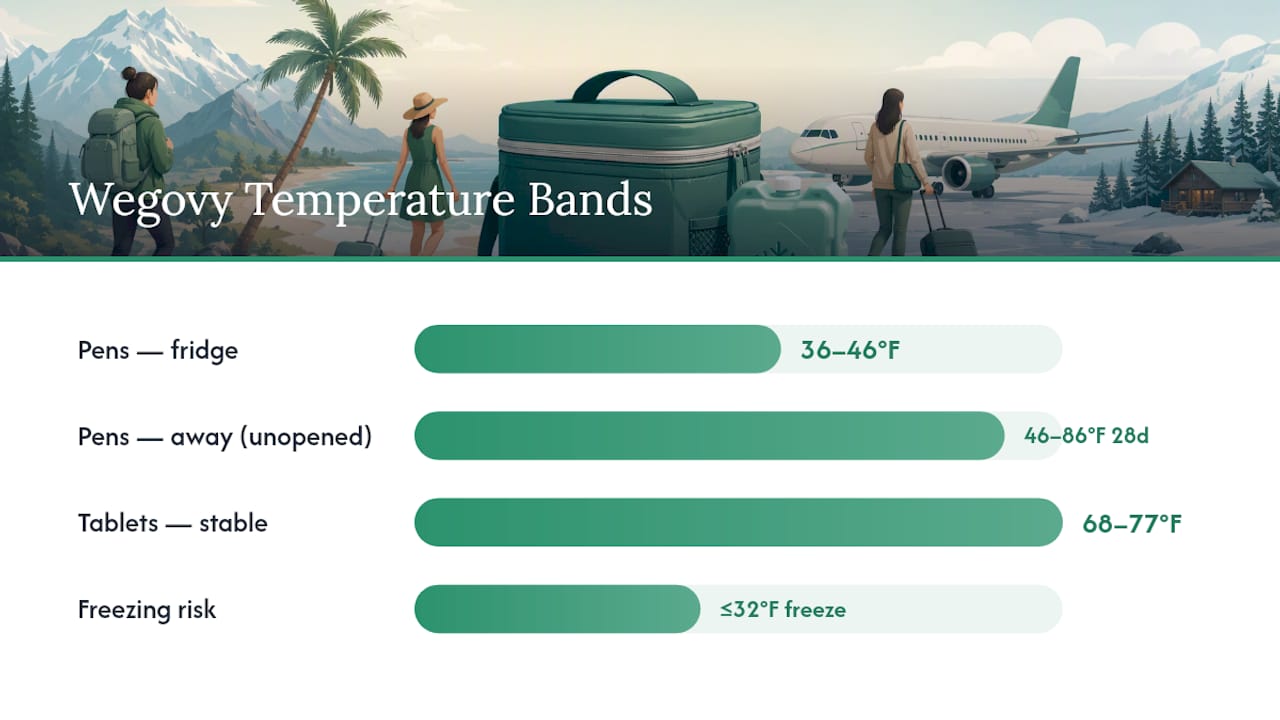
Freezing is the real danger on most trips, not heat. A pen packed against a frozen gel pack in a cooler, or left in an overhead bin near an air vent on a red-eye, can freeze without you noticing until the medication is already compromised. Novo Nordisk’s own storage and stability guidance tells patients to keep pens in their original carton, protect them from direct light, and never store them touching a refrigerator’s cooling element, the exact same principle applies to ice packs in a travel cooler.
A few practices make this manageable on the road:
- Use a soft-sided insulated case with a barrier (a cloth or the original carton) between the pen and any ice pack. Direct contact with ice is close enough to freezing to cause damage.
- Carry a small adhesive thermometer strip inside the case so you can glance at the temperature without opening it constantly.
- If you’re staying in a hotel, ask for a mini-fridge and check that it’s not set so cold it approaches freezing near the back wall, a common issue with cheap minibar units.
- For long-haul flights, pack the pen in your carry-on rather than checked luggage, cargo holds can swing well outside safe ranges.
Pro Tip: Buy a cheap fridge thermometer before you leave and drop it in the hotel mini-fridge for an hour before you trust it with your medication. Minibars are notorious for running colder than their dial suggests.
Getting Wegovy Through TSA Without Delays
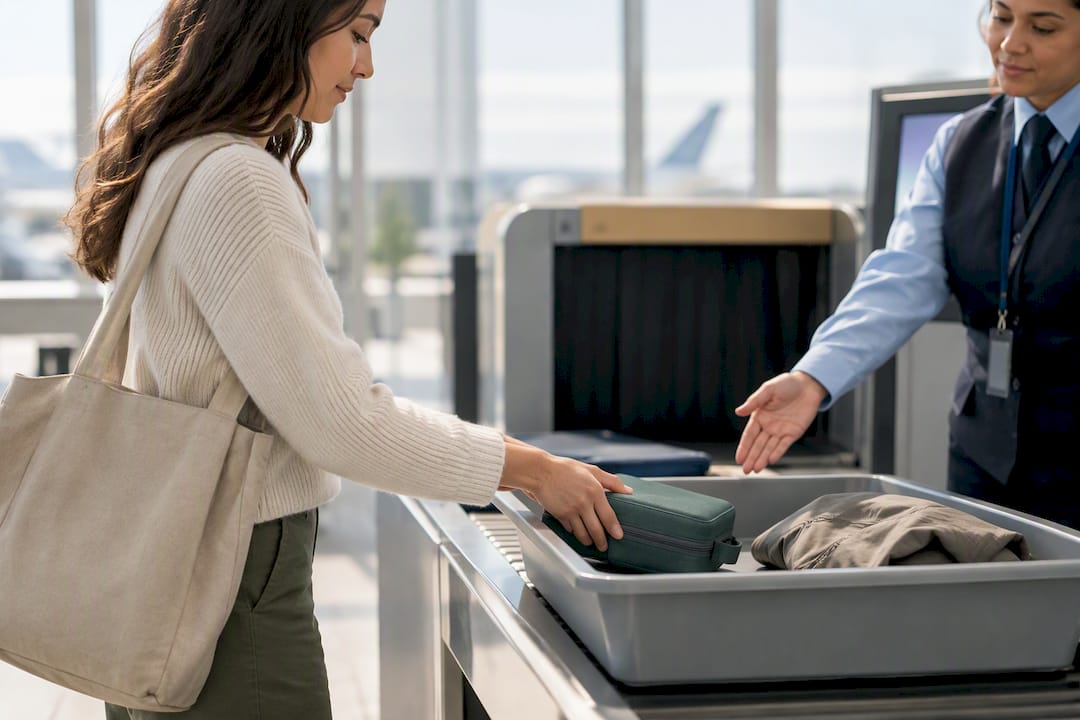
Airport security is usually the part travelers worry about most, and it’s also the part with the clearest rules. The TSA’s guidance on liquid medications is direct: medically necessary liquids, including injectable medications, are allowed in carry-on bags in amounts over the standard 3.4 ounce limit, as long as you declare them at the checkpoint. You don’t need a doctor’s note to get through screening, but having one makes the process faster.
Here’s how to move through the checkpoint with minimal friction:
- Tell the TSA officer before the bin goes through the X-ray that you’re carrying medically necessary medication and injection supplies.
- Remove the pen and any syringes from your bag and place them in a separate bin for visual inspection if asked.
- Keep the medication in its original, labeled packaging, unmarked containers raise more questions and slow you down.
- Expect additional screening, TSA officers may swab the pen or test it separately; this is routine and doesn’t mean confiscation.
Unused syringes travel with you legally, too. According to TSA’s syringe policy, unused syringes are permitted in carry-on bags when they accompany injectable medication, and they should be declared just like the medication itself.
If you have a disability, chronic condition, or just want a smoother screening experience, TSA Cares lets you request a Passenger Support Specialist in advance. Call at least 72 hours before your flight. The final call on how items are screened still rests with the officer at the checkpoint, but having a heads-up from TSA Cares tends to speed things along considerably.
What International Travel With Wegovy Requires
International travel adds a layer most domestic trips don’t: destination-country law. Rules on prescription medications, especially injectables, vary widely, and what’s routine in the U.S. can raise questions elsewhere. The U.S. State Department recommends checking with your destination’s embassy at least four to six weeks before departure, and many countries cap personal medication supplies at around a 30-day quantity, often requiring a prescription or medical certificate to bring more.

If your trip includes a layover in a third country, check that country’s rules too, a connection is still an entry point, even if you never leave the airport building.
Before you go, put together a small paperwork kit:
- A copy of your prescription in its original form.
- A clinician letter that names the generic drug (semaglutide), your dose, your dosing schedule, and states medical necessity in plain language.
- A translated or notarized version of that letter if you’re headed somewhere the primary language isn’t English, this can save real time at customs.
- Enough medication to cover your full trip, plus a modest buffer in case of delays or an extended stay.
The CDC’s travel health guidance adds one more detail worth following closely: keep medication in its original labeled container rather than a pill organizer or unlabeled bag. Customs officers are trained to flag unidentified substances, and an unlabeled pen invites exactly the kind of scrutiny you’re trying to avoid. Also worth knowing: drug names and formulations differ by country, and counterfeit GLP-1 products have shown up in some international markets, so don’t assume you can simply buy a replacement pen abroad if something goes wrong.
Your Travel Day Checklist for Packing Wegovy
Travel days are chaotic enough without wondering whether your medication is packed correctly. Build your kit the night before, not at the gate.
- Original carton with the pen inside, never loose in a bag.
- Prescription copy and clinician letter, both in an easy-to-reach pocket, not buried in checked luggage.
- Insulated case with a barrier between the pen and any cooling element.
- Adhesive thermometer strip for quick temperature checks.
- A spare dose if your prescriber has approved it and your schedule allows, this is optional, not standard.
- A sharps disposal bag or hard-sided container for used needles.
In transit, keep the case with you, not in an overhead bin near a vent, and not in a car’s trunk, where summer heat can spike well past safe limits within minutes. In a rental car, the floor of the back seat or a cooler in the front cabin works better than the trunk on hot days.
Pro Tip: If a flight gets delayed and your insulated case is running warm, ask at an airport lounge or even a pharmacy counter if they can hold your medication in a fridge for an hour. Most will say yes if you explain the situation.
If you suspect the pen has frozen or overheated beyond safe limits, stop using it and contact your prescriber before your next scheduled dose. If the medication itself is lost or stolen, contact your provider immediately, most can coordinate an emergency refill faster than you’d expect, especially with a pharmacy that has your prescription on file.
Handling Missed Doses and Time Zone Shifts
Weekly dosing gives you more flexibility than daily medications, but it’s not infinite. If you’re a day or two late, take the dose as soon as you remember and resume your normal schedule from there. If you’ve missed more than a few days, or you’re unsure how long it’s been, contact your prescriber rather than guessing.
Time zone changes matter less for Wegovy than for medications with tight timing windows, since it’s a once weekly injection. A few practical rules make it easier:
- Anchor your dose to a day of the week rather than a specific hour, and adjust the exact time gradually as you cross time zones.
- Don’t double up to “catch up” after a long flight, spacing your usual weekly gap is safer than rushing the next dose.
- If your pen spent time outside the 46°F to 86°F range for longer than the 28 day limit, or froze at any point, don’t inject it, call your prescriber for guidance before your next dose is due.
What to Do if a Wegovy Pen Malfunctions
A pen that’s been frozen often looks fine but isn’t safe to use. Watch for cloudiness, discoloration, visible particles, or a pen that won’t dial or dispense correctly.
If you suspect a problem:
- Stop using the pen immediately and don’t attempt to thaw or “test” it.
- Record the lot number and expiration date, and keep the box and packaging, you’ll need this information for a replacement.
- Contact your prescriber or pharmacy as soon as possible to arrange a replacement and get guidance on your dosing schedule in the meantime.
- For needle disposal abroad, ask a local pharmacy or clinic, many will accept used sharps even if you’re not a patient there, or can point you to a proper disposal site.
How Legacy Meds Supports Wegovy Travelers
Before you leave, ask your Legacy Meds provider three things: whether your clinician letter is current, whether your refill timing lines up with your travel dates, and whether an extra supply makes sense for your trip length. Legacy Meds coordinates clinician letters, refill timing, and shipping around travel schedules so your treatment doesn’t stall mid-trip. If you’re adjusting your injection routine or timing around a dosing schedule, loop your provider in before you pack, not after you land.
Why Planning Beats Improvising on Wegovy Trips
Most Wegovy travel problems aren’t really about Wegovy. They’re about temperature, timing, and paperwork, three things you can control almost entirely with a night of preparation. Bring the letter. Check the temperature. Confirm the customs rules before you land, not after.
Copy this to your phone: carton intact, insulated case, prescription and letter, thermometer strip, sharps bag, provider’s number saved.
— Bryan
Keep Your Treatment on Track While You Travel
Legacy Meds gets you a clinician-issued letter and refill timing built around your actual travel dates, not a generic template, so you’re not scrambling for documentation the week before a flight. Coordinating a refill or a travel-ready supply typically involves coordination with your provider and pharmacy but can be streamlined through telehealth services.
If you’re on the Semaglutide program or considering Wegovy Injection treatment ahead of an upcoming trip, a quick telehealth visit is the fastest way to get your documentation and refill timing sorted. Your provider reviews your dosing schedule, issues a clinician letter naming semaglutide and your dose, and times your next shipment so it isn’t due to arrive while you’re on the road. Start that visit through Legacy Meds before you book your flight, not after.
Sources
Confirm current rules directly: the FDA/DailyMed label for storage specifics, TSA.gov for screening rules, the CDC Yellow Book for international medication guidance, and your destination’s embassy for entry requirements.
This article is general information, not a substitute for advice from a qualified doctor. Consult a qualified healthcare professional about your own circumstances before acting on anything here.
- Wegovy (semaglutide) prescribing information — DailyMed
- Medications (Liquid) | Transportation Security Administration
- Traveling Abroad with Medicine | U.S. Department of State
- CDC: What to do when sick abroad — Yellow Book
FAQ
How long can Wegovy stay unrefrigerated?
Wegovy pens can stay at 46°F to 86°F for up to 28 days as long as the cap has never been removed. After that window, or if the pen has frozen at any point, it should be discarded.
How do I bring injectable medication through TSA?
Declare the medication and any unused syringes to the officer before screening begins, and keep them in their original packaging. TSA allows medically necessary liquids over the standard 3.4 ounce limit when declared, and unused syringes are permitted alongside the injectable medication.
Do you have to declare Wegovy when traveling?
Yes, declare it at the TSA checkpoint so officers know to screen it separately rather than flag it as an unknown liquid. For international trips, check your destination’s embassy guidance, since many countries require a prescription or medical certificate for personal medication supplies.
Can I skip a week of Wegovy for vacation?
Skipping a single dose occasionally usually just means resuming your normal schedule at the next scheduled date, but you shouldn’t make this a habit without talking to your prescriber. If you’re unsure how a gap affects your treatment plan, contact your provider before your trip rather than guessing mid-vacation.
What does Legacy Meds charge for Wegovy treatment?
Pricing for Wegovy Injection is available directly through Legacy Meds’ site, while the Semaglutide program starts from $159 per month. There are no membership fees or insurance requirements attached.