

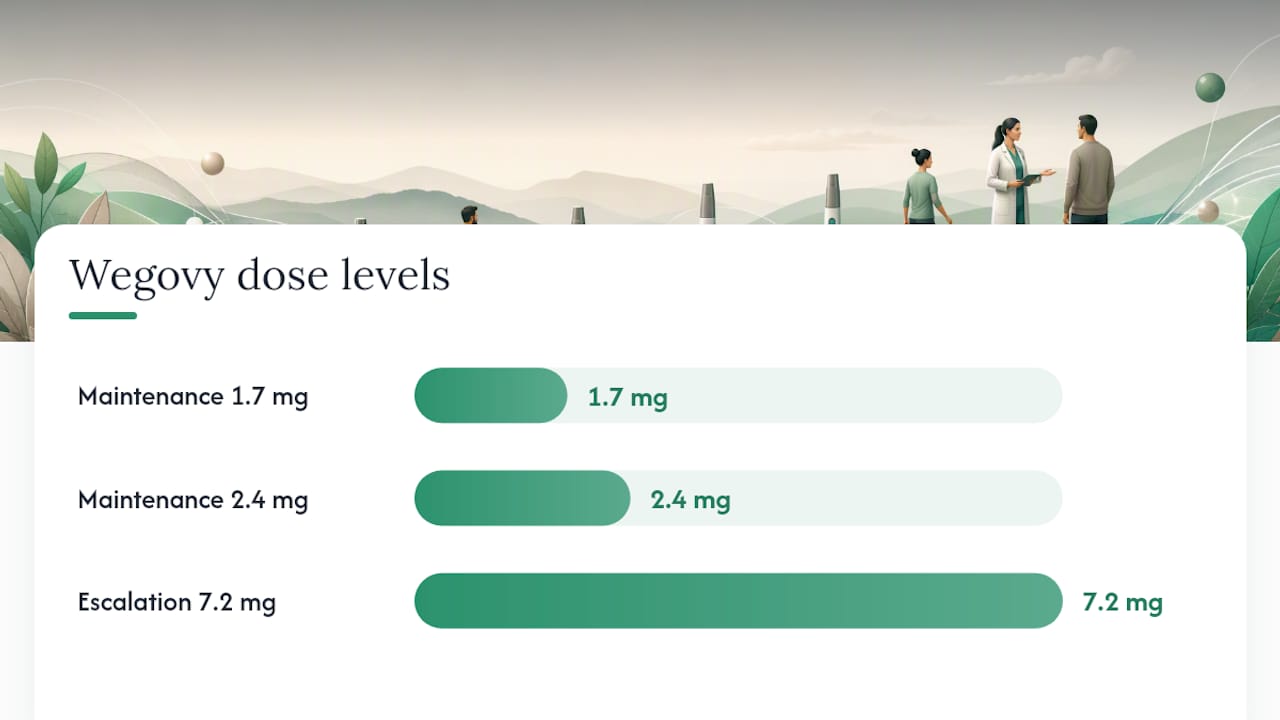
Wegovy injections start at 0.25 mg once weekly and increase every 4 weeks, moving through 0.5 mg, 1 mg, and 1.7 mg before landing on a maintenance dose of 1.7 mg or 2.4 mg. Some patients who tolerate 2.4 mg well may escalate further to 7.2 mg if their prescriber determines more weight reduction is clinically appropriate. The Wegovy tablet follows a separate ramp, starting at 1.5 mg daily and climbing monthly toward a 25 mg maintenance dose.
TL;DR:
- Most patients need at least four weeks per dose level, with strict adherence to the escalation schedule to minimize gastrointestinal side effects.
- Adjusting the injection day is flexible as long as at least 48 hours have passed since the last dose, but jumping ahead or skipping doses can increase health risks.
- If a dose is missed by less than 48 hours, take it as soon as remembered; if longer, skip and wait until the next scheduled dose to avoid severe nausea.
- Dose escalation beyond 2.4 mg or delays due to side effects should be guided by a prescriber, often delaying with a longer waiting period or reducing the dose.
- Continuous medical supervision, including regular check-ins during escalation, improves tolerability management and ensures safe handling of side effects or illness.
Table of Contents
- What Is the Standard Wegovy Dosing Schedule?
- How Do You Prepare and Give a Wegovy Injection?
- What Happens If You Miss a Wegovy Dose?
- When Should You Delay or Adjust Your Wegovy Dose?
- What Side Effects and Warnings Should You Know About?
- How Do You Manage Nausea and Injection-Day Changes?
- How Often Will You Need Checkups During Escalation?
- When Should a Dose Be Reduced or Stopped?
- What About Illness, Surgery, or Hospitalization?
- Legacy Meds’ Approach to Supervised Dose Escalation
- Get Supervised Wegovy Dosing Without the Guesswork
- Sources
- FAQ
What Is the Standard Wegovy Dosing Schedule?
Every Wegovy prescription follows the same skeleton, whether the patient is a first-timer or someone restarting after a break. The schedule is built around 4-week blocks, and each block corresponds to exactly one dose level. This isn’t arbitrary. The label’s own escalation logic exists specifically to reduce gastrointestinal adverse reactions during the buildup phase, which is where most people who quit treatment early tend to drop off.
The injection form and the tablet form (branded as Wegovy oral tablets) escalate on different timelines and different unit doses, so mixing up the two schedules is one of the more common patient errors pharmacists report. Here’s the official injection escalation table, taken directly from the DailyMed label:
| Weeks | Injection dose | Purpose |
|---|---|---|
| 1 to 4 | 0.25 mg once weekly | Initiation, not a treatment dose |
| — | 0.5 mg once weekly | First escalation step |
| — | 1 mg once weekly | Second escalation step |
| — | 1.7 mg once weekly | Third escalation step |
| — | 1.7 mg or 2.4 mg once weekly (maintenance) | Long-term dose; 2.4 mg is the recommended target for weight reduction |
| Selected cases | 7.2 mg once weekly | Only if 2.4 mg is tolerated for at least 4 weeks and further loss is clinically indicated |
The tablet schedule runs on a monthly rather than 4-week cadence and uses entirely different numbers:
A few clarifications matter here beyond the raw numbers:
- The weekly injection can be given on any day of the week, but once you pick a day, you stick with it every week going forward.
- You can shift your regular injection day if needed, as long as your last dose was at least 48 hours earlier. More on that flexibility in the missed-dose section below.
- Maintenance dose selection between 1.7 mg and 2.4 mg isn’t automatic. Clinicians weigh how much weight loss a patient still needs against how well they’ve tolerated the climb so far.
- Tablets must be swallowed whole on an empty stomach. Taking them with food, coffee, or other pills at the same time reduces how much semaglutide actually gets absorbed.
The 4-week block for injections isn’t a suggestion open to personal pacing. Jumping ahead early, even by a week, sharply raises the odds of nausea, vomiting, or diarrhea severe enough to interrupt treatment. The prescribing information is explicit that the entire point of the stepwise structure is giving the gut time to adjust before the next increase lands.
How Do You Prepare and Give a Wegovy Injection?
Getting the injection technique right matters almost as much as getting the dose right. A pen that’s injected too shallow, pulled away too early, or used on scar tissue can shortchange the actual dose delivered, even if the schedule itself was followed correctly.
Before you start:
- Take the pen out of the refrigerator and let it sit at room temperature for 15 to 30 minutes before injecting. Cold medication stings more going in.
- Check the liquid through the window. It should look clear and colorless. If it’s cloudy, discolored, or has visible particles, don’t use that pen.
- Wash your hands, then clean the injection site with an alcohol swab and let it air dry completely.
Choosing and rotating sites: Wegovy is injected subcutaneously into the abdomen, thigh, or upper arm. Rotate to a new spot each week within whichever region you use, and never inject into the exact same point twice in a row. Repeated injections in one small area can cause lumps or thickened skin under the surface (lipohypertrophy), which over time can make absorption less predictable.
Giving the injection:
- Remove the pen cap right before use, not earlier.
- Press the pen firmly against the cleaned skin at a 90 degree angle.
- Press and hold the injection button until you hear the first click, then keep holding for a full 10 seconds through the second click.
- Pull the pen straight away from the skin after the full hold. Pulling early is the single most common reason people get an incomplete dose.
If you see a drop of liquid on your skin after removing the pen, that’s usually just a small residual amount and not a sign the full dose failed to deliver, but mention it at your next visit if it happens repeatedly. Drop the used pen into a proper sharps disposal container immediately. Most pharmacies and local health departments offer free sharps containers or take-back programs, and the Wegovy patient site has region-specific disposal guidance worth checking before you toss anything in the regular trash.
Pro Tip: Set a recurring weekly phone alarm for your injection, not just a calendar reminder. A silent calendar entry is easy to swipe away; an alarm forces you to actually stop and deal with it.
For a deeper walkthrough with site diagrams and troubleshooting for specific injection problems, Legacy Meds’ guide on choosing and rotating Wegovy injection sites covers the mechanics in more depth than fits here.
What Happens If You Miss a Wegovy Dose?
The rule depends entirely on how much time is left before your next scheduled injection, not on how many days have passed since the missed one.
- More than 48 hours until your next dose: Take the missed dose as soon as you remember, then resume your normal weekly schedule from that day forward.
- Less than 48 hours until your next dose: Skip the missed dose entirely. Do not take it. Wait and take your next dose on the regular scheduled day.
- Two or more weeks missed: Do not simply pick back up at your last dose level. Call your prescriber. Restarting after a long gap sometimes means re-initiating at a lower dose and re-climbing the escalation ladder, since tolerance built up over previous weeks can fade.
The one rule that has zero exceptions: never take two doses close together to “catch up.” Doubling up raises the risk of severe nausea and vomiting without adding any extra weight-loss benefit. The Wegovy FAQ page states this plainly, and it’s worth repeating because the instinct to make up a missed dose is common and understandable, just wrong here.
When Should You Delay or Adjust Your Wegovy Dose?
The entire reason Wegovy escalates gradually instead of starting at the effective dose on day one is tolerability. Jumping straight to 2.4 mg would trigger gastrointestinal side effects severe enough that most patients would stop treatment within weeks. The FDA label frames the stepwise structure as a direct mechanism for reducing those adverse reactions during initiation, not just a dosing formality.
That’s also why the schedule has built-in flexibility for people who struggle at a given level. If a dose isn’t sitting well, waiting the standard 4 weeks doesn’t always solve it. In that case, prescribing guidance allows clinicians to delay the next escalation by an additional 4 weeks, keeping you at your current dose longer before trying to move up again. This is a normal, expected part of treatment, not a sign that something has gone wrong or that the medication isn’t working.
Situations where a prescriber commonly holds or delays escalation:
- Persistent nausea or vomiting that hasn’t settled after 2 to 3 weeks at a given dose
- Diarrhea significant enough to affect hydration or daily function
- A patient request for more time to adjust before increasing further
- Any new medical issue that complicates tolerating a dose increase
Maintenance dose selection isn’t one-size-fits-all. Once a patient reaches 1.7 mg, the decision to hold there or continue to 2.4 mg comes down to a few factors your prescriber will actually discuss with you:
- How much additional weight loss is still needed against your goals
- How well you’ve tolerated the climb so far
- Whether you have other health conditions that make a higher dose more or less appropriate
- Your own comfort level with side effect risk versus results
Escalation beyond 2.4 mg to 7.2 mg is not a default next step for everyone who reaches maintenance. If you’re curious how this compares to escalation patterns for other GLP-1 medications, this comparison of semaglutide and tirzepatide breaks down how the two drug classes differ in mechanism and typical outcomes.
For readers who want a deeper look at escalation strategy specifically, Legacy Meds has a dedicated piece on semaglutide dose escalation schedules and tolerability tactics that walks through more scenarios than fit in this guide.
What Side Effects and Warnings Should You Know About?
Gastrointestinal side effects are, by far, the most common complaint during escalation, and they tend to follow a predictable pattern: worse in the first week or two after a dose increase, then easing as the body adjusts.
Common side effects, typically tied to dose increases:
- Nausea, sometimes with vomiting
- Diarrhea or constipation
- Abdominal pain or bloating
- Fatigue
- Headache
Call your provider if nausea or vomiting becomes severe enough that you can’t keep fluids down, or if diarrhea persists for more than a day or two. Dehydration from persistent GI symptoms is actually the pathway to one of the more serious risks on the label.
Serious warnings that require immediate attention:
- Acute kidney injury from volume depletion. Severe vomiting or diarrhea can dehydrate you enough to stress the kidneys, particularly in people who already have reduced kidney function.
- Pancreatitis. Severe abdominal pain that doesn’t go away, sometimes radiating to the back, with or without vomiting, needs urgent evaluation.
- Gallbladder disease. Rapid weight loss itself raises gallstone risk. Watch for right upper abdominal pain, fever, or yellowing of the skin or eyes.
- Hypoglycemia when combined with insulin or insulin secretagogues. Patients on these medications alongside Wegovy need closer blood sugar monitoring and often a dose adjustment to the other drug, not to Wegovy itself.
The boxed warning on Wegovy concerns thyroid C-cell tumors observed in rodent studies. Because of this, Wegovy is contraindicated in anyone with a personal or family history of medullary thyroid carcinoma or Multiple Endocrine Neoplasia syndrome type 2 (MEN2). This isn’t a minor footnote. It’s the single hard exclusion criterion that determines whether someone should be prescribed this drug class at all, and it’s why a proper prescriber intake always screens for thyroid cancer history before writing the first prescription.
Roughly a quarter to a third of patients in semaglutide’s clinical trial program reported nausea as their most common adverse event, according to the drug’s own prescribing information, underscoring why the escalation schedule exists in the first place rather than starting patients at an effective dose immediately.
For a fuller rundown of monitoring recommendations across GLP-1 therapies generally, Legacy Meds maintains a GLP-1 medication safety resource worth bookmarking alongside your actual prescribing information.
How Do You Manage Nausea and Injection-Day Changes?
Most people who stay on Wegovy long enough to reach maintenance dose describe the first few weeks at each new level as the hardest part, and then it fades. A handful of practical adjustments make that stretch more bearable.
For nausea specifically, ask your prescriber about:
- Eating smaller, more frequent meals instead of three large ones
- Avoiding greasy or very rich foods for the first few days after a dose increase
- Staying ahead of dehydration with water or electrolyte drinks rather than catching up after symptoms start
- Whether a short course of an antiemetic makes sense for a particularly rough escalation week
Traveling or need to shift your injection day? You can move your weekly injection day as long as your last dose was at least 48 hours earlier. Once you land on a new day, that becomes your new regular schedule going forward. This flexibility exists specifically so a business trip or vacation doesn’t force you to either skip a dose or inject too early.
Common administration hiccups and quick fixes:
- Didn’t hear the clicks? Some pens click quietly. If you held the injection for the full 10 seconds against the skin, the dose likely delivered even if the click was faint.
- Saw liquid on your skin after injecting? A small residual drop is common and usually not a sign of a failed dose, but if it happens at every injection, have your technique checked.
- Pen won’t prime or seems stuck? Don’t force it. Set it aside and use a new pen rather than risk delivering a partial dose.
Pro Tip: Keep one backup pen in a separate bag when traveling, not just in your main luggage. Lost bags happen, and missing an entire escalation week over a delayed suitcase is an avoidable problem.
Contact your provider rather than self-managing if you experience severe abdominal pain, can’t keep any fluids down for more than a day, or notice signs of dehydration like dizziness or dramatically reduced urination.
How Often Will You Need Checkups During Escalation?
Most prescribers schedule a follow-up around each dose increase, roughly every 4 weeks during the escalation phase, either as a telehealth check-in or an in-person visit depending on how the program is structured. These aren’t just formality visits. They’re the checkpoint where a clinician decides whether you’re ready to move up, need to hold at your current dose, or need to step back down.
Early visits typically focus on how you’re tolerating GI symptoms, whether nausea or diarrhea is interfering with hydration or nutrition, and how your weight is trending. Blood pressure and weight get checked at most visits. Some prescribers order periodic labs, particularly kidney function tests if a patient has had significant vomiting or diarrhea, and baseline metabolic panels are common before starting treatment at all, especially for patients with diabetes or kidney disease already in the picture.
Once you reach a stable maintenance dose, visit frequency usually stretches out, often to monthly or quarterly check-ins, unless new symptoms come up or your prescriber wants to reassess whether a higher maintenance dose makes sense. The exact cadence isn’t fixed by the label itself; it’s a clinical judgment call based on how you’re responding, which is one more reason ongoing access to a prescriber, not just the initial prescription, matters as much as the dosing chart.
When Should a Dose Be Reduced or Stopped?
A dose reduction or a full pause isn’t a failure of treatment. It’s a normal clinical response when side effects outweigh the current benefit, and prescribers use fairly consistent criteria to decide.
The most common trigger is GI intolerance that doesn’t improve after extending time at a given dose. If nausea, vomiting, or diarrhea remain severe after a 4 week delay at the same level, many prescribers will step the dose back down to the last level that was well tolerated rather than continuing to push forward. Signs of dehydration, kidney function changes, or suspected pancreatitis are grounds for stopping the medication outright while the issue gets evaluated, not just slowing down.
Discontinuation for allergic reaction is immediate and non-negotiable. Symptoms like facial swelling, difficulty breathing, or widespread rash require stopping Wegovy and seeking emergency care, not a wait-and-see approach. Similarly, any new diagnosis of medullary thyroid carcinoma or a thyroid nodule discovered during treatment warrants an urgent conversation with your prescriber about stopping.
Outside of emergencies, the decision to reduce or stop is a joint one between patient and prescriber, weighing how much benefit you’re getting against how much the side effects are affecting daily life. This is exactly why ongoing access to your prescriber matters more than the dosing chart alone. A schedule on paper can’t account for how your particular body responds week to week.
What About Illness, Surgery, or Hospitalization?
Acute illness changes the calculus, and it’s an area where patients often guess wrong on their own. If you’re dealing with a stomach bug, food poisoning, or any illness causing vomiting or diarrhea, that illness compounds the GI side effects Wegovy can already cause. Continuing to escalate, or sometimes continuing the current dose at all, during that window raises dehydration risk meaningfully.
The safest approach is contacting your prescriber before your next scheduled dose if you’re acutely ill, rather than defaulting to either taking it on schedule or skipping it on your own judgment. Some prescribers will advise holding the current dose until symptoms resolve; others may recommend proceeding as scheduled if the illness is mild and unrelated to the GI tract. This isn’t a decision to make solo based on a general rule, because the right call depends on how dehydrated you already are and what’s causing the illness.
Hospitalization or upcoming surgery is its own category. Semaglutide’s effect on stomach emptying is relevant to anesthesia planning, which is why many surgical and anesthesia guidelines now ask patients to disclose GLP-1 medication use well before a procedure. If you’re scheduled for surgery, tell both your surgical team and your Wegovy prescriber, since the timing of your last dose relative to the procedure date may need to be adjusted. Don’t assume your surgical team already knows you’re on it just because it’s in your chart. Say it out loud at the pre-op visit.
Legacy Meds’ Approach to Supervised Dose Escalation
Following a printed schedule and actually managing a real escalation are two different challenges. The chart tells you what dose comes next; it doesn’t tell you whether the nausea you’re feeling in week 3 is normal or a reason to pause.
That gap is where supervised care earns its keep. Some telehealth providers combine GLP-1 prescribing, including semaglutide and Wegovy, with free provider visits and ongoing coaching, so escalation decisions aren’t made from a printed insert alone. Patients get a provider reviewing tolerability at each step, adjusting pace when GI side effects flare, and helping decide between 1.7 mg and 2.4 mg maintenance based on actual response rather than guesswork.
None of this replaces a prescriber’s judgment, and no online guide, including this one, can tell you whether your specific symptoms warrant a dose hold. What structured support does is make sure that judgment call is available when you actually need it, not just at your first intake visit.
— Bryan
Get Supervised Wegovy Dosing Without the Guesswork
Figuring out whether to hold at 1 mg another 4 weeks or push forward to 1.7 mg isn’t something you should be deciding alone from a printed chart. Some telehealth providers pair GLP-1 prescribing with free provider visits and ongoing coaching, so every escalation step gets reviewed by a clinician instead of left to trial and error, and there’s no membership fee or insurance requirement standing between you and that oversight.

Every dose change, from your first 0.25 mg injection through maintenance, comes with someone available to answer whether what you’re feeling is normal or worth adjusting. That’s the difference between a dosing chart and actual medical supervision. If you’re ready to start with a provider who reviews your tolerability at each step, you can begin the intake process on the Legacy Meds weight loss program page and get matched with a prescriber who manages the schedule with you, not just hands it to you.
Sources
- DailyMed - WEGOVY (semaglutide) label
- Wegovy prescribing information (Highlights and Full PI)
- Wegovy® dosing schedule and pen instructions (patient site)
This article is general information, not a substitute for advice from a qualified doctor. Consult a qualified healthcare professional about your own circumstances before acting on anything here.
FAQ
What Is the Starting Dose for Wegovy Injections?
Wegovy injections start at 0.25 mg once weekly for the first 4 weeks, a dose intended to initiate treatment rather than produce weight loss on its own.
How Long Does the Full Wegovy Titration Schedule Take?
Moving on to the 1.7 mg dose level takes several weeks from the first injection, and moving on to the 2.4 mg maintenance dose occurs when the prior dose is well tolerated.
Can You Switch From the Wegovy Injection to the Tablet, or Vice Versa?
Switching between the injection and tablet forms requires prescriber guidance, since the two have separate dosing scales and escalation timelines that don’t translate directly between each other.
What Should You Do if You Miss Two Weeks of Wegovy Injections?
Contact your prescriber before restarting; missing 2 or more weeks may require re-initiating at a lower dose rather than resuming at your last dose level.
Does Legacy Meds Help Manage Wegovy Dose Escalation?
Yes. Legacy Meds pairs GLP-1 prescriptions with free provider visits and ongoing coaching, so tolerability and dose timing get reviewed by a prescriber at each escalation step rather than left to a printed schedule alone.