
Most patients on GLP-1 receptor agonists can continue their medication before surgery, but a subset needs a modified plan. The reason comes down to delayed gastric emptying, which raises aspiration risk under anesthesia. Multisociety and American Society of Anesthesiologists guidance takes a risk-stratified approach: daily agents are typically held the day of surgery, weekly agents about one week out, when a hold is warranted at all. The right call depends on your dose, your symptoms, and a conversation between your surgical, anesthesia, and prescribing teams.
TL;DR:
- Patients in early escalation phases or with active gastrointestinal symptoms face higher aspiration risks and may need special planning before surgery.
- The standard recommendation to hold weekly GLP-1 agents one week prior to elective surgery is a guideline, but individual pharmacokinetics, dose, and symptoms may require personalized adjustments.
- Alternatives like a 24-hour clear liquid diet, gastric ultrasound, or adjusted anesthesia techniques can allow continuation of GLP-1 therapy without increasing aspiration risk.
- Stopping GLP-1 medications abruptly can impact blood sugar control and cardiovascular protection, so coordinated management with your care team is essential.
- Centralized care models, like Legacymeds, can provide personalized protocols based on your medication history, reducing guesswork and improving safety during surgery planning.
Table of Contents
- Which Patients Face Higher Risk During GLP-1 and Surgery Planning?
- When Do Doctors Commonly Pause GLP-1 Medications Before Surgery?
- Do You Have to Stop GLP-1s Before Surgery? Alternatives Worth Asking About
- Managing Blood Sugar and Cardiac Risk If GLP-1s Are Paused
- What to Tell Your Surgeon and Anesthesiologist Beforehand
- What Does the Research Actually Show About GLP-1 and Surgery Risk?
- Potential Interactions Between GLP-1 Drugs and Anesthesia
- Does GLP-1 Therapy Affect Wound Healing or Infection Risk After Surgery?
- Bariatric Surgery vs. Other Procedures: Does GLP-1 Change the Plan?
- Legacy Meds’ View: Coordinated Care Beats Blanket Rules
- How Legacymeds Supports Your Perioperative GLP-1 Plan
- Sources
- FAQ
Which Patients Face Higher Risk During GLP-1 and Surgery Planning?
Not everyone on a GLP-1 receptor agonist carries the same aspiration risk, and that’s the whole reason blanket rules fall short. Anesthesiologists look at a handful of factors that push risk up or down, and understanding them helps you have a smarter conversation with your care team.
The escalation phase, the first several weeks after starting or increasing a dose, produces the most gastrointestinal slowing. Nausea, bloating, and delayed stomach emptying are common during this window and tend to settle once you reach a stable maintenance dose. Weekly formulations and higher doses also tend to produce more pronounced gastric slowing than daily, lower-dose regimens.
Key risk factors anesthesia teams evaluate include:
- Recent dose increase or being within the first 4 to 8 weeks of a new prescription
- Weekly dosing schedule versus daily dosing
- Active GI symptoms like nausea, vomiting, or early fullness
- History of gastroparesis or another motility disorder
- Type of procedure and anesthesia planned (general anesthesia with a full stomach carries more risk than a procedure under local anesthesia)
Here’s the catch: feeling fine doesn’t mean your stomach is empty. Prospective studies using ultrasound and endoscopy have found retained gastric contents in some patients who reported no symptoms, which is exactly why guidance leans on objective risk factors rather than how you feel that morning.
When Do Doctors Commonly Pause GLP-1 Medications Before Surgery?
The consensus fallback, when a hold is actually needed, is straightforward on paper: hold daily GLP-1 agents the day of surgery, and hold weekly agents about one week before an elective procedure. The American Society of Anesthesiologists built this timing around when most of the drug clears active circulation, and it’s the number you’ll hear most often from a preop nurse or surgical coordinator.
But the real picture has more texture than a single rule suggests. Semaglutide and other long-acting agents have pharmacokinetics that don’t map cleanly onto a one-week cutoff. Some patients retain measurable drug effect beyond that window, which is part of why multisociety guidance frames one week as a floor, not a guarantee.
A few situations change the calculus:
- If you’re mid-escalation or just increased your dose, your surgeon may push an elective procedure back until you’ve stabilized
- If your GLP-1 is prescribed for diabetes or cardiovascular protection, stopping it isn’t a simple pause. It requires a metabolic backup plan
- Emergency surgery doesn’t wait for any of this. Teams instead shift to mitigation strategies covered below
Pro Tip: Bring your exact medication name, dose, and the date of your last injection to your preop appointment. “I’m on a GLP-1” isn’t specific enough for your anesthesiologist to plan around.
Do You Have to Stop GLP-1s Before Surgery? Alternatives Worth Asking About
Stopping the medication is not the only path to a safe procedure, and more anesthesia teams are leaning on mitigation instead of a blanket hold, especially for patients whose GLP-1 treats diabetes or cardiac risk. If your surgeon raises the possibility of continuing therapy, these are the tools that make it workable.
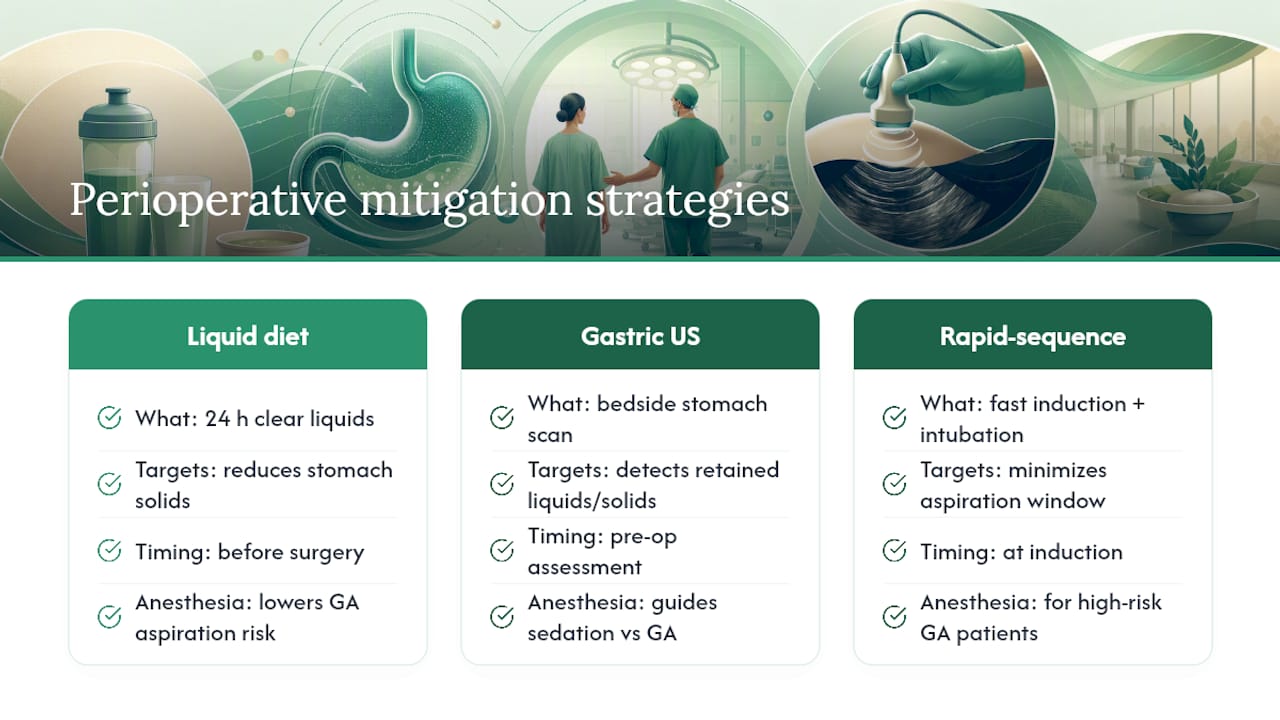
- A 24-hour clear liquid diet before the procedure. This is the same strategy used in colonoscopy prep and bariatric pathways to clear solid stomach contents without stopping the drug itself, and multisociety guidance endorses it as a practical substitute for a medication hold.
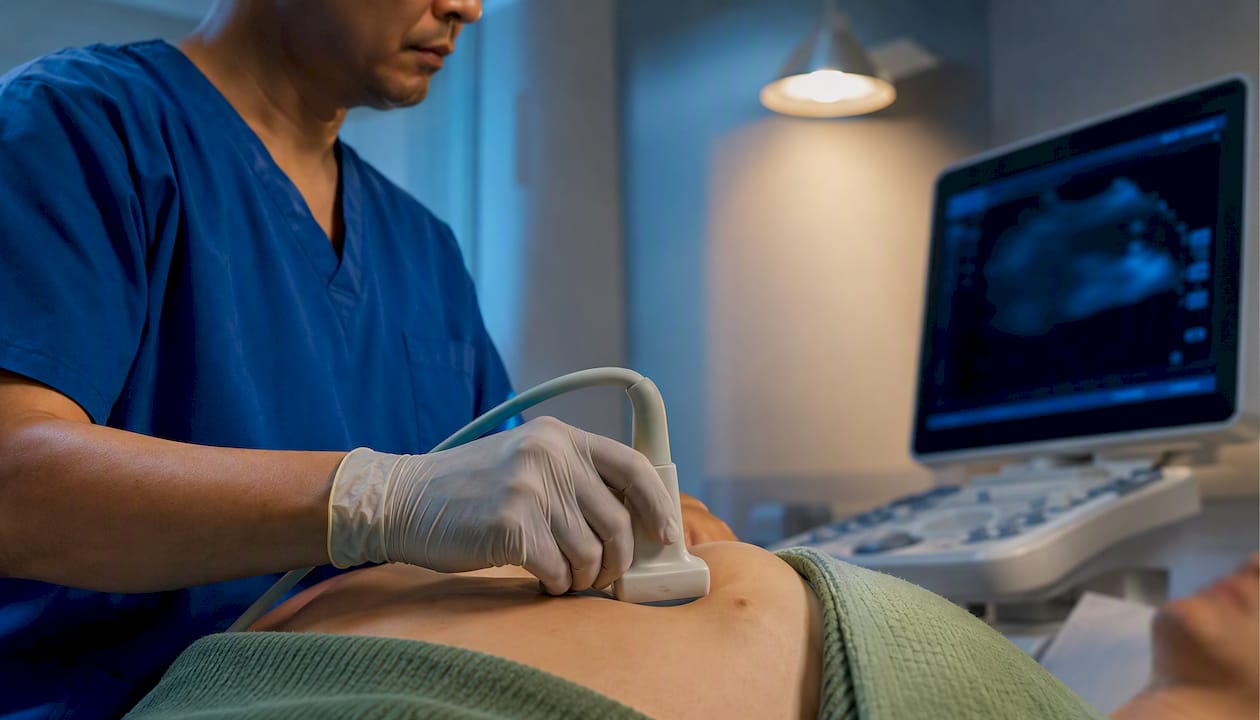
- Point-of-care gastric ultrasound. Where available, an anesthesiologist can scan your stomach right before the procedure to check for retained contents, turning a guess into an actual measurement.
- Anesthesia adjustments. If retained contents are suspected or confirmed, the team can treat you as a “full stomach” case, using rapid-sequence induction and intubation, along with antacids when appropriate, to lower aspiration risk during induction.
- Extended fasting windows. Some centers simply add extra hours to standard fasting instructions for solids and liquids as a lower-tech buffer.
These options let a surgical team say yes to a procedure without demanding you interrupt therapy that’s managing your weight, glucose, or heart health.
Managing Blood Sugar and Cardiac Risk If GLP-1s Are Paused
Holding a GLP-1 isn’t free of risk, particularly if you take it for diabetes or heart failure protection rather than weight management alone. Stopping abruptly can push blood sugar up and, in patients with cardiovascular indications, remove a layer of protection during a physiologically stressful event like surgery.
If your prescribing clinician and surgical team agree a hold is necessary, ask specifically about:
- Whether you need an endocrinology consult to bridge glucose control, often with adjusted insulin dosing or short-term monitoring
- How often your blood sugar will be checked before, during, and after the procedure
- What glucose range the team is targeting perioperatively
- The plan and timeline for restarting your GLP-1 once you’re eating normally and healing
Most protocols restart GLP-1 therapy once oral intake resumes and there’s no ongoing nausea or ileus risk, but timing is individualized rather than fixed.
Pro Tip: If your GLP-1 also manages type 2 diabetes, ask your endocrinologist to write the bridging plan down before surgery day, not after. A verbal “we’ll figure it out” isn’t a plan your surgical team can act on.
What to Tell Your Surgeon and Anesthesiologist Beforehand
Walking into a preop visit with the right information turns a generic conversation into an actual plan. Here’s what to bring:
- Exact drug name, dose, and last dose date, plus whether you’re currently in an escalation phase or on a stable maintenance dose.
- Any current GI symptoms, including nausea, bloating, or slow digestion, and any history of gastroparesis or bowel motility issues.
- Ask directly whether gastric ultrasound is available, whether a 24-hour liquid diet is an option instead of stopping the drug, and what the anesthesia plan looks like if contents are retained.
- Confirm who owns glucose management if your GLP-1 is paused, and get a clear restart timeline in writing before you leave the appointment.
What Does the Research Actually Show About GLP-1 and Surgery Risk?
The honest answer is that guidance is built on a real but incomplete evidence base. A systematic review and meta-analysis found that GLP-1 receptor agonists prolong gastric emptying half-time by a mean of roughly 74 minutes, with the effect more pronounced in short-acting agents and during early treatment. The certainty of that evidence is rated low, meaning the true effect could be smaller or larger than the average suggests.
Retained gastric contents have shown up on ultrasound and endoscopy even in patients who stopped their GLP-1 on schedule and reported no symptoms, a pattern documented across multiple prospective surgical case series.
That gap, between a tidy stop-rule and messier real-world findings, is exactly why multisociety guidance leans on consensus rather than randomized outcome trials. No large trial has tested “hold for X days” against “don’t hold” and measured actual aspiration events. Until one does, the practical takeaway holds: treat the published intervals as a starting point, not a guarantee, and let your specific dose, symptoms, and procedure type shape the final call.
Potential Interactions Between GLP-1 Drugs and Anesthesia
GLP-1 receptor agonists don’t chemically interact with anesthetic drugs the way, say, MAO inhibitors interact with certain opioids. The concern is mechanical, not pharmacologic. GLP-1s slow gastric motility, which means a stomach that anesthesia teams expect to be empty after standard fasting may not be, and general anesthesia removes your normal airway reflexes that would otherwise protect against aspiration if stomach contents come back up.
This changes how anesthesiologists approach induction. Instead of a routine induction sequence, patients flagged as higher risk often get rapid-sequence induction and intubation, a technique that secures the airway faster and minimizes the window where aspiration could occur. Sedation-only procedures, like an upper endoscopy under moderate sedation, carry a different risk profile than a procedure requiring deep general anesthesia, since airway reflexes are more intact under lighter sedation.
There’s also a secondary consideration around gastric motility drugs sometimes used to counteract nausea. Some antiemetics work by speeding gut motility, and in theory that could offset some GLP-1 related slowing, though this hasn’t been studied specifically as a perioperative strategy. The practical interaction that matters most isn’t drug-on-drug chemistry. It’s how a slower stomach changes the airway math during induction, and that’s precisely the risk the mitigation strategies (liquid diet, ultrasound, rapid-sequence induction) are designed to address.
Does GLP-1 Therapy Affect Wound Healing or Infection Risk After Surgery?
Direct evidence linking GLP-1 receptor agonists to impaired wound healing or higher surgical site infection rates is limited, and current guidance doesn’t flag it as a primary perioperative concern the way aspiration risk is. That said, the broader metabolic context matters more than the drug class itself.
Patients starting GLP-1 therapy for weight loss often carry improved glycemic control compared to before treatment, and better blood sugar control is consistently linked to lower infection risk and better wound healing across surgical literature generally. In that sense, a GLP-1 prescription used well before surgery may work in a patient’s favor rather than against it.
The more relevant caution involves rapid, ongoing weight loss and nutritional status heading into a procedure. Patients who are actively losing weight quickly, particularly during dose escalation, may have lower protein intake or reduced appetite right when their body needs nutritional reserves to heal. Surgeons sometimes ask patients to prioritize protein intake in the weeks before an elective procedure regardless of GLP-1 use, and that guidance applies with extra weight to patients on appetite-suppressing therapy. If you have a procedure scheduled and you’ve been losing weight quickly, mention it. Your surgical team may want to check nutritional markers beforehand rather than assume everything is fine because the scale looks good.
Bariatric Surgery vs. Other Procedures: Does GLP-1 Change the Plan?
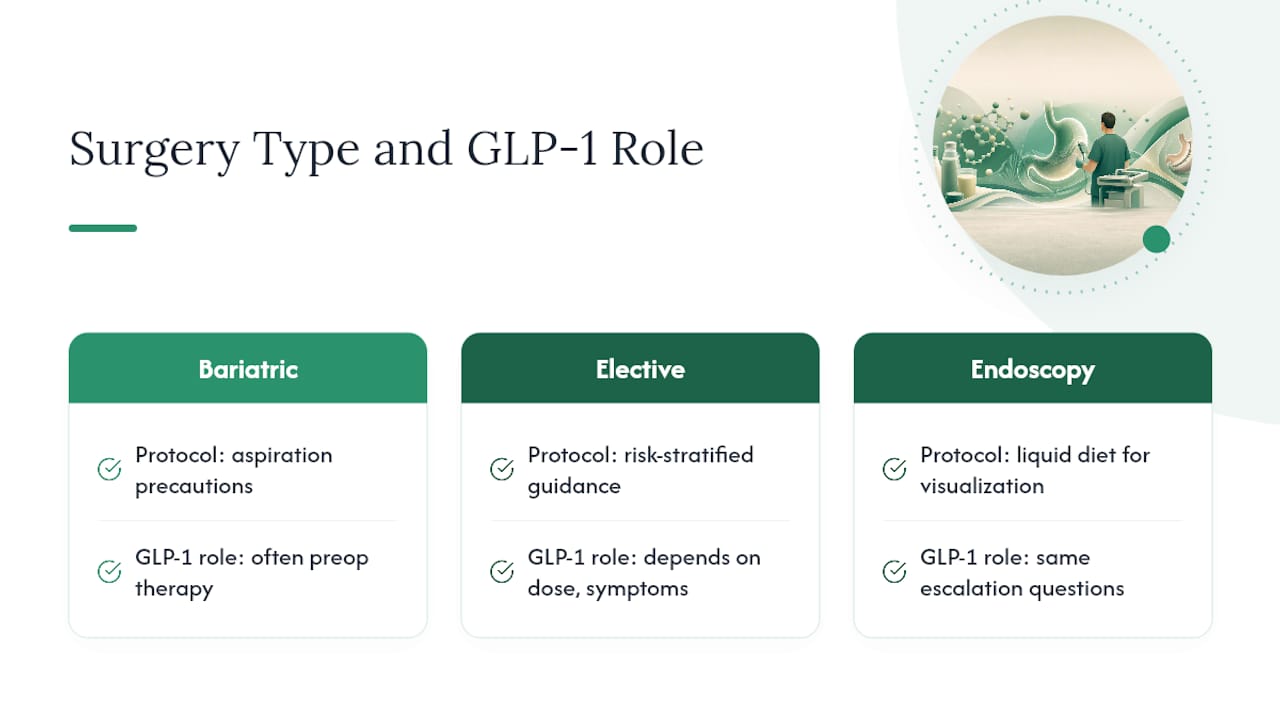
The type of surgery you’re having changes how much weight the GLP-1 conversation carries. Bariatric surgery is its own category, since many candidates are already on GLP-1 therapy specifically to lose weight before their procedure, and some surgical programs actively prescribe it as a bridge to a safer operative weight. For these patients, the gastric emptying question intersects with the surgery itself: bariatric procedures already alter stomach anatomy, so anesthesia teams often apply the same aspiration precautions (liquid diet, full-stomach protocols) regardless of GLP-1 status, given that this population already trends toward slower gastric emptying at baseline.
Non-bariatric elective surgery, orthopedic procedures, hernia repairs, hysterectomies, is where the risk-stratified guidance does the most practical work, since these patients aren’t already being managed under a bariatric-specific protocol. The decision to hold, continue, or mitigate rests more heavily on dose, escalation phase, and symptoms.
Endoscopic procedures deserve their own mention. Upper endoscopy and colonoscopy are particularly sensitive to retained gastric contents because visualization depends on a clear field, which is part of why gastroenterology societies were early adopters of the liquid-diet mitigation strategy, independent of the anesthesia-specific concerns that apply to general surgery. If you’re on a GLP-1 and scheduled for an endoscopic procedure, expect your gastroenterologist to ask the same escalation and symptom questions your surgeon would.
Legacy Meds’ View: Coordinated Care Beats Blanket Rules
We’ve watched patients get caught in the gap between “just stop it” and “just continue it,” neither of which reflects how these medications actually work. Timing around your escalation phase, tracking GI symptoms, and looping in your surgical team before a procedure date is set does more for safety than any fixed rule ever will. That’s the coordination Legacymeds builds into ongoing care: monitoring where you are in your dosing schedule and helping you flag an upcoming procedure early enough that your prescribing clinician and surgeon can actually talk to each other.
— Bryan
How Legacymeds Supports Your Perioperative GLP-1 Plan
If you’re on GLP-1 therapy through Legacymeds and a procedure is coming up, you’re not stuck guessing which guideline applies to you. Legacymeds pairs every patient with a licensed provider who already knows your dose history, your escalation timeline, and your symptom pattern, which means the perioperative conversation starts from real data instead of a generic handout.
An online visit with your Legacymeds provider can produce a specific written plan: whether to continue your current dose, when to pause it if your surgical team requests a hold, and exactly when to resume once you’re cleared to eat normally again. That plan travels with you to your preop appointment, giving your surgeon and anesthesiologist something concrete to work from instead of a verbal summary. If you have an upcoming procedure, log into your Legacymeds account or start a visit today to get your perioperative plan on record before your surgery date gets close.
This article is general information, not a substitute for advice from a qualified doctor. Consult a qualified healthcare professional about your own circumstances before acting on anything here.
Sources
- Most Patients Can Continue Diabetes, Weight Loss GLP-1 Drugs Before Surgery, Those at Highest Risk for GI Problems Should Follow Liquid Diet Before Procedure
- Multisociety Clinical Practice Guidance for the Safe Use of Glucagon-like Peptide-1 Receptor Agonists in the Perioperative Period
FAQ
Why do doctors sometimes stop GLP-1 medications before surgery?
GLP-1 receptor agonists slow gastric emptying, which can leave stomach contents in place even after standard fasting, raising the risk of aspiration under general anesthesia. Guidance now favors assessing individual risk factors over automatically stopping the drug for every patient.
Does GLP-1 interact with anesthesia drugs directly?
There’s no direct pharmacologic interaction between GLP-1 receptor agonists and anesthetic agents. The concern is mechanical: delayed gastric emptying can mean a “full stomach” during induction, which is why some patients get rapid-sequence induction as a precaution.
How long do you have to be off Ozempic before surgery?
The common fallback is holding weekly agents like semaglutide (Ozempic) about one week before an elective procedure, though this isn’t universal and depends on your dose, escalation status, and symptoms. Some clinicians question whether one week fully clears effects given semaglutide’s long half-life, so individualized guidance from your prescribing clinician matters more than a fixed number.
Can I have surgery if I’m on a GLP-1 medication?
Yes. Most patients on GLP-1 therapy can safely undergo surgery, often without stopping the medication at all, using mitigation strategies like a 24-hour liquid diet or gastric ultrasound instead of a hold. The decision comes down to your specific risk factors and a coordinated plan between your surgical and prescribing teams, which is the approach Legacymeds builds into its ongoing patient support.