

If you missed a semaglutide dose, the fix depends on your exact medication and how much time has passed. Injectable Ozempic gives you up to 5 days to take the missed dose; injectable Wegovy uses a 48-hour rule. Never double up to catch up, and call your prescriber if you have missed two or more doses in a row.
TL;DR:
- Missing a dose of semaglutide requires understanding which product you take and how long ago you last dose to determine whether you should take the missed dose or skip it.
- Taking two doses to catch up is dangerous and can cause severe nausea, dehydration, or blood sugar swings, especially if you have missed multiple doses.
- If you’ve missed two or more weekly doses or several weeks, you should contact your healthcare provider for a supervised plan to resume therapy safely.
- Re-titration after a long gap involves restarting at a lower dose and gradually working up again to avoid gastrointestinal issues and preserve medication tolerability.
- Preventing missed doses depends on setting consistent reminders, keeping spare medication on hand, and tracking prescription renewal dates to avoid avoidable gaps.
Table of Contents
- What Do You Do Right Now for a Missed Dose Semaglutide Situation?
- Which Rule Applies to Your Specific Semaglutide Product?
- When Should You Call Your Prescriber Instead of Self-Managing?
- How Does Re-Titration Work After a Longer Gap?
- What Are the Risks of Doubling Up or Restarting Too High?
- How Can You Prevent Missed Doses Going Forward?
- A Clinician-Directed Approach to Missed Doses and Restarts
- How Legacymeds Supports a Safe Restart
- Sources
- FAQ
What Do You Do Right Now for a Missed Dose Semaglutide Situation?
Before you act, pin down three facts: which product you take, when you last dosed, and whether you’re still inside the safe window. Getting these right in the next few minutes matters more than anything else in this guide.
- Confirm the exact product and dose. Check your pen label or prescription bottle. Ozempic, Wegovy injection, and Wegovy tablets each follow different missed-dose rules, so guessing here can lead you to the wrong answer.
- Find your last injection or dose date. Count the days since then. This number decides whether you take the dose now or skip it entirely.
- Compare against your product’s late-dose window. If you’re inside it, take the missed dose today. If you’re past it, skip that dose and resume your normal weekly or daily schedule.
- Never take two doses to make up for lost time. A missed weekly injection does not get “corrected” by adding an extra dose next week.
- Do not restart at a higher dose after a long gap on your own. If it’s been weeks, self-escalating back to your usual maintenance dose is one of the more common ways people end up in urgent care with severe nausea.
- Check your glucose if you use insulin or a sulfonylurea. Missed and made-up GLP-1 doses can shift blood sugar control quickly, and you want to catch that before it becomes a problem.
Pro Tip: Set a note in your phone with your product name and your last dose date every time you inject or swallow a pill. When a dose slips, you won’t waste time hunting for that information while the clock is running on your window.
Which Rule Applies to Your Specific Semaglutide Product?
The label instructions differ enough between products that using the wrong rule can genuinely hurt. Here’s how the three most common forms break down.
| Product | Missed-dose rule | Source |
|---|---|---|
| Ozempic (injectable) | Take the missed weekly dose within 5 days if possible; otherwise skip it and resume on your regular scheduled day | FDA prescribing information — Ozempic label |
| Wegovy (injectable) | If your next scheduled dose is more than 2 days away, take the missed injection now; if it’s less than 2 days away, skip it and resume on schedule | DailyMed — WEGOVY injection prescribing information |
| Wegovy tablets (oral semaglutide) | Skip the missed dose and take your next scheduled dose the following day | Manufacturer dosing guidance |
Two or more missed Wegovy injections in a row is its own category. The label calls for restarting dose escalation at a lower level rather than jumping back to your prior maintenance dose, because your body loses some of its tolerance to the drug during the gap.
If you’re honestly not sure which product is in your fridge, that’s a pharmacy call, not a guessing game. Pharmacists can read the label off the box in seconds and tell you exactly which rule applies.
When Should You Call Your Prescriber Instead of Self-Managing?
Most single missed doses are a non-event you handle at home. Certain situations call for a phone call before you do anything else:
- You’ve missed two or more consecutive weekly doses, roughly 14 days off therapy. UCLA Health advises contacting your prescriber at this point, since resuming at your old dose can trigger real gastrointestinal discomfort.
- You’ve gone several weeks without a dose for any reason, including insurance gaps or travel.
- You develop severe or persistent vomiting, diarrhea, dehydration, fainting, or severe abdominal pain after restarting.
- You take insulin or a sulfonylrea and notice blood sugar readings that are unexpectedly high or low after a missed or resumed dose.
None of these situations mean you failed at treatment. They mean the plan needs a professional’s input before you go further.
How Does Re-Titration Work After a Longer Gap?
Your gastrointestinal system adapts to semaglutide gradually, and that adaptation fades fast once the drug stops. That’s the whole reason re-titration exists. A patient who tolerated a 2.4 mg maintenance dose perfectly fine for months can develop severe nausea and vomiting if they jump straight back to that same dose after a month off, simply because their tolerance reset during the break.
Clinicians address this by restarting patients at the lowest introductory dose and working back up on a schedule, whether that follows the standard label timeline or an individualized plan based on how the patient tolerated escalation the first time. Healthline’s clinical summary notes there’s no single universal cutoff for what counts as a “long” gap; product labeling covers the short windows, but beyond that, your prescriber weighs your history and time off therapy to decide the safest path back.
Some rough distinctions that tend to hold up in practice:
- A single missed dose, or a gap of about one to two weeks, often allows resuming at the same dose per the label.
- A gap stretching into several weeks generally calls for restarting lower and re-titrating, since receptor sensitivity and GI tolerance decline the longer you’re off the drug.
- Exactly where that line falls for you is a judgment call your prescriber makes, not a fixed number of days.
If your interruption was prolonged, your insurer may also ask for updated weight or BMI documentation before approving a restart. Having your dates and prior-dose history ready when you call saves you a second phone call later.
What Are the Risks of Doubling Up or Restarting Too High?
The instinct to “make up for lost time” is understandable and also the fastest route to a bad week. Doubling up on semaglutide, or jumping straight back to your old maintenance dose after weeks off, raises your risk of:
- Severe nausea, vomiting, and diarrhea intense enough to cause dehydration
- A trip to urgent care if vomiting won’t stop or you can’t keep fluids down
- Dangerous swings in blood sugar if you also take insulin or a sulfonylurea, since your GLP-1 exposure just changed sharply
- Complications from self-restarting with leftover medication instead of getting a supervised plan after a multi-week gap
Clinical experts point to one specific pattern as the biggest driver of severe reactions: patients “catching up” by taking a full prior maintenance dose after a long gap, rather than restarting low and working back up.
If you push through severe symptoms after restarting rather than stopping and calling for help, you’re gambling with dehydration and electrolyte problems that are entirely avoidable with a five-minute phone call.
How Can You Prevent Missed Doses Going Forward?
Most missed doses trace back to logistics, not forgetfulness alone. Fix the logistics and the problem mostly disappears.
- Pick one consistent day of the week for your injection or tablet, and set two separate reminders, phone and calendar at minimum, so a dead phone battery doesn’t cost you a dose.
- Ask your prescriber about keeping an authorized spare pen or extra tablet supply on hand for travel or a delayed refill, within whatever your prescription allows.
- Track your prior authorization expiration date and call your pharmacy or prescriber a couple of weeks early if a renewal is coming up. Cost and coverage disruptions cause more missed doses than people expect, and understanding what drives semaglutide pricing can help you plan refills before a gap forms.
- If you’re switching brands or formulations, coordinate the timing with your clinician so one prescription ends exactly when the next begins, rather than leaving a gap while paperwork catches up; understanding why changing diabetes medication affects your supplies can help avoid interruptions.
A Clinician-Directed Approach to Missed Doses and Restarts
Guesswork is the real risk here, not the missed dose itself. Legacymeds builds its dose escalation guidance around the same principle every credible source in this article supports: restarts after a real gap need an individualized plan, not a shortcut back to your old dose. If you’re staring down a multi-week interruption, the right move is a conversation with a provider who can see your history, not a solo decision at the kitchen counter.
— Bryan
How Legacymeds Supports a Safe Restart
Some telehealth services offer licensed providers who review prior dosing history and build re-titration plans, aiming to reduce guesswork on restarting semaglutide after a gap.

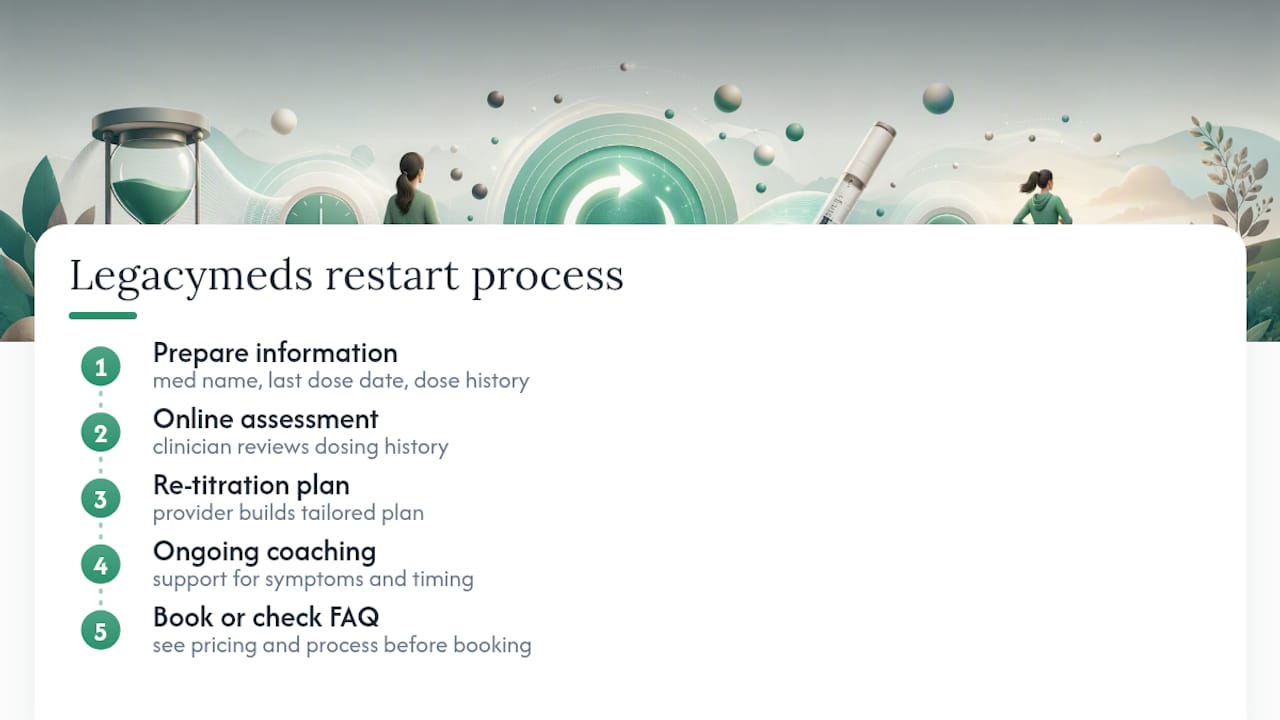
Before you start your online assessment, have three things ready: your exact medication name, the date of your last dose, and your prior dose history including how you tolerated escalation the first time around. That information lets your provider build an accurate plan instead of a generic one. Some programs provide ongoing coaching during the restart process, helping address questions about symptoms and medication timing between visits.
If you’re ready to get a clinician-directed plan instead of managing a multi-week gap on your own, start with the Legacymeds weight loss program or check the weight loss FAQ for pricing and process details before you book your first visit.
Sources
This guide draws on manufacturer prescribing information for Wegovy injections and Ozempic, plus clinician guidance from UCLA Health on when a missed dose requires a provider call. Additional context on re-titration timing comes from Clinical Advisor and payer documentation practices from PharmaDossier.
This article is general information, not a substitute for advice from a qualified doctor. Consult a qualified healthcare professional about your own circumstances before acting on anything here.
- DailyMed — WEGOVY (semaglutide) injection prescribing information
- UCLA Health — Missed a dose (or more) of your GLP-1 medication? Here’s what to do
- Healthline — What to do if you miss a GLP-1 dose
FAQ
What if I miss just one weekly semaglutide dose?
For Ozempic, take it within 5 days of the missed dose or skip it and resume your regular schedule; for Wegovy injection, take it if your next dose is more than 2 days away, otherwise skip it.
What happens if I miss two or more Wegovy doses in a row?
The manufacturer’s label calls for restarting dose escalation at a lower dosage rather than resuming your prior maintenance dose, and contacting your prescriber is the safest next step.
Can I take two semaglutide doses to catch up?
No. Doubling up raises your risk of severe nausea, vomiting, dehydration, and blood sugar swings if you also use insulin, and no product label supports this approach.
What should I do if I missed my dose for several weeks?
Contact your prescriber. A gap of several weeks typically calls for a supervised restart at a lower introductory dose with re-titration, which Legacymeds’ online providers can manage directly.
How do I miss fewer doses going forward?
Set two reminders on a fixed day of the week, keep an authorized spare supply when your prescription allows it, and track your prior authorization renewal dates so refill delays don’t turn into treatment gaps.