

Current human milk studies find semaglutide undetectable using standard lab testing, and the worst-case estimated dose to an infant lands well under the 10% threshold clinicians use to flag concern. That’s reassuring, but the data set is small, follow-up is short, and oral semaglutide is a different story entirely. Most clinicians still recommend discussing any GLP-1 use with your pediatrician and prescriber before continuing or starting it while nursing, watching your infant for feeding or growth changes, and treating oral tablets with more caution than injectables.
TL;DR:
- Human milk studies find semaglutide undetectable in milk samples, with an estimated infant exposure well below the 10% caution threshold, at roughly 1.1% to 1.3%.
- The small sample size of only eight women limits certainty, and the detection methods cannot completely rule out trace amounts or long-term effects in infants.
- Injectable semaglutide’s large peptide structure suggests minimal absorption into breast milk, but oral formulations with absorption enhancers like SNAC may pose separate risks due to increased gut permeability.
- Most guidelines recommend cautious use or delaying semaglutide during breastfeeding, especially for newborns or preterm infants, and advise close monitoring of infant growth and maternal nutrition.
- A licensed healthcare provider can help tailor treatment plans and ensure safe management, preferably under supervision, considering the limited evidence and individual risk factors.
Table of Contents
- Is Semaglutide Safe While Breastfeeding? What the Evidence Shows
- What We Still Don’t Know About Semaglutide in Breast Milk
- Why Oral and Injectable Semaglutide Get Different Advice
- How Doctors Approach GLP-1 Use During Breastfeeding
- Monitoring Your Baby and Supporting Your Own Nutrition
- A Straight Answer, Not a Perfect One
- Considering Medically Supervised GLP-1 Care? Here’s How Legacymeds Helps
- Sources
- FAQ
Is Semaglutide Safe While Breastfeeding? What the Evidence Shows
The honest answer is: probably safer than once assumed, but not proven safe. That distinction matters for how you talk to your doctor about it.
The most direct evidence comes from a human milk study using liquid chromatography-mass spectrometry (LC-MS), the gold-standard method for detecting trace drug levels in biological fluids. Researchers collected milk samples from eight breastfeeding women taking subcutaneous semaglutide at three time points, immediately after dosing, then at 12 hours, then at 24 hours. Semaglutide never showed up in a single sample.
That doesn’t mean zero was in the milk. It means the amount, if any, fell below what the assay could measure. The test’s lower limit of quantification (LLOQ) was 5.7 nanograms per milliliter, and its lower limit of detection (LLOD) was 1.7 nanograms per milliliter. Researchers used the LLOQ as a stand-in worst-case value and calculated what’s called the relative infant dose (RID), a percentage that compares an infant’s estimated exposure through milk to the mother’s weight-adjusted dose.
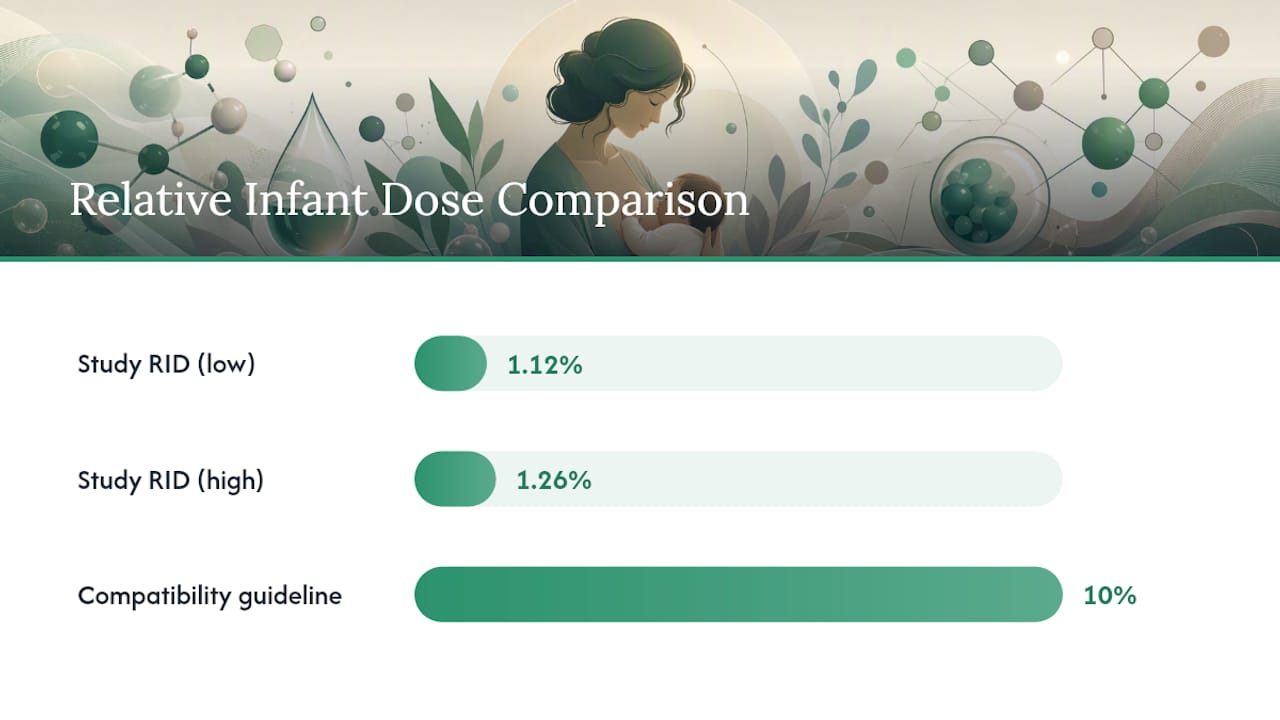
The RID came out to roughly 1.12% to 1.26%. For context, most lactation pharmacology references consider a RID under 10% generally compatible with breastfeeding, though that threshold is a guideline, not a guarantee of safety for every drug or every infant. A number under 1.3% is low by that standard, and it sits alongside a body of thought that infant exposure to injectable semaglutide is often overestimated by worst-case math.
The LactMed database, maintained through the National Institutes of Health’s NCBI Bookshelf and widely used by pediatricians and lactation consultants, reaches a similar conclusion. It reports that subcutaneous semaglutide has not been detected in the breast milk of mothers using it, and that in the small case series reviewed, breastfed infants showed no adverse effects. LactMed is one of the more conservative references in clinical pharmacology, so a reassuring entry there carries real weight.
There’s also a useful data point from semaglutide’s cousin drug, tirzepatide, a dual GLP-1/GIP receptor agonist sold under brand names for both diabetes and weight loss. A LactMed review of tirzepatide covering 11 lactating women found the drug undetectable in 164 of 171 total milk samples, even at subcutaneous doses up to 5 milligrams. That’s not proof semaglutide behaves identically, but it does support a pattern: large peptide-based GLP-1 drugs given by injection don’t appear to move into milk in meaningful quantities.
Here’s what ties the numbers together and why they matter for a nursing parent:
- Semaglutide is a large peptide molecule, and large peptides generally don’t pass efficiently into breast milk or survive intact through an infant’s digestive tract.
- The measured (or estimated) RID of about 1.1% to 1.3% is roughly eight to nine times lower than the 10% reference point used as a general caution line.
- Tirzepatide’s near-total undetectability across 171 samples adds a second, independent data point suggesting the same pattern across this drug class.
- None of the small case series reviewed by LactMed reported clear adverse effects in exposed infants during the observation windows studied.
None of this amounts to a green light without qualification. It amounts to a low-concern signal from limited data, which is a very different statement than “proven safe,” and that difference is exactly why the next section matters.
What We Still Don’t Know About Semaglutide in Breast Milk
Eight women. That’s the entire sample behind the primary RID calculation. Small studies can still be informative, especially when the drug’s chemistry supports the finding, but eight participants cannot rule out rare effects, individual variation in drug metabolism, or outcomes that only show up over months rather than hours.
The detection method itself has a built-in blind spot. Because semaglutide never crossed the assay’s detection threshold, researchers had to estimate exposure using the LLOQ value as a stand-in for the true (unknown) amount. That’s a deliberately conservative approach, treating the worst plausible case as if it were the real number, but it’s still an estimate, not a measurement. If the actual concentration is far below the LLOQ, the real RID could be a fraction of the 1.1% to 1.3% figure. If some other factor pushed levels just under the detection floor at the specific times sampled, it could be modestly higher.
Timing raises its own questions. Semaglutide is a long-acting injectable dosed roughly once a week, and its concentration in the body doesn’t move in a straight line. Researchers sampled milk at 0, 12, and 24 hours post-dose, a narrow window relative to a full week-long dosing cycle. Steady-state accumulation, the buildup of drug levels that occurs with repeated regular dosing over weeks, was not the direct focus of the milk-transfer study, which leaves an open question about whether levels shift later in the dosing interval.
Age matters too. Most participants in the available studies were breastfeeding infants past the newborn stage, so data specific to newborns or preterm infants, whose kidneys, livers, and gut linings handle drug exposure differently, remain sparse.
A few uncertainty points worth holding onto:
- Small cohorts (as few as 8 to 11 participants across the human studies available) limit how confidently results generalize.
- “Undetectable” reflects assay sensitivity limits, not literal zero drug transfer.
- Long-term developmental outcomes in exposed infants haven’t been tracked in any published study to date.
- Newborn- and preterm-specific data are essentially absent from the current evidence base.
That gap between reassuring numbers and genuine long-term proof is exactly why clinical guidance, discussed below, still leans cautious even as the milk-transfer data itself looks encouraging.
Why Oral and Injectable Semaglutide Get Different Advice
The caution around GLP-1 drugs and breastfeeding isn’t uniform, and it shouldn’t be. Injectable semaglutide is a peptide. Peptides are large, complex molecules that the body doesn’t absorb well when swallowed, which is exactly why semaglutide originally had to be injected at all. If trace amounts did end up in breast milk, an infant’s digestive system would likely break most of it down before it ever reached the bloodstream.
Oral semaglutide, sold under brand names like Rybelsus, works completely differently. To survive the stomach and get absorbed at all, oral tablets include an ingredient called salcaprozate sodium, or SNAC, an absorption enhancer that temporarily changes gut permeability so the peptide can pass into the bloodstream. That mechanism is what makes the pill work, and it’s also exactly why oral semaglutide raises separate theoretical concerns for breastfeeding. An absorption enhancer designed to help a difficult molecule cross the gut lining doesn’t know or care whose gut it’s in.
This is why LactMed and product labeling guidance tend to flag oral formulations specifically, even while describing the injectable data as reassuring. It’s not a contradiction. It’s two different drug delivery systems with two different risk profiles wearing the same generic drug name.
- Injectable semaglutide: large peptide, low oral bioavailability, minimal infant absorption expected even with milk exposure.
- Oral semaglutide (SNAC-based tablets): absorption enhancer specifically designed to increase gut permeability, raising a distinct and separate theoretical concern.
- Clinical sources generally treat these two formulations as different risk categories rather than interchangeable versions of the same drug.
Pro Tip: If you’re weighing GLP-1 options while nursing, ask your prescriber specifically which formulation, injectable or oral, they’re recommending and why. “Semaglutide” alone isn’t a complete answer to a breastfeeding safety question.
How Doctors Approach GLP-1 Use During Breastfeeding
Most current clinical guidance lands somewhere between “avoid it” and “proceed with real caution,” and that’s a reasonable place to land given the size of the evidence base, as discussed in cannabis and pregnancy: what you need to know - Virginia Medical Cannabis Certifications. A review of GLP-1 receptor agonists during pregnancy and lactation notes that despite mechanistic reasons to expect minimal infant absorption, most guidelines still recommend avoiding these drugs during breastfeeding simply because long-term safety data haven’t caught up to the theory yet.
That guidance isn’t a blanket rule applied identically to every patient. Clinicians weigh several factors before making a recommendation:
- Infant age and health status. A term infant several months old tolerates far more theoretical risk than a newborn or preterm baby with an immature gut and liver.
- Why the medication is being used. A patient managing type 2 diabetes who needs glycemic control has a different risk-benefit calculation than someone using semaglutide electively for weight loss postpartum.
- Maternal nutritional status. Rapid weight loss during lactation can affect milk supply and nutrient reserves, a factor that shapes timing decisions independent of drug-transfer concerns.
- Available alternatives. If another treatment with a longer safety track record controls the same condition, many clinicians will suggest it first.
For elective use, many providers suggest delaying semaglutide until breastfeeding is complete or well established and reduced in frequency, rather than starting during exclusive nursing. If a patient’s medical need is pressing enough that treatment can’t reasonably wait, the more common approach is: proceed with informed consent, document the shared decision-making conversation, and build in a monitoring plan for the infant’s growth and behavior. Experts at the InfantRisk Center have suggested that real-world infant exposure from maternal semaglutide use is likely lower than worst-case models predict, but they still recommend close monitoring of both mother and baby whenever these medications are used during lactation.
None of this replaces an individual conversation with your own prescriber and your infant’s pediatrician. Guidelines describe a population; your baby is not a population.
Monitoring Your Baby and Supporting Your Own Nutrition
If you and your care team decide to continue semaglutide while breastfeeding, the goal shifts from “should I” to “how do I do this carefully.” That means watching your infant, watching your own nutrition, and keeping a paper trail your providers can actually use.
For your baby, track four things consistently: weight gain against your pediatrician’s growth curve, feeding frequency and how effectively your baby is transferring milk, stool pattern and frequency, and any new irritability, unusual sleepiness, or vomiting. Most pediatricians recommend more frequent weight checks, sometimes every two to four weeks instead of the standard well-visit schedule, for infants whose mothers are on a GLP-1 medication while nursing.
For yourself, the priority is avoiding the caloric restriction that makes weight-loss drugs work for you while still meeting the higher energy and protein demands of lactation. That’s a genuine tension, and it’s one reason nutrition monitoring gets flagged specifically in the human milk semaglutide study, which notes that mothers on rapid weight-loss regimens while breastfeeding should have their nutrient intake watched, not just their weight trend.
- Prioritize protein and micronutrient-dense foods over simply cutting total calories.
- Ask about a postnatal multivitamin if your intake is inconsistent or you’re losing weight quickly.
- Loop in a registered dietitian if your prescriber’s practice has one on staff or can refer you to one.
- Keep a simple log: medication dose and date, your weight and appetite, and your baby’s feeding and diaper patterns side by side.
Pro Tip: A shared notes app or a plain notebook works fine for tracking this. The goal isn’t precision, it’s having real information to hand your pediatrician instead of trying to remember three weeks of feeding patterns from memory at a checkup.
If your baby develops persistent vomiting, unusual lethargy, a feeding refusal, or a flattening weight curve, contact your pediatrician promptly and mention the medication by name and dose. Report anything concerning through your prescriber’s office as well, since that’s how emerging safety signals eventually get documented and studied.
A Straight Answer, Not a Perfect One
Here’s the honest tension in this topic: the injectable semaglutide data is more reassuring than most people expect, and the overall guidance is more cautious than that data alone would justify. Both things are true at once, and neither cancels the other out.
The mechanistic case for low infant exposure is genuinely strong. Semaglutide is a peptide, peptides don’t absorb well through an infant gut, and the milk-transfer numbers back that up. But eight women is not a safety database, and nobody has published a study tracking these infants for two or five years to see if anything shows up later. Clinical caution isn’t a contradiction of the evidence. It’s an acknowledgment that reassuring early data and proven long-term safety are two different bars, and this drug has only cleared the first one so far.
What frustrates a lot of nursing parents is the gap between wanting a definitive answer and getting a probabilistic one. That’s not a failure of the research. It’s just where the science currently sits. The right move isn’t googling your way to a decision. It’s bringing this exact data, the RID figures, the LactMed conclusions, the oral-versus-injectable distinction, into a real conversation with your prescriber and your baby’s pediatrician, and letting them weigh it against your specific medical picture. If you’re researching thyroid-related safety questions around semaglutide too, bring those into the same conversation rather than treating each concern separately.
— Bryan
Considering Medically Supervised GLP-1 Care? Here’s How Legacymeds Helps
If your pediatrician and prescriber agree that GLP-1 therapy makes sense for you right now, whether during breastfeeding, after weaning, or as you plan a future pregnancy, having a provider who follows up consistently matters more than most people realize.
Legacymeds runs telehealth GLP-1 care without membership fees or insurance requirements, which means you get a licensed provider assessment, a personalized plan built around your metabolic needs, and free provider visits without navigating a separate insurance approval process first. The semaglutide program starts at $159 per month, and unlimited ongoing coaching is included, so questions about dose timing relative to feeding schedules, nutrition while nursing, or transitioning treatment postpartum don’t require booking a new appointment every time. If you’re comparing formulations, Legacymeds also offers GLP-1 tablets starting at $249 one-off alongside injectable options. Talk to your pediatrician first, then reach out to Legacymeds to find a supervised plan that fits your specific timeline.
This article is general information, not a substitute for advice from a qualified doctor. Consult a qualified healthcare professional about your own circumstances before acting on anything here.
Sources
- Subcutaneous Semaglutide during Breastfeeding: Infant Safety Regarding Drug Transfer into Human Milk
- Semaglutide - Drugs and Lactation Database (LactMed®)
FAQ
Has Anyone Taken Ozempic While Breastfeeding?
Yes, small case series and a human milk study have followed breastfeeding mothers using subcutaneous semaglutide, the active ingredient in Ozempic and Wegovy. The drug was undetectable in milk samples across the reported cases, and no clear adverse effects were noted in the infants observed, though follow-up periods were short.
Are Any GLP-1 Drugs Considered Safer for Breastfeeding?
No GLP-1 receptor agonist has robust long-term safety data for breastfeeding, but injectable formulations of semaglutide and tirzepatide have the most reassuring milk-transfer data so far. Oral semaglutide is generally viewed as a separate, more cautious case because of its SNAC absorption enhancer.
Does Semaglutide Show Up in Breast Milk?
In the available human study, semaglutide did not show up in any milk sample tested using LC-MS analysis. Researchers still calculated a worst-case relative infant dose of about 1.1% to 1.3% using the assay’s detection limit, a figure well under the 10% threshold generally used as a caution marker.
Are Weight-Loss Injections Safe While Breastfeeding?
Current evidence on injectable GLP-1 medications like semaglutide is reassuring but limited, based on small studies and short infant follow-up. Most clinical guidance recommends discussing use with your prescriber and pediatrician rather than assuming safety, and treating oral tablet forms with extra caution given their absorption-enhancing ingredient.
What Does Legacymeds Charge for a Semaglutide Program?
Legacymeds’ semaglutide program starts at $159 per month, and GLP-1 tablets start at $249 one-off, both without membership fees or insurance requirements. Pricing for Wegovy and Zepbound injection or pill options is available directly on the Legacymeds site.