
TL;DR
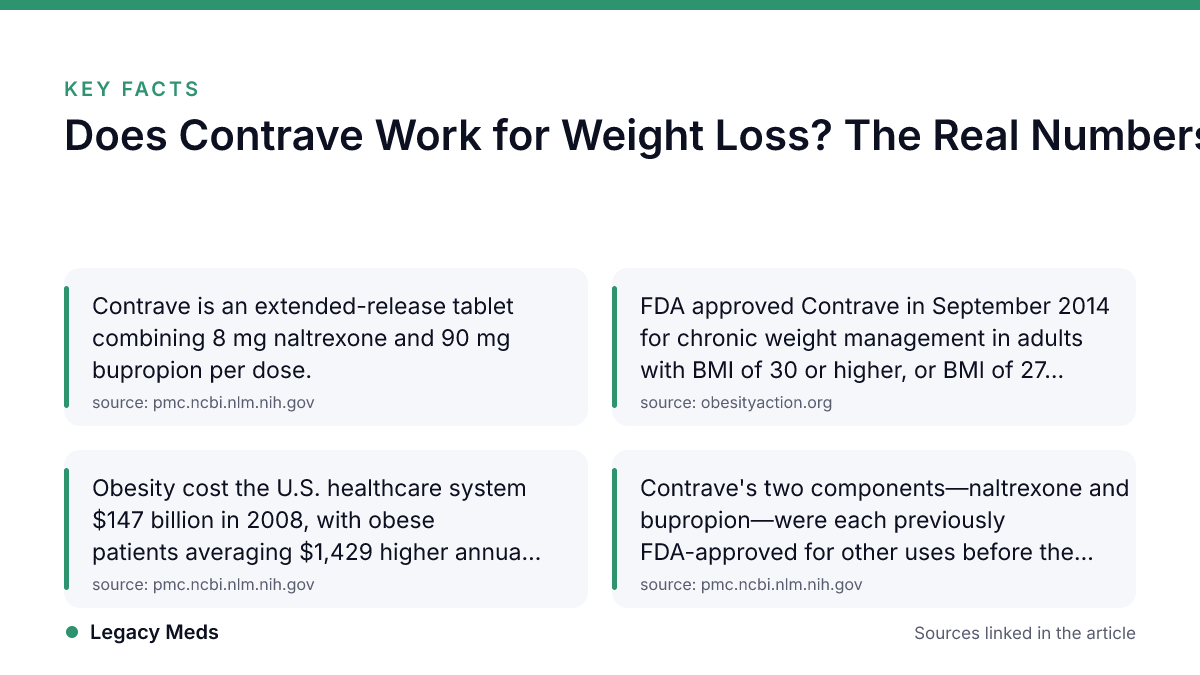
- Contrave is an extended-release tablet with 8 mg naltrexone and 90 mg bupropion per dose. Both ingredients were FDA-approved for other conditions before the combination was cleared in September 2014 for adults with a BMI of 30+, or 27+ with a weight-related condition (Obesity Action Coalition).
- Month one is mostly titration, not weight loss. You don't reach the full dose until week four, so appetite changes usually show up before the scale does.
- The contraindication list is what disqualifies people, not the side effects: opioid use, seizure disorder, MAOIs, and a history of anorexia or bulimia are all hard stops.
- GLP-1s generally win on total pounds lost. Contrave's case is that it's a pill, it's often cheaper, and it's available to people who can't take a GLP-1.
- Obesity carried about $1,429 in extra annual healthcare costs per patient in the cited data, roughly $119 a month. Run that against any medication's price before you decide it's too expensive.
You've been pricing weight loss medications, and Contrave keeps showing up next to Wegovy, Zepbound, and compounded GLP-1s. The question underneath that is simple: can a daily pill approved in 2014 hold its own against the drugs everyone's posting about now?
For some patients, yes. But it works on a different mechanism, it works slower, and its list of people who flat-out can't take it is longer than most product pages admit.
Table of Contents
- How much weight will I lose in a month on Contrave?
- How quickly does Contrave work for weight loss?
- What is the downside of Contrave?
- How does Contrave's cost compare to GLP-1 medications?
- Will I regain weight after stopping Contrave?
- Who should actually consider Contrave over a GLP-1?
- Frequently asked questions
How much weight will I lose in a month on Contrave?
Less than you're hoping, and that's by design. Contrave starts low and climbs. One tablet in the morning during week one, an evening dose added in week two, a second morning tablet in week three, and the full target dose of two tablets twice daily doesn't land until week four (GoodRx).
That ramp exists to keep nausea manageable. It also means the appetite effect you're actually paying for isn't fully switched on until the month is nearly over.
What patients tend to report in our experience: portions shrink first. The second slice stops sounding appealing somewhere around week three. Consistent scale movement usually shows up in months two and three, not month one.
Pro tip: Stop weighing yourself daily during titration and track three things instead: how many times you grazed between meals, whether you finished your plate, and what time your evening snacking started. Those shift before body weight does, and they tell you whether the drug is doing anything at all.

How quickly does Contrave work for weight loss?
Appetite signals start shifting within the first couple of weeks, but the full effect waits for the target dose at week four. Compared to a GLP-1, the early weeks feel subtler. There's no gut-level fullness, just fewer food thoughts.
A few things that change how fast you get there, which nobody mentions until you're already miserable:
- Don't take it with a high-fat meal. Fatty food raises absorption of both ingredients more than is intended. Standard guidance is to avoid taking the tablet with high-fat food.
- Take the evening dose with dinner, not at bedtime. Bupropion is stimulating. Patients who dose late tend to call back about insomnia, then quit, then assume the drug failed them.
- Never split, chew, or crush the tablet. It's an extended-release formulation. Breaking it dumps the full dose at once and raises seizure risk.
- Nausea peaks during step-ups, not steady state. If week three feels rough, that's usually the dose increase, not a permanent verdict.
If you're at the end of week two with nothing to show for it, that's the schedule working as written.
What is the downside of Contrave?
The contraindications, more than the side effects. Common complaints are nausea, headache, constipation, dizziness, and dry mouth, and bupropion carries a boxed warning for suicidal thoughts and behaviors, particularly in younger patients (Cleveland Clinic).
But a real portion of people who ask about Contrave are ruled out before dosing ever comes up:
- Anyone using opioids or in opioid withdrawal. Naltrexone blocks opioid receptors and can trigger sudden, severe withdrawal. This includes prescription pain management you may not think of as "opioid use."
- People with a seizure disorder. Bupropion lowers the seizure threshold.
- Patients with uncontrolled high blood pressure. The combination can push it higher.
- Anyone on an MAOI or within 14 days of stopping one.
- Patients with current or past anorexia or bulimia. Seizure risk in this population is the concern.
- Anyone already taking bupropion for depression or smoking cessation under a different brand name. Stacking them is a double dose.
That last one catches people. A patient on Wellbutrin who asks about Contrave is asking for more bupropion, whether they realize it or not. Bring your full medication list to the consult, including anything prescribed by a different practice.
GLP-1s mostly cause gastrointestinal trouble. Contrave's exclusion list is longer and the consequences of getting it wrong are more serious. That conversation with a provider isn't a formality.
How does Contrave's cost compare to GLP-1 medications?
Generic naltrexone/bupropion ER is usually among the cheaper prescription weight loss options, while brand-name GLP-1s sit at the other end without insurance or a savings program.
At Legacy Meds, GLP-1 injections start at $159 a month and dissolvable GLP-1 tablets start at $249 a month. Brand-name Wegovy® and Zepbound® run on a $99 membership plus the cost of the medication.
Here's how to run your own numbers. Say your pharmacy quotes $90 a month for the generic combination (an illustrative figure, since cash prices swing by pharmacy and region) and you're weighing that against a $159 injection:
- Contrave: $90 × 12 = $1,080 a year
- GLP-1 injection: $159 × 12 = $1,908 a year
- Difference: $828 a year
Now put that against the other side of the ledger. Obesity added an estimated $147 billion to U.S. healthcare spending in 2008, and patients with obesity carried roughly $1,429 more in average annual healthcare costs than normal-weight patients (PMC). Divide $1,429 by 12 and you get about $119 a month already going out the door.
The rule of thumb: if a medication costs less per month than the excess healthcare spending attached to your weight and it actually works for you, the arithmetic favors treating. If you want to use pre-tax dollars, our guide on using HSA or FSA funds for weight loss injections covers what typically qualifies.
| Factor | Contrave | GLP-1 (injection or tablet) |
|---|---|---|
| Mechanism | Blocks opioid receptors, acts on brain reward and appetite centers | Mimics gut hormones, slows digestion, increases fullness |
| Form | Daily oral tablet, 8 mg naltrexone / 90 mg bupropion, titrated over 4 weeks | Weekly injection or daily dissolvable tablet |
| Typical cost | Generic combination usually the cheapest prescription route | $159/month injection, $249/month tablet at Legacy Meds; $99 membership plus medication for Wegovy®/Zepbound® |
| FDA criteria | BMI 30+, or 27+ with a weight-related condition | BMI 30+, or 27+ with a weight-related condition (varies by drug) |
| Common side effects | Nausea, headache, constipation, dizziness, insomnia | Nausea, slowed digestion, constipation, fatigue |
| Hard contraindications | Opioids, seizure disorder, MAOIs, eating disorder history, uncontrolled hypertension | Personal or family history of medullary thyroid carcinoma, MEN2 |
| Best fit | Pill preference, GLP-1 ineligible, lower-cost entry point | Larger total weight loss, comfortable with weekly dosing |
Pro tip: Compare total monthly out-of-pocket cost, not the drug's sticker price. Some telehealth providers bill separately for the consult, the refill review, and shipping. Add those three line items before you decide which option is cheaper.
Will I regain weight after stopping Contrave?
Usually some of it, and often most of it, unless the habits changed while you were on the medication. That's true across essentially every weight loss drug, GLP-1s included.
Contrave works partly by blunting how your brain responds to food cues. Remove the drug and the cues come back at full volume. If the 9 p.m. kitchen trip only stopped because the medication quieted it, it restarts the week you run out.
What separates patients who hold their results from those who don't, in our experience: they used the low-craving window to rebuild the boring infrastructure. A protein target they hit without thinking. A grocery list that repeats weekly. Two gym days that are scheduled, not aspirational. The medication bought them six months of reduced resistance, and they spent it building something that survives without the prescription.
The ones who regain almost always treated the pill as the plan.
Our breakdown of what month one really looks like on GLP-1 treatment covers that same habit-building window, and the logic transfers directly to Contrave.
Who should actually consider Contrave over a GLP-1?
Contrave makes sense for people who want an oral option, can't medically take a GLP-1, or need a lower-cost way into prescription weight loss. It's a reasonable first choice if:
- Injections are a genuine dealbreaker for you, not just a preference you'd get over in two weeks.
- You don't qualify for or can't afford a GLP-1 and want a prescription with a long track record at a lower monthly cost.
- Your pattern is craving-driven, not volume-driven. If your problem is the 3 p.m. vending machine and the after-dinner sweet rather than portion size at meals, Contrave's mechanism targets that more directly than a gut-hormone drug does.
- You're also managing mild depression or trying to quit smoking. Bupropion is used for both, which can make one prescription do two jobs. This only works if a provider who knows your full psychiatric history signs off.
If you're mainly chasing the largest possible total weight loss, a GLP-1 is the stronger opening move. Our comparison of GLP-1s against structured programs like Weight Watchers explains why they outperform most non-surgical options. And if you're deciding between a fast prescription and a supported program, read our take on quick fix vs. full GLP-1 programs first.
Whatever you choose, the decision narrows to three things: what side effects you can live with, what you can pay monthly without resenting it, and whether anyone follows up after the prescription is written. A dietitian or care coach checking in regularly matters nearly as much as the molecule. That's why ongoing support should be built into the program rather than sold back to you later.
Frequently asked questions
Can you take Contrave and a GLP-1 medication together?
It isn't standard practice and should only happen under direct medical supervision. Both affect appetite through separate pathways, and the stacked side-effect load of nausea, GI upset, and mood changes can be rough. Most providers start one medication, assess over two to three months, then adjust.
Does insurance cover Contrave for weight loss?
Coverage varies by plan, and plenty of insurers exclude weight loss medications outright or demand prior authorization with documented BMI. Many patients end up paying cash or using HSA/FSA funds, which Legacy Meds accepts across its GLP-1 plans.
Is there a generic version of Contrave?
Yes. A generic naltrexone/bupropion extended-release combination is available and typically costs less than the brand tablet. Both active ingredients had individual FDA approvals for other conditions before the combination was approved for chronic weight management in 2014 (PMC).
Pull up your current medication list, including anything psychiatric or pain-related, and check it against the contraindications above before you book anything. If you're still a candidate, take Legacy Meds' online quiz to see what you qualify for and compare it against the numbers in our guide to what GLP-1 injections really cost in 2026.