
TL;DR
- GLP-1 medications produce 15% to 25% body weight loss in patients with obesity, according to clinical research published in PMC. For someone starting at 220 pounds, 15% is 33 pounds.
- Generic and compounded options cost far less than brand names. Legacy Meds' GLP-1 injections start at $159/month and dissolvable tablets at $249/month, versus a $99 membership plus medication cost for brand-name Wegovy® and Zepbound®.
- The drugs slow gastric emptying and quiet appetite signaling in the brain, which is why patients describe less "food noise" instead of white-knuckle willpower, per Stanford Medicine.
- Tirzepatide hits two receptors (GLP-1 and GIP), semaglutide hits one, which is why tirzepatide tends to outperform on average. It also tends to bring more GI side effects and a higher price.
- Regain after stopping is the norm without a maintenance plan, so Legacy Meds builds free provider visits and care coaching into every plan rather than mailing a prescription and walking away.
You already know the basics if you've searched "glp-1 weight loss": prescription drugs built for type 2 diabetes that now anchor most medically supervised weight loss programs. The questions that actually matter are how much you'll lose, how fast, what it costs without insurance, and what happens when you stop. Here are the numbers.
Table of Contents
- How many pounds per month can you lose on a GLP-1?
- Which GLP-1 works best for weight loss?
- Is a cheaper generic GLP-1 just as effective as Wegovy or Zepbound?
- What are the negative side effects of GLP-1s?
- Who should not take a GLP-1 medication?
- What happens to your weight after you stop taking a GLP-1?
- What this means for your decision
- Frequently asked questions
How many pounds per month can you lose on a GLP-1?
Expect the biggest drops in months two through six, once your dose has been titrated up to a therapeutic level. Weight loss on a GLP-1 is not linear, and the first four weeks are mostly your body adjusting.
Run the math on your own starting weight. Research shows GLP-1 agonists produce total weight loss of 15% to 25% of body weight in patients with obesity. Take a patient starting at 220 pounds:
- 220 × 0.15 = 33 pounds at the low end of the research range
- 220 × 0.25 = 55 pounds at the high end
- Spread 33 pounds across a 10-month course: 33 ÷ 10 = 3.3 pounds per month on average
That average hides a lot. In our experience, month one often delivers 2 to 4 pounds and a noticeably smaller appetite, then the pace picks up through the middle of the titration schedule, then flattens as you approach a new set point. Wegovy's clinical trial data landed at 15% of body weight, right at the bottom of that research range, which tells you 15% is a reasonable planning number and 25% is the ceiling, not the expectation.
Nausea, appetite changes and some fatigue are common early. Our GLP-1 fatigue guide explains why that happens and how long it usually lasts.
Pro tip: Don't judge month one by the scale. Take waist measurements and photos on day one. Appetite suppression and quieter "food noise" almost always show up before the scale moves much, and that early signal predicts long-term success better than your week-two weight does.
Which GLP-1 works best for weight loss?
Tirzepatide-based medications like Zepbound tend to outperform semaglutide-based ones like Wegovy on average. That does not make tirzepatide the right choice for you.
The pharmacology behind the gap is straightforward. Tirzepatide activates two receptors, both GLP-1 and GIP, which produces more potent appetite and blood sugar effects than a single-receptor drug like semaglutide. More potent also means more pronounced GI side effects for plenty of patients, and a higher price.
What actually decides the right starting point:
- Injection or tablet. If needles are a dealbreaker, a dissolvable GLP-1 tablet uses the same mechanism without the weekly shot. If you're still deciding between medication and lifestyle change alone, our GLP-1 vs. diet breakdown is the place to start.
- How your gut handles it. Some patients tolerate semaglutide better, some tolerate tirzepatide better. This is genuinely individual and usually takes a dose adjustment or two to sort out.
- Budget without insurance. Generic-equivalent options use the same active mechanisms at a fraction of brand pricing.
- Whether coaching is included. Medication without behavior support consistently underperforms medication with it.
The more useful question is not which drug is strongest. It's which one you'll still be taking in month eight. Consistency is what gets patients into that 15% to 25% range, not raw potency.
Is a cheaper generic GLP-1 just as effective as Wegovy or Zepbound?
For most patients, yes. Generic and compounded GLP-1 medications act on the same receptors and produce comparable appetite suppression. The label on the box doesn't change the biology.
GLP-1 agonists work by slowing gastric emptying so food moves more slowly from your stomach to your intestine, which keeps you feeling full longer, and by acting on satiety centers in the brain to blunt hunger and food preoccupation, according to Stanford Medicine. That mechanism is present in a generic-equivalent tablet just as it is in a brand-name injection. What differs is formulation, dosing structure and price.
| Option | Starting cost | What's included |
|---|---|---|
| GLP-1 injection (generic-equivalent) | $159/month | Provider visits, care coaching, free shipping |
| Dissolvable GLP-1 tablet | $249/month | Provider visits, care coaching, free shipping |
| Wegovy® (pill or injection) | $99 membership + medication cost | Brand-name semaglutide |
| Zepbound® injection | $99 membership + medication cost | Brand-name tirzepatide |
The annual gap between the two generic-equivalent formats: ($249 − $159) × 12 = $1,080 a year. Same mechanism of action, one syringe a week instead of a tablet. For patients paying cash, that number is usually the difference between starting this month and starting "eventually." Our full breakdowns of Wegovy cost and Zepbound cost dig into the brand-name side of the same tradeoff.
Pro tip: Pay with HSA or FSA dollars. GLP-1 weight loss treatment typically qualifies as an eligible medical expense, so you're buying with pre-tax money. Here's the math on the $159 injection: $159 × 12 = $1,908 a year. At a 24% marginal federal rate, $1,908 × 0.24 = $458 you don't pay in tax, dropping your real annual cost to roughly $1,450. Our HSA for Wegovy guide runs the same calculation on brand-name treatment.
What are the negative side effects of GLP-1s?
The common ones are gastrointestinal: nausea, constipation, diarrhea, and an appetite reduction that can occasionally tip into feeling too full to eat a normal meal. These come directly from the mechanism. Food is moving through you more slowly, and your digestive system needs a few weeks to adapt.
Fatigue, mild headaches and, rarely, gallbladder problems also show up. One thing GLP-1s generally do not cause on their own is low blood sugar, because they only stimulate insulin release when blood sugar is already elevated. That's a real safety advantage over older diabetes drugs like sulfonylureas.
Side effects peak in the first two to four weeks after starting or stepping up a dose, then fade. This is exactly why titration exists: start low, go up slowly, let your gut catch up. If nausea is bad enough that you're skipping doses, call your care team before you quit. Holding at your current dose for an extra few weeks is almost always better than stopping and restarting from zero. Legacy Meds patients have 24/7 access to a care team for precisely that call, and our GLP-1 fatigue article covers what's normal versus what warrants a message.
Three things most guides skip:
- Alcohol hits differently. Slower gastric emptying changes absorption, and patients regularly report feeling drinks faster or getting sick on amounts that never bothered them before. Our GLP-1 and alcohol guide covers what to expect.
- Travel takes planning. Injections need temperature control, and TSA rules matter if you're flying out of Philadelphia or BWI with pens in your bag. See our Zepbound travel guide.
- Diet still matters. The drug reduces how much you eat; it doesn't decide what you eat. Protein and fiber intake determine whether you lose fat or lose muscle along with it. Our GLP-1 diet plan lays out eating patterns that work with the medication.
Who should not take a GLP-1 medication?
GLP-1s are not for everyone, and a legitimate telehealth provider screens for that before writing anything. Absolute red flags include a personal or family history of medullary thyroid carcinoma or Multiple Endocrine Neoplasia syndrome type 2. A history of pancreatitis or severe GI disease, and pregnancy or breastfeeding, also rule out treatment.
There's a second tier of questions a good intake asks that patients rarely anticipate:
- Are you on insulin or a sulfonylurea? GLP-1s don't cause hypoglycemia alone, but stacked on those medications they can, so the other prescription usually needs adjusting by your prescriber.
- Any gallstone history? Rapid weight loss raises gallbladder risk on its own, independent of the drug.
- Any surgery scheduled? Anesthesia teams increasingly want to know you're on a GLP-1 because delayed gastric emptying affects fasting instructions. Tell your surgeon well before the day of.
- Severe reflux or gastroparesis? Slowing digestion further is a bad trade for most of these patients.
That's why the intake matters more than the price tag. Legacy Meds routes every new patient through an online quiz and a licensed provider review rather than shipping medication to anyone with a card on file. Capital Blue Cross's overview of GLP-1 drugs makes the same point about screening before starting. Our weight loss FAQ covers eligibility basics, but only a real intake conversation settles it for your history.
What happens to your weight after you stop taking a GLP-1?
Some regain is the default. The medication was suppressing appetite signals, and those signals come back once the drug clears your system. That's pharmacology, not a character flaw. In our experience, patients who stop cold with no plan in place see hunger return within weeks and a meaningful share of the weight follow over the next several months.
The ones who hold onto their results do a few specific things:
- They spend the appetite-suppressed window building habits instead of coasting. Concretely: hitting a protein target at every meal (most of our patients aim for 25 to 30 grams per meal) and locking in a movement routine while eating less feels effortless.
- They step down instead of quitting. Dropping one dose level and holding for four weeks before dropping again gives you time to notice hunger creeping back while you still have a tool in hand.
- They keep the coaching relationship through the transition, which is the phase where accountability matters most and most programs disappear.
- They plan around Dover's calendar. Hot, humid summers push outdoor activity off the table from late June through August, and the wet stretches take out a lot of walking days. Patients who already have an indoor default, the Dover Park & Rec pool, a mall loop, a home kettlebell, hold their routine through the summer. Patients whose only plan is "walk the neighborhood" tend to lose six weeks.
This is why every Legacy Meds plan includes free provider visits and ongoing care coaching instead of a one-time prescription and a good-luck email. The medication starts the process. The plan around it is what makes the result stick.
What this means for your decision
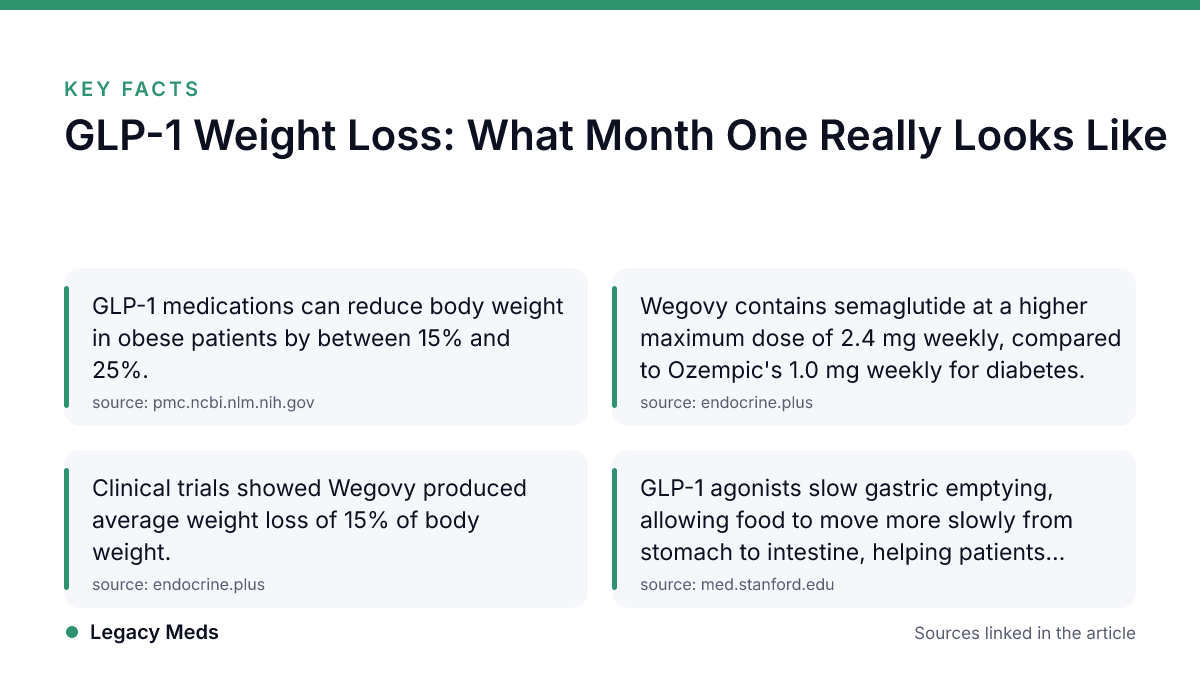
GLP-1 medications work. The research supports 15% to 25% body weight loss in patients with obesity, and the mechanism, slower digestion plus reduced appetite signaling in the brain, is well established. What actually varies between patients is cost, tolerance, and whether anyone is helping you plan for the taper.
| Factor | Brand-name (Wegovy®/Zepbound®) | Legacy Meds generic-equivalent |
|---|---|---|
| Starting cost | $99 membership + medication cost | $159/month injection, $249/month tablet |
| Insurance required | Often needed to make brand pricing workable | Not required |
| Provider visits | Varies by pharmacy or provider | Included free |
| Care coaching | Rarely included | Included free |
| Shipping | Varies | Free |
| HSA/FSA eligible | Typically yes | Typically yes |
The next step isn't more reading. It's finding out whether you qualify, because eligibility comes down to your health history, not which medication sounds best. Legacy Meds serves Dover and the surrounding Kent County area entirely online, no office visit, with more than 500,000 patients through the program. The free online quiz takes a few minutes and tells you where you stand before you spend anything.
Frequently asked questions
Can I use HSA or FSA funds to pay for GLP-1 treatment?
Yes. GLP-1 weight loss treatment generally qualifies as an eligible expense under HSA and FSA plans, so you're paying with pre-tax dollars. Legacy Meds accepts HSA/FSA payment directly, and our HSA for Wegovy guide works through how much that saves at different tax brackets.
Do I need an in-person visit or insurance to get started?
No to both. Legacy Meds operates entirely through telehealth. You complete an online quiz, a licensed provider reviews your history, and if you're approved, medication ships free to your door.
Is Wegovy the same medication as Ozempic?
Both contain semaglutide, but they're not interchangeable. Wegovy goes up to a maximum dose of 2.4 mg weekly and is FDA-approved for chronic weight management. Ozempic tops out at 1.0 mg weekly and is approved for type 2 diabetes. That dosing gap is the main reason Wegovy drives more weight loss.