
TL;DR
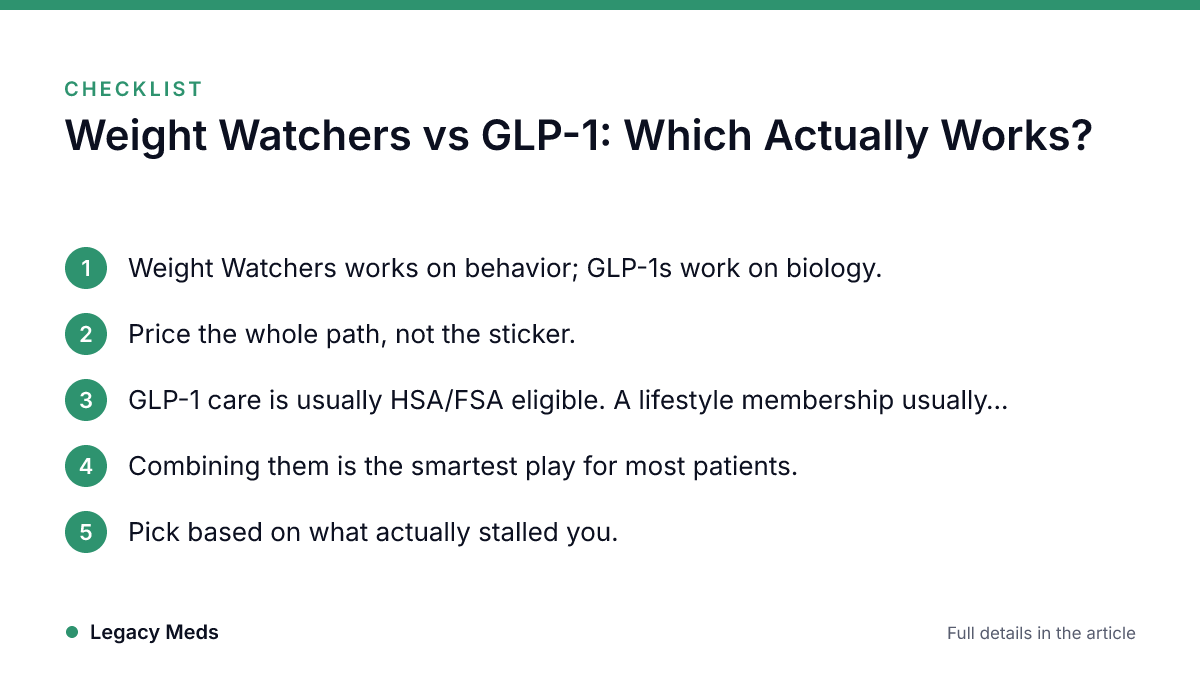
- Weight Watchers works on behavior; GLP-1s work on biology. Points teach you portion awareness. Medication quiets the hunger signal that made portion control feel impossible in the first place.
- Price the whole path, not the sticker. Weight Watchers typically runs somewhere in the $20–$45/month range depending on tier. Legacy Meds GLP-1 plans start at $159/month for injections and $249/month for dissolvable tablets, with provider visits and coaching included.
- GLP-1 care is usually HSA/FSA eligible. A lifestyle membership usually isn't. That alone can swing the real cost by a few hundred dollars a year.
- Combining them is the smartest play for most patients. Medication breaks the constant-hunger cycle; light tracking rebuilds portion sense so you're not starting from zero if you ever come off the drug. Our clinician-guided weight loss plans build coaching in for that reason.
- Pick based on what actually stalled you. If you already know what to eat and still can't stop thinking about food, more tracking isn't the fix.
Weight Watchers (now WW) helps you eat less by counting points. GLP-1 medications help you eat less by changing how hungry you feel. If you've done WW before and still found yourself negotiating with the pantry at 3pm, that's the difference that matters, and it's why so many former members end up on a telehealth call asking about semaglutide or tirzepatide.
Table of Contents
- How do Weight Watchers and GLP-1 medications actually differ?
- Which actually produces more weight loss?
- How do you decide between Weight Watchers and GLP-1 care?
- What does a GLP-1 program cost compared to Weight Watchers?
- Can you do Weight Watchers and GLP-1 medication at the same time?
- What's the best GLP-1 for weight loss if you're choosing between options?
- Your next step
- Frequently asked questions
How do Weight Watchers and GLP-1 medications actually differ?
Weight Watchers is a behavioral program. You track food with a points system, join meetings in person or online, and use community accountability to stay on plan. GLP-1 medications (semaglutide and tirzepatide, sold under names like Wegovy®, Ozempic®, and Zepbound®) are prescriptions that mimic a gut hormone your body releases after eating. They slow digestion and turn down appetite signaling in the brain.
The difference shows up at the dinner table. On WW, you're still fighting hunger. You just have a point budget as backup. On a GLP-1, most of that fight goes quiet because you genuinely feel less hungry and get full faster. That isn't a willpower upgrade, it's a different mechanism, which is why patients who've "tried everything" sometimes see the scale move for the first time in years once medication is added. For a week-by-week sense of what that appetite shift feels like, our breakdown of what month one really looks like walks through it.
Which actually produces more weight loss?
In our clinical experience, GLP-1 therapy produces noticeably more weight loss over six to twelve months than a tracking program used alone, and it gets there faster. Points-based programs tend to produce slow, steady change for people who stay consistent, which is real progress but often not enough to satisfy someone who has fifty pounds to lose.
The two aren't in competition. Patients who do best on medication are almost always the ones who keep some structure around food, which is exactly what a points habit provides. For a closer head-to-head look, see our piece on GLP-1 vs diet.
How do you decide between Weight Watchers and GLP-1 care?
Name the thing that's actually stalling you. If you know what to eat and still think about food an hour after a full meal, that's appetite signaling, not a knowledge gap. WW assumes you need better tools. GLP-1s assume your hunger is working against you. Be honest about which describes you, because everything downstream depends on it.
Check eligibility before you spend anything. Most prescribers, us included, look for a BMI of 27 or higher paired with a weight-related condition such as high blood pressure or prediabetes, or a BMI of 30 and up on its own. You don't need insurance to find out. A short online quiz flags whether you're likely to qualify.
Price the real monthly cost of each path. WW membership generally lands in the $20–$45/month range depending on tier. Legacy Meds injections start at $159/month and dissolvable tablets at $249/month, with provider visits, coaching, and shipping included. Brand-name Wegovy® and Zepbound® run through a $99 membership plus medication cost, which still tends to beat cash pharmacy pricing. Our what weight loss injections really cost in 2026 breakdown and the Wegovy cost guide go deeper.
Choose your format honestly: daily tablet or weekly shot. Dissolvable GLP-1 tablets are a real option now, taken daily. Injections are once a week and then forgotten. Neither is clinically superior. The deciding factor is which one you'll actually do on a bad week.
Decide whether you want coaching or just a script. A prescription from a provider who vanishes after the first visit won't replace what WW meetings give people. Look for a plan that includes care coaching and 24/7 support in the base price rather than as an upsell.
Check your HSA/FSA balance. GLP-1 prescriptions and the visits around them are typically HSA/FSA eligible. A lifestyle membership generally isn't, because it's not classified as medical treatment. If you have pre-tax dollars sitting unused, that's a genuine financial argument for the medical route.
Commit to 90 days, not twelve months. Don't sign a year-long membership contract and don't assume you're married to one GLP-1 formulation. We adjust dose and switch formats regularly based on how patients respond. Three months, tracked honestly, tells you most of what you need to know.
Have a food plan either way. Medication reduces appetite. It does not teach you to hit your protein and fiber when nothing sounds good. Pairing a GLP-1 with loose calorie awareness beats full point-counting for most patients. Our guide on building a calorie deficit diet that sticks is a fine place to start.
Pro tip: Don't judge a GLP-1 by week one. Nausea and tiredness are common early as your body adjusts, and our article on GLP-1 fatigue covers what's normal versus what warrants a call. For most people it settles around week three or four, which is right when the appetite suppression really lands.
What most people miss
Treating this as either/or costs people. The patients who hold onto their loss usually run both: medication to break the hunger cycle, plus a lightweight tracking habit that rebuilds portion sense while their appetite is quiet. Stopping a GLP-1 with no food awareness banked is one of the most common reasons weight comes back.
The other blind spot is alcohol. Tolerance often shifts on a GLP-1, and two drinks can hit like four. Worth reading our GLP-1 and alcohol post before your first happy hour on the medication, not after.
What does a GLP-1 program cost compared to Weight Watchers?
More per month upfront, and frequently less than buying brand-name medication on your own. Here's the comparison side by side.
| Cost factor | Weight Watchers | Legacy Meds GLP-1 (generic) | Legacy Meds brand-name (Wegovy®/Zepbound®) |
|---|---|---|---|
| Monthly cost | ~$20–$45 by tier | $159 injection / $249 tablet | $99 membership plus medication |
| What's included | App, tracking, community | Provider visits, coaching, shipping, 24/7 support | Same, with brand-name drug |
| Insurance required | No | No | No |
| HSA/FSA eligible | Typically no | Yes | Yes |
| How intake drops | You budget points | Appetite signaling quiets | Appetite signaling quiets |
| Needles involved | None | Weekly shot, or daily tablet instead | Weekly shot |
| Commitment | Often tiered contracts | Adjust or switch formats month to month | Adjust or switch formats month to month |
Show the math. Multiply the monthly price by 12. A $40/month membership costs $480 a year. A $159/month starter injection costs $1,908 a year. The gap is $1,428, which is $119 a month ($1,428 ÷ 12).
Now the part only you can fill in. Purely as an illustration, not a promise about your results: if the cheaper path took you from 220 lb to 205 lb over the year and the medicated path took you to 185 lb, that's 20 extra pounds for $1,428, or about $71 per additional pound ($1,428 ÷ 20). Re-run it with whatever numbers you think are realistic for your own body and history.
Here's the threshold we'd offer: if you've given a tracking program an honest 90 days and you're down less than two or three pounds, the per-pound math on the cheaper path is infinite, because the denominator is zero. At that point price stops being the real question.
Pro tip: If cost is the barrier, start at the generic injection or tablet tier instead of assuming brand-name is the only route. The $159–$249 starting price exists specifically for people paying out of pocket.
Can you do Weight Watchers and GLP-1 medication at the same time?
Yes, and for many patients it's the strongest setup. Medication handles appetite. Tracking keeps your nutrition from going sideways while you're eating less, and protein is the piece that slips first. We tell patients to anchor roughly 25 to 30 grams of protein to every meal, because when appetite drops it's easy to lose muscle along with fat without noticing until your lifts or your energy fall off.
One warning about combining them: don't let a point budget talk you into eating. Points exist to cap intake, not to create a quota. On a GLP-1, your actual hunger is the better guide most days. If you're not hungry at dinner, eat your protein and stop, rather than forcing food to hit a number.
If you're comparing standalone programs more broadly, our review of 5 weight loss programs worth it in 2026 covers how WW stacks up against other non-medical options.
What's the best GLP-1 for weight loss if you're choosing between options?
There isn't one universal answer. The right medication depends on your budget, your feelings about needles, and how your body handles the dose. Semaglutide (the ingredient in Wegovy® and Ozempic®) and tirzepatide (Zepbound®) are the two most prescribed, and in practice tirzepatide tends to be the stronger appetite suppressant for many patients, though individual response varies widely enough that we don't predict it in advance.
Two practical notes most comparison articles skip. First, dissolvable tablets need an empty stomach and only a small sip of water, then roughly half an hour before you eat or drink anything else, so they fit a morning routine far better than a chaotic one. Second, rotate injection sites between abdomen, thigh, and back of the arm. Patients who hit the same spot every week end up with tender, lumpy tissue and start dreading dose day.
For cost-conscious patients new to GLP-1 therapy, starting generic and seeing how you respond beats jumping to the most expensive brand on day one. If you're comparing how telehealth providers structure their offerings, our rundown of weight loss medicine providers in Dover is a useful reference.
Your next step
If you gave Weight Watchers an honest run and the scale barely budged, that's information, not failure. Take the free online quiz at Legacy Meds to see whether you qualify for GLP-1 care, and skim the weight loss FAQ before you start.
Frequently asked questions
Does Weight Watchers work without any medication at all?
For some people, yes. It tends to work best for those whose main obstacle is structure and accountability rather than relentless hunger, and who stay consistent with tracking. Progress is usually slower and more gradual than what we see with GLP-1 therapy.
Will I regain weight if I stop GLP-1 medication while still doing Weight Watchers?
Some regain is common after stopping, because appetite returns once the medication clears. Having a tracking habit already in place genuinely limits the rebound, since you're not learning portion control from scratch at the exact moment hunger comes back. Taper under a provider's guidance instead of stopping cold.
Can I switch from Weight Watchers straight into a GLP-1 program without a gap?
Yes. There's no waiting period and no conflict. Plenty of patients keep their membership running through the first few months on medication and use the tracking tools as training wheels while appetite adjusts.