
TL;DR
- HSA and FSA funds generally cover prescription weight loss injections such as semaglutide when a licensed provider prescribes them for a diagnosed condition like obesity or overweight, the same way they cover any other prescription drug.
- Generic GLP-1 injections start at $159/month and dissolvable tablets at $249/month through Legacy Meds. Brand-name Wegovy® and Zepbound® plans run a $99 membership plus the medication cost.
- Paying with pre-tax dollars at a 30% combined tax rate saves roughly $572 a year on a $159/month plan, which covers about three and a half months of treatment on its own.
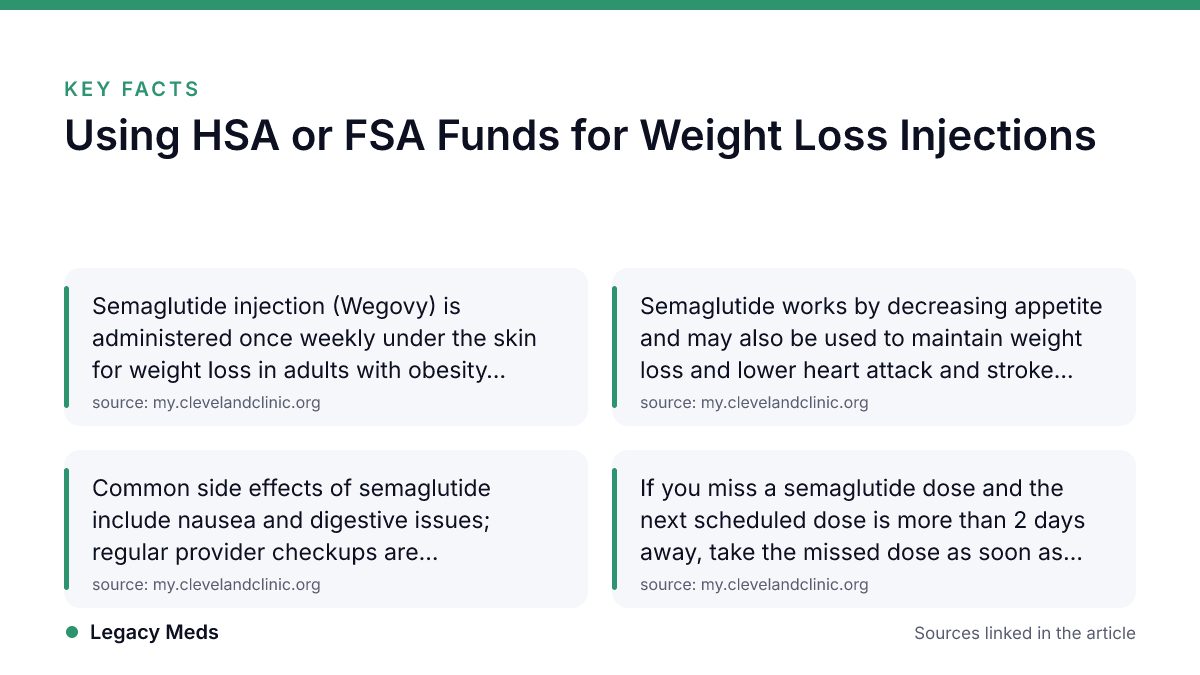
- Semaglutide is injected once weekly under the skin, decreases appetite, and may also be used to maintain weight loss and lower heart attack and stroke risk, per Cleveland Clinic. Nausea and digestive side effects are common, and regular provider checkups are part of safe use.
- Keep your itemized receipt and prescription record. HSA/FSA card declines are usually a merchant-coding issue, not an eligibility issue, and a receipt plus a letter of medical necessity resolves most of them.
Yes, you can pay for injections for weight loss with HSA or FSA dollars, including the provider visits and telehealth care attached to them, as long as a licensed clinician prescribes the medication for a diagnosed condition. Prescribed GLP-1 medication is a medical expense, not a cosmetic one. Legacy Meds takes HSA and FSA cards directly at checkout, with GLP-1 injections starting at $159 a month and dissolvable tablets starting at $249 a month, so you're not fronting the money and chasing reimbursement paperwork for six weeks afterward.
That's the short answer. The part people actually get stuck on is which medication makes sense, what the real annual cost looks like, and what a provider checks before approving you.

Table of Contents
- Which injection is best for weight loss?
- Is injectable weight loss safe?
- How much do weight loss injections actually cost?
- What if my HSA or FSA card gets declined?
- What results can you realistically expect, and how fast?
- How do telehealth providers screen you before prescribing?
- How do you get started?
- Frequently asked questions
Which injection is best for weight loss?
No single injection is best for everyone. It depends on your medical history, your budget, and how your body responds in the first month.
The two GLP-1 medications with the most research behind them are semaglutide (Wegovy®) and tirzepatide (Zepbound®). Both work by slowing digestion and quieting appetite signals to the brain, according to research on injectable weight management drugs. Semaglutide is given once weekly under the skin, decreases appetite, and may also be used to maintain weight loss and lower heart attack and stroke risk, per Cleveland Clinic.
In practice, "best" usually comes down to three things:
- What you can sustain financially for a year. Brand-name medication costs far more out of pocket than generic compounded versions. That's why our generic GLP-1 injections start at $159 a month, and why patients who stop treatment almost always cite cost rather than side effects — a factor worth weighing against structured programs like Weight Watchers, as we break down in Weight Watchers vs GLP-1: Which Actually Works?.
- Whether you want a weekly shot at all. Some people are fine with a once-weekly injection. Others never get comfortable with it. A dissolvable GLP-1 tablet starting at $249/month is the alternative we reach for most often.
- How your first four weeks go. Side effect tolerance varies a lot between people and between medications. A patient who can't get past the nausea on one option sometimes does fine on another at a slower titration.
Pro tip: Pick your injection day with your week in mind. Side effects tend to be strongest in the 24 to 48 hours after a dose, so dosing on a Friday or Saturday means the roughest stretch lands when you're not sitting in meetings or driving kids around. Patients who choose a weekday and then dread it are the ones who skip doses.
Is injectable weight loss safe?
For most adults with obesity or weight-related health conditions, yes, with medical supervision. These are not write-the-script-and-vanish medications.
Nausea and other digestive symptoms are the most common side effects, and Cleveland Clinic specifically recommends regular checkups with your care team throughout treatment. If you already take diabetes medications such as insulin or glipizide, semaglutide can raise your risk of low blood sugar. That interaction is exactly what a thorough intake is supposed to catch before your first dose ships.
Every Legacy Meds plan includes provider visits and care coaching for that reason. Doses get adjusted. Titration schedules get slowed down when someone's struggling. If you miss a dose and your next scheduled one is more than two days away, the guidance is to take the missed dose as soon as you remember rather than doubling up later.
One practical thing people don't hear until they're already dosing: rotate injection sites between your abdomen, thigh, and upper arm instead of using the same spot each week. Repeated injections in one area can leave tissue lumpy and change how consistently the medication absorbs.
How much do weight loss injections actually cost?
Generic options cost a fraction of brand-name ones, and the pricing structures aren't directly comparable, which is where sticker shock comes from.
| Option | Starting price | What's included |
|---|---|---|
| Generic GLP-1 injection | $159/month | Provider visits, care coaching, free shipping |
| Dissolvable GLP-1 tablet | $249/month | Same care team access, daily tablet instead of weekly shot |
| Brand-name Wegovy® / Zepbound® | $99/month membership + medication cost | Brand-name access, same provider oversight |
| Contrave (oral, non-GLP-1) | Varies by pharmacy and insurance | Option for patients avoiding injections entirely |
Run the math on your own tax rate. Take your annual medication cost and multiply it by your combined federal income and payroll tax rate. That's your pre-tax savings.
On the $159/month generic injection plan, a full year is $159 × 12 = $1,908. If your combined rate is around 30% (a 22% to 24% federal bracket plus FICA), paying with pre-tax FSA dollars saves you $1,908 × 0.30 = $572.40 a year versus paying out of your checking account. At $159 a month, that's about three and a half months of treatment funded entirely by the tax break.
Rule of thumb: if your combined rate is 25% or higher, using HSA or FSA dollars is worth the small amount of recordkeeping. Below that, it still helps, just less dramatically.
Pro tip: Compare annual totals, not monthly stickers. A $99 membership looks cheap next to $159 until you add brand-name medication on top of it. Plenty of patients start generic, learn how their body responds, and only move to brand-name if there's a reason to. For more scenarios, see our full pricing guide and Wegovy cost explainer.
What if my HSA or FSA card gets declined?
It's usually a merchant category coding problem, not an eligibility problem, and it happens often enough that it's worth planning for.
Three things fix nearly every case:
- Pay with a regular card and submit for reimbursement. Upload the itemized receipt showing the medication name, date, and amount through your administrator's portal.
- Keep your prescription documentation. Administrators occasionally ask for proof that a licensed provider prescribed the medication for a diagnosed condition. Your visit summary covers this.
- Request a letter of medical necessity if asked. Your prescribing clinician can provide one stating the diagnosis and why the medication is being used. It takes a day or two and settles the question permanently.
Save receipts for at least three years. HSA documentation is your responsibility if the IRS ever asks, and nobody wants to reconstruct two years of pharmacy charges from memory.
What results can you realistically expect, and how fast?
Appetite changes almost always come before scale changes. In our experience, patients notice the "food noise" quieting in the first week or two, while meaningful movement on the scale typically shows up by the end of the first month.
That gap trips people up. Someone weighs themselves on day ten, sees nothing, and decides the medication isn't working, when what's actually happening is that they finished half a dinner for the first time in years. We break the timeline down in GLP-1 Weight Loss: What Month One Really Looks Like. The short version: don't judge your results by week two.
Longer term, progress with GLP-1 medication is gradual rather than dramatic, which fits how semaglutide is used, including to help maintain weight loss over time, per Cleveland Clinic. Food habits matter alongside the medication. If appetite suppression is doing the work and nothing changes about what's on the plate, the eventual plateau hits harder. Our guide to a calorie deficit diet that sticks is a good companion, and a registered dietitian can help turn reduced appetite into better food choices instead of just fewer calories.
How do telehealth providers screen you before prescribing?
Every legitimate telehealth GLP-1 provider runs a medical intake first. A provider that skips it is a red flag, full stop.
A proper screen covers your current medications (especially diabetes drugs like insulin or glipizide, which can raise low blood sugar risk with semaglutide), personal and family medical history, BMI and related conditions, and any prior reactions to similar drugs. Guidance from UT Physicians and the Mayo Clinic both stress that these medications require real medical evaluation, not a two-minute form.
With Legacy Meds, it starts with a short online quiz, followed by a free provider visit where a licensed clinician goes deeper on your history. If a contraindication or interaction rules out a GLP-1, you're not simply turned away. A provider can walk through alternatives, including non-injectable options like Contrave, or recommend coaching-focused support. More detail lives in our weight loss medication safety information.
How do you get started?
- Take the online quiz to see whether you qualify based on your health history and goals.
- Complete a free provider visit where a clinician reviews your intake and recommends a plan: generic injection, dissolvable tablet, or brand-name.
- Pay with your HSA or FSA card at checkout if you want pre-tax dollars doing the work.
- Receive your medication shipped free, with ongoing care coaching and 24/7 access to your care team.
One logistics note worth knowing before your first shipment arrives: injectable GLP-1s are refrigerated, so plan to be home or have a neighbor grab the box. Don't let it sit on a porch in July.
If you're comparing providers, our comparison of weight loss medicine providers covers what matters beyond price, like whether follow-up visits are included and whether anyone answers when you have a side effect question at 9 p.m. on a Tuesday.
Frequently asked questions
What happens if I miss a dose of my weight loss injection?
If your next scheduled dose is more than two days away, take the missed dose as soon as you remember, according to Cleveland Clinic. Don't double up later to catch up. If you're unsure, your care team can confirm the right timing for your plan.
Can I use HSA or FSA dollars for the membership fee, or only the medication?
In most cases both qualify, since the membership covers prescribed medical care rather than a separate non-medical service. Plan rules vary, so check your HSA/FSA documents or ask your administrator for written confirmation before enrolling, particularly for brand-name plans that combine a membership fee with medication cost.
Is Contrave the same thing as an injectable weight loss medication?
No. Contrave is an oral tablet and works through a different mechanism than GLP-1 medications like semaglutide or tirzepatide. It's worth discussing with your provider if you'd rather avoid injections or if a GLP-1 isn't right for your medical history, as outlined by obesity medicine specialists.
Pull up your HSA or FSA balance, multiply your expected annual cost by your tax rate, and see what the pre-tax math looks like for you. Then take the free online quiz and find out which plan you qualify for.