
TL;DR
- Generic GLP-1 injections start at $159 a month through telehealth providers like Legacy Meds. Brand-name Wegovy® and Zepbound® run on a $99 membership plus the medication cost, billed separately.
- Average weight loss from these medications ranges from 5% to 21% of body weight, according to the Obesity Medicine Association. Where you land depends on your starting point, your dose, and how consistent you are.
- Most prescribers require a BMI of 30 or higher, or a lower BMI in the overweight range paired with a weight-related condition like high blood pressure or type 2 diabetes.
- The 12-16 week checkpoint is the one that matters. If you haven't lost at least 5% of your starting weight at your maximum tolerated dose by then, obesity medicine guidance says switch medications instead of waiting it out.
- Weight regain is common once injections stop, so budget for ongoing treatment rather than a 90-day course.
You've counted calories, walked the loop at Silver Lake Park, cut the soda, and the scale gave you four pounds back by March. That's the story we hear most often from patients in Dover, and it's usually the point where weight loss injections enter the conversation.
Here's the short version on price: expect somewhere between $159 a month for a generic GLP-1 injection and several hundred a month for a brand-name product. The medication itself is a GLP-1 or GIP/GLP-1 receptor agonist, the same drug class that covers semaglutide and tirzepatide, taken as a weekly self-injection or in some cases a daily dissolvable tablet.
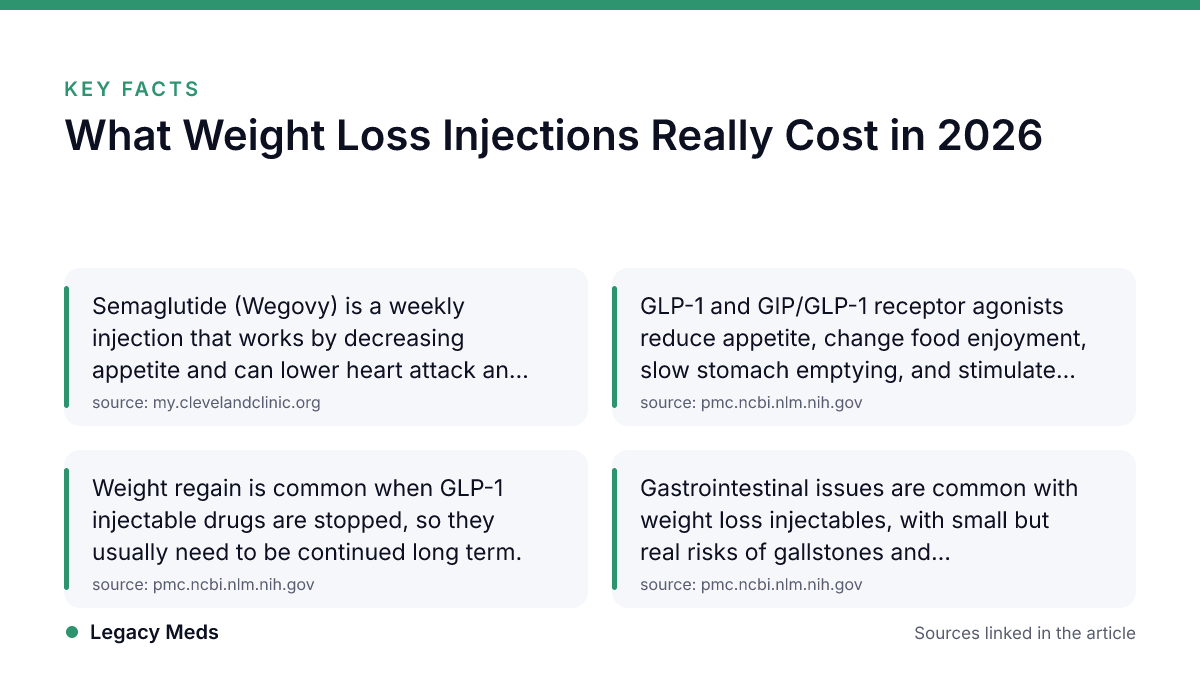
Research on these medications shows they reduce appetite, change how much you enjoy food, slow stomach emptying, and stimulate insulin release. Four mechanisms, one result: you eat less without white-knuckling it.
Table of Contents
- What do weight loss injections actually cost in 2026?
- What is the best injectable for losing weight?
- Is there a safe injection to lose weight?
- How do you get started with weight loss injections?
- What should you expect by 12 to 16 weeks?
- What do most people miss about weight loss injections?
- How do you know if you're a candidate?
- Frequently asked questions
What do weight loss injections actually cost in 2026?
The biggest price gap isn't between clinics. It's between generic and brand name. Without insurance, brand-name GLP-1 drugs can run well into the hundreds of dollars a month, which is why most cash-pay patients start with a generic.
| Option | Starting price | Format | Who it's typically best for |
|---|---|---|---|
| Generic GLP-1 injection | $159/month | Weekly self-injection | Lowest entry price, and you're fine with a needle |
| Dissolvable GLP-1 tablet | $249/month | Daily oral tablet | You'd rather take something daily than inject weekly |
| Wegovy® pill | $99 membership + medication cost | Daily oral tablet | You want the brand-name oral formulation |
| Wegovy® injection | $99 membership + medication cost | Weekly self-injection | You want the original branded semaglutide injection |
| Zepbound® injection | $99 membership + medication cost | Weekly self-injection | You want the tirzepatide-based brand option |
Run the math over a year, not a month. That's the timeframe that actually reflects how people use these drugs.
Generic injection: $159 × 12 = $1,908 a year. Dissolvable tablet: $249 × 12 = $2,988 a year. Difference: $1,080.
Re-run that with your own numbers by multiplying the monthly price by 12. A hundred-dollar monthly gap looks small on a checkout page and looks like a car repair at the end of the year. That's the frame to use.
Pro tip: ask what happens to your price when your dose goes up. Titration means your milligram strength climbs over the first few months, and at some clinics the price climbs with it. Get that answer in writing before your first shipment.
If you're leaning brand name, read the full breakdowns on Wegovy pricing and Zepbound pricing first, because the membership fee and the medication cost are two separate charges. Have an HSA or FSA? Pre-tax dollars work for either path. Here's how that plays out with Wegovy specifically.
What is the best injectable for losing weight?
There's no universal best. There's the one your history, your budget, and your tolerance for nausea point toward.
Semaglutide injections (branded as Wegovy) decrease appetite and can lower heart attack and stroke risk in people carrying excess weight, according to the Cleveland Clinic. That cardiovascular angle matters if you're already managing blood pressure or cholesterol. Tirzepatide injections (branded as Zepbound) hit both GLP-1 and GIP receptor pathways instead of one.
For a cash-pay patient with no insurance coverage, the practical move is to start with the lowest-cost clinically appropriate option and adjust from there. You don't know yet how your body handles a GLP-1. Some people sail through the first month with mild fullness and nothing else. Others spend two weeks negotiating with their stomach. Finding that out at $159 a month is a better trade than finding it out at four times the price.
A few things we've learned watching patients go through this:
- The starting dose is a tolerance test, not a treatment dose. Nobody loses meaningful weight on week one of a GLP-1. You're proving your gut can handle it.
- Nausea usually spikes in the 48 hours after a dose increase, then settles. Patients who know that coming in stop panicking and stop quitting. Patients who don't know it often abandon the medication in month two.
- Injection day matters more than people think. Pick the day that puts your roughest 48 hours on your lightest schedule. Thursday shots mean Friday and Saturday are the tough ones. Sunday shots protect your weekend.
- Rotate sites. Abdomen, thigh, back of the arm. Same site every week tends to produce lumpy, tender spots that patients then misread as an allergic reaction.
Pro tip: don't judge "best" by week two. These medications are titrated up slowly on purpose, and the dose you start on is almost never the dose you finish on.
Is there a safe injection to lose weight?
Yes, for appropriate candidates under clinical supervision, but safe doesn't mean risk-free. Gastrointestinal issues are the common ones: nausea, constipation, diarrhea. There's also a small but real risk of gallstones and pancreatitis, according to research published in PMC.
Most of the GI trouble is manageable with a few habits that clinicians recommend constantly and patients ignore constantly:
- Eat smaller portions and stop at first fullness. Your stomach empties slower now. A normal-sized dinner can sit like a brick for hours.
- Protein first, fried food last. High-fat meals are the single most common trigger patients report for post-dose nausea.
- Stay ahead of constipation. Fluids and fiber from day one, not after four uncomfortable days.
- Don't double up on a missed dose. Call your care team instead. Doubling is a fast route to a very bad week.
Then there are the signs that mean stop and call, not tough it out:
- Severe or persistent abdominal pain, especially pain that bores through to your back. That can signal pancreatitis and needs same-day attention.
- Yellowing skin or eyes, or pain under your right ribs, both of which point toward the gallbladder.
- Signs of real dehydration from repeated vomiting or diarrhea: dizziness, dark urine, confusion.
- Injection site reactions that spread or worsen past a few days, as opposed to mild redness that fades.
- Rapid heartbeat or vision changes, which warrant a same-day call.
This is where 24/7 clinical access earns its keep. The question you'll actually have is "is this pain normal?" at 9:40 on a Sunday night, and a clinic with weekday-only phone hours leaves you Googling symptoms in the dark.
How do you get started with weight loss injections?
Take the health screening quiz. A legitimate telehealth provider needs your health history, current medications, and any weight-related conditions before anything gets prescribed. Legacy Meds runs this as a short online quiz that flags whether you're likely a candidate before you spend a dollar.
Complete a provider visit from your kitchen table. A real clinical visit with a licensed provider, just not in an exam room. You'll cover your BMI, conditions like diabetes or hypertension, and whether an injection or a tablet fits your routine better. Every Legacy Meds plan includes this visit at no extra charge.
Choose your format. $159 generic injection for the lowest entry point. $249 dissolvable tablet if needles are a hard no. Add the $99 membership if you want Wegovy or Zepbound.
Read the safety information before your first dose, not after. Go through the weight loss medication safety information so week one doesn't blindside you.
Get it shipped. Medication goes to your door at no extra cost, which matters if a specialty pharmacy run doesn't fit anywhere in your week.
Start low, titrate slow, keep a log. Appetite, nausea, energy, weight. Four lines in your phone's notes app. It turns your check-in from "I think it's working?" into something your provider can actually act on.
Hit the 12-16 week checkpoint honestly. More on that below. It's the most important date on your calendar.
Plan for the long haul. Weight regain is common once GLP-1 injectables are stopped, so most patients continue treatment, often at a maintenance dose, past their initial goal. Talk budget with your care team early, not in month ten.
What should you expect by 12 to 16 weeks?
At least 5% of your starting body weight, at your maximum tolerated dose. If you're short of that, obesity medicine guidance says it's time to consider a different medication rather than giving it more time.
Do the arithmetic now so you're not guessing later. Multiply your starting weight by 0.05.
A patient starting at 240 pounds: 240 × 0.05 = 12 pounds. That's the floor by week 16.
Say that patient is down 7 pounds at week 15 on the highest dose they can tolerate. It feels like progress, and it is, but it's under the threshold. The right conversation is about switching formulations or drug class, not about trying harder for another three months. Meanwhile a patient down 19 pounds at week 14 is well past the mark and simply keeps going.
Write your number on a sticky note before your first injection. Twelve pounds. Nine pounds. Whatever your math says. It removes the emotion from a decision people otherwise put off for half a year.
For context on the upper end: average weight loss across obesity medications runs from 5% to 21% of body weight, with some people losing more and some less. On a 240-pound starting weight, that spread is roughly 12 to 50 pounds. Both ends are real.
What do most people miss about weight loss injections?
Most of the frustration we hear about comes down to a handful of blind spots that a good provider should raise up front and often doesn't.
- Month two and three, not week one. Early nausea gets all the attention. The second wave of fatigue that arrives as doses climb catches more people off guard. Our GLP-1 fatigue guide covers what's normal and what's worth flagging.
- Medication without a food strategy. These drugs curb appetite, they don't decide what you eat in that smaller window. Patients who pair treatment with a structured plan like our GLP-1 diet plan tend to see steadier results. It's also worth understanding how GLP-1 compares to diet and exercise on its own.
- Alcohol, asked about too late. Drinking on a GLP-1 can amplify nausea, and some people report alcohol hitting them differently. Read our GLP-1 and alcohol breakdown before your first weekend out, not after.
- Travel logistics. Weekly injections need refrigeration planning and TSA-friendly packing. Our Zepbound travel guide covers keeping a dose on schedule across time zones.
- Assuming no insurance means no options. Every option on the table above, from the $159 generic injection to brand-name Wegovy, is built for cash-pay and HSA/FSA patients.
Pro tip: if you're using HSA or FSA funds, check your administrator's eligible-expense rules before you order. Most GLP-1 medications and provider visits qualify, but some administrators want a letter of medical necessity on file and it's far easier to get one at the start than to chase reimbursement later.
How do you know if you're a candidate?
It comes down to BMI, health history, and what your body has already responded to. Most weight loss medications are prescribed for adults with a BMI of 30 or higher, or for people in the overweight range with a weight-related health condition such as high blood pressure, type 2 diabetes, or sleep apnea, according to the Obesity Medicine Association.
If you're wondering whether this is still a fringe treatment: more than 2% of U.S. adults took a GLP-1 for weight loss in 2024, based on FAIR Health data published in May 2025.
Beyond the BMI number, four questions decide it:
- Have lifestyle changes genuinely failed, or have they never run long enough to judge? These medications are typically recommended after diet and exercise alone haven't produced lasting results, not as step one.
- Any personal or family history of pancreatitis, gallbladder disease, or certain thyroid cancers? Your provider weighs this heavily, given the documented links between GLP-1 medications and gallstones or pancreatitis.
- Weekly injection or daily tablet? Both work through similar mechanisms. Which one you'll still be doing in month eight is the real question.
- What's your timeline expectation? Weight-loss injections explained by the BHF notes that results build gradually over months. If you're searching for how to lose weight fast, this is the wrong tool.
A provider visit sorts all of this in one conversation. Our weight loss FAQ has the full rundown if you want it before you take the quiz.
Frequently asked questions
Do I need insurance to start weight loss injections?
No. The $159 starter injection and every other plan are built for patients without weight loss medication coverage. Pay directly or use HSA/FSA funds. Brand-name options through the $99 membership work the same way, with no insurance approval or prior authorization involved.
What happens if I stop taking weight loss injections?
Weight regain is common once GLP-1 injectables are discontinued, because the appetite suppression and slowed stomach emptying fade as the drug clears your system. That's why most patients and providers plan on continued treatment, frequently at a lower maintenance dose, instead of treating it as a short-term fix.
Can I drink alcohol while taking weight loss injections?
You can, with caution. Alcohol can worsen nausea and stomach upset that's already common on these medications, and some patients notice alcohol's effects land differently. Our full breakdown on GLP-1 and alcohol covers what to expect before your first drink on treatment.
Before you do anything else, calculate your 5% number. Starting weight × 0.05. That single figure tells you what success looks like at week 16 and when to change course. Then take the free online quiz, get matched with a licensed provider, and find out which weight loss injection fits your health profile and your budget.