
GLP-1 receptor agonists lower blood pressure by roughly 3 to 5 mmHg systolic on average, driven mostly by weight loss but partly by direct vascular effects. That benefit comes with a catch: real-world data show a measurable rise in symptomatic low blood pressure, especially in older adults and people already taking multiple antihypertensive drugs. The clinical takeaway is straightforward. Track blood pressure closely after starting therapy, and revisit other blood pressure medications before they cause a problem, not after.
TL;DR:
- Blood pressure reductions from GLP-1 receptor agonists typically range from 3 to 5 mmHg systolic, with higher effects linked to greater weight loss and initial blood pressure levels.
- Symptomatic low blood pressure and fainting risks increase in older adults and those taking multiple antihypertensive medications, requiring proactive monitoring.
- Blood pressure must be checked before starting therapy, with follow-ups within 1 to 4 weeks and again at 8 to 12 weeks to adjust medications and reduce safety risks.
- The blood pressure-lowering effect involves both weight-dependent vascular tone improvements and weight-independent mechanisms like increased natriuresis and endothelial function.
- Long-term cardiovascular outcome data is promising but still incomplete, emphasizing the need for ongoing blood pressure tracking and medication review during therapy.
Table of Contents
- How Much Do GLP-1s Lower Blood Pressure?
- How Does GLP-1 Lower Blood Pressure?
- Can GLP-1 Medications Cause Low Blood Pressure or Fainting?
- What Should Monitoring and Medication Adjustment Look Like?
- Do All GLP-1 Drugs Affect Blood Pressure the Same Way?
- A Practical Monitoring Checklist for Starting GLP-1 Therapy
- Legacy Meds’ Approach to Blood Pressure Safety
- What Do We Know About Long-Term Cardiovascular Outcomes?
- How Do GLP-1s Compare to Other Diabetes and Weight-Loss Drugs on Blood Pressure?
- Does GLP-1 Therapy Affect Blood Pressure Rhythm Throughout the Day?
- Should GLP-1 Doses Be Timed Around Blood Pressure Medications?
- What About Resistant or Secondary Hypertension?
- Editorial Take: The Blood Pressure Story Nobody’s Telling Straight
- Sources
- FAQ
How Much Do GLP-1s Lower Blood Pressure?
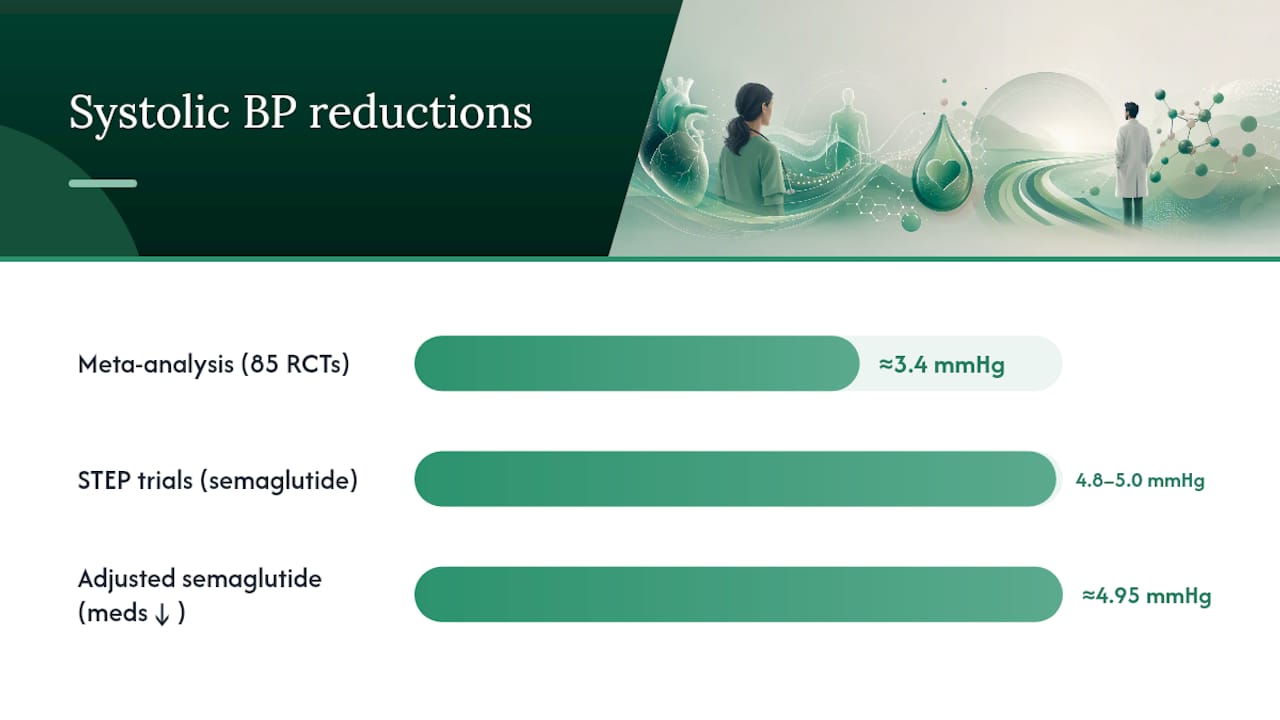
The pooled numbers are consistent across the largest analyses available, which matters given how much noise surrounds this drug class. A systematic review and meta-analysis of 85 randomized controlled trials covering roughly 90,977 participants found GLP-1 receptor agonists reduced systolic blood pressure by about 3.4 mmHg (95% CI 2.8–4.0) and diastolic pressure by about 0.9 mmHg (95% CI 0.5–1.2). Those aren’t huge numbers next to a dedicated blood pressure medication, but they’re not trivial either, and they show up consistently enough across dozens of trials to be considered a real drug effect rather than statistical noise.
Pro Tip: A 3 to 5 mmHg systolic drop sounds modest, but population studies tie even small, sustained reductions of that size to meaningfully lower long-term stroke and heart attack risk when they hold up over years, not just months.
Semaglutide-specific data push the estimate a bit higher. Pooled analysis of the STEP trial program found an average systolic reduction near 4.8 to 5.0 mmHg in people without diabetes. A separate individual-patient-data analysis of semaglutide trials calculated an adjusted between-group difference of about −4.95 mmHg overall, with reductions holding steady across different baseline hypertension categories. That same analysis found something clinicians should sit with: treatment intensity for other blood pressure drugs actually fell in the semaglutide arm, meaning the true drug effect on blood pressure may be somewhat masked by doctors backing off other medications as patients improved.
Why the range varies so much
The spread between “about 3 mmHg” and “about 5 mmHg” is not a contradiction. It reflects real differences in trial design and populations.
- Larger weight loss tracks with larger blood pressure reductions, and semaglutide/tirzepatide trials tend to produce more weight loss than older GLP-1 agents.
- Baseline blood pressure matters. People starting with stage 2 hypertension generally see bigger absolute drops than those who start near-normal.
- Trial duration shapes the numbers too. Most of the studies feeding these meta-analyses ran 26 to 68 weeks, so durability beyond a year or two is still an open question.
- Diabetes status changes the picture slightly. Some analyses show marginally smaller reductions in people with type 2 diabetes compared with those who have obesity alone.
A state-of-the-art review of mechanisms and clinical implications puts the typical range at 2 to 5 mmHg systolic, which is the figure worth remembering if you only take one number away from this section. The review is also candid about a limitation that gets glossed over in marketing material: most trials are too short, and too heterogeneous in who they enroll, to say with confidence whether these reductions persist at year three or year five. The mechanism looks real. The long-term durability data simply hasn’t caught up yet.
How Does GLP-1 Lower Blood Pressure?
Weight loss explains a large share of the effect, but not all of it, and that distinction matters for anyone assuming the drug only works by shrinking the number on the scale.
The weight-mediated pathway works the way you’d expect physiologically. Less adiposity means less mechanical strain on the cardiovascular system, improved insulin sensitivity, and reduced sympathetic nervous system activity, the “fight or flight” signaling that keeps blood vessels constricted and heart rate elevated. Fat tissue itself is metabolically active and contributes to inflammation and vascular resistance, so losing a meaningful percentage of body weight removes a real physiological burden.
The weight-independent pathway is where things get more interesting, and where the science is still catching up. The same state-of-the-art review points to three mechanisms that appear to act somewhat separately from weight loss itself: increased natriuresis (the kidneys excreting more sodium), improved endothelial function (the blood vessel lining relaxing and dilating more efficiently), and reduced vascular inflammation. GLP-1 receptors exist directly in the kidney and vascular endothelium, which gives these drugs a plausible route to affect blood pressure that has nothing to do with fat loss.
This distinction isn’t just academic. If blood pressure improvement were purely a function of weight loss, you’d expect the effect to track weight change almost linearly and to disappear the moment weight loss plateaus. Instead, mechanistic evidence suggests natriuresis and endothelial improvements provide antihypertensive benefit independent of how many pounds come off, which would explain why some patients see blood pressure improvements early, before substantial weight loss has occurred.
The evidence gap here is real and worth naming honestly. Almost none of the large trials were designed to separate “how much of this is weight loss” from “how much of this is a direct drug effect on the vasculature.” Doing that requires mechanistic RCTs with weight-matched comparator groups, and those studies are still thin on the ground. Until they exist, the honest answer is that both pathways likely contribute, and the exact split probably varies by individual metabolic profile, kidney function, and how much weight a given patient loses.
Can GLP-1 Medications Cause Low Blood Pressure or Fainting?
Yes, and this is the part of the story that gets far less attention than the average blood pressure reduction, despite mattering more for a meaningful subset of patients.
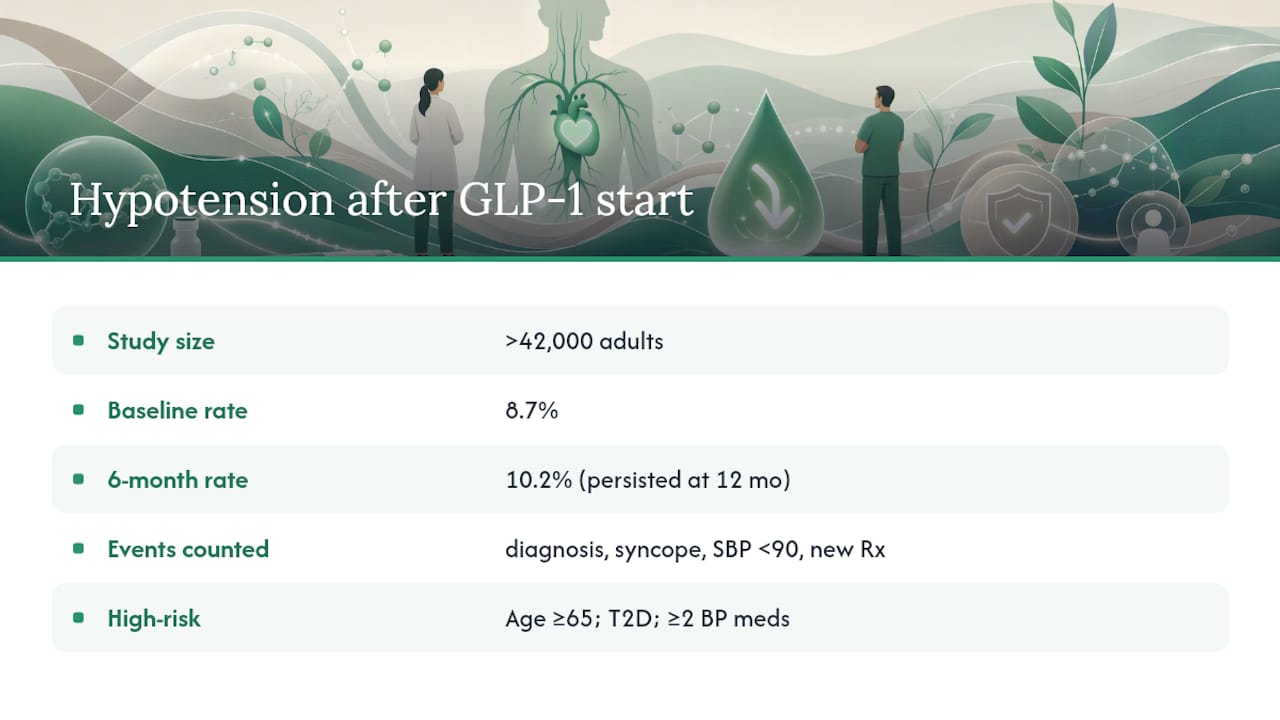
A large observational analysis of electronic health records covering more than 42,000 adults on multi-drug antihypertensive regimens found that hypotensive events rose from 8.7% to 10.2% within six months of starting GLP-1 therapy. That elevated rate persisted at the 12-month mark. The events counted here weren’t trivial background noise. Researchers tracked clinical hypotension diagnoses, syncope (fainting), systolic readings dropping below 90 mmHg, and new prescriptions specifically written to treat hypotension, meaning real clinicians were reacting to real symptoms in real time.
People with type 2 diabetes were also overrepresented, likely because diabetes-related autonomic neuropathy already blunts the body’s ability to compensate for blood pressure swings, so adding a drug that further relaxes blood vessels removes one of the few remaining safety margins.
It’s worth being fair to the data here rather than treating every case as a direct drug effect. Confounding is a real possibility. Patients starting GLP-1 therapy are often losing weight rapidly, eating less, and sometimes drinking less fluid, all of which can independently drop blood pressure regardless of the medication’s direct pharmacology. Some patients were also still on unchanged doses of other antihypertensives that no longer matched their improving blood pressure, essentially getting double-treated. But even accounting for those factors, the practical signal doesn’t disappear: a meaningful number of patients experienced dizziness, fainting, or measurably low readings that required medical attention after starting a GLP-1.
There’s a related pattern worth flagging: background research suggests hypotension risk may be under-recognized in the original approval trials, because those trials often excluded the frailest, most multimorbid patients, exactly the population showing up disproportionately in real-world safety data now. Clinical trials optimize for clean efficacy signals. Real-world prescribing doesn’t have that luxury, and it shows in the numbers.
The highest-risk patients share a fairly recognizable profile: age 65 or older, a diagnosis of type 2 diabetes, and polypharmacy involving two or more blood pressure medications. If you fit more than one of those categories, the conversation about starting a GLP-1 should include an explicit plan for blood pressure monitoring, not a vague “call us if you feel dizzy.”
What Should Monitoring and Medication Adjustment Look Like?
Turning the evidence into practice comes down to timing, communication, and a willingness to actively pull back on other medications rather than waiting for a problem to show up.
Home blood pressure monitoring should start before the first dose, not after. A baseline reading, ideally averaged over a few days, gives you and your provider something real to compare against once the medication starts working. From there, clinical guidance drawn from state-of-the-art reviews points toward two key checkpoints: an early follow-up at 1 to 4 weeks to catch symptomatic drops and dose-related side effects, and a second check at 8 to 12 weeks once weight loss and blood pressure changes have had time to stabilize.
Supervised de-prescribing is the piece most patients don’t expect to hear about, but it’s often the most important safety step. As blood pressure improves, medications prescribed at a higher dose for a higher baseline blood pressure can become too strong. The classes most often reconsidered include diuretics, which compound fluid loss already happening from appetite suppression, and alpha blockers, which independently raise fainting risk when combined with a new vasodilating effect. This isn’t a decision to make solo. It requires a prescriber actively reviewing the regimen, not a patient quietly skipping doses because they feel lightheaded.
- Confirm baseline blood pressure and standing/sitting readings before the first GLP-1 dose.
- Schedule a check-in within the first month, specifically asking about dizziness, lightheadedness on standing, or fainting.
- Reassess the full medication list at 8 to 12 weeks, with particular attention to diuretics and other blood pressure drugs.
- Flag anyone with a history of syncope, autonomic neuropathy, or orthostatic hypotension for closer, more frequent monitoring.
- Keep prescribers in the loop across specialties. A cardiologist adjusting a beta blocker needs to know a patient started a GLP-1 the same month.
Pro Tip: If you feel lightheaded standing up after starting a GLP-1, don’t just push through it. Sit down, check your blood pressure if you have a home monitor, and mention it at your very next appointment rather than waiting for the scheduled follow-up.
Very elderly patients and anyone with a documented history of autonomic neuropathy deserve orthostatic vitals checked in person, meaning blood pressure measured lying down and then again standing up after a couple of minutes. That test catches the kind of postural drop that a single seated reading in a waiting room will miss entirely. Reviewing current drug interaction guidance before starting therapy is a reasonable step for anyone on more than one blood pressure medication already.
Do All GLP-1 Drugs Affect Blood Pressure the Same Way?
Not exactly, though the differences track fairly closely with how much weight loss each drug produces rather than representing some separate, unrelated property.
Semaglutide and tirzepatide, the two agents behind the largest weight-loss results in trials, have also produced the largest average systolic reductions, generally in the 4 to 6 mmHg range. Older GLP-1 receptor agonists, which tend to produce more modest weight loss, generally land at the lower end of the broader 2 to 5 mmHg range described in pooled analyses. The meta-analysis of 85 RCTs found this pattern holds across the drug class: more weight loss correlates with more blood pressure reduction, and dual agonists like tirzepatide, which target both GLP-1 and GIP receptors, show some of the larger effects precisely because they tend to produce more weight loss.
Emerging triple agonists, which add glucagon receptor activity into the mix, are generating early trial interest for even larger metabolic effects. It’s too early to rank them definitively on blood pressure outcomes specifically, and it would be a mistake to treat early trial data as settled science. What can be said with reasonable confidence is that the correlation between weight-loss potency and blood pressure improvement has held consistently as newer agents have entered the field, and there’s no strong signal yet that any approved agent works through a fundamentally different mechanism.
Long-term cardiovascular outcome data, the kind that comes from multi-year trials tracking actual heart attacks and strokes rather than blood pressure readings alone, is still catching up to the newest agents. Anyone switching between GLP-1 medications for cost, tolerability, or effectiveness reasons should expect blood pressure response to shift somewhat with the switch, not necessarily for the worse, but worth tracking rather than assuming it carries over identically.
A Practical Monitoring Checklist for Starting GLP-1 Therapy
This is the short version, the kind of thing worth keeping on a fridge or in a phone note during the first three months of treatment.
- Before the first dose: Get a baseline blood pressure reading, ideally averaged across two or three home checks, and have your provider review your full current medication list.
- Weeks 1 to 4: Watch for dizziness, especially standing up quickly, along with fatigue or a racing heartbeat, and report any of it rather than waiting it out.
- Weeks 8 to 12: Schedule a full medication reconciliation appointment. This is when diuretics and other blood pressure drugs most often need adjusting.
- Ongoing: Take home blood pressure readings at the same time each day, seated, after resting five minutes, and log both the number and how you felt.
- Red flags requiring same-day contact: fainting, a systolic reading consistently below 90 mmHg, or new confusion or extreme fatigue.
Pro Tip: Keep your blood pressure log in the same app or notebook you use to track weight and medication doses. Patterns are much easier to spot when everything lives in one place instead of scattered across memory and sticky notes.
Legacy Meds’ Approach to Blood Pressure Safety
Patients starting a GLP-1 medication benefit from a structured intake process that includes a full medication review before the first prescription is written. Providers inquire about existing blood pressure medications, prior fainting or dizziness episodes, and other conditions like diabetes that raise hypotension risk. Follow-up is ongoing, allowing patients to report new symptoms such as lightheadedness or unusual fatigue as needed.
When a patient’s blood pressure profile suggests higher risk, such as older age combined with multiple existing antihypertensives, plans often include closer check-ins and coordination for adjusting medications with the patient’s other doctors. The approach aims to complement, not replace, cardiologists or primary care physicians managing complex hypertension, by flagging concerns early and maintaining an overview of cardiovascular health during treatment. You can review the medication safety information Legacy Meds provides to every patient before starting.
What Do We Know About Long-Term Cardiovascular Outcomes?
Blood pressure reduction is a means, not the end goal. What actually matters is whether that reduction translates into fewer heart attacks, strokes, and cardiovascular deaths over years, and the honest answer right now is: probably, but the full picture is still forming.
Cardiovascular outcome trials for GLP-1 receptor agonists, run primarily in people with type 2 diabetes and established cardiovascular disease, have shown reductions in major adverse cardiovascular events. Blood pressure improvement is one plausible contributor among several, alongside weight loss, improved lipid profiles, and reduced inflammation markers. Untangling exactly how much of the cardiovascular benefit traces back to blood pressure specifically, versus these other factors moving in parallel, remains an open research question.
The duration mismatch is the honest limitation here. Most blood pressure data comes from trials running one to two years. Cardiovascular events, especially strokes and heart attacks tied to long-term arterial damage, often take five, ten, or more years to fully manifest or prevent. A 3 to 5 mmHg systolic reduction sustained over a decade would be expected, based on general hypertension research, to meaningfully lower stroke risk. Whether GLP-1-induced reductions specifically hold steady that long, rather than plateauing or requiring dose escalation to maintain, isn’t fully settled yet. That’s the honest state of the evidence: encouraging direction, incomplete duration.
How Do GLP-1s Compare to Other Diabetes and Weight-Loss Drugs on Blood Pressure?
Metformin, still the most commonly prescribed first-line diabetes medication, generally produces little to no meaningful blood pressure change on its own. SGLT2 inhibitors, another popular diabetes drug class, do lower blood pressure, largely through a diuretic-like effect that increases urinary glucose and sodium excretion, and the reductions reported for that class are often in a broadly similar range to what’s seen with GLP-1 receptor agonists.
Older weight-loss approaches carry more mixed profiles. Some appetite suppressants have historically raised heart rate and blood pressure rather than lowering it, which is part of why the GLP-1 class stands out. It achieves substantial weight loss while moving blood pressure in the favorable direction rather than working against it.
The mechanism split matters here too. SGLT2 inhibitors lower blood pressure largely through fluid loss, a mechanism that shares some of the same hypotension risk profile seen with GLP-1s, particularly when the two classes are combined in the same patient, which happens often in type 2 diabetes care. GLP-1s bring an added natriuretic and vascular component on top of weight loss that most other diabetes medications don’t replicate. For patients on both a GLP-1 and an SGLT2 inhibitor simultaneously, the combined fluid and vascular effects are a specific reason to prioritize closer blood pressure monitoring rather than assuming the two drugs’ effects simply add up predictably.
Does GLP-1 Therapy Affect Blood Pressure Rhythm Throughout the Day?
Blood pressure isn’t static. It naturally dips at night and rises in the morning, a pattern called circadian variation, and disruption of that pattern, known as a “non-dipping” profile, is itself an independent cardiovascular risk marker separate from the average daytime number.
Direct evidence on how GLP-1 receptor agonists affect nighttime dipping patterns specifically is still limited compared with the robust data on average 24-hour blood pressure change. What’s plausible, based on the broader mechanism data, is that improved endothelial function and reduced sympathetic drive could support a healthier dipping pattern over time, since sympathetic overactivity is one of the drivers of non-dipping. That’s a reasonable inference from the mechanism research, not yet a directly proven outcome specific to this drug class.
Blood pressure variability, meaning how much readings swing day to day rather than just the average level, is a separate concern worth naming for anyone starting therapy. Some patients report more day-to-day fluctuation during the initial weeks of treatment, likely tied to changing food and fluid intake alongside dose titration, rather than a stable new baseline settling in immediately. This is part of why early, frequent home monitoring matters more than a single clinic reading. A single high or low number two weeks into treatment tells you much less than a week’s worth of readings taken at the same time each day.
Should GLP-1 Doses Be Timed Around Blood Pressure Medications?
There’s no strong evidence requiring GLP-1 injections to be timed at a specific hour relative to other antihypertensive medications, and most GLP-1 agents are dosed weekly, which limits how much daily timing even matters compared with drugs taken every day.
The more relevant timing question isn’t hour-of-day but week-of-treatment. The first four to eight weeks after starting or increasing a GLP-1 dose are when blood pressure is most likely to shift meaningfully, so that window is when other blood pressure medications should be reassessed rather than left on autopilot. If a patient takes a diuretic or another blood pressure drug in the morning, keeping that consistent while watching for symptoms is more useful than trying to stagger it against a weekly injection given on a different day entirely.
For daily oral GLP-1 formulations, taken on an empty stomach as directed, there’s no established interaction requiring separation from blood pressure medication by a specific number of hours. The practical guidance from clinical reviews centers on monitoring response and adjusting doses of other drugs based on measured blood pressure trends, not on engineering a precise hourly schedule between medications.
What About Resistant or Secondary Hypertension?
Resistant hypertension, blood pressure that stays elevated despite three or more antihypertensive medications including a diuretic, is a specific clinical situation that deserves its own consideration rather than being lumped in with routine cases.
GLP-1 receptor agonists haven’t been studied as a dedicated resistant-hypertension treatment, and they shouldn’t be started with the expectation of replacing a properly worked-up resistant hypertension evaluation, which typically includes screening for secondary causes like primary aldosteronism, renal artery stenosis, or sleep apnea. That said, the weight loss and modest blood pressure reduction from GLP-1 therapy can meaningfully help patients whose resistant hypertension is driven substantially by obesity, sometimes allowing a reduction in the total antihypertensive burden over time.
Secondary hypertension, caused by an identifiable underlying condition like kidney disease or a hormonal disorder, needs its own separate evaluation and treatment path. A GLP-1 medication addressing weight and metabolic factors doesn’t treat the underlying cause of secondary hypertension, and starting one shouldn’t delay a proper workup if secondary hypertension is suspected. Patients in either category, resistant or secondary hypertension, are also often on the exact polypharmacy combinations flagged as higher-risk for hypotension in the observational safety data, which makes closer monitoring during GLP-1 initiation especially important rather than optional.
Editorial Take: The Blood Pressure Story Nobody’s Telling Straight
Most coverage of GLP-1s and blood pressure picks a side. Either the drugs are framed as a quiet cardiovascular miracle, or the hypotension headlines get treated like a hidden scandal. Neither framing survives contact with the actual data. The pooled evidence is genuinely good, a 3 to 5 mmHg systolic reduction is real and clinically relevant. The safety signal is also genuinely real, and it disproportionately hits people least equipped to handle a sudden blood pressure drop.
The gap I’d push back on hardest is how passively “monitoring” gets treated in most patient-facing material. It’s usually a throwaway line, watch for dizziness, rather than a structured plan with specific checkpoints and an explicit conversation about de-prescribing other medications. That’s backwards. The riskiest window is predictable, the first one to three months, and the patients most likely to have a problem are identifiable in advance: older, diabetic, already on multiple blood pressure drugs. Treating that group generically instead of proactively is the real gap between what the evidence supports and what typically happens in practice.
— Bryan
This article is general information, not a substitute for advice from a qualified doctor. Consult a qualified healthcare professional about your own circumstances before acting on anything here.
Sources
The meta-analysis of 85 randomized trials provides the most robust pooled effect-size data available. The state-of-the-art mechanistic review explains the biological pathways in detail. The Northwestern-affiliated EHR safety analysis offers the clearest real-world hypotension data. The individual-patient-data semaglutide analysis breaks down drug-specific effects and medication de-escalation patterns. Readers managing complex cases should also review drug interaction guidance with a pharmacist directly.
- Effect of incretin-based therapies on blood pressure: a systematic review and meta-analysis
- GLP-1 Receptor Agonists and Blood Pressure: A State-of-the-Art Review of Mechanisms, Evidence, and Clinical Implications
- GLP‑1 drugs tied to elevated risk of low blood pressure episodes
- Individual-patient data analysis: semaglutide and blood pressure change
FAQ
Does GLP-1 Lower Blood Pressure?
Yes. Pooled data from 85 randomized trials show an average systolic reduction of about 3.4 mmHg, with semaglutide-specific analyses showing reductions closer to 5 mmHg, driven by both weight loss and direct vascular effects.
What Do Cardiologists Think of Ozempic and Blood Pressure Risk?
Clinical reviews generally view the average blood pressure reduction as a genuine cardiovascular benefit, while also flagging the need for closer monitoring in patients on multiple antihypertensives, since observational data show a real rise in hypotensive events in that group.
Does Zepbound Make Your Blood Pressure Low?
Tirzepatide, the active ingredient in Zepbound, is associated with average systolic reductions in the 4 to 6 mmHg range in trials, and like other GLP-1 class drugs, it carries a documented risk of symptomatic low blood pressure in vulnerable patients, particularly those already on blood pressure medication.
Why Are Some Older Adults Stopping GLP-1 Medications?
Older adults account for a disproportionate share of hypotension-related events, 53% of episodes in one large analysis despite being only 37% of the study group, and symptoms like dizziness or fainting are a common reason some choose to pause or stop treatment.
How Soon After Starting a GLP-1 Should Blood Pressure Be Checked?
Clinical guidance points to an initial check within 1 to 4 weeks of starting treatment, with a more complete medication reconciliation at 8 to 12 weeks once weight loss and blood pressure changes have started to stabilize. Anyone considering treatment can review pricing and program details or start an online evaluation to see how this monitoring fits into a personalized plan.