
TL;DR
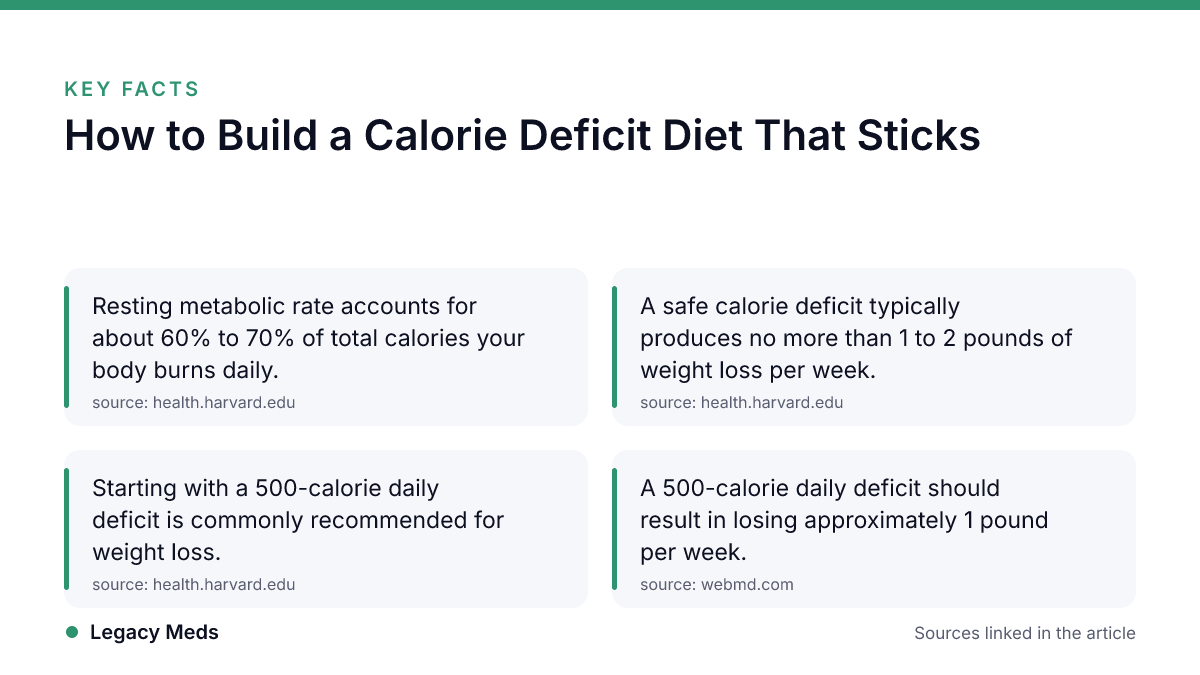
- A safe calorie deficit is 500 to 1,000 calories below what your body burns daily, which produces 0.5 to 2 pounds of weight loss per week according to UH Hospitals.
- Don't eat below 1,200-1,500 calories a day if you're a woman, or 1,500-1,800 if you're a man. Going lower risks muscle loss and a stalled metabolism, per WebMD.
- The math is simple: your maintenance calories minus your target deficit equals your daily calorie goal. A 500-calorie daily cut typically equals about 1 pound lost per week.
- GLP-1 medications like Wegovy® and Zepbound® don't create the deficit for you. They quiet the hunger signals that make sticking to one so hard, which is why a modest deficit plus medication tends to outlast a deficit alone.
- Rapid weight loss burns through lean muscle along with fat, which slows your resting metabolism and makes keeping weight off harder. A 1-2 lb/week pace protects the muscle you need long-term, per Harvard Health.
Denise is 43, works a desk job near Legislative Hall in downtown Dover, and has already done the low-carb thing, the 1,200-calorie app thing, and the "just walk more" thing. Each time she lost eight or ten pounds in a month, felt wrecked, and gained it back by spring. What she never did was calculate a real deficit and give it enough time to work without starving herself along the way. That's the story behind most 11pm searches for "calorie deficit diet." It isn't a willpower problem. It's a missing number.
A calorie deficit diet means eating and moving so your body burns more energy than it takes in, forcing it to pull the difference from stored fat. A safe deficit ranges from 500 to 1,000 calories below your total daily energy expenditure, producing roughly 0.5 to 2 pounds of weight loss per week, according to UH Hospitals. Even then, most adults should stay at or above 1,200-1,500 calories a day for women and 1,500-1,800 for men. Below that, you're trading fatigue and muscle loss for a faster number on the scale, per WebMD.

Table of Contents
- How do I calculate my calorie deficit?
- Is eating 1,200 calories a day a calorie deficit?
- What should a 7-day calorie deficit diet plan actually look like?
- How do GLP-1 medications like Wegovy or Zepbound work with a calorie deficit?
- How do you stay in a deficit without losing muscle or crashing energy?
- How long should you stay in a calorie deficit, and what happens after you reach your goal?
- Frequently asked questions
How do I calculate my calorie deficit?
Start with your maintenance calories, the amount you'd eat to stay exactly the same weight, then subtract 500 to 1,000. WebMD notes you can hit that deficit by eating less, moving more, or combining both. The combination is easier to hold than either extreme.
Here's the arithmetic with round numbers you can swap for your own. Say Denise's maintenance lands around 2,200 calories a day, a figure a provider, a coach, or a decent online calculator can estimate from her age, weight, and activity level. She picks a standard 500-calorie deficit:
2,200 (maintenance) − 500 (deficit) = 1,700 calories per day
Over a week that's 500 × 7 = 3,500 calories below what she burns, which lines up with the commonly cited result of about 1 pound of weight loss per week. Run it for 12 weeks and she's looking at roughly 12 pounds. Her maintenance number will drift down as she loses, which is exactly why deficits get recalculated instead of set once and forgotten.
Pro tip: Resting metabolism, meaning the calories you burn just being alive, accounts for 60% to 70% of your daily total, per Harvard Health. Cut too hard and your body protects that resting burn by breaking down muscle, which lowers the very metabolism you're trying to keep.
Is eating 1,200 calories a day a calorie deficit?
For some women, yes. For most men, no. And for plenty of women it's a far bigger deficit than they realize. If your maintenance is around 2,200, eating 1,200 is a 1,000-calorie cut, the outer edge of what UH Hospitals calls safe. If your maintenance is closer to 1,700, that same plate is a much steeper drop, and the fatigue and irritability usually show up around week three, right before people quit.
That's the flaw in every generic "eat 1,200 calories" plan online. They ignore where you're starting. A 6'2" former athlete and a 5'2" office worker have wildly different maintenance numbers, and handing both the same target helps neither. If you'd rather not track obsessively, an eating pattern like the DASH diet, built on vegetables, lean protein, and whole grains, lands most adults in the 1,500-1,800 range on its own with very little math.
What should a 7-day calorie deficit diet plan actually look like?
Boring, repeatable, and built around a grocery list you can afford. Not a Pinterest board. One mid-range restaurant dinner in Dover costs about what several days of home-cooked meals do, based on local cost-of-living figures, and cooking at home gives you control over calories that no menu ever will.
Here's an illustrative day built to hit Denise's 1,700-calorie target, the kind of structure our care coaches actually suggest:
- Breakfast (~400): Three eggs scrambled with spinach, one apple.
- Lunch (~550): Grilled chicken over rice with peppers and onions, olive oil drizzle.
- Snack (~150): Plain Greek yogurt with berries.
- Dinner (~600): Salmon, roasted potatoes, broccoli.
Repeat with two or three protein rotations and you have a week. The principles that keep it going past Thursday:
- Protein first, every meal. A palm-sized portion of chicken, fish, eggs, or tofu at each meal. Protein keeps you full longer per calorie than carbs or fat, which matters most when calories are tight.
- Fiber-heavy carbs, not zero carbs. Beans, oats, and vegetables fill a plate for few calories and slow digestion, which blunts the 3pm crash.
- Work around Dover's summer. July and August here are hot and sticky by midday even when the skies stay clear. Walk early or after dinner instead of forcing it into the worst hours and then skipping it entirely.
- Batch cook twice a week. A tray of chicken and roasted vegetables on Sunday and again Wednesday removes the decision fatigue that ends most diets.
- Track imperfectly, but track. Nobody needs to weigh every almond. Logging loosely for two weeks tells you more about your real intake than any calculator will.
Pro tip: The single most common logging error we see isn't dessert. It's cooking oil and dressing. Two tablespoons of olive oil is roughly 240 calories, and it disappears into a "healthy" salad without anyone noticing. Measure the oil for one week and a stalled deficit often un-stalls itself.
If you'd rather restrict carbs sharply than count totals, a keto plan can create the same deficit indirectly. Cutting carbs that far usually removes enough calories on its own. Different lever, same equation.
How do GLP-1 medications like Wegovy or Zepbound work with a calorie deficit?
They don't replace the deficit. They make it livable by turning down the hunger signals that normally sabotage it. Wegovy® and Zepbound® slow stomach emptying and act on appetite centers in the brain, so the same 500-calorie cut that used to feel like an all-day fight starts to feel like eating a normal-sized meal and being done. The math doesn't change. The experience of living inside it does.
This is where a lot of people searching "calorie deficit diet" need a different answer than a calculator gives them. If you've held a clean 500-calorie deficit for months with honest logging and the scale barely moves, or you white-knuckle every evening to avoid the pantry, the deficit isn't your problem. Hunger signaling is. At Legacy Meds, we start with an online quiz to see whether GLP-1 care fits your situation, then pair it with the same care coaching and provider visits every patient gets regardless of plan. Options run from GLP-1 injections starting at $159 and dissolvable GLP-1 tablets starting at $249, up to brand-name Wegovy cost and Zepbound cost plans with a $99 membership plus medication. Every plan ships free and works with HSA or FSA dollars, which means pre-tax money instead of post-tax. We break that down on our HSA for Wegovy page.
| Deficit approach | Typical weekly loss | Best fit | Watch for |
|---|---|---|---|
| Diet only, no exercise change | 0.5-1 lb | People who can't add workouts yet | Muscle loss without resistance training |
| 500-cal deficit plus exercise | About 1 lb | Most people starting out | Stalls as maintenance drops with weight |
| Aggressive 1,000-cal deficit | Up to 2 lbs | Short, closely monitored pushes | Fatigue, muscle loss, hard past a few weeks |
| GLP-1 assisted deficit | Varies by plan and provider guidance | People whose hunger, not discipline, is the barrier | Needs deliberate protein intake to protect muscle |
Pro tip: If you're weighing medication against diet alone, our GLP-1 vs. diet breakdown walks both paths side by side before you commit to either.
How do you stay in a deficit without losing muscle or crashing energy?
Eat enough protein and lift something heavy at least twice a week. Cardio alone in a deficit burns fat and muscle without discriminating. Rapid weight loss specifically breaks down lean muscle mass, which lowers metabolism and makes keeping weight off significantly harder later, according to Harvard Health. Crash dieting isn't just unpleasant. It bills your future self.
What separates a deficit you hold for months from one you quit in three weeks:
- Front-load protein at breakfast. Eggs or Greek yogurt with fruit beats a bagel for keeping hunger flat until lunch.
- Hydrate seriously in summer. Dover's humid stretch from July into September makes it easy to read thirst as hunger, and the local climate data explains why you're sweating more than you notice.
- Flag fatigue early if you're on a GLP-1. Don't push through it. Our GLP-1 fatigue guide covers the adjustments that usually fix it, and Legacy Meds patients have 24/7 access to a care team for exactly this.
- Stop chasing "how to lose weight fast." Weight lost beyond the safe 1-2 lb/week pace skews heavily toward muscle and water. The scale moves quicker. Your body composition doesn't.
How long should you stay in a calorie deficit, and what happens after you reach your goal?
Stay in it until you're within a few pounds of your goal, then eat at your new maintenance level for at least several weeks before deciding anything else. The trap is that maintenance falls as you do. A deficit that worked in month one can quietly turn into maintenance by month four if nobody recalculates it.
Watch how fast that happens. Denise starts at 2,200 maintenance and eats 1,700. Twelve pounds later, suppose her maintenance has drifted to about 2,050. Her same 1,700-calorie plate is now a 350-calorie deficit, not 500, which means roughly 0.7 lb a week instead of 1. Nothing went wrong. The numbers moved.
Recalculate when either of these happens: you've lost 10 to 15 pounds, or the scale hasn't budged in three straight weeks while your logging has stayed honest. The fix is usually small, like trimming 100 to 150 calories or adding two 30-minute walks, not slashing another 500.
Once you hit your target, you have two directions:
- Hold at maintenance. Eat at the new number, keep the protein and resistance training, and let your weight stabilize for a few months before changing anything.
- Shift toward building muscle. Eat slightly above maintenance with a protein-forward diet and progressive resistance training. Same math, running in reverse.
This is also the phase where people benefit most from actual care instead of an app's best guess. Every Legacy Meds plan includes free provider visits and care coaching so someone can adjust your targets as your weight and maintenance number change. If you're unsure which phase you're in, our weight loss FAQ covers what patients ask once they're closer to goal than to start.
Run your own version of Denise's math tonight: estimate maintenance, subtract 500, and see what number you land on. If that number looks doable but every past attempt has still fallen apart by week three, hunger is the variable to fix. Take our online quiz and find out what you qualify for before you spend another month guessing.
Frequently asked questions
Do I have to count calories forever to keep weight off?
No. Most people track closely for the first few months to learn portion sizes and their real maintenance number, then move to looser habits like protein-first plates and a weekly weigh-in. Tracking is a training wheel. Once you can eyeball a reasonable plate, the app becomes optional.
Can a keto diet plan create a bigger deficit than counting calories?
It can, indirectly. Cutting carbs sharply tends to remove enough total calories, and enough appetite swings, that many people land in a deficit without counting anything. It isn't inherently better than calorie counting, just a different route to the same place, and it works best for people who find carb restriction easier to follow than arithmetic.
Will exercise alone create enough of a deficit to lose weight fast?
Rarely. In our experience, an hour of moderate exercise burns a few hundred calories for most adults, which is real but usually smaller than what a modest change on the plate produces. Pairing a smaller diet cut with regular movement gets you to a safe deficit more reliably than exercise alone, and without leaving you ravenous by 8pm.