
TL;DR
- GLP-1 medications are the strongest option available. Semaglutide (Wegovy) and tirzepatide (Zepbound) produce the largest documented results of any FDA-approved class, with weight management medications averaging 5% to 21% of body weight depending on individual response.
- Cost, not effectiveness, is what stops most people. Brand-name GLP-1s at full retail without insurance run over $1,000 a month. Telehealth injections at Legacy Meds start at $159.
- Weight regain after stopping is the norm. These medications manage an ongoing condition. Plan for a maintenance dose, not a finish line.
- Daily tablet and weekly injection work through the same mechanism. Choose based on travel, refrigeration, and needle tolerance, not on which sounds more advanced.
- No insurance required to start. Legacy Meds includes free provider visits and coaching, ships nationwide, and accepts HSA/FSA payment.
Ask a pharmacist in Dover what a month of brand-name Wegovy costs without insurance and watch the customer's face when they hear the number. That reaction is the single biggest reason people who qualify for treatment never start it.
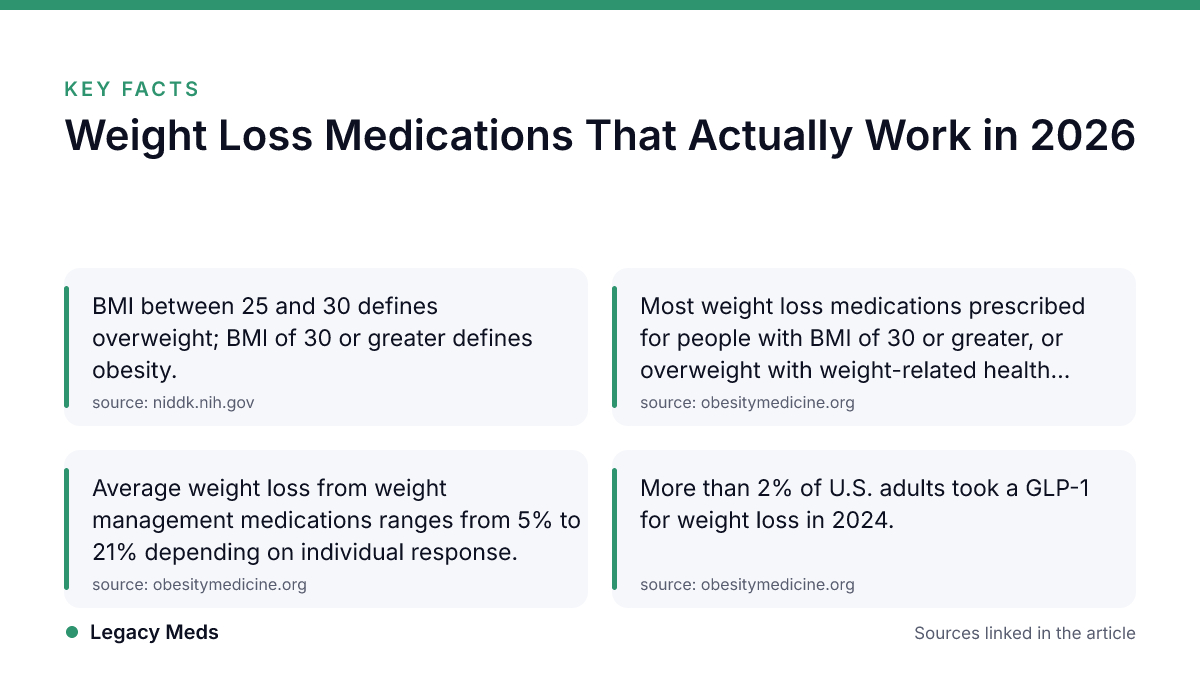
The medications that actually work in 2026 are GLP-1 receptor agonists: semaglutide and tirzepatide. They change how hungry you feel and how quickly food satisfies you, which is a different thing entirely from trying harder. More than 2% of U.S. adults were already taking a GLP-1 for weight loss in 2024, and 32% of adults now say they've heard "a lot" about these drugs. Awareness is no longer the bottleneck. Access is.

Table of Contents
- Which medicine is best for weight loss?
- What's the actual cost difference between these medications?
- How do you lose weight when your BMI is over 30?
- What happens when you stop taking weight loss medication?
- What are the side effects and safety concerns?
- Injection or tablet: which one fits your life?
- How do I know if I actually qualify?
- Frequently asked questions
Which medicine is best for weight loss?
There's no universal best. There's a best option for your BMI, your budget, your needle tolerance, and whether you're also managing type 2 diabetes. That said, GLP-1 receptor agonists outperform older weight loss pills by a wide margin and are the first-line choice for most adults with obesity today.
| Medication | Drug class | Typical result | How it's taken |
|---|---|---|---|
| Semaglutide (Wegovy) | GLP-1 receptor agonist | High end of the 5–21% range | Weekly injection or daily pill |
| Tirzepatide (Zepbound) | GLP-1/GIP dual agonist | High end of the 5–21% range | Weekly injection |
| Liraglutide (Saxenda) | GLP-1 receptor agonist | Moderate, below semaglutide | Daily injection |
| Phentermine-topiramate (Qsymia) | Appetite suppressant combo | Moderate | Daily pill |
| Phentermine (Adipex, Suprenza) | Stimulant appetite suppressant | Lower, short-term use only | Daily pill |
Semaglutide was approved for chronic weight management as Wegovy in 2021. Tirzepatide followed as Zepbound in 2023. Both mimic gut hormones that regulate appetite and slow stomach emptying, which is why patients describe feeling full halfway through a meal they used to finish without thinking. The Obesity Medicine Association puts the range of results across weight management medications at 5% to 21% of body weight. Dose, protein intake, activity, and individual response decide where you land in that spread.
Pro tip: Don't judge a GLP-1 by month one. The first four to six weeks are a titration period at the lowest dose, which exists mostly to protect your stomach, not to move the scale. The visible change usually shows up around months three and four.
What's the actual cost difference between these medications?
This is where most articles get vague, so let's run real numbers.
At full retail with no insurance coverage, brand-name GLP-1 injections are a four-figure monthly expense. Many commercial plans in Delaware still exclude weight management drugs entirely, which means that retail number is what you actually pay at the counter.
| Option | Starting monthly cost | What's included |
|---|---|---|
| Brand-name Wegovy/Zepbound, retail, no coverage | Over $1,000 | Medication only, no clinical support |
| Legacy Meds brand-name membership | $99 membership plus medication | Provider visits, coaching, brand-name access |
| Legacy Meds GLP-1 injections | From $159 | Free provider visits, coaching, free shipping |
| Legacy Meds dissolvable GLP-1 tablets | From $249 | Free provider visits, coaching, free shipping |
Show the math. Take an illustrative retail price of $1,200 a month with no insurance coverage. Over a full year of treatment:
$1,200 × 12 = $14,400 out of pocket
Now the same 12 months on a starter injection plan at $159:
$159 × 12 = $1,908
Difference: $12,492 in one year.
Here's the part that matters more than the savings itself. The single biggest predictor of results is staying on treatment long enough to reach a therapeutic dose, and cost is the reason most people quit at month three. Run the formula on your own numbers before you start: monthly cost × the number of months you realistically expect to stay on treatment. If that total makes you flinch, you've found your answer about which option fits.
An HSA or FSA typically covers GLP-1 treatment, which knocks the effective cost down further by whatever your marginal tax rate is. Legacy Meds accepts HSA/FSA directly. Current plan pricing lives on the weight loss page, and there's a fuller breakdown in our posts on Wegovy cost, Zepbound cost, and GLP-1 cost without insurance.
How do you lose weight when your BMI is over 30?
Diet and exercise alone rarely get it done at this level, and that's biology rather than a character flaw. The NIDDK defines obesity as a BMI of 30 or greater, with the overweight range sitting between 25 and 30. Obesity involves hormonal and metabolic changes that actively defend your current weight, which is why medications are generally prescribed for people with a BMI of 30 or greater, or for people in the overweight range with a weight-related health condition like hypertension, sleep apnea, or type 2 diabetes.
What works is three things running at once:
- A GLP-1 or dual GIP/GLP-1 medication to quiet appetite signals so you're not fighting your own biology at 9 p.m.
- Protein first, portions second. Appetite suppression means you eat less by default, and if the little you eat is mostly carbohydrate, you lose muscle along with fat. Anchor every meal with a protein source before anything else touches the plate. Patients who skip this step are the ones who report feeling weak and cold two months in.
- Ongoing clinical contact. Dose adjustments, side effect triage, and someone checking your progress against your starting numbers all change outcomes.
That third piece is why every Legacy Meds plan includes free provider visits and care coaching. Our care team is available 24/7, and the calls cluster in exactly the window you'd expect: days two through five after a dose increase, when nausea peaks and people start wondering whether to quit. Ten minutes with a provider at that moment saves the whole plan.
Not sure whether you're eligible? Our GLP-1 eligibility guide walks through the criteria, or you can take the quiz on the homepage in a few minutes.
What happens when you stop taking weight loss medication?
Most people regain a meaningful share of the weight they lost. These drugs manage an appetite and metabolic response rather than curing it, so removing the medication removes the effect.
Obesity medicine specialists now talk about GLP-1s the way they talk about blood pressure medication. It's ongoing management, not a ten-day course of antibiotics with a defined end.
- Stopping cold brings appetite back fast. The hormone-mimicking effect clears your system within weeks, and hunger returns before your habits have hardened.
- A maintenance dose beats a full stop. Many patients hold results on a lower dose than the one that got them there. That's a conversation with your provider, not a decision to make alone.
- Use the suppression window to build habits. Higher protein, smaller portions, consistent movement. These are what carry you when the medication support drops.
Pro tip: Before you start any plan, ask what maintenance pricing looks like at month thirteen, not just the introductory rate. A price that only holds for the first 90 days isn't a plan, it's a promotion.
What are the side effects and safety concerns?
Each medication class has its own profile, and knowing which one applies to your drug beats a blanket "may cause nausea" warning.
- GLP-1 injections and tablets (semaglutide, tirzepatide, liraglutide): nausea, constipation, diarrhea, and reduced appetite, worst during dose increases. Most of it eases as your body adjusts over several weeks.
- Phentermine and phentermine-topiramate: these are stimulant-based, so the risks look different. Elevated heart rate, insomnia, and dry mouth are more common than GI symptoms, and they're intended for shorter-term use.
- All prescription weight loss medications: Mayo Clinic is clear that these drugs are meant to be used alongside diet and activity changes rather than in place of them, and that medical supervision matters because your health history changes which drug is appropriate.
Legacy Meds requires clinician review before any prescription is issued, in line with Delaware's telehealth rules, which require appropriate informed consent before treatment begins. Our weight loss medication safety information and consent to telehealth pages are both public, and you can read them before you ever start a quiz.
Pro tip: If nausea worries you, ask about a slower titration schedule up front. Rushing the dose increase is the number one reason people abandon a GLP-1 plan inside the first month, and a slower ramp costs you a few weeks at most.
Injection or tablet: which one fits your life?
Same mechanism, different logistics. Pick on lifestyle fit.
- Starting price: injections start at $159 a month with Legacy Meds, tablets at $249.
- Dosing rhythm: one injection a week versus a tablet every day. If you've never been good at daily pills, be honest about that now.
- Storage: injections often need refrigeration, which complicates long trips and hotel minibars. Tablets are typically room-temperature stable.
- Needle aversion: a real and common reason people rule out treatment entirely. The tablet removes it.
- Brand-name route: Wegovy® and Zepbound® are available through the $99 membership plus medication cost, including the Wegovy® pill.
The FDA's approval of the first oral GLP-1 for obesity treatment at the end of 2025 widened this choice considerably. For patients who'd written off GLP-1 therapy over needles, it reopened the door.
How do I know if I actually qualify?
You likely qualify if your BMI is 30 or higher, or if you're in the 25 to 30 overweight range with a condition like high blood pressure, type 2 diabetes, or sleep apnea. Certainty requires a clinical review, and that's what the Legacy Meds quiz is built for.
What the provider is actually looking at when they read your answers:
- Your BMI and weight history, including what you've already tried and how your weight has moved over the past few years.
- Personal or family history of medullary thyroid carcinoma or MEN2, which rules out GLP-1 therapy entirely.
- Prior pancreatitis or active gallbladder disease, which changes the calculation on dose and monitoring.
- Your current medication list, especially anything for diabetes, since GLP-1s stack with some drugs and require adjustment alongside others.
- Pregnancy status and plans, since these medications aren't used during pregnancy or while trying to conceive.
No in-office visit, no insurance required, and everything ships to your door in Dover. If you're weighing a brand-name option specifically, our guide on how to get a Zepbound prescription covers the process step by step, and the weight loss FAQ answers what patients ask most before a first visit. You can read more about us if you'd rather know who's behind the prescription first.
Whatever medication and format you land on, three questions decide the outcome: what you can afford to sustain for twelve months, which delivery method fits your actual week, and whether anyone is monitoring your progress instead of just shipping boxes. Take the quiz on legacymeds.org and find out where you stand. It costs nothing to check.
Frequently asked questions
Can I use weight loss medication without a diagnosed health condition?
Yes, if your BMI is 30 or higher. Obesity, defined as a BMI of 30 or greater, qualifies on its own with no separate diagnosis needed. If your BMI falls in the 25 to 30 overweight range, you'll generally need an associated condition such as high blood pressure or prediabetes.
Do weight loss injections work differently for men and women?
The mechanism is identical. Appetite regulation through GLP-1 or GIP receptor activity doesn't change by sex. Results still vary widely based on starting weight, metabolism, dose, and habits. Women should raise any pregnancy plans with their provider early, since GLP-1 medications aren't used during pregnancy or while trying to conceive.
Is a weight loss program more effective than medication alone?
Yes. Pairing medication with coaching, regular check-ins, and nutrition guidance produces better sustained results than a prescription on its own, which is why free care coaching is built into every Legacy Meds plan rather than sold as an upgrade.