

If your weight has held steady for three to four weeks on a GLP-1, treat it as a confirmed plateau, not drug failure. The first move is a two-week audit: verify you’re taking the medication correctly, then track calories and protein honestly before calling your prescriber. Most plateaus break with adjustments to food, training, and sleep, not a dose change.
TL;DR:
- Most weight loss plateaus on GLP-1 medications occur after a 10% reduction in body weight due to metabolic adaptation, including decreased non-resting energy expenditure.
- Confirm that adherence, dosing, and lifestyle factors like calorie intake, protein levels, and sleep are accurate for at least three to four weeks before considering a true plateau.
- Fixing issues such as calorie creep, increasing protein intake, adding resistance training, and addressing gut health can typically resolve most stalls within a few weeks.
- Longer-term plateaus, especially beyond six months to two years, may require medication adjustments, higher doses, or testing for underlying health conditions.
- Maintaining behavioral support and monitoring body composition and non-scale indicators help sustain progress through plateaus rather than relying solely on medication changes.
Table of Contents
- What Causes a Weight Loss Plateau on GLP-1 Medications?
- How Do You Know If It’s a Real Plateau?
- What’s the Fastest Way to Break a GLP-1 Weight Loss Plateau?
- When Should You Talk to Your Prescriber About a Plateau?
- How Long Do GLP-1 Plateaus Usually Last?
- Does Your Mindset Affect Whether You Break Through a Plateau?
- Do You Need More Than Weight Training to Break a Plateau?
- Can Other Medications or Health Conditions Cause a Plateau?
- How Do You Track Progress Beyond the Scale?
- Can Side Effects Be Quietly Slowing Your Progress?
- A Clinician’s View on Troubleshooting a Stall
- How Legacy Meds Supports You Through a Plateau
- Sources
- FAQ
What Causes a Weight Loss Plateau on GLP-1 Medications?
Your body actively resists weight loss, and it gets better at resisting the longer you stick with it. After roughly a 10% reduction in body weight, total energy expenditure can drop by 300 to 400 calories a day, and researchers attribute more than half of that decline to skeletal muscle becoming mechanically more efficient. The same amount of walking, standing, and fidgeting simply burns less fuel than it used to.
GLP-1 drugs like semaglutide and tirzepatide work primarily by turning down appetite and slowing digestion, not by preventing this adaptation. Semaglutide and tirzepatide can blunt the body’s appetite feedback loop more than calorie restriction alone, which is part of why people on these drugs often lose weight for longer before stalling.
There’s a specific, less-discussed mechanism behind that wall: GLP-1 receptor agonists and dual GLP-1/GIP agonists appear to lower non-resting energy expenditure, the calories burned through daily movement rather than digestion or basal metabolism. One analysis found GLP-1 and dual-agonist therapies cut non-resting energy expenditure by around 170 calories a day, even in people who hadn’t lost much weight yet. That’s a meaningful chunk of your daily burn disappearing quietly.
A few things drive how early or late your plateau shows up:
- Drug and dose: higher-efficacy agents tend to delay the plateau, not eliminate it.
- Starting body composition: more lean mass to lose means more adaptive slowdown.
- Rate of loss: faster initial weight loss often triggers a sharper metabolic pullback.
- Time on treatment: adaptation compounds the longer you’ve been in a calorie deficit.
None of this means the medication stopped working. It means your metabolism caught up to it, which is exactly what the physiology predicts.
How Do You Know If It’s a Real Plateau?
Before troubleshooting anything, confirm you’re actually stuck. A single flat week on the scale is noise, not a plateau. Clinicians generally define a true plateau as a stable weight trend across three to four consecutive weeks under consistent conditions.
- Weigh yourself the same way each time. Same scale, same time of day, ideally right after waking and before eating.
- Track the trend, not the daily number. A weekly average smooths out water weight swings that make a normal fluctuation look like a stall.
- Check non-scale indicators. Waist measurement, how clothes fit, energy levels, and strength in the gym often move even when the scale doesn’t.
- Rule out common maskers. Constipation, sodium and water retention, your menstrual cycle, underestimated portions, and a missed or delayed dose can all fake a plateau for a week or two.
If the trend is genuinely flat after four weeks and none of those maskers explain it, you’re dealing with a real plateau, and it’s time to work the checklist.
What’s the Fastest Way to Break a GLP-1 Weight Loss Plateau?
Work through these in order. Most plateaus resolve within the first three steps, so don’t skip ahead to the prescriber before you’ve ruled out the basics.
-
Confirm adherence and technique. Check your injection schedule against what was prescribed, verify the pen or vial was stored correctly, and make sure you haven’t quietly shifted your dosing day by a day or two. A skipped or delayed dose is one of the most common, and most fixable, causes of a stall.
-
Run an honest calorie audit for one to two weeks. Log everything, including bites, tastes, coffee add-ins, and cooking oil. Calorie creep is quietly the most common hidden cause of a plateau, and a detailed food log almost always turns up calories you weren’t counting, not evidence the drug stopped working.
-
Push protein to 1.2 to 1.6 grams per kilogram of body weight daily. That range is the recommended target for preserving lean mass during extended appetite suppression. Losing muscle instead of fat is one of the quiet ways a plateau gets locked in, since muscle is what keeps your resting metabolic rate from falling further.
-
Add or restore resistance training, two to three sessions a week. Resistance training paired with adequate protein helps counter the metabolic slowdown that comes with weight loss. If you’ve never lifted weights, bodyweight circuits or resistance bands count.
-
Audit liquid calories and alcohol. Juice, sweetened coffee drinks, and alcohol add up fast and don’t trigger the same fullness signal as solid food. Sauces, cooking oils, and packaged snacks are the other quiet culprits worth checking. For lower-calorie swaps that still feel like a treat, a low-sugar drink routine can close this gap without much effort.
-
Fix constipation and hydration before you fix anything else. GLP-1s slow gut motility, and a backed-up system can mask two or three pounds of real fat loss. Fiber, water, and movement usually resolve it within days. If it’s persistent, targeted relief strategies work faster than waiting it out.
-
Get seven to nine hours of sleep and manage stress. Poor sleep raises ghrelin, the hunger hormone, and cortisol, both of which work against appetite regulation and make adherence harder across the board.
-
Reassess after three to four weeks. If your trend line is still flat and you’ve genuinely nailed adherence, protein, training, and sleep, that’s your signal to loop in your prescriber rather than keep guessing.
Pro Tip: Screenshot your food log and weight trend before your next appointment. A prescriber can troubleshoot in five minutes with data instead of twenty minutes of guesswork based on memory.
When Should You Talk to Your Prescriber About a Plateau?
Reach out once you’ve verified three to four weeks of a true plateau, your basics (adherence, protein, training, sleep) are actually solid, and side effects remain manageable. If you’re not yet at your maximum tolerated dose, that conversation matters more, since clinicians typically rule out adherence and lifestyle drift first before treating a plateau as a medical issue.
Your prescriber has several options depending on where you are in treatment:
- Dose escalation, moved up gradually to manage gastrointestinal side effects, following the standard titration schedule for your medication.
- Switching to a different or higher-efficacy agent, such as moving between semaglutide and tirzepatide, which is a decision worth walking through carefully rather than doing on your own.
- Adjunctive support for specific barriers, addressed case by case rather than as a blanket add-on.
- Testing for underlying medical causes, including thyroid dysfunction, sleep apnea, or medications like steroids that can independently stall weight loss.
Come prepared to discuss any recent life changes, new medications or supplements, and honest adherence, since all three shape what your prescriber recommends next.
How Long Do GLP-1 Plateaus Usually Last?
Plateau timing varies by drug and dose, but modeling work gives a useful reference point. Simulations of semaglutide and tirzepatide show weight loss commonly extending toward roughly 24 months before leveling off, which is considerably longer than the plateaus typically seen with calorie restriction alone.
That means a plateau at month six looks very different from one at month twenty. A few points worth keeping in mind:
- Early plateaus (within the first few months) often point to a fixable issue: dose timing, calorie creep, or inadequate protein.
- Later plateaus (approaching the one to two year mark) are more consistent with the natural leveling predicted by the modeling above.
- Staying on medication, even once you’ve plateaued, tends to protect against regain better than stopping.
- Persistent plateaus despite solid adherence and lifestyle effort are when treatment intensification, not more willpower, becomes the right conversation.
Knowing which category you’re in changes how urgently you should act, and how much patience the situation actually calls for.
Does Your Mindset Affect Whether You Break Through a Plateau?
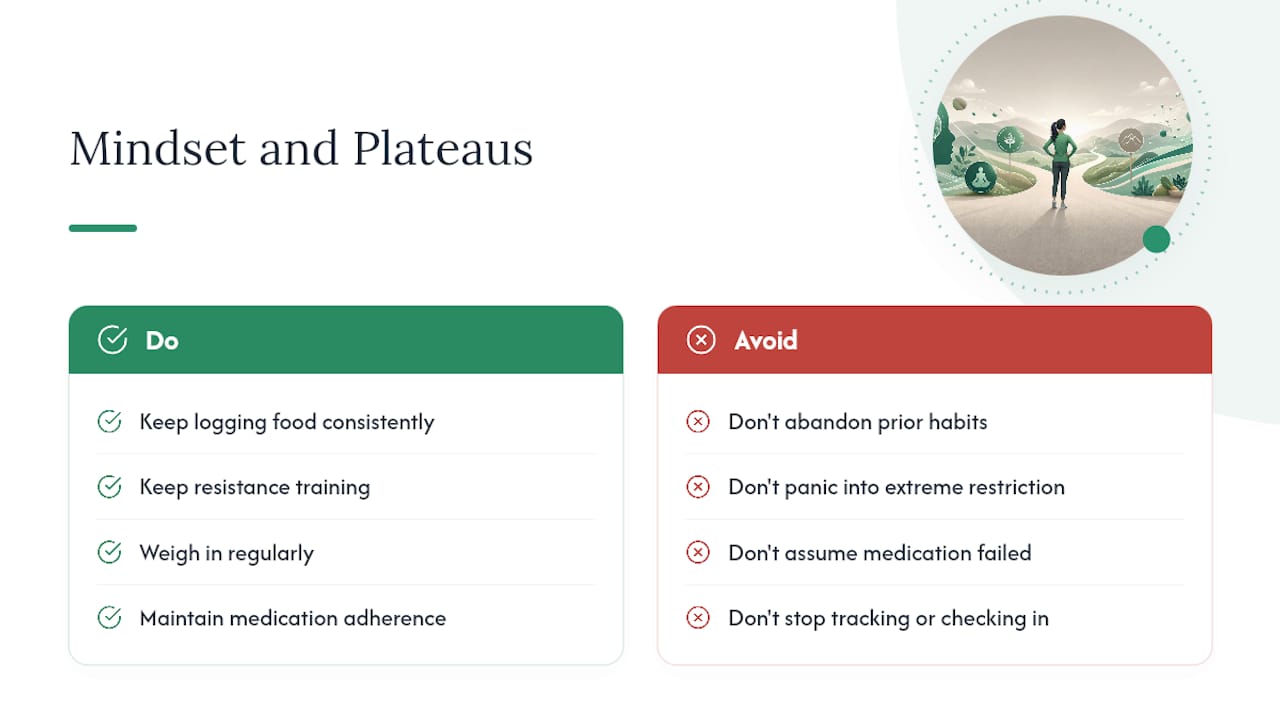
A plateau is a physiology problem, but how you respond to it is a behavior problem, and that’s where a lot of people quietly derail. The frustration of a flat scale after months of steady progress tends to push people toward one of two extremes: giving up on the habits that got them here, or panicking into extreme restriction that backfires within a week.
Clinicians who work with long-term GLP-1 patients push back on the idea that the medication does the work alone. Long-term success with these drugs depends heavily on sustained behavioral support, not just the prescription itself. A plateau is often the exact moment that support matters most, because it’s when motivation naturally dips and the temptation to loosen tracking, skip workouts, or assume “it stopped working” is strongest.
There’s a practical fix hiding in that observation: treat the plateau phase as a maintenance skill-building window, not a failure state. People who keep logging food, keep showing up for resistance training, and keep weighing in through a plateau tend to break through it faster than people who go quiet for a few weeks out of discouragement, because they catch calorie creep and adherence slips early instead of three weeks late.
If you notice your tracking has quietly stopped, or you’ve skipped two doses in the last month “because you were busy,” that’s not a coincidence. That’s the plateau talking. Naming it as a motivation dip rather than a drug failure is often the difference between a two-week stall and a two-month one.
Do You Need More Than Weight Training to Break a Plateau?
Resistance training gets most of the attention in plateau advice, and for good reason, but it’s not the only lever. Non-exercise activity thermogenesis, commonly called NEAT, covers the calories you burn through everyday movement: walking to your car, taking the stairs, fidgeting, doing chores. NEAT often drops without you noticing once you’ve lost a meaningful amount of weight, partly because a lighter body requires less energy to move and partly because people who feel less hungry also tend to move less.
A deliberate NEAT boost, like a 20 minute walk after dinner or parking farther from the entrance, adds up over a week in a way that feels effortless compared to another gym session. It’s also more sustainable for people who are exhausted or dealing with GLP-1 fatigue, since it doesn’t require the same energy output as structured exercise.
Cardio still has a role, particularly for cardiovascular health and daily calorie burn, but it shouldn’t replace resistance training as your primary strategy. Steady-state cardio burns calories during the session; resistance training helps protect the muscle mass that keeps your metabolism from sliding further during the plateau itself. The most effective combination for most people stuck on a GLP-1 is two to three resistance sessions a week, daily walking or NEAT-focused movement, and cardio layered in based on preference and recovery, not as a replacement for either.
Can Other Medications or Health Conditions Cause a Plateau?
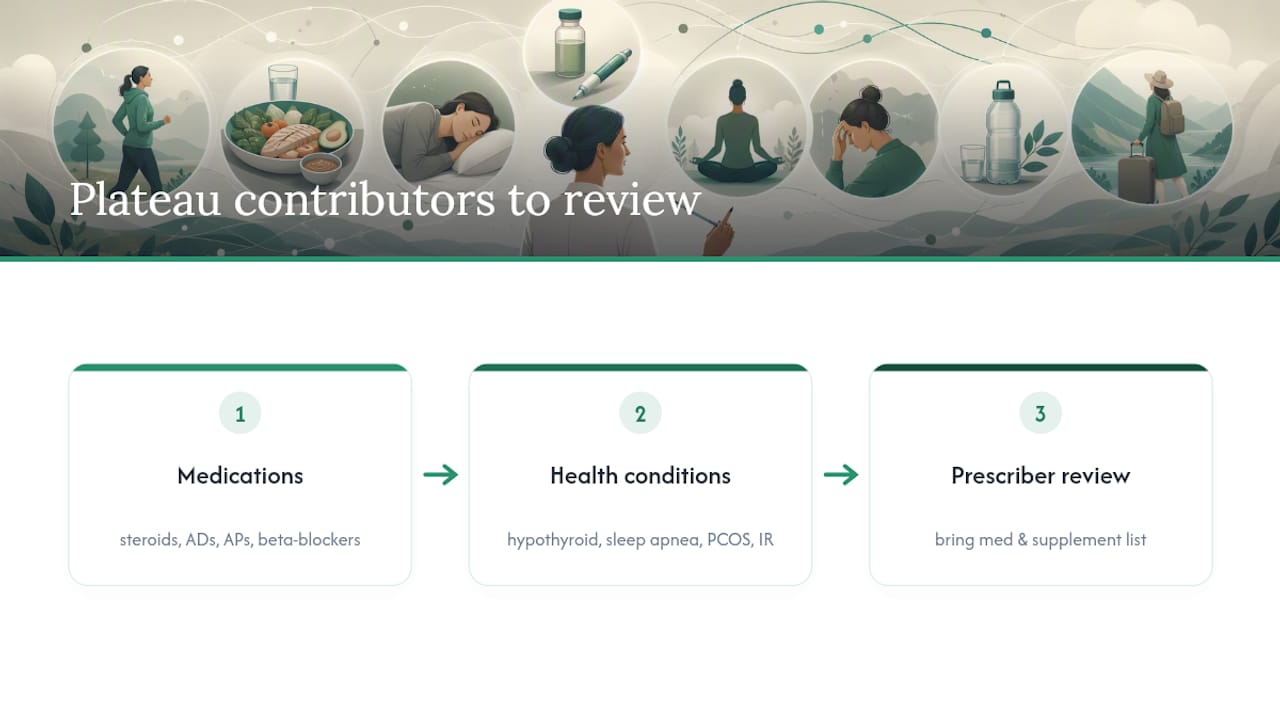
Not every plateau traces back to diet or training. Several common medications work against GLP-1 weight loss, sometimes without either you or your prescriber immediately connecting the dots. Corticosteroids like prednisone, certain antidepressants, some antipsychotics, and beta blockers can all promote weight retention or slow loss independent of anything you’re doing wrong.
Underlying health conditions matter just as much. Hypothyroidism slows metabolism directly and is worth ruling out with bloodwork if a plateau shows up alongside fatigue, cold intolerance, or hair thinning. Sleep apnea, especially if it developed or worsened with weight gain before you started treatment, disrupts the hormones that regulate hunger and can stall progress even when your food and training are dialed in. Polycystic ovary syndrome and insulin resistance can also blunt the response to GLP-1 medications in ways that require a tailored approach rather than a generic troubleshooting checklist.
This is exactly why the criteria for contacting your prescriber include the phrase “not explained by lifestyle factors.” If you’ve genuinely nailed adherence, calories, protein, training, and sleep, and the plateau persists, a medical cause is a real possibility, not an excuse. Bring a list of every medication and supplement you’re taking to that appointment, including over-the-counter items, since interactions aren’t always obvious from the outside.
How Do You Track Progress Beyond the Scale?
The scale is the least sensitive tool you have for measuring fat loss, and relying on it exclusively is part of why plateaus feel worse than they are. Body composition can shift meaningfully, fat down, muscle up or preserved, while total weight barely moves, especially once you’re several months into treatment and adding resistance training.
Waist circumference, measured at the navel with a soft tape first thing in the morning, tends to track fat loss more reliably than scale weight during a plateau. Progress photos taken in the same lighting and clothing every two weeks catch changes your eyes miss day to day. How your clothes fit, particularly waistbands and sleeves, often shifts before the scale does. Strength gains in the gym, lifting more weight or more reps than a month ago, are a strong sign you’re building or holding muscle even if the number on the scale is flat.
Energy levels and hunger patterns are worth logging too. If your hunger cues feel different, sharper or duller, than they did a month ago, that’s useful information for your next prescriber conversation, and it’s the kind of non-scale signal obesity medicine clinicians increasingly treat as a primary data point rather than an afterthought. A body composition scan, if you have access to one, gives the clearest picture, but even a tape measure and a phone camera will tell you more than a bathroom scale alone during a stall.
Can Side Effects Be Quietly Slowing Your Progress?
Side effects don’t just make treatment uncomfortable, they can actively work against the weight loss they’re supposed to support, usually in ways that aren’t obvious at first. Nausea severe enough to make you skip meals sounds like it should help, but it often pushes people toward bland, calorie-dense comfort foods, crackers, toast, and simple carbs, that don’t do much for satiety or protein targets.
Fatigue is another quiet saboteur. If GLP-1 fatigue is cutting into your energy for workouts or daily movement, that directly reduces the calorie burn you’re counting on to break a plateau, creating a cycle where the side effect and the plateau reinforce each other.
Constipation, covered earlier as a measurement masker, deserves a second mention here because it’s also genuinely uncomfortable enough to affect sleep, mood, and appetite regulation, all of which loop back into plateau risk. Managing it isn’t just about getting an accurate scale reading. It’s about removing a source of daily stress that’s working against you on multiple fronts.
If side effects are severe enough to affect eating, sleep, or activity, that’s worth raising with your prescriber directly. Titration speed can often be adjusted to reduce the burden without abandoning the medication, and that adjustment alone sometimes unsticks a plateau that looked like it was about calories all along.
A Clinician’s View on Troubleshooting a Stall
The workflow that actually works is boring, and that’s the point: verify adherence first, tune up nutrition and training second, reassess in three to four weeks, then escalate clinically only if the basics didn’t move the needle. Skipping straight to “maybe I need a higher dose” is the single most common mistake, because it treats a fixable lifestyle gap as a drug failure.
A provider model built around this same sequence offers unlimited coaching so adherence and nutrition questions get answered before they turn into a stalled month. That structure matters more than any single tactic in this article, because a plateau caught at week two behaves very differently than one ignored until week eight. Shared decision-making, where you and your provider look at the same data together, tends to produce better outcomes than either extreme: white-knuckling it alone or escalating the dose on a hunch.
— Bryan
How Legacy Meds Supports You Through a Plateau
A clinician-led program can help you run this exact troubleshooting checklist without guessing whether your adherence, dosing, or nutrition gaps are the real problem. Some programs pair a GLP-1 prescription (semaglutide, tirzepatide, Wegovy, or Zepbound) with a provider assessment and unlimited coaching, so questions about calorie creep, protein targets, or a stalled dose get answered in real time instead of piling up until your progress stalls for a month.

That structure maps directly onto the checklist above: a provider reviews adherence and dosing, coaches help with nutrition and resistance-training questions, and side effects like constipation or fatigue get addressed as part of ongoing care rather than a one-off appointment. There is no membership fee and no insurance requirement standing between you and that support. If your weight has been flat for a few weeks and you want a clinician looking at your specific numbers, you can start an assessment with Legacy Meds and get a personalized plan built around where you actually are in treatment.
Sources
- Physiology of the Weight Loss Plateau after Calorie Restriction, GLP-1 Receptor Agonism, and Bariatric Surgery (NCBI Bookshelf)
- Modeling study: why plateaus differ across interventions (PMC)
- Protein recommendations for preserving lean mass (PMC)
- GLP-1 plateau: what clinicians should do next (Diabetes In Control)
This article is general information, not a substitute for advice from a qualified doctor. Consult a qualified healthcare professional about your own circumstances before acting on anything here.
FAQ
How Do You Break a Weight Loss Plateau on GLP-1?
Confirm adherence and correct dosing first, then run a two-week calorie and protein audit, add resistance training, and fix sleep and hydration before assuming the medication has stopped working.
Do You Eventually Plateau on GLP-1 Medications?
Yes. Modeling shows even high-efficacy agents like semaglutide and tirzepatide typically plateau, often around the two-year mark, because metabolic adaptation eventually catches up with any weight loss method.
How Long Does a Semaglutide Plateau Last?
It varies by dose and individual physiology, but many plateaus resolve within three to four weeks once adherence and lifestyle factors are corrected; later-stage plateaus tied to natural leveling can persist longer without treatment adjustment.
How Do You Shock Your Body Out of a Plateau?
There’s no shortcut that overrides physiology, but tightening protein intake to 1.2 to 1.6 grams per kilogram, adding resistance training, and closing calorie-tracking gaps address the actual mechanisms behind most stalls. If those steps don’t move the trend after three to four weeks, a prescriber review through a program like Legacy Meds can assess whether a dose or medication change makes sense.