

Yes, you can get semaglutide online in the U.S., but only through a licensed clinician and a state-licensed pharmacy. Any seller that ships semaglutide without a prescription review is operating illegally, and the FDA has warned consumers that these products carry real safety risks. The rest of this guide walks through the legal workflow, real costs, compounding risks, and how to vet a program like Legacy Meds before you hand over a credit card.
TL;DR:
- Only licensed clinicians and pharmacies in the U.S. can legally supply semaglutide online; skip any site that ships without a prescription review.
- Prescription approval requires a thorough intake and is reviewed by a licensed prescriber, who must evaluate your medical history before prescribing.
- Legitimate pharmacies are named, licensed in your state, and can be verified through official sources like the FDA or state boards; beware of vague or overseas sources.
- Compounded semaglutide has inconsistent quality and increased safety risks since new regulations tightened in 2026, making FDA-approved products safer choices.
- Proper dosing involves a written schedule, clinician guidance, and clear instructions to prevent common injections errors, especially with vials rather than prefilled pens.
Table of Contents
- How Do You Get Semaglutide Online Legally?
- What Does Semaglutide Cost, and How Long Does It Take?
- Compounded Semaglutide vs. FDA-Approved Products: What’s the Real Difference?
- How Do You Avoid Dosing Errors With Semaglutide?
- What Questions Should You Ask Before Choosing a Program?
- Why Clinician-Led Programs Outperform DIY Sourcing
- The Gap Between “Available Online” and “Safe to Use”
- Start Semaglutide Treatment the Legal Way
- Sources
- FAQ
How Do You Get Semaglutide Online Legally?
A legitimate telehealth pathway to semaglutide follows a specific order: intake, prescriber review, prescription, then pharmacy fulfillment. Skip any one of those steps and you’re not looking at a medical program, you’re looking at a shortcut with your health as collateral.
Real intake takes time. Expect a form asking about your weight history, current medications, prior surgeries, thyroid or pancreatic conditions, and any history of eating disorders. If a website lets you check out in under two minutes without asking a single clinical question, that’s not efficiency. That’s a company that never intended to involve a doctor in the first place.
The prescriber review is where legitimacy gets tested. Federal and state rules require a state-licensed clinician (a physician, nurse practitioner, or physician assistant) to evaluate your case before writing anything. Some platforms do this over live video; others use a documented asynchronous review where a clinician reads your intake and history and follows up with questions before approving treatment. Both can be legitimate. What’s not legitimate is a “provider” who never actually reviews your file or whose license you can’t verify. You’re allowed to ask for a clinician’s name and the state where they’re licensed. A program with nothing to hide will tell you.
Once approved, your prescription routes to a pharmacy, and this is the step people skip checking. The pharmacy filling your semaglutide should be named, not vague, and it should be licensed in the state where it operates. You can verify licensure yourself through your state board of pharmacy or the FDA’s BeSafeRx pharmacy locator, which is built exactly for this kind of check.
- Complete a full medical intake covering weight history, medications, and relevant conditions.
- A state-licensed clinician reviews your case and either approves, requests more information, or declines.
- Your prescription routes to a named, state-licensed pharmacy.
- The pharmacy ships your medication with proper labeling and storage instructions.
- You confirm the package on arrival matches what was prescribed, including dose and manufacturer.
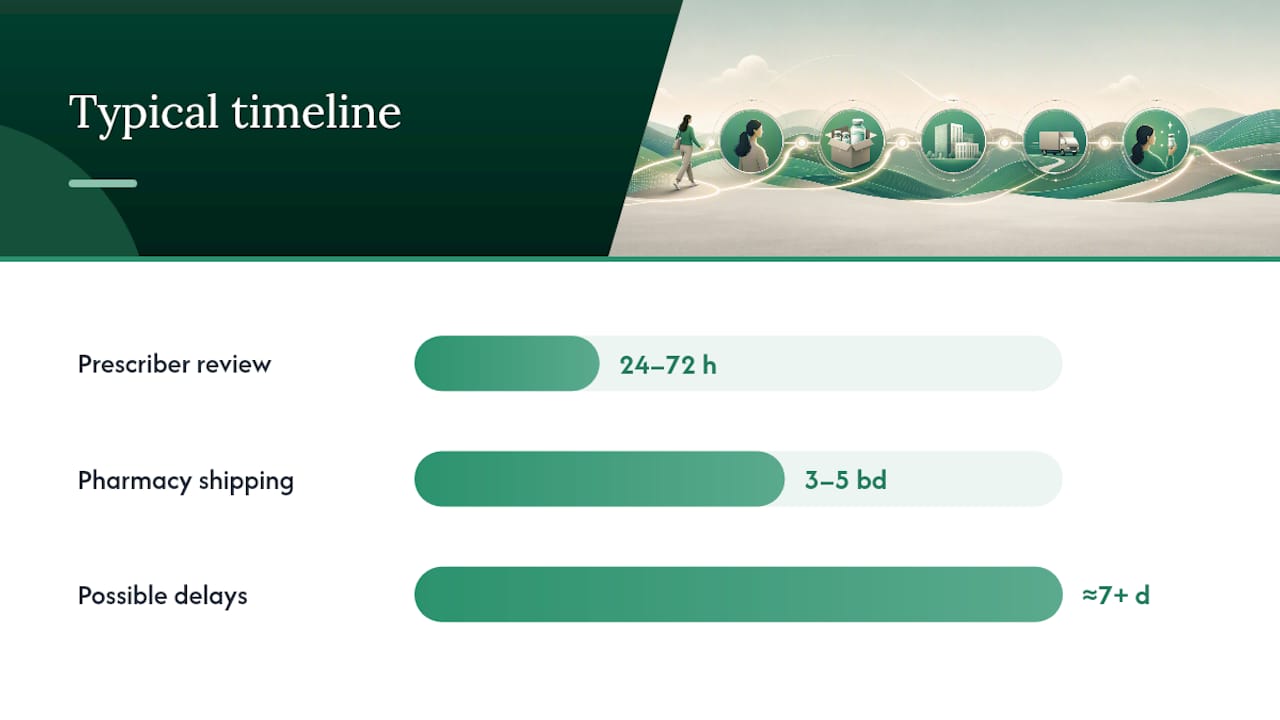
Turnaround varies but follows a rough pattern: prescriber review typically takes 24 to 72 hours, and shipping adds another 3 to 5 business days once the pharmacy fills the order. Labs, prior authorization for insurance-covered brands, or seasonal demand spikes (January is brutal for every weight-loss telehealth company) can stretch that timeline by a week or more.
Pro Tip: Ask directly, “Which pharmacy fills my prescription, and can you show me a sample label?” A program with nothing to hide will answer in one sentence. One that hedges or changes the subject is telling you something.
What Does Semaglutide Cost, and How Long Does It Take?
Price and safety move together more often than people expect. A price that looks too good almost always means something got cut, and it’s usually the medical oversight or the legitimate pharmacy sourcing.
Branded semaglutide products carry list prices that are generally high without insurance, which is exactly why so many patients look at compounded alternatives that run cheaper. Compounded semaglutide through a legitimate 503A pharmacy, tied to an individual prescription and genuine clinical need, often costs less than the branded pen. But “compounded” is not automatically “cheap and safe.” Since the FDA narrowed compounding rules after semaglutide came off the national shortage list, mass-produced compounded copies sit in a legally shakier zone than before, and pricing that ignores that shift should raise questions.
- Subscription or membership-style programs bundle the medication with provider visits and coaching into one recurring payment.
- Per-shipment or pay-as-you-go models charge separately each time a prescription refills.
- Insurance-covered brand prescriptions, when covered at all, usually require prior authorization and documented medical necessity.
- Cash-pay remains the norm across most telehealth weight-loss programs, since GLP-1 coverage for weight management (as opposed to diabetes) is inconsistent across insurers.
Most patients paying out-of-pocket should expect this reality: insurance coverage for weight-loss-specific semaglutide is the exception, not the rule, and even when a plan covers it, prior authorization can add days or weeks before your first fill goes through.
A useful gut check: if a website advertises semaglutide at a price dramatically below what compounding at a licensed U.S. pharmacy typically costs, ask why. Foreign sourcing, unlicensed suppliers, and skipped clinical review are the usual answers, and none of them are ones you want attached to something you inject weekly. Detailed program pricing structures, including how membership and per-shipment models compare, are worth reviewing before you commit to any single provider.
Compounded Semaglutide vs. FDA-Approved Products: What’s the Real Difference?
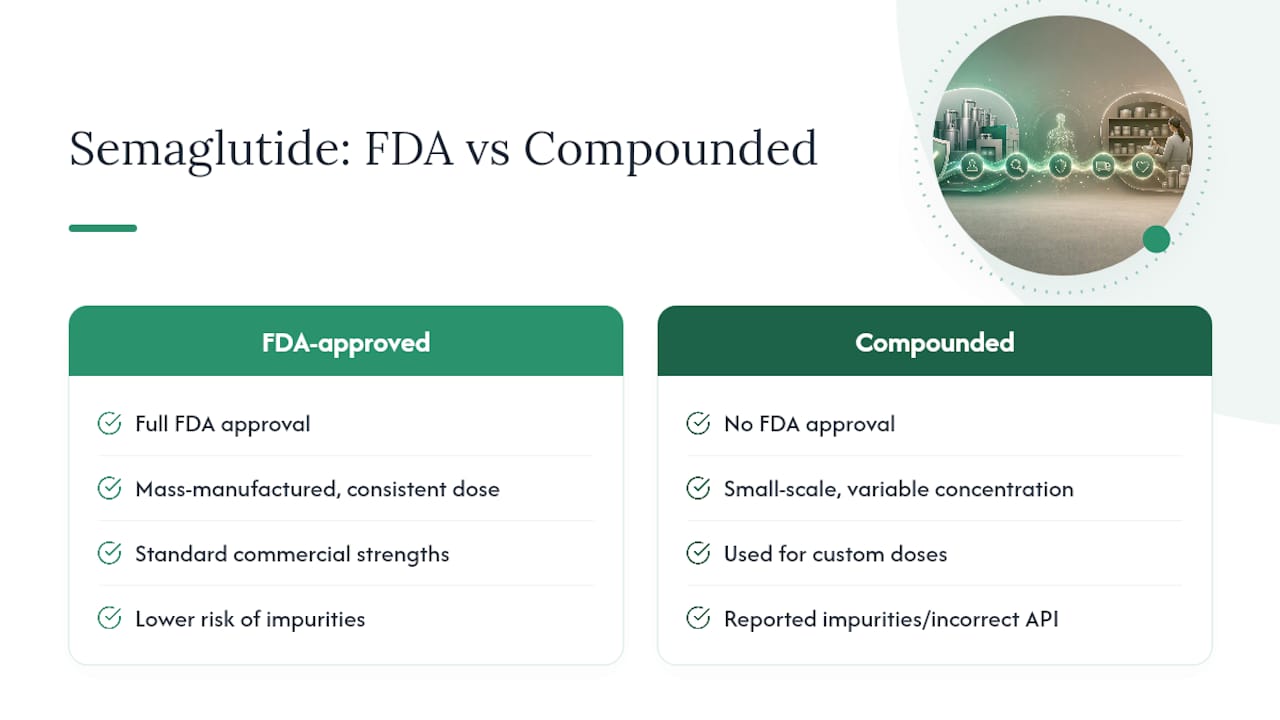
FDA-approved semaglutide pens go through a manufacturing and testing process that guarantees consistent concentration in every dose. Compounded semaglutide does not carry FDA approval, because compounding pharmacies mix or prepare medication on a smaller scale, often to meet a specific patient need or fill a supply gap, rather than mass-produce an approved drug.
Compounding exists for legitimate reasons: a patient who needs a different dose strength than what’s commercially available, or a documented shortage that leaves no approved alternative. The justification related to shortage notably changed when semaglutide came off the FDA’s shortage list in 2025. The agency’s April 2026 policy update tightened what 503A and 503B compounders can legally produce, and enforcement against companies still mass-marketing compounded semaglutide has picked up since.
Some compounded semaglutide products have shown inconsistent concentrations and, in isolated cases, contained impurities or the wrong active ingredient entirely, according to reporting from NPR on the compounding pharmacy landscape. That variation is the core danger. You’re trusting the vial to contain exactly what the label says, and not every compounder earns that trust.
Legitimate compounding tends to leave a paper trail. Look for signs such as an individual, documented clinical justification for why compounding fits your case specifically, a named 503A pharmacy licensed in your state, small-batch, patient-specific fills rather than mass production, and willingness to provide sourcing or batch documentation if you ask. If a company can’t answer basic questions about which pharmacy compounds their product or why compounding was medically necessary for your case, treat that as disqualifying. A deeper breakdown of compounded semaglutide safety covers what to check before starting any compounded product.
How Do You Avoid Dosing Errors With Semaglutide?
Dosing errors are the most preventable, and most common, safety failure with semaglutide, and they happen almost exclusively with vials rather than prefilled pens. A prefilled pen delivers a fixed dose by design. A vial requires you or a caregiver to draw up the correct milliliter amount based on the vial’s specific concentration, and concentrations vary between compounders. Mix up the math once and you can under-dose or overdose significantly.
The FDA has specifically flagged dosing errors tied to compounded products, and the fix is almost always the same missing piece: a clear, written, patient-specific dosing schedule stating exact milliliters per dose, not just “start low and go slow.”
Before you inject anything from a vial, demand these four things from your program:
- A written dosing schedule listing the exact mL amount for each week of your dose-escalation plan.
- Hands-on or video-based training on drawing up the correct amount and injecting properly.
- A direct contact for reporting side effects or unexpected reactions, not a generic support ticket.
- Written guidance on what to do if you miss a dose or think you injected the wrong amount.
Common side effects, nausea, constipation, mild blood sugar shifts, are expected during dose escalation and usually manageable with clinician guidance. Persistent vomiting, severe abdominal pain, or signs of a thyroid issue warrant an immediate call to your provider, not a wait-and-see approach. Yale Medicine’s John Morton notes that ongoing follow-up is one of the biggest factors in whether patients stay on GLP-1 therapy long enough to see results, since roughly half of patients without structured follow-up stop treatment within a year.
Pro Tip: If a program can’t tell you your exact next-dose milliliter amount before you inject, don’t inject. Call first. A one-day delay beats a dosing mistake with a medication this powerful. A full dose-escalation schedule guide can help you understand what a normal titration timeline looks like.
What Questions Should You Ask Before Choosing a Program?
Before you commit to any online semaglutide program, run it through a short list of questions. If the answers come easily and specifically, that’s a good sign. If they’re vague, evasive, or missing entirely, walk away.
- Who is my prescriber, and in which state are they licensed to practice?
- Which pharmacy fills this prescription, and where is that pharmacy licensed?
- Can you show me what the shipping label and packaging will look like?
- Do you require labs or prior authorization before approving treatment?
- What happens if my prescription is denied, and can I appeal or request a second review?
Watch for these red flags, any one of which should end the conversation:
- No prescription requirement at all, or a “prescription” issued without any clinician interaction.
- An unnamed or vague pharmacy (“our fulfillment partners” instead of an actual pharmacy name).
- Shipping that originates overseas for a product marketed as a U.S. prescription medication.
- Pricing dramatically below the market range, especially paired with unusual payment methods like crypto or wire transfer.
Trust-building signals work the same way in reverse: a named, state-licensed pharmacy, verifiable clinician credentials, direct references to NABP or BeSafeRx verification, and a clear, written refund or return policy. Copy these questions into any chat window or intake call before you pay a cent. A legitimate program won’t flinch.
Why Clinician-Led Programs Outperform DIY Sourcing
The evidence on GLP-1 adherence points to one clear pattern: patients who stay connected to a clinician through dose escalation and side-effect management do better than patients who source medication and figure out the rest alone. That’s not a marketing claim, it’s what shows up in how the field talks about long-term outcomes.
Those numbers reflect a program built around continuous contact rather than a one-time transaction.
- Free provider visits mean cost never becomes the reason someone skips a follow-up when a dose needs adjusting.
- Unlimited guidance gives patients a place to ask about side effects immediately instead of waiting or guessing.
- No membership fees or insurance requirement removes a common barrier that keeps people from starting treatment at all.
As a company operating in this exact category, Legacy Meds has an obvious interest in this framing. That doesn’t make the underlying logic less sound: continuous clinical contact reduces the two biggest failure points in GLP-1 treatment, dosing errors and early dropout, and it’s why the program is structured around ongoing access rather than a single prescription drop.
The Gap Between “Available Online” and “Safe to Use”
Here’s what gets lost in most of the coverage on this topic: the question was never really “can you get semaglutide online.” Of course you can. Dozens of websites will sell you something claiming to be semaglutide within an hour of your first visit. The real question is whether what arrives in the box is what the label says, made by someone accountable to a state pharmacy board, prescribed by someone who actually looked at your medical history.
Conventional advice tends to focus on price comparison, which one program is cheapest this month. That’s the wrong first filter. Price should be the last thing you check, after you’ve confirmed the pharmacy is named and licensed and the prescriber is real. A cheap price on an unverified product isn’t a deal. It’s a discount on risk.
If I had to boil this down to one priority: verify the pharmacy before you ever look at the price tag. Everything else, including dosing safety and long-term adherence, tends to follow from that one decision.
— Bryan
Start Semaglutide Treatment the Legal Way
Legacy Meds gives you a direct path that skips the guesswork this article just walked through: intake, a real clinician review, a prescription, and fulfillment through a named, licensed U.S. pharmacy, all without a membership fee or insurance requirement standing in the way.
Here’s what that actually looks like in practice. You complete a full medical intake online. A state-licensed provider reviews your history and approves a personalized treatment plan if you’re a fit. Your prescription ships from a licensed U.S. pharmacy with free shipping included, no vague “fulfillment partner,” no overseas package with a customs form you can’t read. From there, you get unlimited ongoing guidance and free provider visits for dose adjustments and side-effect management, the exact continuous-contact model shown to reduce early dropout and dosing errors.
If you’ve read this far because you want the legal route without spending weeks vetting pharmacy licenses yourself, start your consultation directly on the Legacy Meds program page and see whether you qualify.
Sources
- FDA’s Concerns with Unapproved GLP-1 Drugs Used for Weight Loss | FDA
- Thinking of buying Wegovy online? Here’s what to know about compounding pharmacies | NPR
This article is general information, not a substitute for advice from a qualified doctor. Consult a qualified healthcare professional about your own circumstances before acting on anything here.
FAQ
How Much Does the New Semaglutide Pill Cost?
Oral semaglutide, now available in higher-dose daily forms, typically carries a list price similar to or above the weekly injectable without insurance, though exact pricing depends on the pharmacy and whether it’s a branded or compounded formulation. Check current oral semaglutide options for a detailed cost comparison against the injectable form.
How Much Does Semaglutide Injection Cost in the U.S.?
Branded semaglutide pens carry list prices that are generally high without insurance, while compounded versions through a licensed 503A pharmacy often cost less, though pricing has shifted since the FDA tightened compounding rules in 2026.
Can I Get Semaglutide Cheaper?
You can lower costs through cash-pay telehealth programs that bundle medication with provider visits, like Legacy Meds’ no-membership-fee model, but be wary of prices so low they suggest missing prescriber review or unlicensed sourcing.
Can I Still Get My Semaglutide?
Yes, semaglutide remains available through licensed prescribers and pharmacies even though it came off the FDA shortage list in February 2025; what changed is that mass-compounded versions face tighter restrictions, so confirming your source is a licensed pharmacy matters more now than before.