
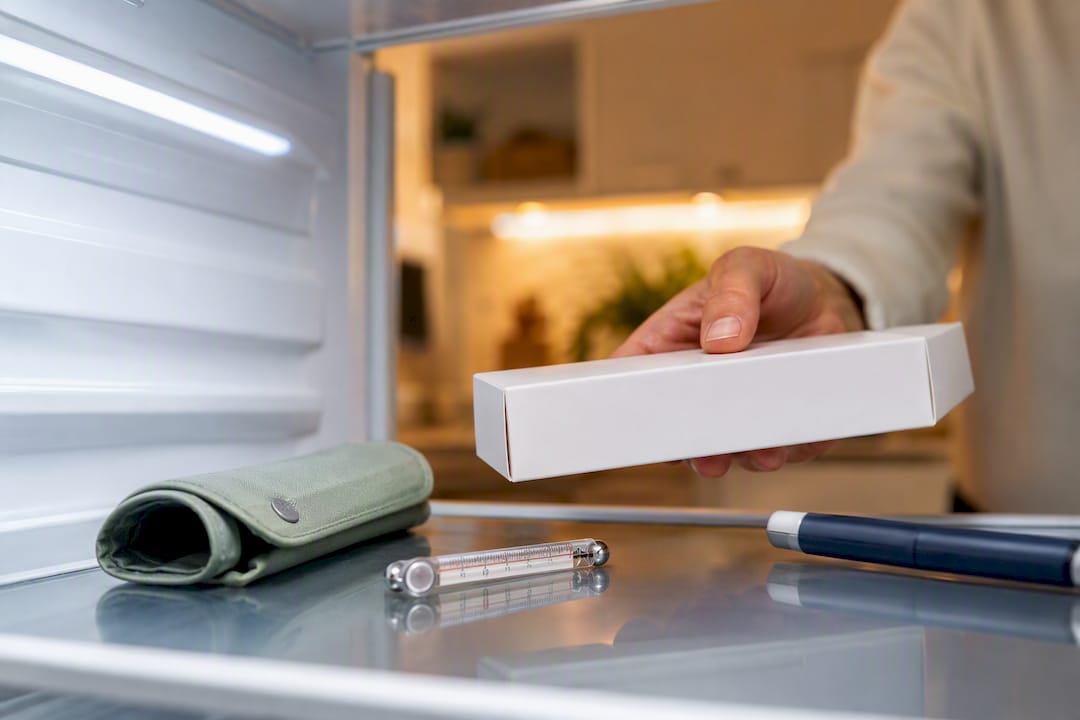
Injectable branded pens (Ozempic, Wegovy) need refrigeration at 36°F–46°F before first use, then follow their own room-temperature clock once opened: Ozempic allows 56 days, Wegovy allows 28 or 56 days depending on the pen. Compounded injectable semaglutide almost always stays refrigerated at 36°F–46°F the entire time, per your pharmacy’s label. Oral Rybelsus tablets stay at room temperature, 68°F–77°F, sealed in their original bottle away from moisture.
TL;DR:
- Unopened branded pens like Ozempic and Wegovy must stay refrigerated at 36°F–46°F, protected from light, and never be frozen, as freezing damages the medication irreversibly.
- After first use, Ozempic pens are safe for 56 days at room temperature, while Wegovy options last 28 to 56 days depending on the pen type and storage conditions.
- Compounded semaglutide vials require continuous refrigeration and their beyond-use dates depend on pharmacy instructions, typically ranging from 14 to 90 days, with detailed tracking essential.
- Rybelsus tablets should be stored at room temperature in their original moisture-protected bottles, away from humidity, and are unaffected by refrigeration.
- If medication is left out, overheated, or frozen, it should be discarded if frozen or exposed to high temperatures, with some branded pens still usable within their labeled room-temperature window if undamaged.
Table of Contents
- How to Store Semaglutide by Product Type
- Branded Injectable Pen Storage: Ozempic and Wegovy Exact Rules
- Oral Semaglutide (Rybelsus) Storage: Room Temperature and Moisture Protection
- Compounded Semaglutide and Vials: Refrigeration and Beyond-Use Dates
- Household Refrigeration Best Practices
- What to Do if Semaglutide Is Left Out, Overheated, or Frozen
- Traveling With Semaglutide: TSA and Temperature Control
- Visual Inspection and Safe Disposal
- Why Getting Storage Right Matters More Than People Think
- Get Supervised Access to Semaglutide With Storage Built In
- Where to Verify Brand-Specific Storage Rules
- Sources
- FAQ
How to Store Semaglutide by Product Type
The right answer depends entirely on what’s in your hand: a brand-name pen, a compounded vial from a specialty pharmacy, or an oral tablet. Mixing up the rules is the single most common storage mistake, and it’s an easy one to make since all three products treat the same molecule so differently.
Unopened Ozempic and Wegovy pens belong in the refrigerator at all times, kept in their original carton so light doesn’t degrade the solution. Once you use a pen for the first time, the clock changes. Compounded semaglutide, by contrast, typically needs continuous refrigeration with no room-temperature grace period unless your pharmacy states otherwise in writing. Rybelsus skips the fridge altogether and lives at room temperature, but it has its own enemy: humidity.
Here’s the quick breakdown before you dig into the specifics below:
- Ozempic and Wegovy (unopened): refrigerate at 36°F–46°F, protected from light.
- Ozempic and Wegovy (after first use): room temperature or fridge, following each brand’s specific day limit.
- Compounded semaglutide vials: refrigerate at 36°F–46°F continuously, per your pharmacy’s beyond-use date.
- Rybelsus tablets: room temperature, 68°F–77°F, in the original moisture-protected bottle.
Knowing which category your medication falls into determines every decision that follows, from where it sits in your kitchen to whether you can toss it in a bag for a weekend trip.
Branded Injectable Pen Storage: Ozempic and Wegovy Exact Rules
Unopened Ozempic and Wegovy pens must stay refrigerated at 36°F–46°F (2°C–8°C) in their original carton, which blocks light exposure that can degrade the active ingredient. Never freeze either product. Once frozen, the medication is compromised at a structural level, since peptides like semaglutide suffer irreversible damage when frozen, and a frozen pen goes straight in the trash no matter how new it is.
After first use, the two brands diverge. Ozempic pens are good for 56 days at room temperature, while Wegovy is more particular: single-dose pens last 28 days after the cap comes off, while Wegovy’s FlexTouch pens are approved for 56 days after first use, stored at either 59°F–86°F (15°C–30°C) or refrigerated. Check your specific pen type on the box, because using the wrong window is a common source of confusion.
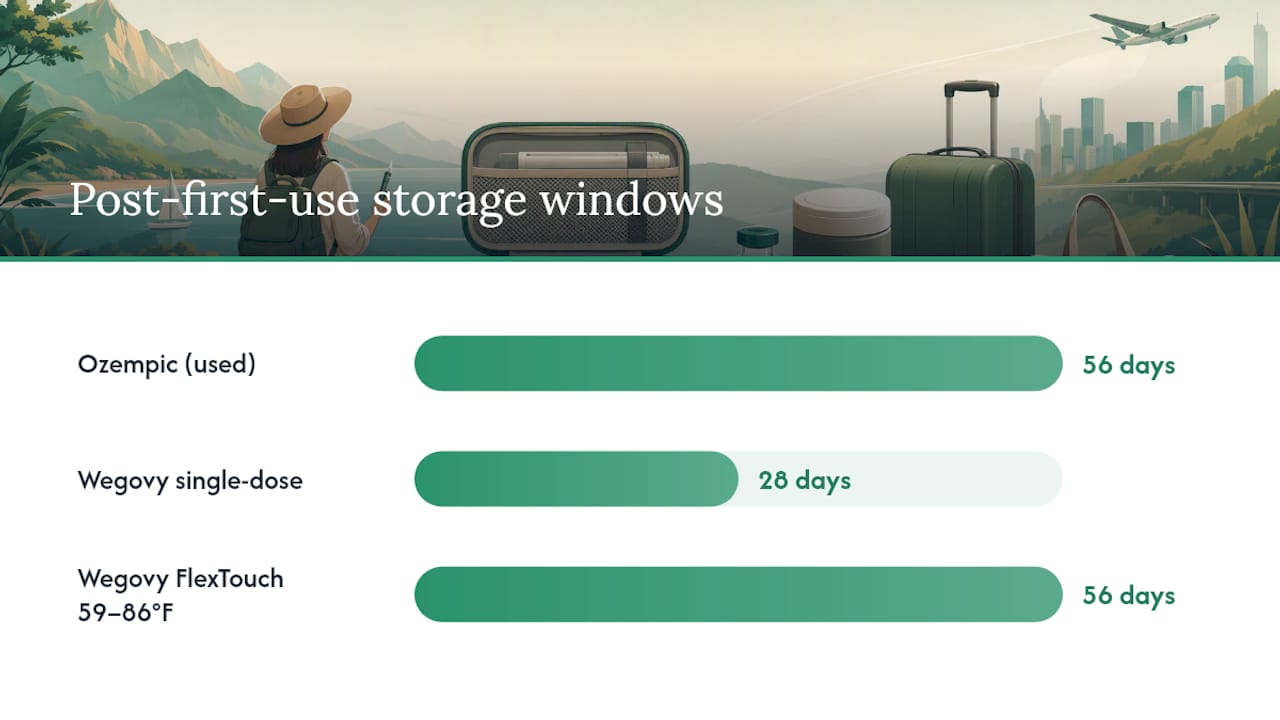
56 days is the maximum room-temperature life for a first-used Ozempic pen or a Wegovy FlexTouch pen. That’s the number to write on your calendar the day you open a new one.
Discard any pen immediately if it has frozen, been exposed to temperatures above 86°F (30°C), turned cloudy, developed visible particles, or simply outlasted its brand-specific window. A few habits make the routine easier:
- Keep the pen cap on between uses to block light and reduce contamination risk.
- Remove and discard the injection needle after every use, never leaving one attached.
- Store the pen upright, and label it with the date of first use so you’re not guessing later.
Oral Semaglutide (Rybelsus) Storage: Room Temperature and Moisture Protection
Rybelsus tablets need to stay at 68°F–77°F (20°C–25°C), with brief excursions allowed up to 59°F–86°F (15°C–30°C) if you’re traveling or your air conditioning has a rough day. Unlike the injectable pens, Rybelsus has nothing to do with your refrigerator. Its real enemy is moisture, and that changes where you should and shouldn’t keep it.
Keep tablets in their original bottle, which contains a desiccant designed to absorb ambient humidity. Close the cap tightly after every use and store the bottle somewhere genuinely dry.
- Do not transfer Rybelsus tablets to a weekly pill organizer or a decorative pill box.
- Avoid the bathroom medicine cabinet, since shower steam is exactly the kind of humidity that damages the tablets.
- Store the bottle in a bedroom drawer, kitchen cabinet away from the stove, or another dry, stable spot.
- If the bottle was accidentally left open overnight or tablets got wet, call your pharmacy before taking the next dose.
That last point matters more than people assume. A tablet that looks fine can already be compromised if it absorbed moisture, and pharmacists would rather field a quick question than have you take a degraded dose.
Compounded Semaglutide and Vials: Refrigeration and Beyond-Use Dates
Compounded semaglutide plays by different rules than the branded pens, and treating it the same way is where a lot of people run into trouble. Most compounding pharmacies require continuous refrigeration at 36°F–46°F for the entire life of the vial, with no room-temperature allowance unless your specific pharmacy documents one in writing.
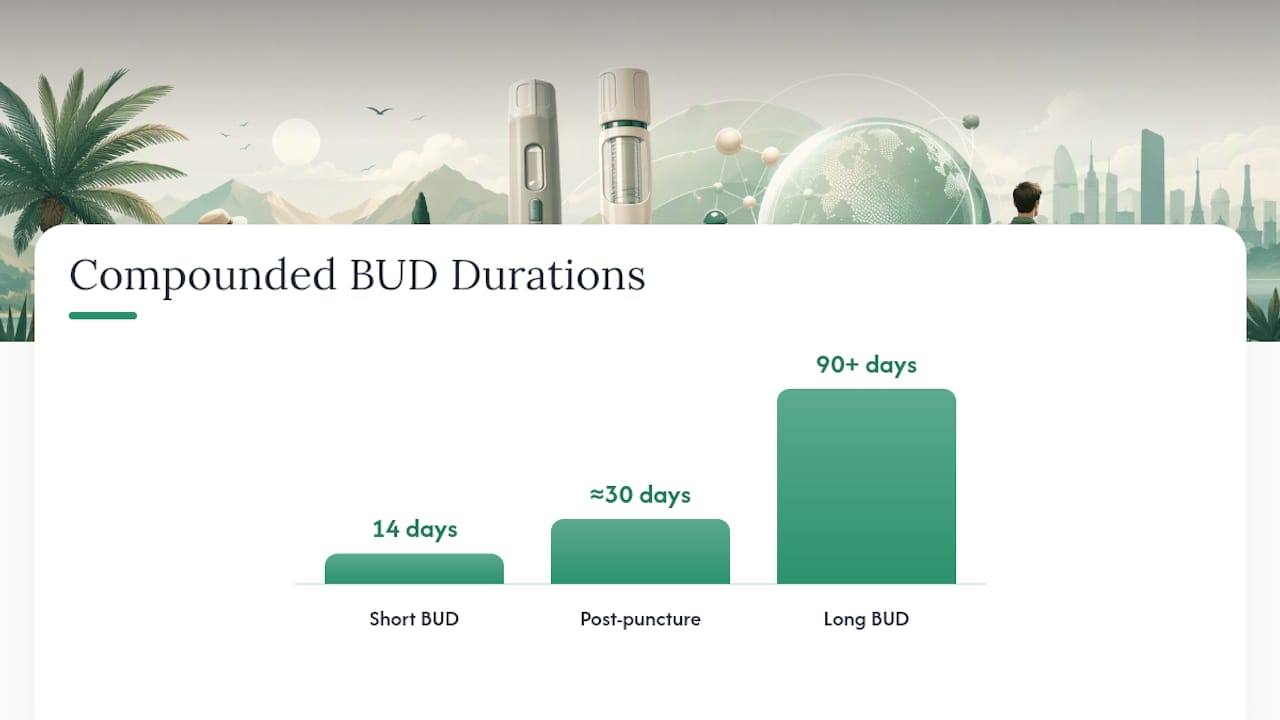
Beyond-use dates, or BUDs, vary widely because they depend on each pharmacy’s own stability testing rather than a single FDA-approved standard. Compounded semaglutide BUDs commonly range from 14 to 90 days or longer, and the label your pharmacy attaches is the only number that counts for your specific batch. Once you puncture a multi-dose vial, that window often shrinks to around 30 days, though this again depends on your pharmacy’s guidance.
Follow this sequence with any compounded vial:
- Write the date you received the vial and the date of first puncture directly on the label.
- Store it in the refrigerator immediately, positioned upright, away from the door.
- Use aseptic technique every time you draw a dose, wiping the stopper with an alcohol swab first.
- Track the post-puncture window against your pharmacy’s stated BUD, not a number you read online.
- Call your pharmacy if you notice cloudiness, discoloration, or suspect the vial was contaminated.
Pro Tip: Keep a small notebook or phone note with the puncture date for every vial you open. Compounded semaglutide doesn’t come with the built-in day-counter that branded pens effectively have, so you’re the one keeping track.
For a deeper look at how compounded product handling differs from branded pens, Legacy Meds’ guide on compounded semaglutide safety walks through the pharmacy-specific variables in more detail.
Household Refrigeration Best Practices
Where you place semaglutide inside your fridge matters almost as much as the fact that it’s refrigerated at all. The door is the worst spot, since it swings open dozens of times a week and experiences the widest temperature swings in the entire appliance.
The middle shelf, front-center, is the most stable location in a standard refrigerator. Avoid the back wall too, since it sits closest to the cooling element and runs a real risk of accidentally freezing your medication.
- Set your refrigerator to around 37°F–40°F, comfortably inside the 36°F–46°F range with a buffer against freezing.
- Buy an inexpensive fridge thermometer and place it near where you store your medication, then check it periodically.
- Keep pens or vials in their original carton or an opaque container to block light even inside the fridge.
- Label everything with the date received and the date of first use, and always store containers upright.
A cheap thermometer, the kind sold for under $10 at most pharmacies, solves a problem most people don’t realize they have: refrigerator dials are notoriously inaccurate, and “cold” doesn’t mean the same thing on every unit.
What to Do if Semaglutide Is Left Out, Overheated, or Frozen
Mistakes happen. Someone leaves a pen on the counter overnight, or a vial sits in a hot car for an afternoon. What you do next depends on exactly what happened and to which product.
- If the medication froze at any point, discard it. Freezing breaks down the peptide structure permanently, and there’s no reversing that damage.
- If it was exposed to temperatures above 86°F (30°C), even briefly, discard it. This applies to both branded pens and compounded vials.
- If the solution looks cloudy, discolored, or has visible particles floating in it, discard it regardless of how it got that way.
- For a branded pen left at room temperature within its normal range, check the brand’s day-limit window (56 days for Ozempic, 28 or 56 for Wegovy) rather than assuming it’s ruined.
- For a compounded vial exposed to any temperature excursion, call your pharmacy directly. Compounded products are generally less forgiving than branded pens and don’t have the same tested tolerance data behind them.
- If you’re not certain what temperature the medication reached or for how long, call your pharmacy with your best estimate. They can tell you definitively whether it’s still usable.
When you genuinely can’t tell whether a dose is safe, throw it out. A wasted pen costs money. An ineffective or degraded dose costs you a week of treatment and a false sense of progress.
Traveling With Semaglutide: TSA and Temperature Control
Injectable semaglutide belongs in your carry-on, never in checked luggage. Checked bags sit in cargo holds where temperatures swing unpredictably, and TSA permits prescription injectable medications in carry-on bags as long as you can identify them if asked.
- Pack pens or vials in an insulated medical travel case with gel ice packs, keeping the packs from direct contact with the medication to prevent accidental freezing.
- Carry the pharmacy label or original box, plus a copy of your prescription, especially for international travel.
- For trips longer than a couple of days, bring a small travel thermometer so you can confirm the case is holding temperature.
- Skip dry ice entirely. It runs far colder than semaglutide can tolerate and risks freezing the product solid.
Pro Tip: If you’re flying somewhere with a layover, pack an extra gel pack in your carry-on. A four-hour delay on the tarmac can outlast a pack that was only rated for a two-hour trip.
Long trips call for more planning than a weekend away. If you’re relocating temporarily or traveling somewhere without reliable refrigeration, Legacy Meds’ guidance on 30-day travel storage rules covers the logistics of extended trips with GLP-1 medications in more depth.
Visual Inspection and Safe Disposal
Before every single injection, take five seconds to look at the solution. It should be clear and colorless, or close to it, with nothing floating inside.
- Check for cloudiness, discoloration, or visible particles, and discard the pen or vial immediately if you see any of these.
- Never use medication past its beyond-use date or expiration date, even if it looks fine.
- Never use a pen or vial that you know was frozen or overheated, regardless of appearance.
- Dispose of needles and used pens in FDA-approved sharps containers or through a local pharmacy take-back program. Never flush injectable medications or toss loose needles in household trash.
- Write the date on every vial or pen the moment you start using it, so you’re never guessing how many days have passed.
A quick look before every dose takes less time than reading this sentence, and it’s the cheapest insurance you have against injecting something that’s already gone bad. Legacy Meds’ medication safety guidance covers this same checklist alongside broader safety practices for GLP-1 treatment.
Why Getting Storage Right Matters More Than People Think
Storage instructions get treated as fine print, something you skim once and forget. That’s a mistake specific to semaglutide, because unlike a lot of medications, a mishandled dose doesn’t just lose some potency. It can become genuinely ineffective, and you won’t know until your appetite control slips and the number on the scale stalls for reasons that have nothing to do with your effort.
What surprises people most is the gap between branded pens and compounded vials. Ozempic and Wegovy went through the testing required to earn those specific 28 day and 56 day windows, and that data doesn’t automatically transfer to a compounded product just because the active ingredient is the same. A compounding pharmacy’s BUD reflects its own stability testing, which is exactly why that number can range so widely from one pharmacy to another. Treating a compounded vial like a branded pen, assuming it has the same room-temperature flexibility, is the single riskiest assumption in this whole topic.
Support is available that provides medically-informed guidance, provider visits, and ongoing assistance specifically so patients aren’t left guessing about details like these. A $10 fridge thermometer and a habit of writing first-use dates on every label will do more for your treatment’s effectiveness than almost anything else in your routine. If a storage question comes up that’s specific to your prescription, your dispensing pharmacy’s BUD is always the authoritative answer, and Support teams are available to help you confirm shipping and handling practices too.
— Bryan
Get Supervised Access to Semaglutide With Storage Built In
Legacymeds is the alternative to piecing together GLP-1 treatment on your own: a full online prescription weight loss program that pairs your semaglutide or tirzepatide prescription with a free provider assessment and unlimited coaching, all without insurance or membership fees.
Every shipment arrives with clear labeling and handling instructions, so you’re not left decoding a compounding pharmacy’s beyond-use date on your own. If a pen gets left out or a vial takes a hit from a hot car, support teams can walk you through what to do next instead of leaving you to guess. That kind of ongoing access, paired with a provider who reviews your case, is what separates supervised treatment from buying medication and hoping the instructions on the box cover every situation. Start your intake at Legacy Meds to get matched with a provider and see what your personalized plan looks like.
Where to Verify Brand-Specific Storage Rules
Manufacturer prescribing information remains the final word when brand-specific details don’t match general guidance. The Wegovy prescribing information on DailyMed and Novo Nordisk’s GLP-1 storage and stability page cover Ozempic, Wegovy, and Rybelsus directly. For disposal questions, the FDA’s consumer guidance on medicine disposal is the standard reference. If your pharmacy’s label ever conflicts with general brand guidance, follow the pharmacy label.
This article is general information, not a substitute for advice from a qualified doctor. Consult a qualified healthcare professional about your own circumstances before acting on anything here.
Sources
- GLP-1 RAs Storage & Stability | Novo Nordisk Medical
- WEGOVY prescribing information (DailyMed)
- Where and How to Dispose of Unused Medicines | FDA
- Peptide stability and handling (NCBI/PMC)
FAQ
Does Semaglutide Need to Be Stored in the Fridge?
Unopened branded pens and most compounded vials need refrigeration at 36°F–46°F. Once opened, Ozempic and Wegovy pens can move to room temperature for their specific allowed window, while Rybelsus tablets never needed the fridge in the first place.
Is Semaglutide Still Good After 30 Days?
It depends entirely on the product. An opened Ozempic pen is good for up to 56 days at room temperature, and Wegovy pens last 28 or 56 days depending on the pen type, but compounded vials often carry shorter or pharmacy-specific windows, so check your label rather than assuming a 30-day rule applies universally.
I Accidentally Left Semaglutide Out of the Fridge. What Should I Do?
Check the temperature it reached and how long it was out. If it stayed within a branded pen’s normal room-temperature range, it’s likely still within its usable window; if it hit above 86°F (30°C) or you’re unsure, call your pharmacy or contact Legacy Meds’ support team for guidance specific to your prescription.
Can I Skip a Week of Semaglutide for Vacation?
Storage rules and dosing schedules are separate questions, and skipping a dose without medical guidance isn’t advisable. If you’re traveling, pack your medication in an insulated case for your carry-on and talk to your provider ahead of time about scheduling around your trip.