

Yes, telehealth can legitimately prescribe GLP-1 weight-loss medications, but only under specific conditions: a licensed clinician who actually reviews your case, individualized dose titration with ongoing monitoring, and fulfillment through a properly licensed pharmacy. Before enrolling anywhere, verify the prescriber’s license and confirm the pharmacy meets FDA safety standards.
TL;DR:
- Legitimate telehealth prescribing requires a licensed clinician to review your case and supervise dose adjustments, not just an automated form.
- Verification steps include checking the clinician’s license and certification, and ensuring the pharmacy is licensed and follows FDA safety standards.
- Safety concerns such as thyroid cancer risk, pancreatitis, and drug interactions demand a thorough clinical assessment before prescribing GLP-1 medications.
- Programs lacking scheduled follow-ups, proper clinical review, or team-based care are likely unsafe and should be avoided.
- Out-of-pocket costs vary but should be transparent, with no hidden fees or automatic renewals, and require an active license and licensed pharmacy fulfillment.
Table of Contents
- How telehealth prescribing for weight-loss medications typically works
- Can telehealth legitimately prescribe GLP-1 drugs and injections?
- Safety profile and oversight needs for GLP-1 medications
- How to verify a legitimate telehealth provider and safe online pharmacy
- Regulatory enforcement, common scams, and red flags to avoid
- What legitimate telehealth care looks like in practice
- How Legacy Meds structures safe telehealth weight-loss care
- Author perspective: weighing access against oversight
- How Legacy Meds can help you get started safely
- Sources
- FAQ
How telehealth prescribing for weight-loss medications typically works
A legitimate telehealth visit starts with an intake form covering medical history, current medications, and weight-related health conditions. From there, a licensed clinician reviews your case, either through a live video or phone visit or, in some models, a thorough asynchronous chart review, and orders labs when your history calls for it.

That clinician interaction matters because GLP-1 drugs like semaglutide and tirzepatide are not one-dose-fits-all. Starting doses are low and increased gradually to reduce nausea and other gastrointestinal effects, so someone needs to check in as your body adjusts.
Once a prescription is written, it typically routes to a partner pharmacy or a local pharmacy of your choice, which fills and ships the medication. The pharmacy step is where a surprising number of shortcuts happen, which is why it deserves its own scrutiny later on.
Can telehealth legitimately prescribe GLP-1 drugs and injections?
Prescription weight-loss medications require a valid prescription from a clinician licensed in your state, whether that visit happens in an office or on a screen. Telehealth itself is not a workaround to that rule. A real evaluation still has to happen, and the clinician still has to hold an active license where you live.
Clinical appropriateness matters as much as legality. Semaglutide and similar drugs are contraindicated for people with a personal or family history of medullary thyroid carcinoma or Multiple Endocrine Neoplasia syndrome type 2, and they are not recommended during pregnancy. A clinician also needs to know your full medication list before prescribing, since interactions can change how these drugs are dosed. Direct evaluation catches these issues; a form with no clinician behind it does not.
The regulatory line separating legitimate practice from illegal marketing became sharper in 2026, when the FDA warned 30 telehealth companies for making false or misleading claims about compounded GLP-1 products, a reminder that compounded versions are not FDA-approved even when marketed as equivalent.

Safety profile and oversight needs for GLP-1 medications
Nausea, constipation, and diarrhea are common during dose escalation and usually ease as your body adjusts, which is exactly why titration needs a clinician watching, not a fixed schedule mailed to your door. More serious concerns include pancreatitis risk and the thyroid C-cell tumor warning carried on semaglutide labeling, along with the pregnancy contraindication already mentioned.
- GI side effects are expected during dose increases and typically improve over time.
- Thyroid C-cell tumor risk and personal or family MTC/MEN2 history rule out these drugs entirely.
- Pancreatitis symptoms, such as severe abdominal pain, warrant an immediate call to your provider.
- Drug interactions can shift dosing, so a full medication review before starting matters.
One small single-site study found that structured virtual shared medical appointments improved patient engagement and dose management compared to less structured telehealth models. That is a modest signal, not a universal guarantee, but it points toward a clear pattern: programs built around real clinical touchpoints outperform ones built around a single automated intake.
How to verify a legitimate telehealth provider and safe online pharmacy
Before you hand over a credit card, run through a short verification pass.
- Confirm the prescribing clinician’s name and state license number, and check whether they hold board certification in obesity medicine or endocrinology.
- Look for evidence of a real, individualized visit rather than a questionnaire that auto-generates a prescription.
- Verify the pharmacy is licensed with a state board of pharmacy, lists a U.S. physical address, and employs licensed pharmacists.
- Read the pricing page for hidden fees, automatic renewals, or vague “membership” language before you agree to anything.
- Check that consent forms and privacy practices are clearly posted, not buried in a footer link.
Pro Tip: Search the clinician’s license number directly on your state medical board’s website rather than trusting a badge or seal displayed on the company’s own page.
A platform that skips any of these steps, especially the licensed-pharmacy check, is not one you want dispensing an injectable prescription drug.
Regulatory enforcement, common scams, and red flags to avoid
Enforcement activity has picked up alongside GLP-1 demand. Beyond the FDA’s 2026 warning letters on compounded product marketing, the FTC has pursued telehealth companies over deceptive pricing and fake reviews, including action against a telemedicine firm for misleading price claims tied to weight-loss programs.
Watch for these signals:
- No prescription requirement, or a prescription issued without any real clinical review.
- Discounts so steep they undercut the cost of the active ingredient itself.
- Testimonials with no verifiable patient identity or suspiciously uniform language.
- Membership terms or auto-renewal clauses disclosed only after checkout.
If you spot these, you can report the company to the FDA, the FTC, or your state medical board.
What legitimate telehealth care looks like in practice
Expect a follow-up cadence tied to your dose, not a calendar default. Most GLP-1 titration schedules call for a check-in every four weeks as the dose increases, giving your clinician a chance to adjust pace if side effects are hard to manage. A program with no scheduled touchpoints between the first visit and a refill is skipping a step that matters.
Real programs also pair medication with behavioral and nutrition support, since obesity medicine specialists recommend team-based care that includes dietitians and behavioral health resources rather than prescriptions alone. Medically supervised programs built this way tend to support better adherence over the months of gradual dose changes that GLP-1 treatment requires.
Outcomes vary by person, and long-term follow-up, not a single before-and-after photo, is what determines whether the weight loss holds.
How Legacy Meds structures safe telehealth weight-loss care
Legacy Meds offers a GLP-1 program, including semaglutide and tirzepatide options in injection and tablet form, built around telemedical provider assessment rather than an automated intake alone. Every patient gets a provider visit at no added cost, along with unlimited coaching for the length of treatment, and there is no membership fee or insurance requirement to access care.
That structure lines up with the verification points above: a real clinician review before prescribing, ongoing support through titration, and transparent out-of-pocket pricing instead of hidden recurring charges. Readers weighing candidacy and contraindications can review GLP-1 eligibility criteria and details on drug interaction risk before starting.
Author perspective: weighing access against oversight
The honest tension in telehealth weight loss is speed versus depth. Fast access is genuinely useful for people who cannot easily see a specialist in person, but speed only helps if the clinical review behind it is real. My priority list stays short: verify the clinician’s license, confirm a titration plan exists, and check the pharmacy before the medication. Skip any of those three and you are gambling with an injectable prescription drug.
— Bryan
How Legacy Meds can help you get started safely
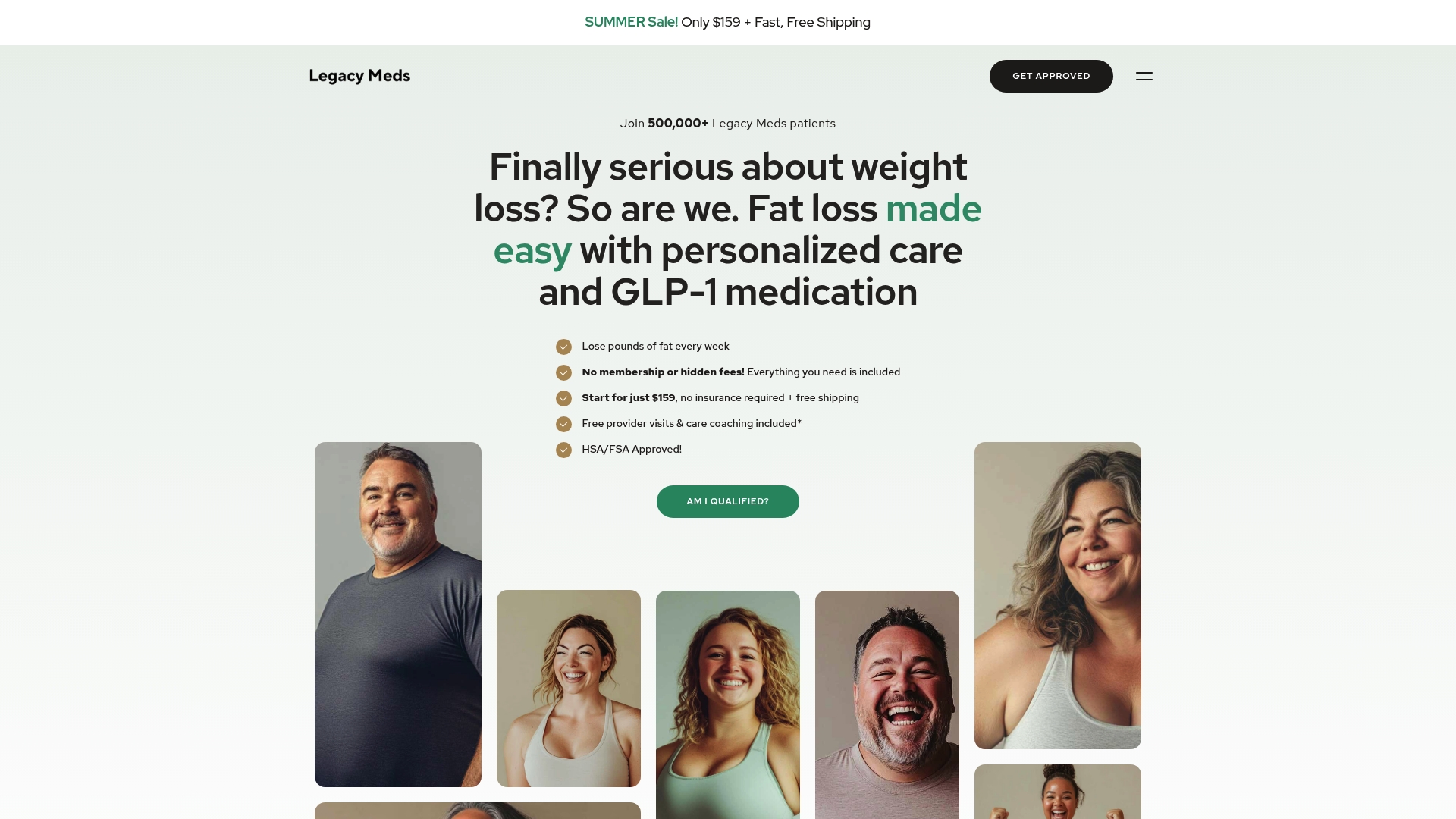
If you have run through the checklist above and want a program built around clinician oversight rather than a one-click order form, Legacy Meds pairs a free provider visit with unlimited ongoing coaching and no membership fee.
| Plan | Price | Format |
|---|---|---|
| GLP-1 Injections | from $159 one-off | Injection |
| GLP-1 Tablets | from $249 one-off | Tablet |
| Semaglutide program | from $159 per month | Injection or tablet |
Pricing is out-of-pocket with no insurance requirement, so what you see is what you pay. You can start an intake and provider review directly through the site.
Sources
- Considering an Online Pharmacy? | FDA
- AMA guidance on telehealth and obesity care
- Virtual shared medical appointments for obesity and GLP-1 medications: A scalable method for optimizing care delivery - PMC
This article is general information, not a substitute for advice from a qualified doctor. Consult a qualified healthcare professional about your own circumstances before acting on anything here.
FAQ
Which telehealth weight loss program is best?
The best programs share three traits: a licensed clinician who conducts a real evaluation, individualized dose titration with monitoring, and fulfillment through a licensed pharmacy. Rather than a single “best” answer, compare programs against the FDA’s online pharmacy safety checklist and confirm the clinician’s state license before enrolling.
What is the cheapest GLP-1 drug I can buy without insurance?
Prices vary by formulation, dose, and provider, and no single “cheapest” option holds across the market. Compounded versions marketed as cheaper alternatives are not FDA-approved and have drawn FDA warning letters for misleading marketing, so price alone should never be the deciding factor.
Will telehealth prescribe weight loss medication?
Yes, a licensed telehealth clinician can legally prescribe GLP-1 weight-loss medication after a real medical evaluation, the same standard that applies to an in-person visit. The prescription still has to come from a clinician licensed in your state, and the medication still has to ship from a properly licensed pharmacy.
Can I get weight loss injections through telehealth?
Yes, injectable GLP-1 medications like semaglutide and tirzepatide can be prescribed through telehealth when a licensed clinician evaluates your history and sets an individualized titration schedule. Some telehealth providers offer GLP-1 injections at varying prices, fulfilled after a provider assessment rather than an automated order.
Is telehealth weight loss safe?
Telehealth weight loss can be safe when it includes real clinician oversight, gradual dose titration, and a licensed pharmacy for fulfillment. Risk increases sharply with programs that skip clinical review entirely, since GLP-1 drugs carry contraindications and side effects that require individualized monitoring.