
TL;DR
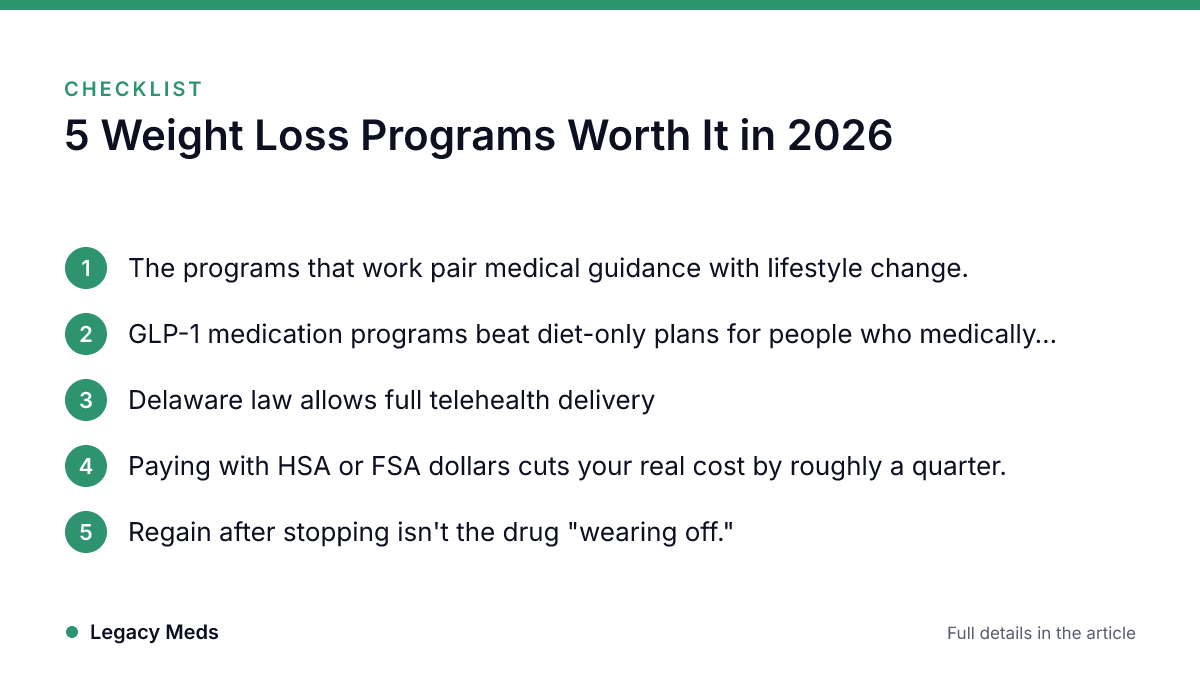
- The programs that work pair medical guidance with lifestyle change. NIDDK names four required pieces: a reduced-calorie eating plan, a physical activity plan, habit coaching, and a maintenance plan.
- GLP-1 medication programs beat diet-only plans for people who medically qualify, because they change appetite signaling instead of asking you to out-discipline it.
- Delaware law allows full telehealth delivery, including video, message-based, and audio-only visits, so Dover residents can get clinician-guided GLP-1 care without a waiting room (Delaware Code).
- Paying with HSA or FSA dollars cuts your real cost by roughly a quarter. A $249/month plan works out to about $717 in annual tax savings at a 24% effective rate.
- Regain after stopping isn't the drug "wearing off." Appetite hormones drift back toward baseline, which is why the coaching months matter more than the final number on the scale.
Nearly three out of four U.S. adults carry excess weight, according to NIDDK. If diets and gym memberships haven't stuck for you, you're not the outlier. You're the majority. The programs that actually hold combine four things: a lower-calorie eating plan, regular movement, coaching on daily habits, and a real strategy for keeping the weight off. For most adults in 2026, the fastest route to all four runs through a GLP-1 medication with clinical support behind it, not a standalone diet.

Table of Contents
- What is the most successful weight loss program?
- What is the best program to lose weight?
- Do GLP-1 medications really work better than diet-only programs?
- Do you need an in-person doctor's visit to get real weight-loss care?
- Will you regain the weight after stopping a GLP-1 program?
- How much do weight loss programs actually cost in Dover?
- What's next if you want to actually stick with a program this time?
- Frequently asked questions
What is the most successful weight loss program?
The one you can still follow in month seven. NIDDK's guidance on choosing a safe program lists four non-negotiables: a healthy reduced-calorie eating plan, a physical activity plan, guidance for changing daily habits, and a plan for maintaining the loss (NIDDK).
What's changed recently is which tool gets you there. GLP-1 medications like semaglutide (Wegovy®) and tirzepatide (Zepbound®) slow digestion and quiet appetite signaling in the brain. That turns "eat fewer calories" from a daily argument with yourself into something closer to the default. The eating plan doesn't change. Your relationship with it does.
That's why clinician-guided GLP-1 programs with coaching layered on top are outperforming plain diet-and-exercise plans for patients who qualify.
Pro tip: if a program promises results without asking about your medical history, current medications, or personal or family history of thyroid C-cell tumors, that's not a shortcut. That's a company skipping the part that keeps you safe.
What is the best program to lose weight?
It depends on four things: whether you need a brand-name medication, whether cost is the deciding factor, whether you'll tolerate a weekly needle, and how much coaching you want. Here's how five common paths compare.
| Program | Starting cost | Format | Best for |
|---|---|---|---|
| GLP-1 injections | $159/month | Weekly injection | Lowest-cost entry into GLP-1 care, no insurance needed |
| Dissolvable GLP-1 tablets | $249/month | Daily dissolvable tablet | Needle-averse patients, or anyone who does better with a daily ritual |
| Wegovy® pill | $99 membership + medication | Daily oral tablet | Brand-name semaglutide without an office visit |
| Wegovy® injection | $99 membership + medication | Weekly injection | Patients specifically prescribed the brand injectable |
| Zepbound® injection | $99 membership + medication | Weekly injection | Patients who respond better to tirzepatide than semaglutide |
Every one of these, through Legacy Meds' weight loss program, includes free provider visits, ongoing care coaching, and free shipping. The medication is half the equation. The coaching is what turns a prescription into a program.
One pattern we see constantly: patients pick the format they think they should want, then quietly fall off it by week five. Injection patients who travel for work forget their cooler. Tablet patients who skip breakfast forget the morning dose. Pick for your worst week, not your best one.
Pro tip: if you're torn between the two, ask which one you'd still take on a Wednesday when you're behind on everything. Adherence beats "optimal" every time. Our breakdown of GLP-1 versus diet-only approaches goes deeper if you're still deciding.
Do GLP-1 medications really work better than diet-only programs?
For people who qualify medically, yes, and the gap isn't subtle. Diet-only programs depend on you overriding hunger signals meal after meal. That works until life gets stressful, busy, or social, and then it doesn't.
GLP-1 medications change the input. Reduced appetite plus slower gastric emptying means the calorie deficit that used to take constant vigilance becomes the path of least resistance.
Diet-only plans aren't worthless. The Mayo Clinic Diet and similar structured programs genuinely work for people with mild excess weight and solid support around them. But if you've already cut calories and exercised consistently without lasting results, that's information. It usually means the biology needs help that discipline can't supply.
| Factor | GLP-1 medication programs | Diet and exercise only |
|---|---|---|
| Time to noticeable change | Weeks | Months |
| Reliance on daily willpower | Low; appetite is medically reduced | High; requires constant tracking |
| Ongoing cost | $99–$249+/month plus medication | Often free, but time-intensive |
| Clinical oversight | Required, with prescription and monitoring | Optional but recommended |
| Best fit | Repeat dieters with no lasting results | Mild excess weight, strong existing habits |
The "real weight loss comes from willpower" myth persists partly because GLP-1 drugs are still new to the mainstream and partly because going without medication sounds more virtuous. CDC's guidance on losing weight treats the whole plan as the thing that matters: food, activity, sleep, stress. Medication is a tool inside that plan, not a substitute for it.
Do you need an in-person doctor's visit to get real weight-loss care?
No. Delaware law authorizes telehealth across its licensing boards, including synchronous video visits, asynchronous message-based care, and audio-only encounters when a patient has no video access (Delaware Code Title 24).
The idea that telehealth is lesser care comes from an older era of medicine. A licensed clinician reviewing your labs, history, and current medication list is doing the same clinical work whether you're in an exam room or your kitchen. What matters is whether that review actually happens and whether someone's reachable when your dose changes.
When you're evaluating a telehealth weight-loss provider, look for:
- A clinician who reads your full medical history before prescribing, not a five-question form with a credit card field at the bottom.
- Ongoing access to your care team rather than one consultation followed by silence. Legacy Meds patients get 24/7 support for exactly this reason, because nausea at 9pm on a Sunday is when people quit.
- Clear safety information about the drug class, including who shouldn't take GLP-1s. Our medication safety information page covers the contraindications.
- A real qualification step, not a provider who approves everyone who fills out a form.
- No pressure to add supplements you never asked about.
For a state employee in Dover who can't burn a Tuesday afternoon on a 20-minute appointment, or someone in West Dover without a nearby internal medicine practice, telehealth isn't a downgrade. It's often the only version of consistent care that survives a real schedule. You can start with a short quiz to see if you qualify before committing to anything.
Will you regain the weight after stopping a GLP-1 program?
Regain is common after stopping without a maintenance plan, and the reason is mechanical: appetite-regulating hormones drift back toward their pre-treatment baseline once the medication clears. Nothing "stopped working."
This is the assumption that costs patients the most. They treat the goal weight as a finish line, stop the medication that week, and are genuinely confused when hunger returns at full volume two months later. GLP-1s manage appetite while you take them, the same way blood pressure medication manages blood pressure while you take it.
What actually prevents regain is using the treatment window to build what NIDDK identifies as the core of any lasting program: a sustainable eating pattern, a movement routine, and ongoing support (NIDDK).
In practice, that means the months where eating feels easy are the months you should be doing the boring work. Lock in a protein target you can hit without thinking. Get the grocery list down to a repeatable rotation. Find the walk you'll take in February, not just the one you'll take in May. Patients who wait until they taper to start building habits are starting from zero at the hardest possible moment.
Dover's weather cooperates more than most places. Outside the muggy mid-summer stretch, the year sits in a range that's workable for walking or outdoor activity most weeks (WeatherSpark), which makes the activity habit your coach asks about easier to actually keep.
If fatigue or other side effects are making consistency hard, our post on managing GLP-1 fatigue covers what's normal and what's worth flagging.
How much do weight loss programs actually cost in Dover?
They start at $159/month for a GLP-1 injection plan and run to $99 membership plus medication cost for brand-name options like Wegovy® or Zepbound®. Delaware helps at the margins: no sales tax means less of your monthly budget disappears before it reaches healthcare (The Oldfather Group).
The bigger lever is how you pay. Here's an illustrative scenario worth running with your own numbers.
Say you pick the dissolvable tablet plan at $249/month and pay through an FSA instead of a regular debit card. FSA contributions come out of your paycheck pre-tax, so you skip both income tax and the 7.65% payroll tax. At a 22% federal bracket, that's roughly 24 to 30 cents saved on every dollar depending on your exact situation.
The formula: monthly cost × 12 × your effective tax savings rate = annual savings.
The math: $249 × 12 = $2,988 a year in medication cost. At a 24% effective rate, $2,988 × 0.24 = $717.12 saved per year, just by routing the payment through pre-tax dollars.
The pharmacy isn't discounting anything. That's tax money you were going to pay regardless, redirected into care you already planned to buy. Run the same math on a $159/month plan and you're looking at roughly $458 back.
If you're weighing HSA funds against a brand-name prescription, our HSA for Wegovy breakdown covers eligible expenses, and the Wegovy cost and Zepbound cost guides explain what you're paying beyond the membership.
Pro tip: call your plan administrator before you enroll, not after. Most plans cover GLP-1s as a prescribed treatment, but ask specifically whether they require a letter of medical necessity. Some do, and getting it upfront beats fighting a denied reimbursement in March.
What's next if you want to actually stick with a program this time?
Pick the format that fits your real life, not your aspirational one. A daily tablet only works if you'll take it daily. A weekly injection only works if you're fine with the routine six months from now.
Then get screened. Clinician qualification is the line between a weight-loss program and someone selling you a bottle, and it's also where you find out whether a GLP-1 is even the right tool for your history.
If diets and exercise plans haven't held before, that wasn't a character flaw. Something was missing from the plan, and for most adults it's the medical support underneath the coaching.
You can take the free online quiz to see whether you qualify, or read the weight-loss FAQ first if you want the process spelled out before you start.
Frequently asked questions
How quickly do GLP-1 weight loss programs show results?
Most patients notice reduced appetite within the first couple of weeks, with visible weight changes building over the following one to two months as your provider adjusts the dose. Results vary with starting weight, dose, and how closely you follow the eating and activity guidance from your care team.
Can I switch between a tablet and an injection if one isn't working for me?
Yes. Every Legacy Meds plan includes free provider visits, so you can raise a format change with your care team if the routine isn't fitting or side effects are getting in the way. Read how GLP-1 medications work first to understand why response differs between semaglutide and tirzepatide.
Is it safe to drink alcohol while on a GLP-1 weight loss program?
GLP-1 medications often change how you tolerate alcohol, and many patients feel effects faster or more strongly than before treatment. Combining the two can also worsen nausea and GI discomfort. Our guide on GLP-1 and alcohol covers what to expect and when to check with your provider.