
TL;DR
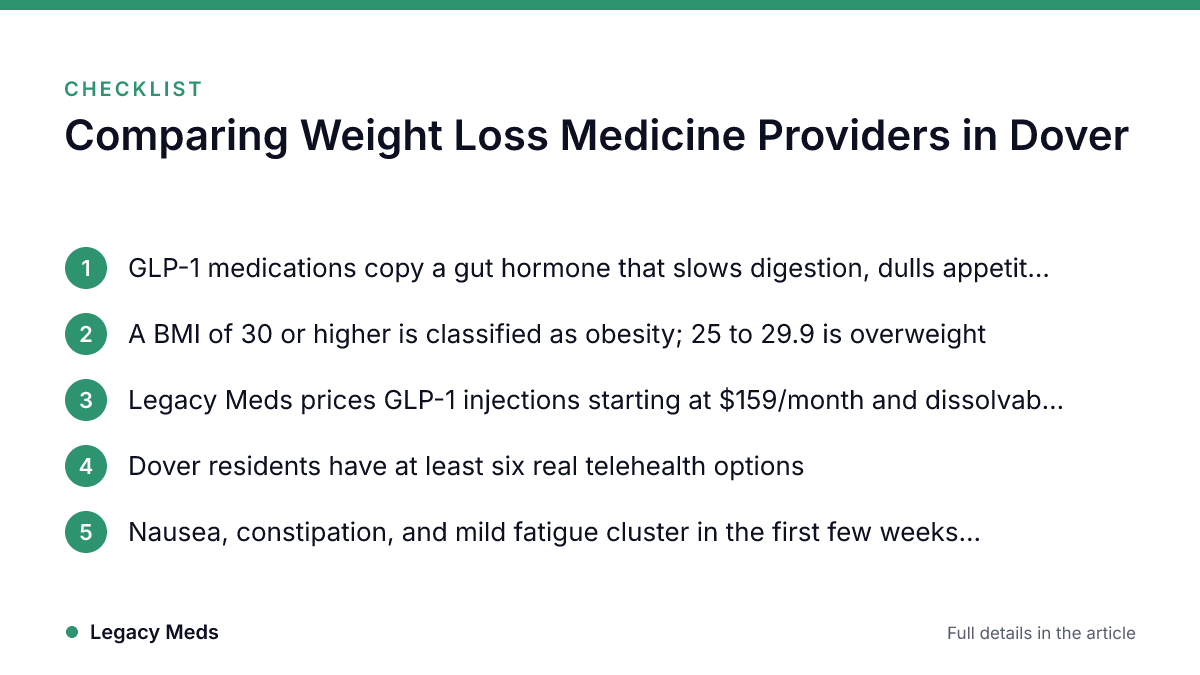
- GLP-1 medications copy a gut hormone that slows digestion, dulls appetite, and steadies blood sugar. That's the mechanical reason people eat less on them.
- A BMI of 30 or higher is classified as obesity; 25 to 29.9 is overweight, per the NIDDK. Most telehealth providers use that range as the eligibility starting point.
- Legacy Meds prices GLP-1 injections starting at $159/month and dissolvable tablets starting at $249/month, with provider visits, coaching, and shipping included. No insurance required.
- Dover residents have at least six real telehealth options (Legacy Meds, Klinic, Amble, Medvi, Shed, Fridays). The right pick depends on whether you care most about brand-name access, lowest monthly cost, or a daily pill instead of a weekly shot.
- Nausea, constipation, and mild fatigue cluster in the first few weeks after each dose increase and usually settle as your body adjusts.
You typed "weight loss medicine" into Google and got a wall of ads. Here's the part nobody puts in the ad copy: the drug class behind Ozempic, Wegovy, and Zepbound is the most effective prescription option available for sustained weight loss, and telehealth has made it accessible in Dover without one in-person appointment. So the real question isn't whether to try a GLP-1. It's which provider, which format, and what you'll actually be paying in month four.
Table of Contents
- What is the best medicine for weight loss?
- How do GLP-1 medications work in the body?
- How long does it take to lose 20 lbs on Ozempic?
- How much does a 30-day prescription of Ozempic cost?
- What are the most common side effects of GLP-1 medications?
- How do Dover's telehealth weight loss providers actually compare?
- Which provider is right for you?
- What actually determines who qualifies for weight loss medication?
- Frequently asked questions
What is the best medicine for weight loss?
There's no single best one. The right choice depends on your health history, whether you can tolerate a weekly injection, and what you can pay every month without resenting it.
GLP-1 receptor agonists (semaglutide and tirzepatide) are currently considered the most effective class of prescription weight-loss drugs, according to Mayo Clinic, because they pair appetite suppression with metabolic effects older diet pills never had. Brand names get the headlines. Compounded and generic-equivalent semaglutide formulations, including injections and dissolvable tablets, use the same active mechanism at a price cash-paying patients can actually sustain.
Tirzepatide acts on two gut hormone receptors instead of one, and in clinical use it tends to be the more aggressive of the two. But strongest isn't automatically best. A gentler option you take every week for a year beats a stronger one you abandon in month two because the nausea wrecked your weekends. We see that trade play out constantly.
How do GLP-1 medications work in the body?
They mimic glucagon-like peptide-1, a hormone your intestines release after you eat. That hormone tells your pancreas to release insulin, slows how fast food leaves your stomach, and signals fullness to your brain. The practical result: smaller portions satisfy you, snack cravings quiet down, and blood sugar stays steadier through the afternoon. Tirzepatide also activates GIP receptors, a second pathway, which is part of why it sits at the top of the strength ladder.
Compare that to old stimulant-based diet pills, which pushed weight loss by revving your nervous system. More cardiovascular risk, less durable results. GLP-1s work with your digestive and hormonal systems instead of against them, which is why obesitymedicine.org and other clinical sources now treat them as a first-line option for qualifying patients.
Pro tip: if needles are a dealbreaker, ask any provider whether they offer a dissolvable tablet. Same GLP-1 pathway, different delivery. You're changing the format, not the science.

How long does it take to lose 20 lbs on Ozempic?
Nobody can give you a date on a calendar, and be suspicious of anyone who does. Dosing starts low and steps up over roughly 8 to 16 weeks to keep side effects manageable, so your weight loss curve follows your titration schedule.
Here's an illustrative way to pace your expectations. Say you settle into a rate of 1 to 2 lbs per week once you reach an established dose:
20 lbs ÷ 1.5 lbs per week ≈ 13 weeks of steady loss. Add the 4 to 8 weeks of titration up front, when the scale moves slowly, and you land around four to five months total.
Run that with your own numbers. If you lose closer to 2 lbs a week, you're looking at 10 weeks plus titration, roughly three months. At 1 lb a week, closer to six. What matters is the threshold: if you're twelve weeks in at a stable dose and the scale genuinely hasn't moved, that's a conversation about dose adjustment, not evidence the medication failed.
How much does a 30-day prescription of Ozempic cost?
Brand-name GLP-1s routinely run several hundred dollars a month without coverage, and coverage is a coin flip. Plenty of plans pay only when the drug is prescribed for type 2 diabetes, not weight loss, which pushes a large share of patients to cash pricing. GoodRx tracks how far those cash prices swing between pharmacies.
Now the arithmetic, using Legacy Meds' published pricing:
- Injection at $159/month × 12 = $1,908 per year
- Dissolvable tablet at $249/month × 12 = $2,988 per year
- Difference: $1,080 a year, or $90 a month
That $90 is what you're paying for the privilege of swallowing a tablet instead of injecting once a week. Some people consider it the best money they spend all year. Others try one injection, realize the needle is thinner than a diabetic pen tip and barely registers, and pocket the difference. Do the math before you decide on principle.
For brand-name Wegovy or Zepbound, Legacy Meds runs a $99 membership plus the medication cost. Price that against your local Dover pharmacy's cash number before committing. Current figures are broken out on the Wegovy cost, Zepbound cost, and semaglutide cost pages.
Pro tip: weight loss medication prescribed by a licensed provider typically qualifies as an HSA or FSA expense. Paying with pre-tax dollars trims your effective cost without changing a thing about your treatment. On that $1,908 annual injection cost, a 24% effective tax rate saves you roughly $458.
What are the most common side effects of GLP-1 medications?
Nausea, mild constipation, occasional loose stools, and low energy. They hit hardest in the first two to four weeks after starting or stepping up a dose, then ease as your gut adapts. Nausea usually peaks in the first few days post-increase and fades inside a week.
Constipation is the one that lingers, and it needs managing rather than waiting out. What actually works in practice: water before you feel thirsty, fiber added gradually instead of all at once, a daily walk, and magnesium if your provider clears it. Our constipation on GLP-1 guide covers the specifics.
Two more things practitioners see that patients don't expect. Some people report mild hair shedding a few months in, which usually tracks with the speed of the weight loss itself rather than the drug (see our GLP-1 hair loss breakdown). And injection-site irritation shows up almost exclusively in people who keep using the same spot, which is why rotating injection sites between abdomen, thigh, and upper arm is worth the ten seconds of thought.
If you're searching for weight loss medicine for women without side effects, the useful thing to know is that side effect intensity tracks with dose escalation speed far more than with sex. Slowing the titration reduces nausea and GI symptoms in anyone. A good telehealth provider adjusts your dose based on how you're tolerating it, not on a fixed calendar. And if you're pregnant, trying to conceive, or drinking regularly, read our notes on GLP-1 and pregnancy and GLP-1 and alcohol, then raise both with a provider before your first dose.
How do Dover's telehealth weight loss providers actually compare?
Every provider serving Dover offers the same broad shape: online quiz, virtual visit, medication mailed to your door. Where they diverge is pricing structure, drug selection, and what's bundled into the base price versus billed on top.
| Provider | Specialty focus | Pricing approach | Medication formats | What to ask them directly |
|---|---|---|---|---|
| Legacy Meds | GLP-1 weight loss, injections and tablets | $159/month injection; $249/month tablet; $99 membership plus medication for brand-name | Injections, dissolvable tablets, brand-name Wegovy and Zepbound | Answered on their weight loss FAQ |
| Klinic | General telehealth including weight management | Ask about membership fees versus per-visit pricing | Ask which GLP-1 formats they carry | Is weight loss a specialty or one service among many? |
| Amble | Weight loss and metabolic health coaching | Ask if pricing is subscription or pay-per-fill | Confirm injection versus tablet availability | What does coaching include beyond the prescription? |
| Medvi | GLP-1 and hormone therapy telehealth | Ask for total monthly cost including add-on fees | Confirm brand versus compounded options | Is compounded medication sourced from a licensed pharmacy? |
| Shed | Weight loss-focused telehealth | Ask about intro pricing versus ongoing monthly cost | Confirm whether tablets are offered alongside injections | What's the price after the promotional period ends? |
| Fridays | Weight loss telehealth with brand-name focus | Ask if membership and medication bill separately | Confirm which brand names they carry | Do they require insurance, or accept HSA/FSA? |
Pricing models and drug availability shift fast in this category. Don't take a homepage number at face value. Start each intake quiz and get the total monthly figure, membership included, before you line them up side by side.
Pro tip: ask every provider the same question: "what does month four cost?" Introductory rates are everywhere in this space. A $99 first month against a $299 ongoing rate is a worse twelve-month deal than a flat $159, and the annual math proves it: $99 + ($299 × 11) = $3,388 versus $1,908.
Which provider is right for you?
Three clear scenarios, based on what we see people actually decide between.
- Lowest sustainable monthly cost. Legacy Meds' $159 starter injection includes provider visits, coaching, and shipping, with no separate consult fee bolted on at checkout. That last part matters: a $129 headline price with a $45 monthly visit charge is a $174 price.
- You will not inject yourself. The $249 dissolvable tablet handles that without switching providers or restarting intake. Worth being honest with yourself here before you sign up for the cheaper option and let three unopened pens sit in the fridge.
- You want a specific brand by name. If a previous doctor put you on Wegovy or Zepbound and it worked, the $99 membership plus medication cost gets you back on it without traditional insurance.
Where someone else may serve you better: if you need in-person lab draws as part of your care, want weight management bundled with broader primary care, or you're comparison-shopping brand-name pricing across four platforms, get quotes from Klinic, Amble, Medvi, Shed, and Fridays first. Any provider worth using will tell you to do exactly that. Review the full weight loss program details, check your eligibility, or read more on the about page.
What actually determines who qualifies for weight loss medication?
BMI is the starting gate. A BMI of 30 or greater qualifies as obesity, and 25 to 29.9 is classified as overweight, according to NIDDK. Most providers, Legacy Meds included, read that number alongside your health history and any related conditions such as high blood pressure, prediabetes, or sleep apnea.
The screening also runs the other direction. Providers look for reasons not to prescribe: a personal or family history of medullary thyroid carcinoma or MEN2, prior pancreatitis, pregnancy or active plans to conceive, and certain gallbladder and GI conditions. This is why intake forms ask questions that feel unrelated to your weight. They aren't.
The NIDDK is direct that these drugs work best alongside diet and activity changes rather than replacing them. In practice, that means protein first at every meal and some resistance training, because losing weight quickly on a suppressed appetite makes it easy to lose muscle along with fat. For people who've genuinely done the diet-and-exercise work without lasting results, GLP-1s address the biological appetite signals that discipline alone rarely overrides.
An online quiz is the fastest way to find out where you land. A few minutes of health history, and you'll know whether you're a likely candidate before you ever speak to a provider.
Frequently asked questions
Can men and women both use the same GLP-1 medications for weight loss?
Yes. GLP-1s work through the same appetite and metabolic pathways in everyone, and eligibility rests on BMI and health history rather than sex. Dosing and titration schedules are generally identical, though your provider may slow the pace based on how you personally tolerate each step up.
Do I need a diagnosis of obesity or diabetes to get a prescription?
Not necessarily. Many telehealth providers, Legacy Meds included, will prescribe for weight management if you fall in the overweight-to-obese BMI range and have no disqualifying conditions, with no diabetes diagnosis required. An intake quiz plus provider review is how that gets decided. You don't need to arrive with a formal obesity diagnosis from another doctor.
What happens if I stop taking GLP-1 medication?
Appetite and hunger cues generally drift back toward where they were before treatment. These drugs manage appetite while you're on them; they don't permanently rewire your metabolism. That's why care teams push hard on building sustainable eating and activity habits during treatment, and why you should discuss a taper or maintenance dose with your provider instead of just stopping.
Ready to see where you stand? Take Legacy Meds' online quiz. A few minutes, a straight answer on whether you qualify, and a real provider on the other end. No office visit.