
TL;DR
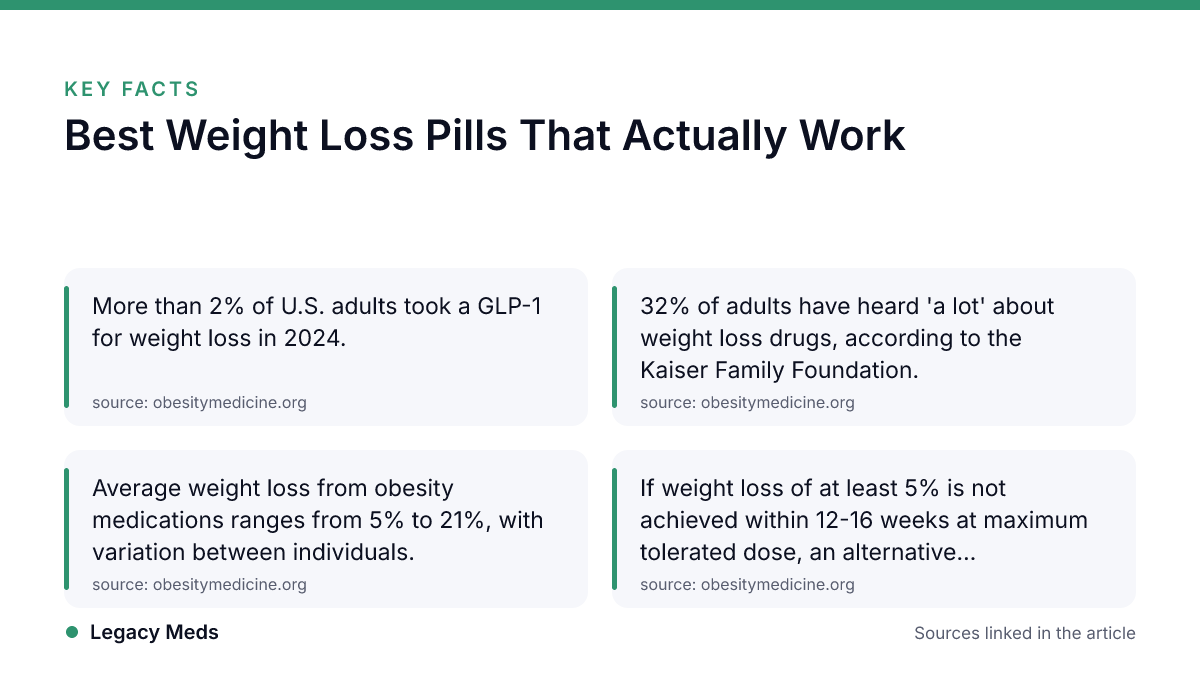
- More than 2% of U.S. adults used a GLP-1 medication for weight loss in 2024, and average weight loss from obesity medications ranges from 5% to 21% depending on the person and the drug (Obesity Medicine Association).
- There's no single "#1 weight loss pill." Tirzepatide (Zepbound) and semaglutide (Wegovy) post the strongest results in clinical use, and the first oral GLP-1 for obesity, a pill form of Wegovy, only reached the market at the end of 2025.
- If you haven't lost at least 5% of your body weight within 12-16 weeks at the maximum tolerated dose, clinical guidance says switch medications instead of waiting it out.
- Dissolvable GLP-1 tablets skip needles and refrigeration; weekly injections cost less per month and have the longer track record. Both require a prescriber.
- Appetite signals return to baseline after you stop, so the maintenance plan matters more than which format you picked on day one.
A friend of mine spent four years cycling through Noom, keto, and a gym membership she used twice a month. She lost the same 15 pounds three times and gained it back three times. That's not a willpower problem. It's biology. Obesity medications work by changing how your body regulates hunger and blood sugar, which is part of why more than 2% of U.S. adults took a GLP-1 medication for weight loss in 2024, according to the Obesity Medicine Association. If you're searching for the best weight loss pills, you're not hunting for a magic bullet. You're hunting for the medication, dose, and format you'll actually stay on.

Table of Contents
- What is the #1 weight loss pill?
- How do GLP-1 pills compare to injections for weight loss?
- How quickly do weight loss medications start working?
- What happens when you stop taking weight loss pills?
- How much do weight loss pills cost without insurance?
- Which weight loss pill is right for you?
- Frequently asked questions
What is the #1 weight loss pill?
No single pill outranks every other option, because the right one depends on your health history, how you handle side effects, and whether you'd rather swallow a tablet or inject once a week.
That said, tirzepatide (sold as Zepbound for weight loss) was approved by the FDA for obesity treatment in 2023 and consistently delivers some of the strongest average results of any current obesity medication. Semaglutide, the active ingredient in Wegovy and Ozempic, is the close runner-up with a longer real-world history behind it. Oral semaglutide, essentially a pill version of Wegovy, became available at the end of 2025. For anyone who's been stalling on GLP-1 therapy purely because of the needle, that changes the conversation.
Here's what the evidence actually supports, courtesy of the Obesity Medicine Association, and what each fact means for your decision:
| What the evidence says | What it means for you |
|---|---|
| Average weight loss on obesity medications: 5% to 21% of body weight | At 220 lbs, that's a 11 to 46 lb range, so expectations should be a range, not a number |
| No 5% loss by 12-16 weeks at max tolerated dose means switch drugs | You get a real decision point at month three or four, not an open-ended trial |
| Tirzepatide (Zepbound) approved for obesity in 2023 | The newest injectable option has the shortest safety history of the major players |
| First oral GLP-1 for obesity arrived late 2025 | Needle avoidance is no longer a reason to skip treatment entirely |
| More than 2% of U.S. adults used a GLP-1 for weight loss in 2024 | Pharmacy supply and provider familiarity are far better than they were three years ago |
| 32% of adults have heard "a lot" about these drugs (KFF) | Most of what circulates is secondhand, so verify dosing claims with a prescriber |
Pro tip: If a product bills itself as the strongest weight loss pill on the market and doesn't require a prescription, close the tab. Real GLP-1 medications require a clinician to review your history, including personal or family history of medullary thyroid carcinoma, pancreatitis, and gallbladder disease. That's why our weight loss program starts with a quiz instead of a checkout page.
How do GLP-1 pills compare to injections for weight loss?
Same drug class, different delivery, and the difference shows up in cost, travel logistics, and daily routine. Mayo Clinic notes that prescription weight-loss drugs work best alongside diet and activity changes rather than instead of them (Mayo Clinic). That holds whether you're dissolving a tablet or drawing up a shot.
Dissolvable GLP-1 tablets
These dissolve under the tongue, so no needles and no cooler bag at the airport. Our dissolvable GLP-1 tablets start at $249 and include provider visits and coaching. The practical catch nobody mentions: sublingual dosing only works if you leave the tablet alone. Patients who chew it, wash it down with coffee, or eat ten minutes later are the ones who come back at week six wondering why their appetite hasn't changed.
GLP-1 injections
Weekly injections are the most-studied and most widely used format, and they're usually the cheaper entry point. Our starter injection plan begins at $159 with no membership fee stacked on top. One shot a week also means one decision a week, which is a real advantage for people who already struggle to remember a daily pill.
Brand-name Wegovy and Zepbound
If you want the exact medication you've seen advertised, brand-name Wegovy (pill or injection) and Zepbound injection are available through a $99 membership plus the cost of the medication. Our GLP-1 medication list breaks down which active ingredient does what.
Pro tip: Every format follows a titration schedule. You start low and step up gradually so your gut adapts. The patients who tolerate it best tend to do three things: eat smaller portions than feel natural, stop eating at the first hint of fullness instead of plate-clean, and get ahead of constipation with fluid and fiber before it starts. If you're on Wegovy, our Wegovy dosing schedule guide walks through the increases week by week.
How quickly do weight loss medications start working?
Appetite usually quiets down in the first one to two weeks. The scale takes longer.
Clinical guidance is specific: if you haven't lost at least 5% of your starting body weight within 12-16 weeks at your maximum tolerated dose, your provider should consider a different medication (Obesity Medicine Association). Run your own number. At 220 pounds, 220 × 0.05 = 11 pounds. That's your three-to-four-month checkpoint, and it's a conversation about switching drugs, not a verdict on you.
Across a full course of treatment, average loss ranges from 5% to 21% of body weight. Same 220-pound starting point: 220 × 0.05 = 11 pounds at the low end, 220 × 0.21 = 46 pounds at the high end. Dose, medication, and individual response explain most of that spread, which is why check-ins matter more than picking the "perfect" pill on day one. When the scale stalls for three or four weeks while you're doing everything right, that's a plateau with a cause. Our guide on getting past a GLP-1 weight loss plateau covers what to adjust.
What happens when you stop taking weight loss pills?
Weight comes back for most people, and faster than they expect. These medications work by altering appetite and satiety signals, and those signals return to baseline once the drug clears your system. Hunger that was easy to ignore on month six gets loud again within weeks of the last dose.
That's the part listicles skip, and it's the part that decides whether your results stick.
What actually protects the loss, in our experience:
- Protein and resistance training during treatment, not after. Rapid loss costs you lean mass, and lean mass is what keeps your metabolic rate up afterward. Lifting twice a week while you're still on medication is worth more than any post-taper plan.
- A step-down, not a stop. Dropping from a maintenance dose straight to nothing is the version that fails. Spacing doses out under provider supervision gives your appetite time to recalibrate.
- A regain threshold you commit to in advance. Pick a number, usually 5 pounds above your lowest weight, and treat crossing it as a trigger to call your provider. Waiting until 25 pounds is back means starting over.
- Weekly weigh-ins, same day, same conditions. Monthly weigh-ins hide a trend until it's a problem.
Every Legacy Meds plan includes care coaching for exactly this reason. And if you're already thinking about your exit, raise it with your provider months before you taper — a mapped transition beats a scare-tactic warning and a guess.
How much do weight loss pills cost without insurance?
Pricing swings wildly depending on whether you go brand-name or use a telehealth provider working with compounding pharmacies. Here's the math using our own pricing.
Take the dissolvable tablet plan at $249 a month. Over a year: $249 × 12 = $2,988. Pay with HSA or FSA dollars in the 24% federal bracket and you avoid tax on that income: $2,988 × 0.24 = $717 saved. Your effective annual cost drops to roughly $2,271, or about $189 a month. Re-run it with your own bracket and plan price.
The injection starter plan runs $159 a month, or $1,908 a year, with no membership fee. Brand-name Zepbound goes through a $99 membership plus the medication itself, which typically lands several hundred dollars more per month before insurance or manufacturer savings cards. For brand-name pricing trends, see our post on Zepbound cost. For a side-by-side across every option, our guide to GLP-1 cost without insurance runs the numbers.
What's included in every plan:
- Free provider visits so a licensed clinician reviews your history before and during treatment.
- Care coaching for nutrition and habit changes alongside the medication.
- Free shipping to your door, no pharmacy pickup.
- 24/7 care team support for dosing and side effect questions between visits.
- HSA/FSA eligibility so pre-tax dollars cover the cost.
| Plan type | Starting price | Format | Best for |
|---|---|---|---|
| GLP-1 injection | $159/month | Weekly injection | Lowest monthly cost, longest track record |
| Dissolvable GLP-1 tablet | $249/month | Daily sublingual tablet | Needle avoidance and travel-heavy schedules |
| Brand-name Wegovy/Zepbound | $99 membership + medication | Pill or injection | Patients who want the name-brand drug specifically |
Weighing medication against a structured program instead? Our comparison of Weight Watchers vs. GLP-1 covers which approach produces lasting results, and for whom.
Which weight loss pill is right for you?
Three honest questions sort this faster than any brand comparison.
- Can you give yourself a weekly shot? If the answer is a hard no, the dissolvable tablet is your lane. Don't talk yourself into injections you won't take.
- Is monthly cost the binding constraint? Then the $159 injection plan is the cleanest start, and you can switch formats later if your budget changes.
- Do you specifically want Wegovy or Zepbound by name? The $99 membership route gets you there, with the brand-name medication cost on top.
One more test before you commit: can you stay on this for a year? The plan people abandon in month four, usually because the monthly cost crept past comfortable or the daily tablet got forgotten, is the one that produces regain. Pick the option you can still afford and still remember next spring.
Whichever you choose, provider oversight is the variable that makes the medication work. Both NIDDK and Cleveland Clinic frame these drugs as part of an ongoing monitored plan, not a one-and-done purchase. Our weight loss FAQ answers eligibility questions if you're not sure you qualify.
Take the online quiz, get matched with a licensed provider, and find out which option fits your goals and budget before you spend a dollar.
Frequently asked questions
Do weight loss pills work without diet and exercise changes?
They work, but they work better and faster paired with modest diet and activity changes. The medication reduces appetite; it doesn't build the habits that keep weight off after you stop. Clinicians treat medication as one component of a broader plan rather than the whole strategy.
Are over-the-counter weight loss pills as effective as prescription options?
No. Over-the-counter supplements aren't held to the same efficacy standards as prescription GLP-1 medications, and none have demonstrated the 5% to 21% average weight loss seen with prescription obesity medications. A supplement promising dramatic fast results with no prescription and no clinician involvement is a red flag.
Can I switch between GLP-1 tablets and injections?
Yes, and plenty of patients do when cost, side effects, or travel patterns change. Dosing isn't equivalent between formats, so your provider needs to map the transition rather than you swapping on your own. Raise it at a routine visit before you run out of your current supply.