
TL;DR
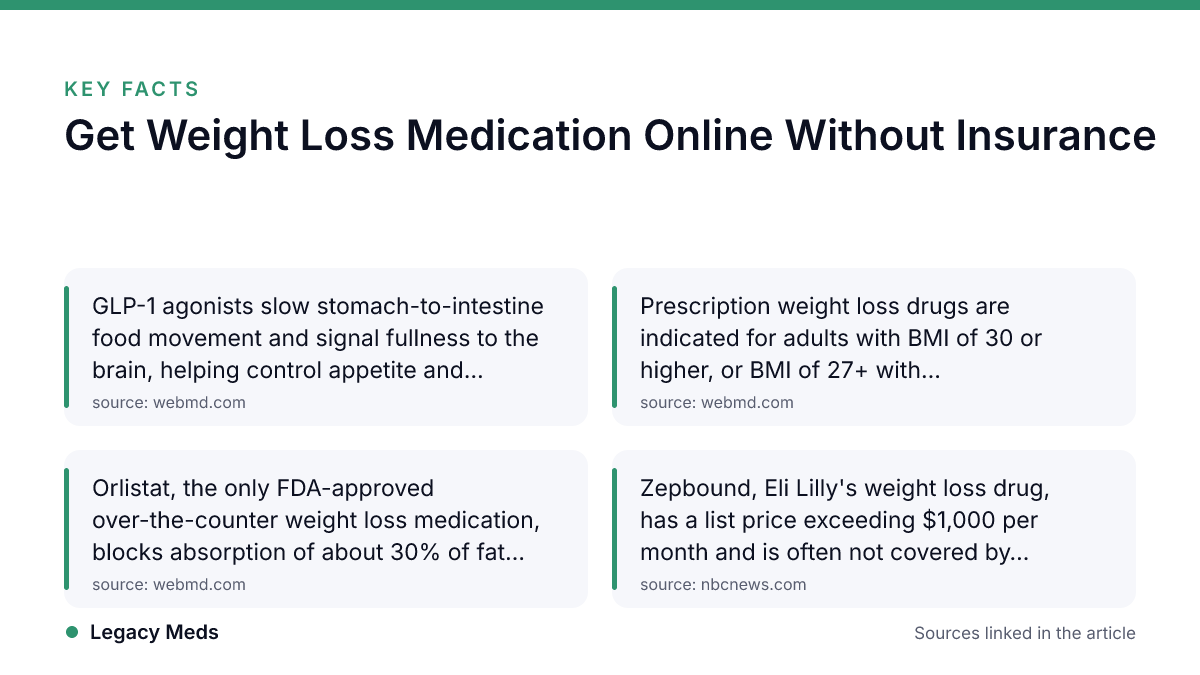
- GLP-1 medications are indicated for adults with a BMI of 30+, or 27+ with a weight-related condition like high blood pressure or type 2 diabetes, according to WebMD.
- Legacy Meds offers GLP-1 injections starting at $159/month, dissolvable GLP-1 tablets starting at $249/month, and brand-name options like Wegovy® and Zepbound® for a $99 membership plus medication cost, with free provider visits and no insurance required.
- Brand-name Zepbound carries a list price over $1,000 a month and often isn't covered by insurance, per NBC News, which is why lower-cost options have become the default for self-pay patients.
- Online evaluations run on an intake quiz, your medical history, and a licensed provider's review. No office visit and no blood draw are required to get started in most cases.
- HSA and FSA dollars typically cover GLP-1 treatment, and because that money is pre-tax, your real cost drops by roughly your marginal tax rate.
Dana is a 34-year-old ER charge nurse in Columbus. Twelve-hour shifts, rotating nights, a kitchen that mostly holds protein bars and whatever's left in the break room fridge. She'd done Weight Watchers twice, lost 15 pounds both times, gained it back both times. Her employer plan treats weight loss drugs as a lifestyle expense rather than a medical one, so Zepbound's sticker price was a non-starter. A standing monthly doctor's appointment wasn't happening either.
So she did what a lot of people in her position do now. She looked up weight loss medication online.
If you're in the same spot, here's how the process actually works, what it costs, and what to expect once you start.

Table of Contents
- How Do You Qualify for Weight Loss Medication Online?
- How Does an Online Evaluation Work Without an Office Visit?
- What Are Some Common Weight Loss Medication Pills?
- Do Appetite Suppressants Really Work?
- What Does Weight Loss Medication Actually Cost Online?
- How Do Side Effects and Results Compare Across GLP-1 Options?
- What's the Right Next Step?
- Frequently asked questions
How Do You Qualify for Weight Loss Medication Online?
Eligibility comes down to BMI and health history, and you can estimate yours before you ever talk to a provider. The clinical threshold is a BMI of 30 or higher, or 27 or higher if you also have a weight-related condition like type 2 diabetes or high blood pressure, according to WebMD. Calculate BMI by dividing your weight in pounds by your height in inches squared, then multiplying by 703.
Dana is 5'6" (66 inches) and weighs 190 pounds:
190 ÷ (66 × 66) × 703 = 190 ÷ 4,356 × 703 = 30.6
That clears 30 on its own, no secondary condition needed. Had she landed at 28, her high blood pressure would have put her on the 27-plus pathway instead. Run your own numbers first. It tells you in advance which conversation you're walking into.
A few things get flagged during review. Most aren't automatic disqualifiers, but a provider will want detail:
- Pregnancy or breastfeeding. GLP-1s aren't appropriate during pregnancy, and providers will pause treatment.
- Personal or family history of medullary thyroid carcinoma or MEN2. This one is a hard stop for GLP-1 prescribing.
- Eating disorder history. Not a no, but it changes how a provider handles dosing and how often they check in.
- Gallbladder disease or pancreatitis. GLP-1s slow digestion, so your provider needs the specifics before prescribing.
- Insulin or sulfonylurea use. Adding a GLP-1 on top can drop blood sugar too far, so doses of the existing medication often need adjusting at the same time.
Pro tip: Have your current weight, height, and the exact names and doses of your medications in front of you before you start the quiz. "Around 200, I think" and "the blue blood pressure pill" both trigger a follow-up message, and that adds a day or two to approval.
How Does an Online Evaluation Work Without an Office Visit?
It replaces the in-person physical with a structured intake: a health history questionnaire, self-reported vitals and sometimes photos, then a licensed clinician reviewing all of it before anything is prescribed. At Legacy Meds, that starts with a short online quiz covering your weight history, current medications, past attempts at losing weight, and anything that affects eligibility. A licensed provider reads your answers and either approves a plan, asks for more information, or tells you it isn't a good fit. No algorithm makes that call.
The follow-up is the part cut-rate telehealth sites skip. GLP-1 medications work by slowing how fast food moves from your stomach into your intestine and signaling fullness to your brain, per WebMD. That mechanism is exactly why dose adjustments and side-effect management need a real clinician behind them instead of a one-time prescription drop. Every Legacy Meds plan includes free provider visits and care coaching, plus 24/7 access to a care team when something comes up between appointments: a stomach bug stacking on top of nausea, a dose increase hitting harder than the last one. If your needs run past weight loss into hormone support, skincare, or general primary care, a telehealth company like RoenRx runs a similar provider-review model across a broader range of conditions.
Dana's intake took about eight minutes. Her approval came back the next morning with a note from her provider about starting at the low end of the dosing range given her blood pressure history. That's the kind of individualized call you want out of an evaluation.
What Are Some Common Weight Loss Medication Pills?
Oral options fall into three buckets: GLP-1 tablets, older combination appetite suppressants, and the one over-the-counter drug.
GLP-1 tablets are dissolvable formulations that act on the same gut-brain pathway as the injectables. They've become popular with patients who want the metabolic effect without a needle, and Legacy Meds' dissolvable tablets start at $249 a month. Brand-name oral options exist too. Wegovy® now has a pill version available through Legacy Meds for a $99 membership plus medication cost.
Then there's orlistat, sold over the counter as Alli, which works on a completely different principle. It blocks absorption of about 30% of the fat calories you eat instead of touching appetite at all, and it produces modest results of roughly 5% of total body weight, according to WebMD. Five percent is real weight. It's also a fraction of what GLP-1 therapy typically delivers, and the digestive side effects are unforgiving. Eat a slice of pizza on orlistat and you'll know within a couple of hours. That's why most people who try it quit inside the first month.
Choosing between a daily tablet and a weekly injection is mostly about honesty with yourself. If you already take a daily medication and never miss it, the tablet fits your life. If you've abandoned every vitamin bottle you ever bought, the once-a-week shot is the better bet. Our guide on what month one really looks like on GLP-1 treatment walks through the adjustment period either way.
Do Appetite Suppressants Really Work?
Yes, though "works" means different things depending on the drug. GLP-1s are the most effective category available by a wide margin because they amplify the same gut-brain fullness signaling your body already runs, per WebMD. Patients describe it less as willpower and more as the food noise going quiet. Older appetite suppressants that only push on hunger hormones produce smaller and less consistent results, and orlistat caps out around that 5% figure.
What no suppressant does is build your habits for you. The pattern we see over and over: appetite drops sharply in weeks two through four, and patients who were already eating poorly just eat less of the same thing. Then protein intake tanks, energy follows, and they lose muscle alongside fat. Set a protein floor early, somewhere around 100 grams a day for most adults, and plan what that looks like in actual meals before your appetite disappears. It's far easier to decide in week one than in week three when nothing sounds good.
If you're building that plan, our piece on building a calorie deficit that actually sticks pairs well with any medication. And if you're still deciding between a structured program and a prescription, we broke that down in Weight Watchers vs GLP-1: Which Actually Works?
What Does Weight Loss Medication Actually Cost Online?
For patients without coverage, cost decides everything, and the spread between options is wider than most people expect. Zepbound's list price runs over $1,000 a month and is frequently not covered by insurance at all, which is part of why Eli Lilly launched its own direct-to-consumer site, as reported by NBC News — our guide to Zepbound weight loss results, cost, and eligibility breaks down what that price actually buys you. That number pushes most self-pay patients toward lower-cost GLP-1 alternatives.
Here's three months of treatment, brand-name list price against a starter injection plan:
Brand-name Zepbound (list price): $1,000/month × 3 months = $3,000 Legacy Meds GLP-1 injection (starting price): $159/month × 3 months = $477 Difference over three months: $3,000 − $477 = $2,523
That's an illustrative comparison using starting prices, not a guarantee. Your dose and plan move the monthly number. But it explains why "cheapest weight loss medication online" is one of the most searched phrases in this category: for a lot of people, that gap is the difference between starting now and putting it off another year.
| Cost factor | Brand-name GLP-1 (self-pay) | Legacy Meds injection | Legacy Meds tablet |
|---|---|---|---|
| Starting monthly cost | $1,000+ list price | $159 | $249 |
| Membership fee | None | None on starter plan | $99 for brand-name options |
| Provider visits | Billed separately | Included, free | Included, free |
| Shipping | Varies by pharmacy | Free | Free |
| 3-month total at starting price | $3,000+ | $477 | $747 |
| HSA/FSA eligible | Yes | Yes | Yes |
Now run the HSA math, because almost nobody does. Say you're on the $159 injection plan for a full year: $159 × 12 = $1,908. If your marginal federal rate is 22%, paying with pre-tax HSA or FSA dollars means that $1,908 bill only costs you $1,908 × 0.22 = $420 less in take-home pay, so your effective annual cost is about $1,488. Swap in your own bracket and the formula holds: annual medication cost × your marginal rate = what you keep.
Pro tip: FSA funds are use-it-or-lose-it by plan year, so if you're starting treatment in the fall, front-load the medication purchases you know you'll need rather than letting the balance expire in December. Our breakdown of using HSA or FSA funds for weight loss injections covers which expenses typically qualify, and our Wegovy cost guide goes deeper on brand-name pricing.
How Do Side Effects and Results Compare Across GLP-1 Options?
Nausea is the most common early side effect across every GLP-1 formulation, injection or tablet, brand or alternative. It's usually worst in the first two to four weeks and again for a few days after each dose increase. Dana's run was typical: mild nausea the first week, rougher at her first titration, manageable by week three once she swapped her two big meals for four small ones.
Where the options genuinely differ is in delivery, not drug class:
- Weekly injections produce a wave. Side effects peak in the day or two after dosing, fade, then repeat. Some patients inject on Friday night specifically so the worst of it lands on a weekend.
- Daily tablets spread the effect out more evenly, which removes the dosing-day dread but asks more of your memory.
- Timing with food changes GI tolerance on either format. Taking your dose on a fuller stomach, with water, cuts nausea noticeably for a lot of patients.
- Constipation sneaks up around week four, usually because appetite dropped and fiber and fluid intake dropped with it. It's fixable before it starts.
In practice, people quit over side effects or cost, not because the medication stopped working. That's the whole argument for ongoing provider access. Someone who can lower your dose, hold you at your current step for an extra month, or move you from injection to tablet is the difference between pushing through a rough first month and bailing in week two. Bargain telehealth sites leave that gap wide open. Legacy Meds builds care coaching and provider check-ins into every plan instead of selling a script and going quiet. If you're researching options as a man, our GLP-1 for men guide covers male-specific dosing and side-effect patterns.
What's the Right Next Step?
Calculate your BMI with the formula above. Write down any related conditions, including blood pressure and blood sugar numbers if you have recent ones. Then take the online quiz. Legacy Meds moves most patients to provider review within a day and ships to your door, no insurance required. If you're comparing providers, our look at weight loss medicine providers serving Dover and the weight loss FAQ page show how the details stack up before you commit.
Frequently asked questions
Can I get a GLP-1 prescription online with insurance?
Some online providers will bill insurance if your plan covers weight loss medication, but many employer plans still exclude it entirely as elective. If yours doesn't cover it, a self-pay model with transparent pricing (injections from $159, tablets from $249) usually beats paying a percentage copay against a $1,000-plus list price.
Does Medicare cover weight loss medication?
Medicare Part D may cover a weight loss drug when it's prescribed to treat another condition, such as diabetes, according to WebMD. Coverage for weight loss alone is far less common, so check your specific plan's formulary before assuming either way.
How fast will I see results after starting weight loss medication?
Most patients notice reduced appetite within the first one to two weeks. Visible weight change usually shows up across the first month as the dose titrates up. Starting weight, dose, and nutrition consistency all shift the timeline, which is why a provider who adjusts your plan based on how month one goes matters more than what the scale says on day seven.
What happens if a medication doesn't work for me?
Your provider can change the dose, switch you between injection and tablet, or move you to a different GLP-1 depending on whether the problem is side effects or a lack of results. That's why ongoing visits are included rather than sold as an upsell. A static prescription with no follow-up leaves you stuck when the first approach doesn't fit.