
TL;DR
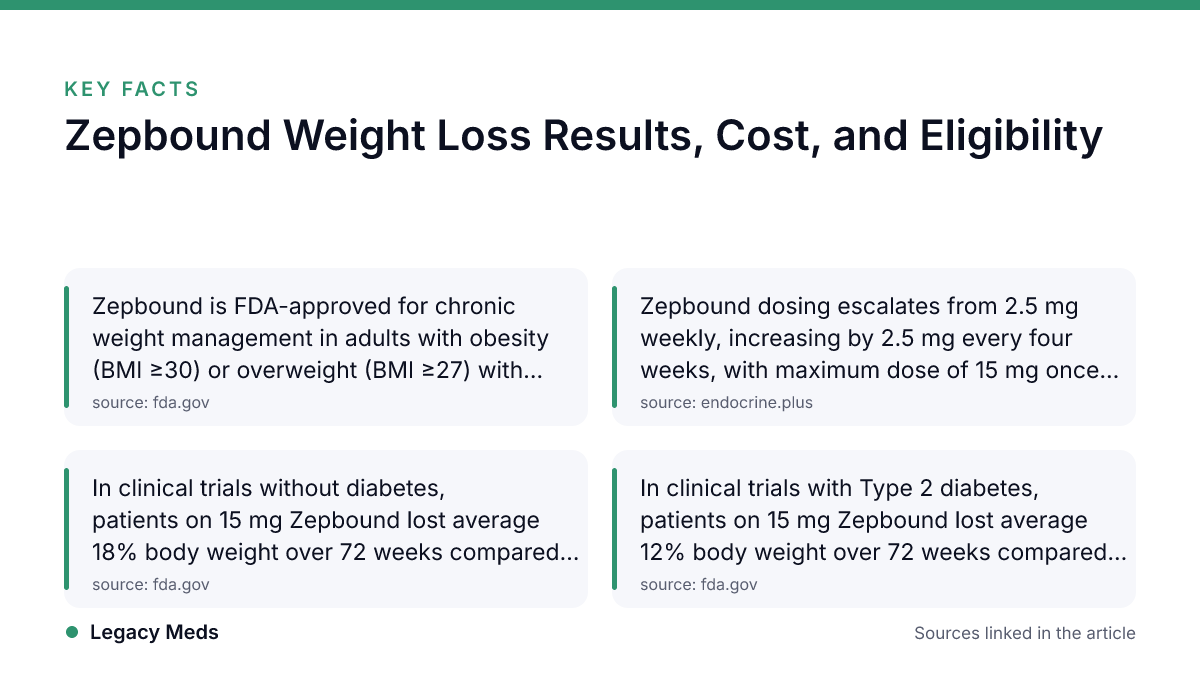
- Clinical trial results: Adults without diabetes lost an average of 18% of body weight on 15 mg Zepbound over 72 weeks; adults with Type 2 diabetes lost an average of 12%, per the FDA's approval announcement.
- Dosing takes time: Zepbound starts at 2.5 mg weekly and steps up every four weeks to a max of 15 mg, roughly 20 weeks of titration, so the first two months look modest compared to months 6 through 18.
- Head-to-head data: Zepbound produced roughly 47% more weight loss than semaglutide 2.4 mg (Wegovy) in direct comparison trials, according to Endocrine Plus.
- Cost without insurance: Through Legacy Meds, brand-name Zepbound runs a $99 membership plus medication cost, lower-cost GLP-1 injections start at $159, and dissolvable GLP-1 tablets start at $249. All are HSA/FSA eligible.
- Eligibility is specific: Zepbound is FDA-approved for adults with a BMI of 30+, or 27+ with a weight-related condition like high blood pressure or high cholesterol.
Zepbound produces an average 18% body weight loss over 72 weeks in adults without diabetes and 12% in adults with Type 2 diabetes, according to the clinical trials behind its FDA approval for chronic weight management. The drug, tirzepatide, activates both GLP-1 and GIP receptors to curb appetite. Dosing climbs slowly from 2.5 mg to a maximum of 15 mg weekly over roughly 20 weeks, which is exactly why most of that weight loss shows up in the back half of treatment.
That timeline trips people up constantly. They start Zepbound expecting dramatic numbers by week four, get discouraged when the scale barely moves, and quit before the medication has done its real work.

Table of Contents
- How much weight can you lose with Zepbound in a month?
- How long will it take to lose 40 lbs on Zepbound?
- What does Zepbound actually cost, and does insurance cover it?
- Is Zepbound safer or more effective than Wegovy and Ozempic?
- Will you regain the weight after stopping Zepbound?
- Do you need insurance or a specialist referral to get started?
- Frequently asked questions
How much weight can you lose with Zepbound in a month?
A few pounds. That's the honest answer for month one, because you're still on 2.5 mg or 5 mg, the doses designed to let your gut adjust rather than to drive weight loss.
Here's the math, using the trial average as a baseline. Over 72 weeks (about 16.6 months), patients without diabetes lost an average of 18% of body weight on 15 mg. Spread evenly, that's roughly 1.1% of body weight per month. Real-world loss isn't evenly spread, though. Months one and two run below that average while you titrate, and months three through twelve run above it. For a 200-pound person, early-month loss commonly lands somewhere between 2 and 6 pounds, with the pace picking up after each dose increase. Our guide to what month one really looks like walks through week-by-week expectations, including when appetite suppression typically kicks in.
One detail nobody tells new patients: the appetite effect is strongest in the two or three days right after your injection and fades toward the end of the week. Pick an injection day that puts those strong days on your hardest eating days. If weekends are where your plan falls apart, inject Thursday.
Pro tip: Don't judge the medication by week four. Judge it by week twelve, after a few dose increases. That's when the GIP pathway starts amplifying fat metabolism alongside GLP-1 appetite suppression.
How long will it take to lose 40 lbs on Zepbound?
For most people, 12 to 18 months, tracking the same trial timeline that produced an 18% average loss at 72 weeks. Here's how to run your own version.
Figure out what 40 pounds represents as a percentage of your current weight. A 220-pound person losing 40 pounds is losing about 18.2% of body weight (40 ÷ 220 = 0.182), which lines up almost exactly with the 18% average seen over 72 weeks in patients without diabetes. So a 220-pound starting point puts a 40-pound goal right on pace with the full trial timeline: around 72 weeks, or about a year and a half, assuming you stay on treatment and tolerate the dose increases.
Rerun it with your own numbers. Divide 40 by your current weight, then compare the result to the 18% (non-diabetic) or 12% (diabetic) trial averages. If your target percentage comes in under the average, you'll likely get there sooner. If it comes in well above, plan for a longer runway and tighter dietary structure. Our post on building a calorie deficit that sticks is worth reading alongside your treatment plan.
A caveat from practice: not everyone needs 15 mg. Plenty of patients find their appetite is well controlled at 7.5 or 10 mg and stay there. Climbing to the max dose just because the label allows it usually buys side effects, not results.
What does Zepbound actually cost, and does insurance cover it?
Coverage is inconsistent. Many employer plans exclude weight-loss drugs outright, and the ones that cover Zepbound often require prior authorization plus documented proof you tried diet and exercise first. That paperwork loop can eat six to eight weeks before a single pen ships.
Through Legacy Meds, you don't need insurance to get started.
| Option | How it's taken | Starting price through Legacy Meds | What's included |
|---|---|---|---|
| GLP-1 injection (starter) | Weekly injection | $159/month | Provider visits, care coaching, free shipping |
| Dissolvable GLP-1 tablet | Daily tablet | $249/month | Provider visits, care coaching, free shipping |
| Wegovy® injection or pill | Weekly injection or daily pill | $99 membership + medication cost | Provider visits, care coaching, free shipping |
| Zepbound® injection | Weekly injection | $99 membership + medication cost | Provider visits, care coaching, free shipping |
Run the annual number before you commit to anything. The starter injection at $159 per month comes to $1,908 for a year ($159 × 12). The dissolvable tablet at $249 per month comes to $2,988 ($249 × 12), a difference of $1,080 over twelve months for the convenience of swallowing a tablet instead of using a weekly pen.
Then apply the HSA math, because this is where most people leave money on the table. HSA and FSA dollars go in before taxes, so if your combined federal, state, and payroll tax rate is 25%, paying $159 from an HSA costs you about $119 in take-home pay ($159 × 0.75). Across a year that's roughly $477 back in your pocket on the starter plan. Your own rate will differ, so swap in your bracket and rerun it. Our breakdown on using HSA or FSA funds for weight loss injections explains how to submit the expense. If you're comparing brand pricing specifically, see our page on Wegovy cost and our look at what weight loss injections really cost in 2026.
Pro tip: If brand-name pricing is the barrier, Zepbound isn't your only path. The starter injection and dissolvable tablet work on the GLP-1 receptor at a far lower entry cost, which is a sensible way to learn how your body handles this class of drug before committing to brand pricing.
Is Zepbound safer or more effective than Wegovy and Ozempic?
Not safer, but more effective at the top dose. Zepbound produced about 47% more weight loss than semaglutide 2.4 mg (Wegovy) in head-to-head trials, according to Endocrine Plus. The idea that one GLP-1 is universally "better" misses what actually decides outcomes: how your body responds.
The difference is receptors. Wegovy and Ozempic both use semaglutide, which hits the GLP-1 receptor alone. Zepbound uses tirzepatide, which hits GLP-1 and GIP together, and the GIP pathway appears to amplify fat metabolism beyond what GLP-1 achieves by itself. Side effect profiles look similar across the class, and misconceptions about how they work drive a lot of the frustration patients feel early on, something we unpack in our piece on Ozempic weight loss myths that stall progress. Nausea, diarrhea, constipation, and blunted appetite are common with all of them, concentrated around dose increases, and they usually settle as your body adapts. Fatigue comes up constantly in our patient check-ins, and we cover how to handle it in our post on GLP-1 fatigue.
Beyond the scale, Zepbound's trials showed metabolic benefits worth knowing about:
- Blood pressure: Average systolic blood pressure dropped 7 to 9 mmHg during trials.
- Cholesterol markers: Significant improvements in cholesterol and other metabolic markers showed up alongside the weight loss.
- Cardiovascular risk context: Roughly 70% of American adults have obesity or overweight, and losing just 5% to 10% of body weight through any combination of medication, diet, and exercise measurably reduces cardiovascular disease risk, per the FDA.
Worth flagging: Zepbound and Mounjaro contain the same active ingredient, tirzepatide. Mounjaro is approved for Type 2 diabetes and Zepbound for weight management. Same molecule, different label, different insurance treatment.
Deciding between a structured program and a medication? Our comparison on Weight Watchers vs GLP-1 breaks down where each one actually delivers.
Will you regain the weight after stopping Zepbound?
Usually, yes, at least some of it. Appetite suppression stops when the drug clears your system, and hunger comes back at the level your biology set before treatment. That isn't a personal failure. It's pharmacology.
Obesity behaves like high blood pressure or high cholesterol. Stop treating it and the underlying condition reasserts itself. Zepbound manages appetite and metabolic signaling for as long as you take it; it doesn't rewrite the set point and hand you a permanent fix. This is why the patients who hold their results are the ones who built something durable during treatment: a protein target they hit daily, two or three resistance training sessions a week to protect lean mass, and a plan for what happens at month 18.
Pro tip: Don't stop cold. Talk to your care team about stepping down one dose level and holding there for six to eight weeks to see what happens to your hunger and the scale. Many patients maintain on a dose well below where they peaked, which protects results and cuts monthly cost at the same time.
Do you need insurance or a specialist referral to get started?
No. No insurance, no referral, no in-person visit. FDA eligibility criteria are specific (BMI of 30+, or 27+ with a weight-related condition such as high blood pressure, high cholesterol, or sleep apnea), but meeting them doesn't require an endocrinologist's waiting room or a six-week scheduling delay.
At Legacy Meds, you start with an online quiz that takes a few minutes and covers your health history and goals. A licensed clinician reviews your answers, and if you're a fit, your medication ships free to your door. Care coaching and provider visits are included in every plan, and the care team is reachable around the clock when something comes up mid-treatment.
Have two things ready before you take the quiz: your current height and weight, and any recent labs or diagnoses you can name, specifically blood pressure readings, A1C, and cholesterol numbers. Those are what establish the BMI 27+ pathway if your BMI is under 30, and patients who can cite them move through review faster. If you're comparing providers near you, see our rundown of weight loss medicine providers in Dover and our weight loss FAQ.
Frequently asked questions
Can you take Zepbound if you're already on another weight loss medication?
Stacking a GLP-1/GIP medication with another appetite suppressant isn't standard practice and should only happen under direct clinician supervision, since overlapping mechanisms compound nausea and dehydration risk. List every medication and supplement during intake, including over-the-counter diet aids, so your care team can flag interactions before your first dose.
Does Zepbound work if you don't change your diet at all?
It reduces appetite and food intake on its own, so some weight loss happens without deliberate dietary changes. Patients who add even light structure around meals do better and keep more of it. The medication handles the biology. Your habits decide how much sticks once you're at a stable dose or eventually taper down.
Is the Zepbound pill the same as the injection?
There is no Zepbound pill. Zepbound is a once-weekly subcutaneous injection given in the abdomen, thigh, or upper arm, and you rotate sites each week to avoid irritation. If you'd rather take something daily by mouth, the Legacy Meds dissolvable GLP-1 tablet starts at $249 and works through the GLP-1 pathway.
Pull up your current weight, divide 40 by it, and see where your target percentage lands against the 18% trial average. Then take the online quiz to find out which option you qualify for and what it costs.